Asia Pacific Magnesium Supplement Market Size & Outlook, 2026-2034
Last Updated : 27 July, 2026 |
Study Period : 2022-2034 |
Format : PDF, Excel |
Author : Anna Morgan
Asia Pacific Magnesium Supplement Market Insights
- As highlighted in Deep Market Insights analysis, the Asia Pacific Magnesium Supplement Market, valued at USD 375.06 Million in 2025, is estimated to achieve USD 605.28 Million by 2034.
- The market is estimated to grow at a CAGR of 5.43% spanning 2026 to 2034.
- By market size, Oxide led the Salt type category in 2025.
- The Salt type segment led by Oxide is estimated to post the fastest growth, sustaining its position as the most lucrative during the forecast timeframe.
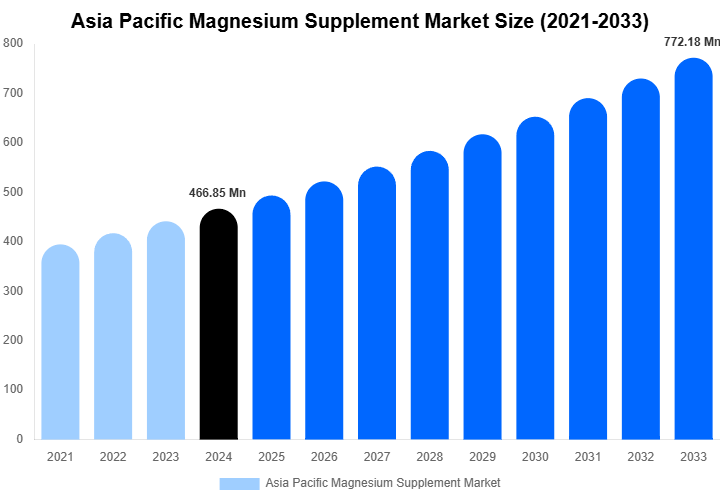
Source: DMI Analysis Company Publications, Primary Interviews.

Other Key Findings
- Asia Pacific represented 16.29% of the global Magnesium Supplement Market size in 2025.
- By 2034, United States is estimated to hold the largest position in the global market in terms of size.
- Singapore is estimated to remain the fastest-growing market in Asia Pacific, advancing to USD 12.44 Million by 2034.
Asia Pacific Magnesium Supplement Market Dynamics
- Asia Pacific's magnesium supplement market continues expanding as preventive healthcare awareness, urbanization, and wellness-focused lifestyles increase nutritional supplement adoption. Consumers increasingly prefer magnesium products supporting sleep quality, muscle recovery, stress management, and bone health while seeking convenient, science-backed supplementation options.
- Pharmacies, supermarkets, specialty nutrition retailers, healthcare practitioners, e-commerce platforms, and modern retail formats strengthen accessibility through expanding omnichannel distribution. Manufacturers increasingly improve digital engagement, broaden premium supplement portfolios, and strengthen educational initiatives to support preventive health awareness.
- Companies invest in highly bioavailable magnesium forms, clean-label ingredients, innovative delivery technologies, sustainable packaging, and personalized nutrition development to strengthen product differentiation. Innovation also focuses on magnesium glycinate, citrate, powders, gummies, capsules, and functional ingredient combinations addressing multiple wellness needs.
- Supplement manufacturers collaborate with ingredient suppliers, healthcare providers, research institutions, pharmacies, retail partners, and digital marketplaces to strengthen scientific credibility and supply chain resilience. Continued investment in nutritional innovation, premium formulations, and preventive wellness solutions reinforces competitiveness across Asia Pacific's magnesium supplement industry.
Key Industry Insights
- Preventive wellness strengthens supplement adoption.
- E-commerce expands consumer accessibility.
- Bioavailable ingredients improve differentiation.
- Personalized nutrition supports innovation.
Asia Pacific Magnesium Supplement Market Country 2026-2034 (USD Million)
| Asia Pacific | 2022 | 2023 | 2024 | 2025 | 2026 | 2027 | 2028 | 2029 | 2030 | 2031 | 2032 | 2033 | 2034 |
|---|---|---|---|---|---|---|---|---|---|---|---|---|---|
| China | XX.x | XX.x | XX.x | 142.6 | XX.x | XX.x | XX.x | XX.x | XX.x | XX.x | XX.x | XX.x | XX.x |
| India | XX.x | XX.x | XX.x | XX.x | XX.x | XX.x | XX.x | XX.x | XX.x | XX.x | XX.x | XX.x | XX.x |
| Japan | XX.x | XX.x | XX.x | XX.x | XX.x | XX.x | XX.x | XX.x | XX.x | XX.x | XX.x | XX.x | XX.x |
| Korea | XX.x | XX.x | XX.x | XX.x | XX.x | XX.x | XX.x | XX.x | XX.x | XX.x | XX.x | XX.x | XX.x |
| Taiwan | XX.x | XX.x | XX.x | XX.x | XX.x | XX.x | XX.x | XX.x | XX.x | XX.x | XX.x | XX.x | XX.x |
| Australia | XX.x | XX.x | XX.x | XX.x | XX.x | XX.x | XX.x | XX.x | XX.x | XX.x | XX.x | XX.x | XX.x |
| Singapore | XX.x | XX.x | XX.x | XX.x | XX.x | XX.x | XX.x | XX.x | XX.x | XX.x | XX.x | XX.x | XX.x |
| South East Asia | XX.x | XX.x | XX.x | XX.x | XX.x | XX.x | XX.x | XX.x | XX.x | XX.x | XX.x | XX.x | XX.x |
| Total | XX.x | XX.x | XX.x | 375.06 | XX.x | XX.x | XX.x | XX.x | XX.x | XX.x | XX.x | XX.x | XX.x |
Source: DMI Analysis Company Publications, Primary Interviews.
Asia Pacific Magnesium Supplement Market Salt type 2026-2034 (USD Million)
| Salt type | 2022 | 2023 | 2024 | 2025 | 2026 | 2027 | 2028 | 2029 | 2030 | 2031 | 2032 | 2033 | 2034 |
|---|---|---|---|---|---|---|---|---|---|---|---|---|---|
| Oxide | XX.x | XX.x | XX.x | 180.29 | XX.x | XX.x | XX.x | XX.x | XX.x | XX.x | XX.x | XX.x | XX.x |
| Citrate | XX.x | XX.x | XX.x | XX.x | XX.x | XX.x | XX.x | XX.x | XX.x | XX.x | XX.x | XX.x | XX.x |
| Glycinate | XX.x | XX.x | XX.x | XX.x | XX.x | XX.x | XX.x | XX.x | XX.x | XX.x | XX.x | XX.x | XX.x |
| Total | XX.x | XX.x | XX.x | 375.06 | XX.x | XX.x | XX.x | XX.x | XX.x | XX.x | XX.x | XX.x | XX.x |
Source: DMI Analysis Company Publications, Primary Interviews.
Asia Pacific Magnesium Supplement Market Format 2026-2034 (USD Million)
| Format | 2022 | 2023 | 2024 | 2025 | 2026 | 2027 | 2028 | 2029 | 2030 | 2031 | 2032 | 2033 | 2034 |
|---|---|---|---|---|---|---|---|---|---|---|---|---|---|
| Tablet | XX.x | XX.x | XX.x | 188.06 | XX.x | XX.x | XX.x | XX.x | XX.x | XX.x | XX.x | XX.x | XX.x |
| Powder | XX.x | XX.x | XX.x | XX.x | XX.x | XX.x | XX.x | XX.x | XX.x | XX.x | XX.x | XX.x | XX.x |
| Topical | XX.x | XX.x | XX.x | XX.x | XX.x | XX.x | XX.x | XX.x | XX.x | XX.x | XX.x | XX.x | XX.x |
| Total | XX.x | XX.x | XX.x | 375.06 | XX.x | XX.x | XX.x | XX.x | XX.x | XX.x | XX.x | XX.x | XX.x |
Source: DMI Analysis Company Publications, Primary Interviews.
Asia Pacific Magnesium Supplement Market Use 2026-2034 (USD Million)
| Use | 2022 | 2023 | 2024 | 2025 | 2026 | 2027 | 2028 | 2029 | 2030 | 2031 | 2032 | 2033 | 2034 |
|---|---|---|---|---|---|---|---|---|---|---|---|---|---|
| Sleep | XX.x | XX.x | XX.x | 204.82 | XX.x | XX.x | XX.x | XX.x | XX.x | XX.x | XX.x | XX.x | XX.x |
| Cramps | XX.x | XX.x | XX.x | XX.x | XX.x | XX.x | XX.x | XX.x | XX.x | XX.x | XX.x | XX.x | XX.x |
| General wellness | XX.x | XX.x | XX.x | XX.x | XX.x | XX.x | XX.x | XX.x | XX.x | XX.x | XX.x | XX.x | XX.x |
| Total | XX.x | XX.x | XX.x | 375.06 | XX.x | XX.x | XX.x | XX.x | XX.x | XX.x | XX.x | XX.x | XX.x |
Source: DMI Analysis Company Publications, Primary Interviews.
Asia Pacific Magnesium Supplement Market Channel 2026-2034 (USD Million)
| Channel | 2022 | 2023 | 2024 | 2025 | 2026 | 2027 | 2028 | 2029 | 2030 | 2031 | 2032 | 2033 | 2034 |
|---|---|---|---|---|---|---|---|---|---|---|---|---|---|
| Retail | XX.x | XX.x | XX.x | XX.x | XX.x | XX.x | XX.x | XX.x | XX.x | XX.x | XX.x | XX.x | XX.x |
| Online | XX.x | XX.x | XX.x | XX.x | XX.x | XX.x | XX.x | XX.x | XX.x | XX.x | XX.x | XX.x | XX.x |
| Total | XX.x | XX.x | XX.x | XX.x | XX.x | XX.x | XX.x | XX.x | XX.x | XX.x | XX.x | XX.x | XX.x |
Source: DMI Analysis Company Publications, Primary Interviews.
Inside This Report
This section examines Asia Pacific's magnesium supplement market through changing consumer preferences, formulation innovation, distribution developments, and competitive strategies. It highlights how manufacturers strengthen competitiveness by expanding premium nutritional portfolios, improving omnichannel availability, and advancing science-backed supplement development.
- Regional market landscape: Reviews Asia Pacific's magnesium supplement ecosystem.
- Consumer and purchasing trends: Explores preventive nutrition preferences.
- Product innovation and distribution: Covers formulation advances and retail expansion.
- Competitive and industry developments: Highlights scientific innovation and premium nutrition.
Report Summary
| Report Scope | Details |
|---|---|
| Base Year for Study | 2025 |
| Study Period | 2022-2034 |
| Historical Period | 2022-2024 |
| Forecast Period | 2026-2034 |
| Market Size In 2025 | USD 375.06 Million |
| Market Size In 2034 | USD 605.28 Million |
| Largest segment | Oxide |
| Units | Revenue in USD Million |
| CAGR | 5.43% (2026-2034) |
| Report Coverage | Revenue Forecast, Competitive Landscape, Growth Factors, Environment & Regulatory Landscape and Trends |