Europe Luxury Goods Market Size & Outlook, 2026-2034
Last Updated : 16 July, 2026 |
Study Period : 2022-2034 |
Format : PDF, Excel |
Author : Anna Morgan
Europe Luxury Goods Market Insights
- As highlighted in Deep Market Insights analysis, the Europe Luxury Goods Market, valued at USD 106.84 Billion in 2025, is estimated to achieve USD 212.14 Billion by 2034.
- The market is estimated to grow at a CAGR of 7.84% spanning 2026 to 2034.
- By market size, Leather Goods led the Category category in 2025.
- The Category segment led by Watches is estimated to post the fastest growth, sustaining its position as the most lucrative during the forecast timeframe.
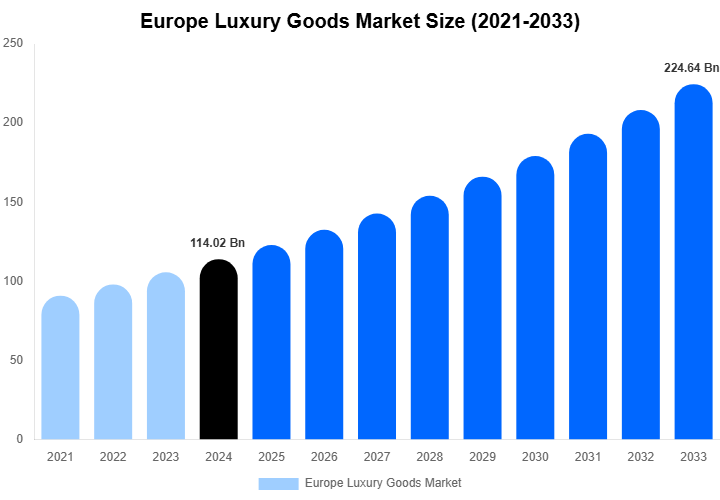
Source: DMI Analysis Company Publications, Primary Interviews.

Other Key Findings
- In 2025, Europe contributed 23.72% to the overall global Luxury Goods Market size.
- By 2034, United States is anticipated to dominate the global market based on market size.
- Benelux is expected to witness the fastest growth within Europe, attaining USD 11.05 Billion by 2034.
Europe Luxury Goods Market Dynamics
- The Europe luxury goods market remains a global leader, supported by renowned heritage brands, affluent consumers, international tourism, and strong demand for luxury fashion, handbags, watches, fine jewelry, cosmetics, footwear, and premium accessories. Consumers continue to prioritize craftsmanship, exclusivity, timeless design, and product authenticity.
- Luxury boutiques, flagship stores, department stores, premium shopping districts, airport duty-free retailers, and e-commerce platforms continue strengthening market accessibility. Omnichannel retail, personalized clienteling, and exclusive VIP services enhance customer experiences.
- Luxury brands invest in AI-powered personalization, sustainable materials, digital commerce, limited-edition collections, premium craftsmanship, and immersive retail technologies. Product innovation focuses on customization, heritage-inspired collections, and seamless digital integration.
- Sustainability initiatives encourage ethical sourcing, recycled luxury materials, circular fashion, eco-friendly packaging, carbon-neutral manufacturing, and transparent supply chains. Luxury companies increasingly adopt responsible production and circular economy strategies.
Key Industry Insights
- Heritage brands strengthen premium positioning.
- Personalized retail enhances customer loyalty.
- Digital luxury commerce supports market expansion.
- Sustainable luxury improves long-term competitiveness.
Europe Luxury Goods Market Country 2026-2034 (USD Billion)
| Europe | 2022 | 2023 | 2024 | 2025 | 2026 | 2027 | 2028 | 2029 | 2030 | 2031 | 2032 | 2033 | 2034 |
|---|---|---|---|---|---|---|---|---|---|---|---|---|---|
| Germany | XX.x | XX.x | XX.x | 28.22 | XX.x | XX.x | XX.x | XX.x | XX.x | XX.x | XX.x | XX.x | XX.x |
| United Kingdom | XX.x | XX.x | XX.x | XX.x | XX.x | XX.x | XX.x | XX.x | XX.x | XX.x | XX.x | XX.x | XX.x |
| France | XX.x | XX.x | XX.x | XX.x | XX.x | XX.x | XX.x | XX.x | XX.x | XX.x | XX.x | XX.x | XX.x |
| Italy | XX.x | XX.x | XX.x | XX.x | XX.x | XX.x | XX.x | XX.x | XX.x | XX.x | XX.x | XX.x | XX.x |
| Spain | XX.x | XX.x | XX.x | XX.x | XX.x | XX.x | XX.x | XX.x | XX.x | XX.x | XX.x | XX.x | XX.x |
| Russia | XX.x | XX.x | XX.x | XX.x | XX.x | XX.x | XX.x | XX.x | XX.x | XX.x | XX.x | XX.x | XX.x |
| Nordic | XX.x | XX.x | XX.x | XX.x | XX.x | XX.x | XX.x | XX.x | XX.x | XX.x | XX.x | XX.x | XX.x |
| Benelux | XX.x | XX.x | XX.x | XX.x | XX.x | XX.x | XX.x | XX.x | XX.x | XX.x | XX.x | XX.x | XX.x |
| Total | XX.x | XX.x | XX.x | 106.84 | XX.x | XX.x | XX.x | XX.x | XX.x | XX.x | XX.x | XX.x | XX.x |
Source: DMI Analysis Company Publications, Primary Interviews.
Europe Luxury Goods Market Category 2026-2034 (USD Billion)
| Category | 2022 | 2023 | 2024 | 2025 | 2026 | 2027 | 2028 | 2029 | 2030 | 2031 | 2032 | 2033 | 2034 |
|---|---|---|---|---|---|---|---|---|---|---|---|---|---|
| Leather Goods | XX.x | XX.x | XX.x | 32.09 | XX.x | XX.x | XX.x | XX.x | XX.x | XX.x | XX.x | XX.x | XX.x |
| Fashion | XX.x | XX.x | XX.x | XX.x | XX.x | XX.x | XX.x | XX.x | XX.x | XX.x | XX.x | XX.x | XX.x |
| Watches | XX.x | XX.x | XX.x | XX.x | XX.x | XX.x | XX.x | XX.x | XX.x | XX.x | XX.x | XX.x | XX.x |
| Jewellery | XX.x | XX.x | XX.x | XX.x | XX.x | XX.x | XX.x | XX.x | XX.x | XX.x | XX.x | XX.x | XX.x |
| Beauty | XX.x | XX.x | XX.x | XX.x | XX.x | XX.x | XX.x | XX.x | XX.x | XX.x | XX.x | XX.x | XX.x |
| Accessories | XX.x | XX.x | XX.x | XX.x | XX.x | XX.x | XX.x | XX.x | XX.x | XX.x | XX.x | XX.x | XX.x |
| Total | XX.x | XX.x | XX.x | 106.84 | XX.x | XX.x | XX.x | XX.x | XX.x | XX.x | XX.x | XX.x | XX.x |
Source: DMI Analysis Company Publications, Primary Interviews.
Europe Luxury Goods Market Channels 2026-2034 (USD Billion)
| Channels | 2022 | 2023 | 2024 | 2025 | 2026 | 2027 | 2028 | 2029 | 2030 | 2031 | 2032 | 2033 | 2034 |
|---|---|---|---|---|---|---|---|---|---|---|---|---|---|
| Retail | XX.x | XX.x | XX.x | 50.51 | XX.x | XX.x | XX.x | XX.x | XX.x | XX.x | XX.x | XX.x | XX.x |
| Travel Retail | XX.x | XX.x | XX.x | XX.x | XX.x | XX.x | XX.x | XX.x | XX.x | XX.x | XX.x | XX.x | XX.x |
| Online | XX.x | XX.x | XX.x | XX.x | XX.x | XX.x | XX.x | XX.x | XX.x | XX.x | XX.x | XX.x | XX.x |
| Total | XX.x | XX.x | XX.x | 106.83 | XX.x | XX.x | XX.x | XX.x | XX.x | XX.x | XX.x | XX.x | XX.x |
Source: DMI Analysis Company Publications, Primary Interviews.
Inside This Report
This section explores Europe's luxury goods industry through consumer demand, retail transformation, product innovation, and sustainability initiatives. It highlights how companies strengthen market leadership through premium craftsmanship and exclusive shopping experiences.
- Regional market landscape: Reviews luxury goods developments across Europe.
- Consumer and purchasing trends: Explores premium buying behavior and luxury preferences.
- Product innovation and distribution: Covers luxury collections, retail channels, and digital commerce.
- Competitive and industry developments: Highlights sustainability, innovation, and commercialization.
Report Summary
| Report Scope | Details |
|---|---|
| Base Year for Study | 2025 |
| Study Period | 2022-2034 |
| Historical Period | 2022-2024 |
| Forecast Period | 2026-2034 |
| Market Size In 2025 | USD 106.84 Billion |
| Market Size In 2034 | USD 212.14 Billion |
| Largest segment | Leather Goods |
| Units | Revenue in USD Billion |
| CAGR | 7.84% (2026-2034) |
| Report Coverage | Revenue Forecast, Competitive Landscape, Growth Factors, Environment & Regulatory Landscape and Trends |