Japan Herbal Beauty Products Market Size & Outlook, 2026-2034
Last Updated : 10 August, 2026 |
Study Period : 2022-2034 |
Format : PDF, Excel |
Author : Deep Market Insights
Japan Herbal Beauty Products Market Insights
- As per Deep Market Insights insights, the Japan Herbal Beauty Products Market stood at USD 2680.09 Million in 2025 and is anticipated to grow to USD 5605.2 Million by 2034.
- The Japan market is expected to advance at a CAGR of 8.46% from 2026 through 2034.
- In 2025, Skin care accounted for the highest share of the Category market size.
- During the forecast period, Skin care is set to register the highest growth, making it the most lucrative Category segment.
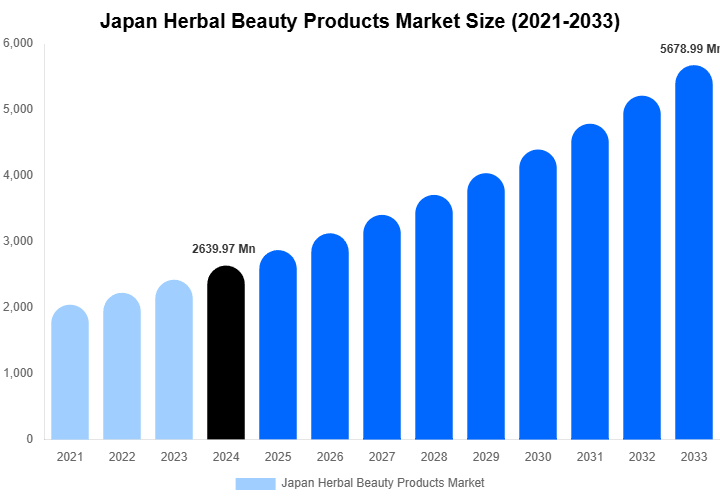
Source: DMI Analysis Company Publications, Primary Interviews.

Other Key Findings
- In 2025, Japan accounted for 3.12% of the global Herbal Beauty Products Market size.
- By 2034, United States is expected to lead the global Herbal Beauty Products Market in terms of market size.
- Within Asia Pacific, China is projected to dominate the regional Herbal Beauty Products Market size by 2034.
- Taiwan is identified as the fastest-growing market in Asia Pacific, anticipated to reach USD 2517.57 Million by 2034.
Japan Herbal Beauty Products Market Dynamics
- Japan's herbal beauty products category reflects longstanding appreciation for botanical ingredients, minimalist skincare, and high-quality personal care formulations. Consumers increasingly value naturally derived extracts, gentle formulations, ingredient transparency, and products that support healthy skin while complementing daily beauty rituals.
- Drugstores, department stores, specialty beauty retailers, pharmacies, supermarkets, brand boutiques, and e-commerce platforms support distribution. Premium beauty chains and direct-to-consumer channels increasingly introduce herbal skincare and haircare collections targeting wellness-conscious consumers.
- Product innovation increasingly includes green tea, rice bran, camellia oil, yuzu, botanical extracts, fermented ingredients, herbal shampoos, facial care, and multifunctional skincare. Manufacturers combine traditional Japanese botanicals with modern cosmetic science to enhance efficacy and sensory appeal.
- Sustainability, refill packaging, and clean beauty principles increasingly shape product development. Beauty companies emphasize responsibly sourced ingredients, recyclable packaging, environmentally conscious manufacturing, and transparent product communication to strengthen consumer confidence.
Key Industry Insights
- Botanical ingredients support premium skincare positioning.
- Refill packaging enhances sustainable beauty practices.
- Green tea remains a preferred cosmetic ingredient.
- Drugstores strengthen herbal beauty accessibility.
Japan Herbal Beauty Products Market Category 2026-2034 (USD Million)
| Category | 2022 | 2023 | 2024 | 2025 | 2026 | 2027 | 2028 | 2029 | 2030 | 2031 | 2032 | 2033 | 2034 |
|---|---|---|---|---|---|---|---|---|---|---|---|---|---|
| Skin care | XX.x | XX.x | XX.x | 1307.62 | XX.x | XX.x | XX.x | XX.x | XX.x | XX.x | XX.x | XX.x | XX.x |
| Hair care | XX.x | XX.x | XX.x | XX.x | XX.x | XX.x | XX.x | XX.x | XX.x | XX.x | XX.x | XX.x | XX.x |
| Color cosmetics | XX.x | XX.x | XX.x | XX.x | XX.x | XX.x | XX.x | XX.x | XX.x | XX.x | XX.x | XX.x | XX.x |
| Total | XX.x | XX.x | XX.x | 2,680.09 | XX.x | XX.x | XX.x | XX.x | XX.x | XX.x | XX.x | XX.x | XX.x |
Source: DMI Analysis Company Publications, Primary Interviews.
Japan Herbal Beauty Products Market Ingredient 2026-2034 (USD Million)
| Ingredient | 2022 | 2023 | 2024 | 2025 | 2026 | 2027 | 2028 | 2029 | 2030 | 2031 | 2032 | 2033 | 2034 |
|---|---|---|---|---|---|---|---|---|---|---|---|---|---|
| Botanical extracts | XX.x | XX.x | XX.x | XX.x | XX.x | XX.x | XX.x | XX.x | XX.x | XX.x | XX.x | XX.x | XX.x |
| Essential oils | XX.x | XX.x | XX.x | XX.x | XX.x | XX.x | XX.x | XX.x | XX.x | XX.x | XX.x | XX.x | XX.x |
| Total | XX.x | XX.x | XX.x | XX.x | XX.x | XX.x | XX.x | XX.x | XX.x | XX.x | XX.x | XX.x | XX.x |
Source: DMI Analysis Company Publications, Primary Interviews.
Japan Herbal Beauty Products Market Channel 2026-2034 (USD Million)
| Channel | 2022 | 2023 | 2024 | 2025 | 2026 | 2027 | 2028 | 2029 | 2030 | 2031 | 2032 | 2033 | 2034 |
|---|---|---|---|---|---|---|---|---|---|---|---|---|---|
| DTC | XX.x | XX.x | XX.x | 1453.68 | XX.x | XX.x | XX.x | XX.x | XX.x | XX.x | XX.x | XX.x | XX.x |
| Salons | XX.x | XX.x | XX.x | XX.x | XX.x | XX.x | XX.x | XX.x | XX.x | XX.x | XX.x | XX.x | XX.x |
| Retail | XX.x | XX.x | XX.x | XX.x | XX.x | XX.x | XX.x | XX.x | XX.x | XX.x | XX.x | XX.x | XX.x |
| Total | XX.x | XX.x | XX.x | 2,680.09 | XX.x | XX.x | XX.x | XX.x | XX.x | XX.x | XX.x | XX.x | XX.x |
Source: DMI Analysis Company Publications, Primary Interviews.
Inside This Report
This section examines Japan's herbal beauty products industry through botanical skincare, traditional ingredients, clean beauty, retail distribution, sustainability, and product innovation. It explores how brands combine Japanese herbal heritage with modern cosmetic technologies, premium positioning, and environmentally responsible practices.
- Country market landscape: Reviews Japan's herbal beauty retail and cosmetics ecosystem.
- Consumer and purchasing trends: Explores botanical ingredients, clean beauty, and skincare preferences.
- Product innovation and distribution: Covers herbal skincare, haircare, and multifunctional cosmetics.
- Competitive and industry developments: Highlights sustainability, refill systems, and premium branding.
Report Summary
| Report Scope | Details |
|---|---|
| Base Year for Study | 2025 |
| Study Period | 2022-2034 |
| Historical Period | 2022-2024 |
| Forecast Period | 2026-2034 |
| Market Size In 2025 | USD 2680.09 Million |
| Market Size In 2034 | USD 5605.2 Million |
| Largest segment | Skin care |
| Units | Revenue in USD Million |
| CAGR | 8.46% (2026-2034) |
| Report Coverage | Revenue Forecast, Competitive Landscape, Growth Factors, Environment & Regulatory Landscape and Trends |