North America Fast Fashion Market Size & Outlook, 2026-2034
Last Updated : 14 July, 2026 |
Study Period : 2022-2034 |
Format : PDF, Excel |
Author : Anna Morgan
North America Fast Fashion Market Insights
- As highlighted in Deep Market Insights analysis, the North America Fast Fashion Market, valued at USD 67177.12 Million in 2025, is estimated to achieve USD 167661.39 Million by 2034.
- The market is estimated to grow at a CAGR of 10.77% spanning 2026 to 2034.
- By market size, Women apparel led the Product category in 2025.
- The Product segment led by Men apparel is estimated to post the fastest growth, sustaining its position as the most lucrative during the forecast timeframe.
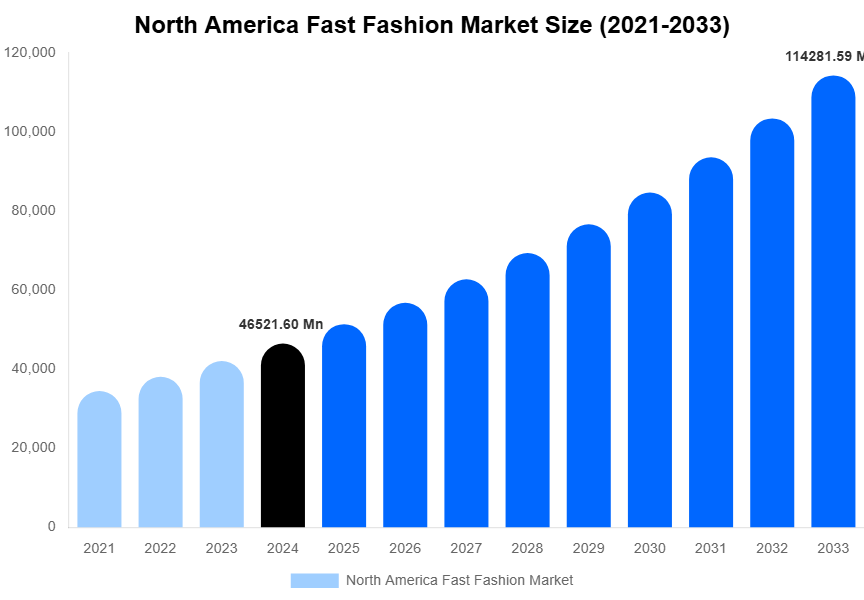
Source: DMI Analysis Company Publications, Primary Interviews.

Other Key Findings
- In 2025, North America contributed 38.36% to the overall global Fast Fashion Market size.
- By 2034, United States is anticipated to dominate the global market based on market size.
- United States is expected to witness the fastest growth within North America, attaining USD 123066.1 Million by 2034.
North America Fast Fashion Market Market Dynamics
- Consumers across North America increasingly seek affordable apparel that balances trend relevance with versatility, encouraging retailers to shorten product development cycles and introduce frequent collection updates. Demand for inclusive sizing, casual wear, and seasonally refreshed assortments continues shaping merchandising strategies across regional fashion retailers.
- Omnichannel retail has become central to fast fashion distribution, with e-commerce platforms, shopping malls, outlet centers, and click-and-collect services creating seamless purchasing experiences. Retailers integrate digital engagement, personalized recommendations, and flexible fulfillment options to strengthen customer retention and improve shopping convenience.
- Sustainability is becoming an important competitive differentiator, prompting apparel companies to expand recycled fabric collections, garment recycling initiatives, and environmentally responsible packaging. Brands also strengthen supply chain transparency and responsible sourcing practices to address evolving consumer expectations regarding ethical fashion.
- Retailers increasingly invest in demand forecasting, inventory optimization, and digital merchandising technologies to improve responsiveness to changing fashion trends. Strategic collaborations, limited-edition collections, and data-driven assortment planning enable brands to maintain consumer interest while improving operational efficiency.
Key Industry Insights
- Online channels account for a substantial share of apparel purchases.
- Mobile commerce continues expanding fashion retail accessibility.
- Consumers increasingly value sustainable apparel options.
- Flexible fulfillment services improve shopping convenience.
North America Fast Fashion Market Country 2026-2034 (USD Million)
| North America | 2022 | 2023 | 2024 | 2025 | 2026 | 2027 | 2028 | 2029 | 2030 | 2031 | 2032 | 2033 | 2034 |
|---|---|---|---|---|---|---|---|---|---|---|---|---|---|
| United States | XX.x | XX.x | XX.x | XX.x | XX.x | XX.x | XX.x | XX.x | XX.x | XX.x | XX.x | XX.x | XX.x |
| Canada | XX.x | XX.x | XX.x | XX.x | XX.x | XX.x | XX.x | XX.x | XX.x | XX.x | XX.x | XX.x | XX.x |
| Total | XX.x | XX.x | XX.x | XX.x | XX.x | XX.x | XX.x | XX.x | XX.x | XX.x | XX.x | XX.x | XX.x |
Source: DMI Analysis Company Publications, Primary Interviews.
North America Fast Fashion Market Product 2026-2034 (USD Million)
| Product | 2022 | 2023 | 2024 | 2025 | 2026 | 2027 | 2028 | 2029 | 2030 | 2031 | 2032 | 2033 | 2034 |
|---|---|---|---|---|---|---|---|---|---|---|---|---|---|
| Women apparel | XX.x | XX.x | XX.x | 33890.86 | XX.x | XX.x | XX.x | XX.x | XX.x | XX.x | XX.x | XX.x | XX.x |
| Men apparel | XX.x | XX.x | XX.x | XX.x | XX.x | XX.x | XX.x | XX.x | XX.x | XX.x | XX.x | XX.x | XX.x |
| Kids apparel | XX.x | XX.x | XX.x | XX.x | XX.x | XX.x | XX.x | XX.x | XX.x | XX.x | XX.x | XX.x | XX.x |
| Total | XX.x | XX.x | XX.x | 67,177.12 | XX.x | XX.x | XX.x | XX.x | XX.x | XX.x | XX.x | XX.x | XX.x |
Source: DMI Analysis Company Publications, Primary Interviews.
North America Fast Fashion Market Channel 2026-2034 (USD Million)
| Channel | 2022 | 2023 | 2024 | 2025 | 2026 | 2027 | 2028 | 2029 | 2030 | 2031 | 2032 | 2033 | 2034 |
|---|---|---|---|---|---|---|---|---|---|---|---|---|---|
| Online | XX.x | XX.x | XX.x | XX.x | XX.x | XX.x | XX.x | XX.x | XX.x | XX.x | XX.x | XX.x | XX.x |
| Offline | XX.x | XX.x | XX.x | XX.x | XX.x | XX.x | XX.x | XX.x | XX.x | XX.x | XX.x | XX.x | XX.x |
| Total | XX.x | XX.x | XX.x | XX.x | XX.x | XX.x | XX.x | XX.x | XX.x | XX.x | XX.x | XX.x | XX.x |
Source: DMI Analysis Company Publications, Primary Interviews.
Inside This Report
This section examines the North America fast fashion market through consumer purchasing behavior, retail transformation, product innovation, sustainability initiatives, and competitive strategies. It explores how apparel retailers respond to digital commerce, changing fashion preferences, and operational priorities across the regional fashion ecosystem.
- Regional market landscape: Reviews omnichannel retail and commercial developments across North America.
- Consumer and purchasing trends: Explores affordability, convenience, and evolving fashion preferences.
- Product innovation and distribution: Covers sustainable apparel and digital retail strategies.
- Competitive and industry developments: Highlights inventory management and merchandising innovation.
Report Summary
| Report Scope | Details |
|---|---|
| Base Year for Study | 2025 |
| Study Period | 2022-2034 |
| Historical Period | 2022-2024 |
| Forecast Period | 2026-2034 |
| Market Size In 2025 | USD 67177.12 Million |
| Market Size In 2034 | USD 167661.39 Million |
| Largest segment | Women apparel |
| Units | Revenue in USD Million |
| CAGR | 10.77% (2026-2034) |
| Report Coverage | Revenue Forecast, Competitive Landscape, Growth Factors, Environment & Regulatory Landscape and Trends |