China Body Wash Market Size & Outlook, 2026-2034
Last Updated : 27 July, 2026 |
Study Period : 2022-2034 |
Format : PDF, Excel |
Author : Anna Morgan
China Body Wash Market Insights
- According to Deep Market Insights analysis, the China Body Wash Market size was USD 1796.41 Million in 2025 and is projected to reach USD 2744.78 Million by 2034.
- The China market is projected to grow at a CAGR of 4.77% between 2026 and 2034.
- By segment, Mass-market emerged as the largest Positioning in terms of market size in 2025.
- Mass-market is anticipated to remain the most attractive Positioning segment, recording the fastest growth during the forecast period.
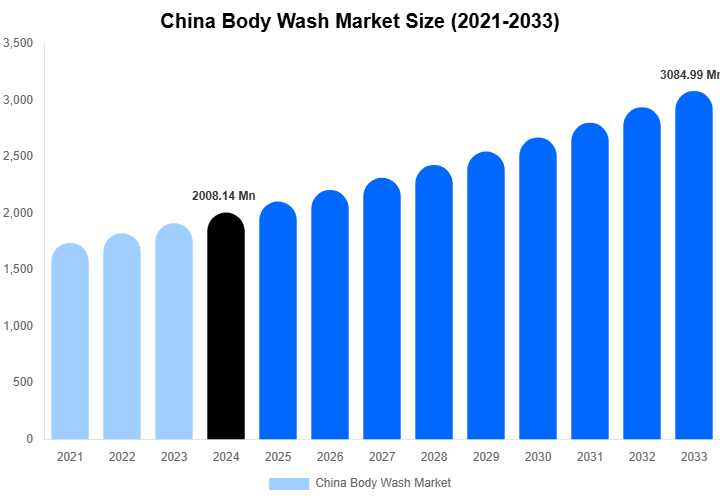
Source: DMI Analysis Company Publications, Primary Interviews.

Other Key Findings
- As of 2025, China held 6.08% of the global Body Wash Market size.
- By 2034, United States is anticipated to capture the largest share of the global Body Wash Market.
- In Asia Pacific, China is expected to lead the regional Body Wash Market size by 2034.
- Japan will remain the fastest-growing market in Asia Pacific, reaching USD 994.26 Million by 2034.
China Body Wash Market Dynamics
- China's body wash market continues evolving as consumers increasingly prioritize skincare-oriented cleansing products featuring moisturizing benefits, premium fragrances, and naturally inspired ingredients. Younger consumers actively seek multifunctional body care solutions that combine cleansing, hydration, and skin-conditioning properties within convenient everyday routines.
- Supermarkets, health and beauty retailers, e-commerce marketplaces, live-commerce platforms, and direct-to-consumer brands strengthen accessibility through broad product portfolios and immersive digital shopping experiences. Online education and influencer engagement significantly influence purchasing behavior across premium and mass-market segments.
- Manufacturers invest in plant-based ingredients, microbiome-supporting formulations, refill packaging, and advanced fragrance technologies to strengthen product differentiation. Innovation also focuses on moisturizing cleansers, sulfate-free products, and environmentally responsible packaging that aligns with changing wellness and sustainability priorities.
- Personal care brands collaborate with dermatologists, influencers, beauty platforms, and lifestyle communities to strengthen consumer engagement and premium positioning. Continued investment in digital commerce, localized product development, and ingredient transparency reinforces competitiveness within China's body wash industry.
Key Industry Insights
- E-commerce remains a major beauty purchasing channel.
- Plant-based ingredients receive increasing consumer attention.
- Refill packaging supports sustainability initiatives.
- Premium fragrances strengthen product differentiation.
China Body Wash Market Positioning 2026-2034 (USD Million)
| Positioning | 2022 | 2023 | 2024 | 2025 | 2026 | 2027 | 2028 | 2029 | 2030 | 2031 | 2032 | 2033 | 2034 |
|---|---|---|---|---|---|---|---|---|---|---|---|---|---|
| Mass-market | XX.x | XX.x | XX.x | 718.92 | XX.x | XX.x | XX.x | XX.x | XX.x | XX.x | XX.x | XX.x | XX.x |
| Premium | XX.x | XX.x | XX.x | XX.x | XX.x | XX.x | XX.x | XX.x | XX.x | XX.x | XX.x | XX.x | XX.x |
| Natural/Organic | XX.x | XX.x | XX.x | XX.x | XX.x | XX.x | XX.x | XX.x | XX.x | XX.x | XX.x | XX.x | XX.x |
| Medicated/Dermatological | XX.x | XX.x | XX.x | XX.x | XX.x | XX.x | XX.x | XX.x | XX.x | XX.x | XX.x | XX.x | XX.x |
| Total | XX.x | XX.x | XX.x | 1,796.41 | XX.x | XX.x | XX.x | XX.x | XX.x | XX.x | XX.x | XX.x | XX.x |
Source: DMI Analysis Company Publications, Primary Interviews.
China Body Wash Market Product Type 2026-2034 (USD Million)
| Product Type | 2022 | 2023 | 2024 | 2025 | 2026 | 2027 | 2028 | 2029 | 2030 | 2031 | 2032 | 2033 | 2034 |
|---|---|---|---|---|---|---|---|---|---|---|---|---|---|
| Liquid Body Wash | XX.x | XX.x | XX.x | 969.88 | XX.x | XX.x | XX.x | XX.x | XX.x | XX.x | XX.x | XX.x | XX.x |
| Shower Gels | XX.x | XX.x | XX.x | XX.x | XX.x | XX.x | XX.x | XX.x | XX.x | XX.x | XX.x | XX.x | XX.x |
| Bar Alternatives | XX.x | XX.x | XX.x | XX.x | XX.x | XX.x | XX.x | XX.x | XX.x | XX.x | XX.x | XX.x | XX.x |
| Total | XX.x | XX.x | XX.x | 1,796.41 | XX.x | XX.x | XX.x | XX.x | XX.x | XX.x | XX.x | XX.x | XX.x |
Source: DMI Analysis Company Publications, Primary Interviews.
Report Summary
| Report Scope | Details |
|---|---|
| Base Year for Study | 2025 |
| Study Period | 2022-2034 |
| Historical Period | 2022-2024 |
| Forecast Period | 2026-2034 |
| Market Size In 2025 | USD 1796.41 Million |
| Market Size In 2034 | USD 2744.78 Million |
| Largest segment | Mass-market |
| Units | Revenue in USD Million |
| CAGR | 4.77% (2026-2034) |
| Report Coverage | Revenue Forecast, Competitive Landscape, Growth Factors, Environment & Regulatory Landscape and Trends |