Yogurt Market Size
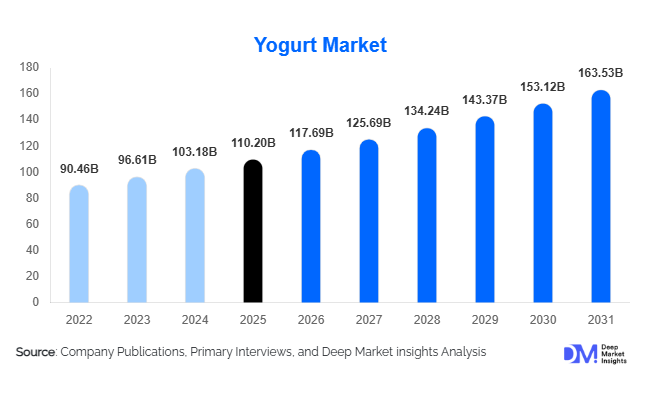
According to Deep Market Insights, the global yogurt market size was valued at USD 110.2 Billion in 2025 and is projected to grow from USD 117.69 Billion in 2026 to reach USD 163.53 Billion by 2031, expanding at a CAGR of 6.8% during the forecast period (2026–2031). The yogurt market growth is primarily driven by increasing consumer preference for probiotic-rich foods, rising demand for high-protein diets, and the rapid expansion of plant-based dairy alternatives. Growing awareness of gut health, immunity, and clean-label consumption is further accelerating adoption across both developed and emerging markets.
Key Market Insights
- Yogurt consumption is increasingly linked to functional health benefits, particularly digestive health, immunity, and protein intake.
- Greek yogurt and high-protein variants are expanding rapidly, driven by fitness-conscious consumers and premiumization trends.
- Asia-Pacific dominates the global market, supported by large populations and traditional yogurt consumption patterns.
- Plant-based yogurt is the fastest-growing segment, fueled by veganism and lactose intolerance trends.
- Supermarkets and hypermarkets remain the leading distribution channels, though e-commerce is gaining traction globally.
- Innovation in flavors, packaging, and functional ingredients is reshaping competitive dynamics and consumer engagement.
What are the latest trends in the yogurt market?
Rise of Plant-Based and Dairy-Free Yogurt
The global shift toward plant-based diets is significantly influencing the yogurt market. Consumers are increasingly opting for dairy-free alternatives such as almond, oat, soy, and coconut-based yogurt. These products cater to lactose-intolerant populations and environmentally conscious consumers seeking sustainable food choices. Manufacturers are investing in improving texture, taste, and nutritional profiles to match traditional dairy yogurt. The introduction of fortified plant-based yogurt with added protein, calcium, and probiotics is accelerating adoption. Retail shelves are expanding with diverse offerings, and foodservice operators are incorporating plant-based yogurt into smoothies, desserts, and breakfast menus, making this one of the most transformative trends in the market.
Functional and Probiotic Enrichment
Yogurt is increasingly positioned as a functional food, with manufacturers enhancing formulations with probiotics, prebiotics, vitamins, and minerals. Products targeting immunity, digestive health, and weight management are gaining strong traction. This trend is supported by growing consumer awareness of gut microbiome health. Companies are also introducing personalized nutrition concepts, where yogurt products are tailored to individual health needs. Functional claims and clean-label ingredients are becoming key differentiators, with premium pricing strategies supporting higher margins in this segment.
What are the key drivers in the yogurt market?
Growing Health and Wellness Awareness
Consumers worldwide are increasingly prioritizing health, leading to higher demand for nutritious and functional foods. Yogurt, rich in probiotics and essential nutrients, is widely perceived as a healthy dietary option. Post-pandemic, immunity-focused consumption has accelerated, with yogurt becoming a staple in daily diets. The growing popularity of low-sugar, organic, and clean-label products further supports this trend.
Rising Demand for High-Protein Diets
The global fitness movement has driven demand for high-protein foods, positioning Greek yogurt and Skyr as preferred options. These products offer higher protein content compared to traditional yogurt, making them popular among athletes and health-conscious consumers. This trend has led to product innovation, including protein-fortified yogurt variants targeting specific consumer segments.
What are the restraints for the global market?
Volatility in Raw Material Prices
Fluctuations in milk prices and plant-based raw materials significantly impact production costs. Rising feed costs, climate-related disruptions, and supply chain inefficiencies contribute to price volatility, affecting profit margins for manufacturers.
Cold Chain and Shelf-Life Constraints
Yogurt requires continuous refrigeration, posing challenges in regions with limited cold chain infrastructure. Short shelf life increases logistical costs and limits distribution in rural and developing markets, restricting overall market expansion.
What are the key opportunities in the yogurt industry?
Expansion in Emerging Markets
Emerging economies in Asia-Pacific, Latin America, and Africa present significant growth opportunities due to rising disposable incomes and urbanization. Increasing awareness of health benefits and expanding retail networks are driving yogurt consumption in these regions. Companies investing in localized production and affordable packaging formats can capture untapped demand.
Integration of Functional Nutrition
The incorporation of probiotics, vitamins, and protein fortification offers strong differentiation opportunities. Yogurt’s versatility as a functional food enables manufacturers to target niche health segments such as immunity, digestion, and weight management. This trend supports premium pricing and higher margins.
Report Scope
| Report Metric | Details |
|---|---|
| Market Size in 2025 | USD 110.2 Billion |
| Market Size in 2026 | USD 117.69 Billion |
| Market Size in 2031 | USD 163.53 Billion |
| CAGR | 6.8% (2026-2031) |
| Base Year for Estimation | 2025 |
| Historical Data | 2022-2024 |
| Forecast Period | 2026-2031 |
| Report Coverage | Revenue Forecast, Competitive Landscape, Supply Chain Disruption, Growth Factors, Environment & Regulatory Landscape and Trends |
| Geographies Covered | North America, Europe, APAC, Middle East and Africa, LATAM |
| Countries Covered | U.S., Canada, U.K., Germany, France, Spain, Italy, Russia, Nordic, Benelux, Rest of Europe, China, Korea, Japan, India, Australia, Singapore, Taiwan, South East Asia, Rest of Asia-Pacific, UAE, Turky, Saudi Arabia, South Africa, Egypt, Nigeria, Rest of MEA, Brazil, Mexico, Argentina, Chile, Colombia, Rest of LATAM |
Explore more data points, trends and opportunities Download Free Sample Report
Product Type Insights
The global yogurt market continues to be strongly influenced by evolving consumer preferences toward health, nutrition, and convenience, with product type segmentation playing a critical role in shaping demand patterns. Among all product categories, Greek yogurt remains the dominant segment, accounting for approximately 28% of the market share in 2025. Its leadership position is primarily driven by its high protein content, thick texture, and perceived premium quality. Consumers increasingly associate Greek yogurt with fitness, weight management, and satiety, making it a preferred choice among health-conscious individuals, athletes, and urban professionals. The leading segment driver for Greek yogurt lies in its ability to align with protein-rich dietary trends, including keto and high-protein diets, which continue to gain traction globally.Frozen yogurt, while still considered a niche category, is gaining momentum in developed markets due to its positioning as a healthier alternative to traditional ice cream. Consumers seeking indulgence without compromising on health are increasingly turning to frozen yogurt, especially variants with reduced sugar content and added probiotics. The segment benefits from the broader trend of guilt-free indulgence, although its growth remains geographically concentrated in regions with higher disposable incomes and established cold-chain infrastructure.Probiotic and functional yogurt variants represent one of the most dynamic areas within the product type segment. These products are formulated to deliver specific health benefits, particularly related to gut health, immunity, and digestion. The growing awareness of the gut microbiome and its impact on overall health has significantly boosted demand for probiotic yogurt. Manufacturers are investing heavily in research and development to introduce innovative strains and functional benefits, further expanding the segment’s appeal. As consumers increasingly prioritize preventive healthcare through diet, functional yogurt is expected to witness sustained growth over the forecast period.
Application Insights
Yogurt’s versatility across various applications has been a key factor driving its widespread consumption globally. Household consumption dominates the market, contributing over 65% of total demand. The leading segment driver in this category is the integration of yogurt into daily diets as a staple food, supported by rising awareness of its nutritional benefits. Yogurt is consumed across all age groups and is often included in breakfast routines, snacks, and meal accompaniments. Its adaptability in both sweet and savory dishes further enhances its household penetration.Industrial applications are also gaining traction, particularly in the bakery and processed food industries. Manufacturers are increasingly using yogurt as an ingredient in baked goods, sauces, dressings, and ready-to-eat meals. The leading driver in this segment is the growing demand for clean-label and functional ingredients, as yogurt enhances both the nutritional profile and texture of processed foods. Its natural composition and perceived health benefits make it an attractive alternative to artificial additives, aligning with consumer preferences for transparency and quality in food products.Overall, the application landscape of yogurt continues to expand, supported by its multifunctional nature and compatibility with various culinary uses. As innovation in product formulations and foodservice offerings accelerates, yogurt is expected to maintain its relevance across all application segments.
Distribution Channel Insights
Distribution channels play a crucial role in determining the accessibility and visibility of yogurt products, with supermarkets and hypermarkets accounting for approximately 48% of global sales. The leading segment driver for this channel is the wide product assortment and strong consumer trust associated with organized retail. These outlets provide consumers with access to a diverse range of yogurt products, including premium, organic, and functional variants, enabling informed purchasing decisions. Strategic product placement, promotional activities, and in-store sampling further enhance sales through this channel.Convenience stores cater to the growing demand for quick and accessible food options, particularly in urban areas. These outlets are well-positioned to capitalize on impulse purchases and on-the-go consumption trends, especially for single-serve and drinkable yogurt formats. Their proximity to residential and commercial areas makes them a preferred choice for consumers seeking immediate consumption options.Specialty stores focusing on organic and health foods are gaining popularity, particularly in developed markets. These outlets cater to niche consumer segments seeking premium, natural, and ethically sourced products. The rising demand for plant-based and clean-label yogurt variants has further strengthened the position of specialty stores in the distribution landscape.Foodservice channels continue to expand as yogurt becomes an integral component of various menu offerings. Partnerships between yogurt manufacturers and foodservice providers are increasing, enabling the introduction of innovative products tailored to specific consumer preferences. As distribution networks become more diversified and technologically advanced, the overall market is expected to benefit from improved product availability and consumer reach.
Ingredient Type Insights
The ingredient composition of yogurt is a key determinant of consumer preference and market growth, with dairy-based yogurt dominating the segment with approximately 78% market share. The leading segment driver for dairy-based yogurt is its established consumption patterns and widespread acceptance across all demographics. Its rich taste, nutritional profile, and affordability make it a staple product in many regions. Additionally, advancements in dairy processing and fortification have enhanced the quality and variety of dairy-based yogurt products.Innovation in plant-based yogurt formulations has been a major growth catalyst for this segment. Manufacturers are investing in research and development to improve taste, texture, and nutritional value, addressing initial consumer concerns regarding product quality. Ingredients such as almond, soy, coconut, and oat are being used to create diverse product offerings, catering to a wide range of preferences. The inclusion of probiotics and functional ingredients further enhances the appeal of plant-based yogurt, positioning it as a viable alternative to traditional dairy products.As sustainability and environmental concerns continue to influence consumer choices, plant-based yogurt is expected to witness substantial growth over the forecast period. The segment’s ability to align with health, ethical, and environmental considerations makes it a key area of focus for market players.
Explore more data points, trends and opportunities Download Free Sample Report
Yogurt Market Segmentations
By Product Type
- Set Yogurt
- Stirred Yogurt
- Greek Yogurt
- Drinkable Yogurt
- Frozen Yogurt
- Probiotic/Functional Yogurt
By Application / End Use
- Household Consumption
- Foodservice & HoReCa
- Industrial Use
By Distribution Channel
- Supermarkets/Hypermarkets
- Convenience Stores
- Online Retail/E-commerce
- Specialty Stores
- Foodservice Channels
Regional Insights
Asia-Pacific
Asia-Pacific leads the global yogurt market with approximately 34% market share in 2025, making it the largest and fastest-growing regional segment. The region’s growth is driven by a combination of traditional consumption patterns and rapid economic development. Countries such as China and India play a pivotal role, where yogurt has long been a staple in daily diets. The primary driver of regional growth is the increasing urbanization and rising disposable incomes, which are enabling consumers to shift toward value-added and premium yogurt products.Additionally, growing health awareness and the rising prevalence of lifestyle-related diseases are encouraging consumers to adopt functional and probiotic yogurt variants. Government initiatives promoting nutrition and dairy consumption further support market expansion. The rapid development of retail infrastructure, including supermarkets and e-commerce platforms, has improved product accessibility, particularly in urban and semi-urban areas. As a result, Asia-Pacific is expected to maintain its leadership position with a robust growth trajectory over the forecast period.
North America
North America accounts for around 26% of the global yogurt market, with the United States being the largest contributor. The region is characterized by high consumer awareness and a strong preference for health-oriented products. The primary driver of regional growth is the increasing demand for high-protein and functional foods, which has significantly boosted the popularity of Greek yogurt and plant-based alternatives.Innovation and premiumization are key trends shaping the market in North America. Consumers are willing to pay a premium for products that offer added health benefits, organic ingredients, and clean-label formulations. The presence of established market players and continuous product innovation further strengthen the region’s competitive landscape. Additionally, the widespread adoption of online retail and subscription-based delivery models has enhanced product accessibility, contributing to sustained market growth.
Europe
Europe holds approximately 24% market share, making it a mature yet innovation-driven market. Yogurt is deeply ingrained in the dietary habits of European consumers, with countries such as Germany, France, and the United Kingdom leading consumption. The primary driver of regional growth is the strong demand for organic, natural, and clean-label products, reflecting the region’s emphasis on quality and sustainability.European consumers are highly discerning, prioritizing transparency in ingredient sourcing and production processes. This has led to increased demand for premium and artisanal yogurt products. Additionally, the growing popularity of plant-based diets is driving the expansion of dairy-free yogurt alternatives. Regulatory support for food safety and quality standards further enhances consumer confidence, supporting steady market growth despite its maturity.
Latin America
Latin America represents a growing market with significant potential, driven by urbanization and improving economic conditions. Brazil and Mexico are the key contributors, accounting for a substantial share of regional demand. The primary driver of growth in this region is the increasing availability of affordable yogurt products, which cater to price-sensitive consumers.The expansion of modern retail infrastructure, including supermarkets and convenience stores, has improved product distribution and accessibility. Additionally, rising awareness of health and nutrition is encouraging consumers to incorporate yogurt into their diets. While the market is still developing, increasing investments by global and regional players are expected to drive further growth in the coming years.
Middle East & Africa
The Middle East & Africa region is witnessing steady growth in the yogurt market, supported by demographic and economic factors. Countries such as Saudi Arabia and South Africa are key markets, with increasing demand for both traditional and premium yogurt products. The primary driver of regional growth is the rising urban population, which is leading to changes in dietary habits and increased consumption of packaged food products.Growing awareness of the health benefits associated with yogurt, particularly its role in digestion and immunity, is further boosting demand. Additionally, the expansion of retail and foodservice sectors is enhancing product availability across the region. While challenges such as limited cold-chain infrastructure persist in certain areas, ongoing investments and technological advancements are expected to support long-term market growth.
Key Players in the Yogurt Market
- Danone S.A.
- Nestlé S.A.
- General Mills Inc.
- Lactalis Group
- Chobani LLC
- Yili Group
- Mengniu Dairy
- Fonterra Co-operative Group
- Arla Foods
- FrieslandCampina
- Müller Group
- Bright Dairy & Food Co.
- Yakult Honsha
- Amul (GCMMF)
- Stonyfield Farm