Xanthan Gum Market Size
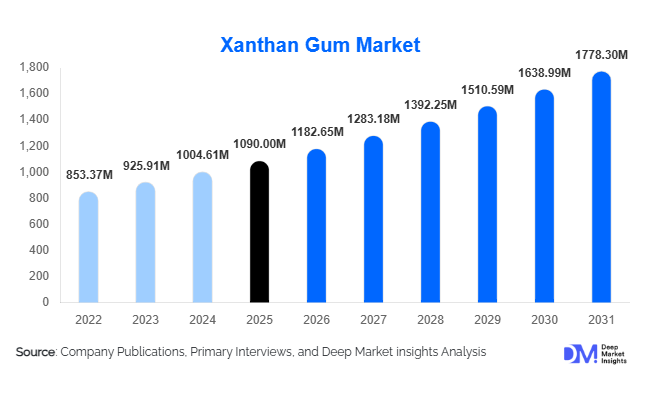
According to Deep Market Insights, the global xanthan gum market size was valued at USD 1,090 million in 2025 and is projected to grow from USD 1,182.65 million in 2026 to reach USD 1,778.30 million by 2031, expanding at a CAGR of 8.5% during the forecast period (2026–2031). The xanthan gum market growth is primarily driven by increasing demand for processed and convenience foods, expanding oil & gas exploration activities, and rising adoption of clean-label and natural ingredients across food, pharmaceutical, and personal care industries.
Key Market Insights
- Food & beverages dominate the xanthan gum market, accounting for over 50% of global demand, driven by its use as a stabilizer and thickener in processed and gluten-free foods.
- Asia-Pacific leads global production and consumption, with China emerging as the largest exporter due to cost-efficient fermentation capabilities.
- Oil & gas applications are witnessing strong growth, particularly in shale exploration and enhanced oil recovery activities.
- Clean-label and plant-based trends are accelerating demand, positioning xanthan gum as a preferred natural hydrocolloid.
- Powder form dominates the market, accounting for nearly 85% share due to ease of handling and storage.
- Technological advancements in fermentation processes are improving production efficiency and reducing manufacturing costs.
What are the latest trends in the xanthan gum market?
Rising Demand for Gluten-Free and Functional Foods
The increasing prevalence of gluten intolerance and growing consumer awareness around healthy eating are driving demand for gluten-free food products. Xanthan gum plays a critical role as a binding and texture-enhancing agent in gluten-free bakery and packaged foods. Manufacturers are innovating with new formulations that improve product texture, shelf life, and sensory appeal. The trend is particularly strong in North America and Europe, where consumers are actively seeking functional and clean-label ingredients. Additionally, plant-based food innovations are further supporting xanthan gum consumption as it aligns well with vegan and allergen-free product formulations.
Expansion in Oilfield Applications
Xanthan gum is increasingly being used in oilfield applications due to its ability to maintain viscosity under extreme temperature and pressure conditions. The expansion of shale gas exploration and deepwater drilling activities is significantly boosting demand for oilfield-grade xanthan gum. Countries such as the U.S., China, and Argentina are investing heavily in unconventional oil extraction, creating sustained demand. Innovations in drilling fluid formulations are further enhancing the performance of xanthan gum, enabling companies to achieve higher efficiency and reduced operational costs in oil extraction processes.
What are the key drivers in the xanthan gum market?
Growth in Processed Food Industry
The rapid expansion of the global processed food industry is a major driver for xanthan gum demand. Increasing urbanization, changing lifestyles, and rising disposable incomes are driving consumption of ready-to-eat and packaged foods. Xanthan gum is widely used to enhance texture, stability, and shelf life in sauces, dressings, and bakery products. Emerging economies, particularly in Asia-Pacific, are witnessing strong growth in food processing, further fueling demand for food-grade xanthan gum.
Increasing Adoption of Natural Ingredients
Consumers are increasingly favoring natural and bio-based ingredients over synthetic additives. Xanthan gum, derived from fermentation processes, aligns well with clean-label trends. Regulatory support for natural additives in regions such as Europe and North America is further encouraging its adoption. This shift toward transparency and sustainability is expected to remain a long-term growth driver for the market.
What are the restraints for the global market?
Volatility in Raw Material Prices
The production of xanthan gum depends heavily on agricultural raw materials such as sugar and corn. Fluctuations in these commodity prices can significantly impact production costs and profit margins. Price volatility creates uncertainty for manufacturers and may lead to inconsistent pricing in the market, affecting demand in price-sensitive regions.
Availability of Alternative Hydrocolloids
The presence of alternative hydrocolloids such as guar gum and locust bean gum poses a challenge to xanthan gum market growth. These substitutes can offer similar functionality at lower costs in certain applications, particularly in developing markets. This competitive pressure may limit the penetration of xanthan gum in cost-sensitive industries.
What are the key opportunities in the xanthan gum industry?
Expansion in Emerging Markets
Emerging economies in Asia-Pacific, Latin America, and the Middle East present significant growth opportunities due to increasing industrialization and food processing activities. Rising middle-class populations and urbanization are driving demand for processed foods, pharmaceuticals, and personal care products, creating new avenues for xanthan gum manufacturers.
Growth in Personal Care and Pharmaceutical Applications
The increasing demand for natural and multifunctional ingredients in personal care and pharmaceutical products offers new growth opportunities. Xanthan gum is widely used in creams, lotions, and drug formulations due to its stabilizing and controlled-release properties. Innovation in these sectors is expected to create high-margin opportunities for market participants.
Report Scope
| Report Metric | Details |
|---|---|
| Market Size in 2025 | USD 1090.00 Million |
| Market Size in 2026 | USD 1182.65 Million |
| Market Size in 2031 | USD 1778.30 Million |
| CAGR | 8.5% (2026-2031) |
| Base Year for Estimation | 2025 |
| Historical Data | 2022-2024 |
| Forecast Period | 2026-2031 |
| Report Coverage | Revenue Forecast, Competitive Landscape, Supply Chain Disruption, Growth Factors, Environment & Regulatory Landscape and Trends |
| Geographies Covered | North America, Europe, APAC, Middle East and Africa, LATAM |
| Countries Covered | U.S., Canada, U.K., Germany, France, Spain, Italy, Russia, Nordic, Benelux, Rest of Europe, China, Korea, Japan, India, Australia, Singapore, Taiwan, South East Asia, Rest of Asia-Pacific, UAE, Turky, Saudi Arabia, South Africa, Egypt, Nigeria, Rest of MEA, Brazil, Mexico, Argentina, Chile, Colombia, Rest of LATAM |
Explore more data points, trends and opportunities Download Free Sample Report
Grade Insights
The xanthan gum market is segmented by grade into food-grade, oilfield-grade, and industrial/pharmaceutical-grade variants, each serving distinct end-use industries with varying performance requirements and regulatory standards. Among these, food-grade xanthan gum continues to dominate the global market, accounting for approximately 48% share in 2025. This dominance is primarily attributed to the widespread adoption of xanthan gum in the global food and beverage industry, where it plays a critical role as a stabilizer, emulsifier, and thickening agent. Its ability to maintain viscosity across a wide range of temperatures and pH levels makes it particularly valuable in processed foods such as sauces, dressings, dairy products, gluten-free baked goods, and ready-to-eat meals.The leading driver for the food-grade segment is the rapidly growing global demand for processed and convenience foods, particularly in urban markets where changing lifestyles and time constraints are influencing consumption patterns. Additionally, the increasing popularity of clean-label and plant-based food products is further boosting demand, as xanthan gum is often perceived as a natural and safe additive compared to synthetic alternatives. The expansion of the global food processing sector, coupled with innovations in texture enhancement and product stability, continues to reinforce the segment’s leading position.Meanwhile, oilfield-grade xanthan gum is emerging as the fastest-growing segment, driven by its critical application in drilling fluids and enhanced oil recovery (EOR) processes. This grade is specifically engineered to withstand extreme conditions such as high salinity, temperature, and pressure, making it indispensable in oil and gas exploration activities. The primary growth driver for this segment is the increasing global energy demand, which is prompting both developed and emerging economies to intensify exploration and production activities. Furthermore, advancements in drilling technologies and the growing adoption of unconventional extraction techniques such as shale gas and deepwater drilling are accelerating the demand for high-performance drilling additives like xanthan gum.Industrial and pharmaceutical-grade xanthan gum also contribute to the market, particularly in applications such as cosmetics, personal care products, and drug formulations. Growth in these segments is supported by the rising demand for bio-based and multifunctional ingredients across industries, although their market share remains comparatively smaller than food and oilfield grades.
Form Insights
Based on form, the xanthan gum market is categorized into powder and liquid forms, with powder xanthan gum dominating the segment, accounting for nearly 85% share of the global market. The widespread preference for powder form is largely due to its superior stability, ease of storage, and cost-effective transportation. Powder xanthan gum offers a longer shelf life compared to liquid variants, making it highly suitable for bulk handling and international trade. It is also easier to incorporate into dry mixes and formulations across food, pharmaceutical, and industrial applications.The primary driver behind the dominance of powder xanthan gum is its versatility and compatibility with a wide range of applications. In the food industry, it is extensively used in powdered beverage mixes, bakery premixes, and seasoning blends. In industrial sectors, it is preferred for its ease of handling and ability to disperse uniformly in various formulations. Additionally, the scalability of powder production processes supports large-volume manufacturing, further strengthening its market position.On the other hand, liquid xanthan gum represents a smaller but steadily growing segment, particularly in specialized applications where rapid solubility and ease of dispersion are critical. Liquid formulations are increasingly being adopted in oilfield operations and certain industrial processes where time efficiency and uniform mixing are essential. The growth of this segment is driven by the need for ready-to-use solutions that reduce processing time and enhance operational efficiency. Although its share remains limited, technological advancements in formulation and packaging are expected to expand its adoption in the coming years.
Functionality Insights
In terms of functionality, xanthan gum serves multiple roles including thickening, stabilizing, emulsifying, and suspending agents. Among these, thickening agents represent the largest functionality segment, contributing approximately 40% of the market. Xanthan gum’s exceptional ability to provide high viscosity at low concentrations, along with its stability under varying environmental conditions, makes it a preferred thickening solution across numerous industries.The leading driver for the thickening functionality segment is the increasing demand for improved texture and consistency in food and beverage products. Consumers are placing greater emphasis on product quality, mouthfeel, and sensory experience, prompting manufacturers to adopt high-performance ingredients like xanthan gum. Additionally, the growth of gluten-free and low-fat food products has further amplified the importance of xanthan gum as a texture enhancer, as it helps replicate the structural properties of gluten and fats.Beyond food applications, xanthan gum’s thickening properties are also widely utilized in industrial processes such as oil drilling, where it enhances the viscosity of drilling fluids, ensuring efficient cuttings removal and well stability. In the pharmaceutical sector, it is used to control the release of active ingredients in drug formulations. The multifunctional nature of xanthan gum, combined with its cost-effectiveness and performance reliability, continues to drive its adoption across diverse applications.
Application Insights
The application landscape of the xanthan gum market is diverse, encompassing food & beverages, oil & gas, pharmaceuticals, personal care, and other industrial uses. Among these, the food & beverages segment dominates the market, accounting for approximately 52% market share. This dominance is driven by the extensive use of xanthan gum in improving texture, stability, and shelf life of processed food products.The primary driver for the food & beverages segment is the growing global demand for convenience foods, ready-to-eat meals, and functional beverages. Urbanization, rising disposable incomes, and changing dietary habits are contributing to increased consumption of packaged and processed foods. Additionally, the trend toward clean-label and natural ingredients is encouraging manufacturers to incorporate xanthan gum as a safe and recognizable additive.The oil & gas segment is the fastest-growing application area, fueled by increasing exploration and production activities worldwide. Xanthan gum is a key component in drilling fluids, where it enhances viscosity and stability under challenging conditions. The rising demand for energy, coupled with the expansion of unconventional oil and gas extraction methods, is driving significant growth in this segment.Other applications, including pharmaceuticals and personal care, are also experiencing steady growth. In pharmaceuticals, xanthan gum is used as a stabilizer and controlled-release agent, while in personal care products, it serves as a thickener and emulsifier in formulations such as lotions, creams, and shampoos. The increasing demand for natural and sustainable ingredients in these industries is further supporting market expansion.
Distribution Channel Insights
The xanthan gum market is distributed through direct B2B sales, distributors, and online platforms. Direct B2B sales dominate the market, accounting for nearly 65% share, as large-scale industrial buyers prefer to establish long-term supply agreements with manufacturers. This channel offers advantages such as cost efficiency, consistent quality, and reliable supply, making it the preferred choice for major end-use industries including food processing and oil & gas.The leading driver for the dominance of direct B2B sales is the need for bulk procurement and customized product specifications. Large manufacturers often require specific grades and formulations of xanthan gum, which are best delivered through direct partnerships with suppliers. Additionally, long-term contracts help mitigate price volatility and ensure supply chain stability.Distributors and online platforms are gaining traction, particularly in emerging markets where small and medium-sized enterprises rely on third-party suppliers for procurement. The growth of e-commerce and digital platforms is also facilitating easier access to xanthan gum products, enabling manufacturers to reach a broader customer base. As market dynamics evolve, the role of these channels is expected to expand, complementing the dominance of direct sales.
End-Use Industry Insights
By end-use industry, the xanthan gum market is led by the food processing sector, which accounts for around 50% share. This dominance is driven by the increasing global demand for packaged and processed foods, where xanthan gum plays a critical role in enhancing texture, stability, and shelf life. The expansion of the global food industry, particularly in developing regions, continues to support strong demand for xanthan gum.The key driver for the food processing segment is the rapid growth of convenience food consumption, coupled with the rising demand for clean-label and functional ingredients. Manufacturers are increasingly focusing on product innovation and quality enhancement, further boosting the adoption of xanthan gum.The oil & gas industry is the fastest-growing end-use segment, driven by increasing energy demand and exploration activities. Xanthan gum is widely used in drilling fluids to improve efficiency and performance, making it an essential component in oilfield operations. The expansion of unconventional drilling techniques is further accelerating demand in this sector.Pharmaceutical and personal care industries are also witnessing steady growth, supported by the rising demand for natural and multifunctional ingredients. Xanthan gum’s biocompatibility and stability make it a valuable component in various formulations, contributing to its increasing adoption in these industries.
Explore more data points, trends and opportunities Download Free Sample Report
Xanthan Gum Market Segmentations
By Grade
- Food Grade Xanthan Gum
- Oilfield Grade Xanthan Gum
- Industrial Grade Xanthan Gum
- Pharmaceutical & Personal Care Grade Xanthan Gum
By Form
- Powder Xanthan Gum
- Liquid Xanthan Gum
By Functionality
- Thickening Agent
- Stabilizing Agent
- Emulsifying Agent
- Suspending Agent
- Rheology Modifier
By Application
- Food & Beverages
- Oil & Gas
- Pharmaceuticals
- Personal Care & Cosmetics
- Industrial Applications
By Distribution Channel
- Direct Sales
- Distributors & Traders
- Online Industrial Platform
Regional Insights
Asia-Pacific
Asia-Pacific dominates the global xanthan gum market, accounting for approximately 42% share in 2025, with major contributions from China and India. China stands as the largest producer and exporter, benefiting from large-scale manufacturing capabilities, cost advantages, and strong supply chain networks. India, on the other hand, is emerging as a significant consumer market due to the rapid expansion of its food processing and pharmaceutical industries.The primary drivers of growth in the Asia-Pacific region include rapid urbanization, rising disposable incomes, and changing consumer lifestyles, which are fueling demand for processed and convenience foods. Additionally, the region’s strong manufacturing base and availability of raw materials support large-scale production of xanthan gum. Government initiatives aimed at boosting industrial growth and food processing sectors are further contributing to market expansion. The growing demand for oil and gas exploration in countries such as China and India is also driving the adoption of oilfield-grade xanthan gum.
North America
North America holds around 25% of the global market, with the United States being the largest contributor. The region benefits from a well-established food processing industry and advanced technological infrastructure, which support the widespread use of xanthan gum across various applications.Key growth drivers in North America include the strong demand for clean-label and natural food ingredients, as well as the increasing popularity of gluten-free and health-oriented products. The region’s robust oil and gas industry, particularly in shale exploration, is also driving demand for xanthan gum in drilling applications. Additionally, ongoing research and development activities are leading to innovative applications and improved product performance, further supporting market growth.
Europe
Europe accounts for nearly 20% share of the xanthan gum market, driven by stringent regulatory standards and a strong focus on sustainability and product quality. Countries such as Germany, France, and the United Kingdom are key contributors, supported by well-developed food and pharmaceutical industries.The primary drivers in Europe include the increasing demand for clean-label and organic food products, as well as growing consumer awareness regarding ingredient transparency. Regulatory frameworks that promote the use of safe and sustainable additives are also encouraging the adoption of xanthan gum. Additionally, the region’s focus on innovation and product development is supporting the expansion of applications across various industries.
Middle East & Africa
The Middle East & Africa region is experiencing steady growth in the xanthan gum market, primarily driven by increasing oilfield activities in countries such as Saudi Arabia and the United Arab Emirates. The region’s strong dependence on the energy sector makes xanthan gum an essential component in drilling operations.Key growth drivers include the expansion of oil and gas exploration activities, rising investments in energy infrastructure, and the adoption of advanced drilling technologies. Additionally, the growing food processing industry in certain parts of the region is contributing to increased demand for xanthan gum in food applications.
Latin America
Latin America represents an emerging market for xanthan gum, with Brazil and Argentina leading regional demand. The region is witnessing increasing adoption of xanthan gum across food processing and oil exploration industries.The primary drivers of growth in Latin America include rising industrialization, expanding food and beverage sector, and increasing investments in oil and gas exploration. Additionally, growing export activities and improving economic conditions are supporting market expansion. As the region continues to develop its industrial base, demand for xanthan gum is expected to grow significantly in the coming years.
Key Players in the Xanthan Gum Market
- CP Kelco
- Fufeng Group
- Deosen Biochemical
- Meihua Holdings Group
- Jungbunzlauer
- ADM (Archer Daniels Midland)
- Cargill Incorporated
- DuPont (IFF Nutrition & Biosciences)
- Hebei Xinhe Biochemical
- Zibo Zhongxuan Bio-chem
- Solvay SA
- Qingdao Deosen Bio-Tech
- Tate & Lyle PLC
- Ingredion Incorporated
- Shandong Fufeng Fermentation