Whiskey Market Size
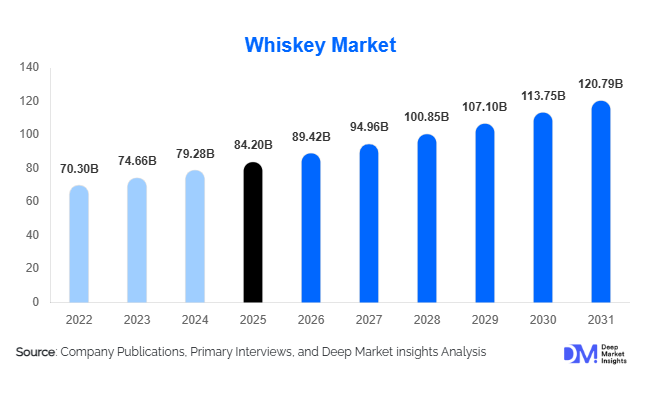
According to Deep Market Insights, the global whiskey market size was valued at USD 84.20 Billion in 2025 and is projected to grow from USD 89.42 Billion in 2026 to reach USD 120.79 Billion by 2031, expanding at a CAGR of 6.2% during the forecast period (2026–2031). The whiskey market growth is primarily driven by rising premiumization trends, increasing global consumption of aged spirits, and expanding demand across emerging economies. Changing consumer preferences toward high-quality and craft whiskey products, coupled with strong brand heritage and global distribution expansion, are further supporting sustained market growth.
Key Market Insights
- Premium and super-premium whiskey segments are expanding rapidly, driven by rising disposable incomes and consumer preference for quality over volume.
- Asia-Pacific is emerging as the fastest-growing region, led by strong demand in India, China, and Southeast Asia.
- Off-trade distribution channels dominate globally, supported by strong retail and e-commerce penetration.
- Innovation in flavored and ready-to-drink (RTD) whiskey products is attracting younger consumer demographics.
- North America remains the largest market, driven by strong domestic production and consumption of bourbon and Tennessee whiskey.
- Sustainability and eco-friendly production practices are increasingly influencing brand positioning and consumer choices.
What are the latest trends in the whiskey market?
Premiumization and Craft Whiskey Growth
The whiskey market is witnessing a strong shift toward premium and craft products, with consumers increasingly favoring single malts, small-batch bourbons, and aged variants. This trend is driven by a growing appreciation for quality, heritage, and unique flavor profiles. Craft distilleries are gaining traction by offering limited-edition releases and innovative blends, which appeal to niche consumer segments. Premiumization is also enabling companies to achieve higher margins, with luxury whiskey becoming a key revenue driver in developed markets.
Expansion of Ready-to-Drink and Flavored Whiskey
The rise of ready-to-drink (RTD) whiskey cocktails and flavored variants is reshaping consumption patterns, particularly among younger consumers. These products offer convenience and accessibility, making whiskey more approachable for new drinkers. Flavored whiskey infused with honey, apple, and spices is gaining popularity, while RTD formats are expanding in retail and e-commerce channels. This trend is expected to significantly contribute to volume growth, especially in urban markets.
What are the key drivers in the whiskey market?
Rising Global Demand for Premium Spirits
The increasing preference for premium alcoholic beverages is a major driver of the whiskey market. Consumers are shifting from mass-produced spirits to high-quality, aged whiskey products, driven by rising disposable incomes and aspirational lifestyles. Premium whiskey consumption is particularly strong in North America and Europe, while emerging markets are witnessing rapid growth in this segment.
Growth of Social Drinking Culture and Hospitality Industry
The expansion of bars, restaurants, and nightlife culture is significantly boosting whiskey consumption. Whiskey-based cocktails are gaining popularity, enhancing the drink’s appeal among younger consumers. The hospitality sector, including luxury hotels and tourism, is also contributing to increased demand for premium whiskey offerings.
What are the restraints for the global market?
High Taxation and Regulatory Constraints
Stringent government regulations and high excise duties in several countries pose a major challenge to market growth. These factors increase retail prices and limit accessibility, particularly in price-sensitive markets. Regulatory restrictions on alcohol advertising further impact brand visibility and market expansion.
Volatility in Raw Material and Production Costs
Fluctuations in the prices of key raw materials such as barley, corn, and energy can impact production costs and profit margins. Supply chain disruptions and climate-related agricultural challenges also add to cost pressures, especially for smaller producers.
What are the key opportunities in the whiskey industry?
Expansion in Emerging Markets
Emerging economies, particularly in Asia-Pacific, present significant growth opportunities for whiskey manufacturers. Rising urbanization, increasing disposable income, and westernization of lifestyles are driving consumption in countries such as India and China. Local production combined with global branding strategies can help companies capture untapped market potential.
Innovation and Product Diversification
Product innovation, including flavored whiskey, organic variants, and RTD cocktails, is creating new growth avenues. Companies investing in advanced distillation technologies and unique flavor profiles are gaining competitive advantage. Limited-edition releases and personalized products are also attracting premium consumers.
Report Scope
| Report Metric | Details |
|---|---|
| Market Size in 2025 | USD 84.20 Billion |
| Market Size in 2026 | USD 89.42 Billion |
| Market Size in 2031 | USD 120.79 Billion |
| CAGR | 6.2% (2026-2031) |
| Base Year for Estimation | 2025 |
| Historical Data | 2022-2024 |
| Forecast Period | 2026-2031 |
| Report Coverage | Revenue Forecast, Competitive Landscape, Supply Chain Disruption, Growth Factors, Environment & Regulatory Landscape and Trends |
| Geographies Covered | North America, Europe, APAC, Middle East and Africa, LATAM |
| Countries Covered | U.S., Canada, U.K., Germany, France, Spain, Italy, Russia, Nordic, Benelux, Rest of Europe, China, Korea, Japan, India, Australia, Singapore, Taiwan, South East Asia, Rest of Asia-Pacific, UAE, Turky, Saudi Arabia, South Africa, Egypt, Nigeria, Rest of MEA, Brazil, Mexico, Argentina, Chile, Colombia, Rest of LATAM |
Explore more data points, trends and opportunities Download Free Sample Report
Product Type Insights
The global whiskey market continues to be strongly anchored by Scotch whisky, which dominates the product landscape and accounts for approximately 34% of the total market share in 2025. This leadership position is underpinned by the enduring global reputation of Scotch as a premium and heritage-rich spirit, supported by strict geographical indication standards and centuries-old distillation traditions in Scotland. The international export strength of Scotch whisky remains unparalleled, with significant demand originating from mature markets such as the United States, France, and emerging premium-consuming markets in China and India. The leading segment driver for Scotch whisky is its strong premiumization appeal, which aligns with the global shift toward high-quality alcoholic beverages and consumer willingness to pay more for authenticity, provenance, and craftsmanship.Irish whiskey and Japanese whisky are carving out a strong presence within the premium and super-premium segments. Irish whiskey, known for its smooth and approachable flavor profile, is benefiting from rapid expansion in distillery investments and global exports, particularly in North America and Europe. Meanwhile, Japanese whisky continues to command high prestige due to its meticulous production techniques and limited availability, which create strong demand among collectors and connoisseurs. The leading segment driver for these categories is exclusivity combined with distinctive taste profiles, which appeal to consumers seeking differentiated drinking experiences.The rest-of-world whisky segment, particularly from countries such as India and Australia, is expanding at a remarkable pace. India stands out as one of the largest whiskey-consuming nations globally by volume, driven by a vast population and increasing acceptance of branded spirits. Indian single malts are also gaining global recognition, signaling a shift from volume-driven consumption to quality-driven demand. Similarly, Australian whisky is emerging as a premium niche category with growing exports. The primary driver for this segment is the rapid expansion of domestic consumption coupled with rising export competitiveness, supported by improving quality standards and innovation in production techniques.
Application (End-Use) Insights
In terms of application, individual consumption remains the dominant segment, accounting for nearly 68% of total demand in 2025. This dominance is largely attributed to evolving lifestyle patterns, where consumers increasingly prefer home-based socialization and personal consumption experiences. The leading driver for this segment is the growing trend of premium home drinking, supported by the rise of personal whiskey collections, digital content on whiskey appreciation, and the increasing availability of premium products through retail and online channels. Consumers are becoming more knowledgeable about whiskey varieties, leading to a shift from casual consumption to curated experiences at home.Commercial consumption, encompassing bars, restaurants, hotels, airlines, and cruise lines, is experiencing steady expansion and is poised for long-term growth. This segment benefits from the recovery and expansion of global tourism, particularly in regions such as Europe, Asia-Pacific, and the Middle East. The leading driver for commercial consumption is the resurgence of experiential hospitality, where premium whiskey offerings play a central role in enhancing customer experience. Whiskey tasting events, distillery tours, and themed hospitality experiences are becoming increasingly popular, driving higher consumption volumes in commercial settings.Furthermore, the integration of whiskey into luxury experiences, such as high-end lounges, business-class airline services, and cruise packages, is reinforcing its position as a premium lifestyle product. The growing influence of social media and digital storytelling is also encouraging consumers to explore whiskey in social and experiential contexts, further boosting demand in both individual and commercial applications.
Distribution Channel Insights
The distribution landscape of the whiskey market is led by off-trade channels, which account for approximately 62% of total sales. This segment includes supermarkets, hypermarkets, liquor stores, and specialty retail outlets, all of which benefit from strong consumer footfall and extensive product availability. The leading driver for the off-trade segment is the widespread accessibility and convenience it offers, combined with competitive pricing strategies and promotional activities that encourage bulk purchases and brand switching.Online retail is emerging as a transformative force within the distribution ecosystem, driven by increasing digital adoption and changing consumer preferences. E-commerce platforms are enabling consumers to access a broader range of whiskey products, including rare and premium labels that may not be available in physical stores. The primary growth driver for this channel is convenience coupled with product diversity, as well as the ability to compare prices, read reviews, and make informed purchasing decisions. Regulatory relaxations in alcohol e-commerce in certain markets are further accelerating this trend.On-trade channels, including bars, restaurants, and hotels, continue to play a critical role in shaping consumer perceptions and driving premium brand visibility. These establishments serve as key platforms for introducing consumers to new products and facilitating trial experiences. The leading driver for on-trade channels is brand positioning and experiential consumption, where premium and super-premium whiskey brands leverage curated environments to enhance their image and attract affluent consumers. Urbanization and the expansion of nightlife culture in cities across Asia-Pacific and Latin America are further strengthening this segment.
Price Segment Insights
The premium segment leads the whiskey market with an approximate 31% share, reflecting a global shift toward higher-quality alcoholic beverages. Consumers are increasingly prioritizing quality over quantity, driven by rising disposable incomes and evolving taste preferences. The leading driver for the premium segment is the ongoing premiumization trend, where consumers seek authenticity, craftsmanship, and superior flavor profiles.Super-premium and ultra-premium segments are witnessing the fastest growth, fueled by increasing demand for luxury products and gifting solutions. Limited-edition releases, aged variants, and collectible bottles are gaining traction among high-net-worth individuals and enthusiasts. The key driver for these segments is exclusivity and status appeal, which position whiskey as both a consumable product and an investment asset.Despite the rapid growth of premium categories, economy and standard segments continue to dominate in terms of volume, particularly in emerging markets such as India, Brazil, and South Africa. Price sensitivity remains a critical factor in these regions, where large consumer bases prioritize affordability. The leading driver for these segments is accessibility and mass-market appeal, supported by local production and cost-effective distribution strategies.
Explore more data points, trends and opportunities Download Free Sample Report
Whiskey Market Segmentations
By Product Type
- Scotch Whisky
- American Whiskey
- Irish Whiskey
- Canadian Whisky
- Japanese Whisky
- Rest of World Whisky
By Application (End-Use)
- Individual Consumption
- Hospitality
- Events & Catering
- Travel Retail
By Distribution Channel
- Liquor Stores
- Supermarkets/Hypermarkets
- Online Retail
- Bars & Pubs
- Restaurants & Hotels
Regional Insights
North America
North America holds the largest share of the global whiskey market, accounting for approximately 32% in 2025, with the United States serving as the primary growth engine. The region’s dominance is driven by a strong cultural affinity for whiskey, particularly bourbon and Tennessee whiskey, which are deeply embedded in American heritage. The leading driver for regional growth is the robust domestic demand supported by high disposable incomes and a well-established distribution infrastructure that ensures widespread product availability.In addition, the craft distillery movement across the United States is fostering innovation and product diversification, attracting younger consumers and driving premiumization. The expansion of whiskey tourism, including distillery tours and tasting experiences in states such as Kentucky and Tennessee, is further enhancing market growth. The presence of global players and strong export performance also contribute to North America’s leadership position in the global market.
Europe
Europe accounts for around 28% of the global whiskey market, with key contributions from the United Kingdom, Ireland, and Germany. The region benefits from a rich heritage of whiskey production, particularly in Scotland and Ireland, which are globally recognized for their high-quality offerings. The leading driver for regional growth is the strong export demand for Scotch whisky, which continues to generate significant revenue across international markets.Additionally, Europe’s mature consumer base exhibits a strong preference for premium and artisanal products, supporting the growth of high-value segments. The region’s well-developed tourism industry also plays a crucial role, with whiskey distilleries serving as major attractions for international visitors. Innovation in cask finishing and flavor experimentation is further driving consumer interest and sustaining market expansion.
Asia-Pacific
The Asia-Pacific region is the fastest-growing market, with a CAGR exceeding 7.5%, driven by dynamic economic growth and changing consumer lifestyles. Countries such as India and China are at the forefront of this expansion, with India being one of the largest whiskey consumers by volume and China emerging as a key market for premium whiskey. The leading driver for regional growth is the rapid expansion of the middle class, which is increasing purchasing power and enabling consumers to shift toward premium products.Urbanization and westernization of drinking habits are also contributing to the rising popularity of whiskey, particularly among younger demographics. In Japan, the emphasis on craftsmanship and quality continues to drive global demand for Japanese whisky, reinforcing the region’s influence in the premium segment. Government policies, increasing retail penetration, and the growth of e-commerce platforms are further supporting market development across Asia-Pacific.
Latin America
Latin America holds approximately 8% of the global market, with Brazil and Mexico serving as key growth markets. The region is experiencing steady demand growth, supported by increasing urbanization and a rising middle-class population. The leading driver for regional growth is the gradual shift in consumer preferences toward premium alcoholic beverages, driven by greater exposure to global brands and evolving lifestyle aspirations.The expansion of modern retail infrastructure and the growing influence of international tourism are also contributing to increased whiskey consumption. While price sensitivity remains a factor, the adoption of premium products is steadily increasing, particularly in urban centers where consumers are more receptive to global trends.
Middle East & Africa
The Middle East & Africa region accounts for around 6% of the global whiskey market, with growth concentrated in countries such as the United Arab Emirates and South Africa. The leading driver for regional growth is the expansion of the luxury hospitality sector, which is driving demand for premium whiskey in hotels, resorts, and fine-dining establishments.Tourism plays a pivotal role in shaping consumption patterns, particularly in the Middle East, where international visitors contribute significantly to alcohol sales. In Africa, rising urbanization and increasing disposable incomes are supporting gradual market expansion. The introduction of international brands and the development of modern retail channels are further enhancing accessibility and driving consumption growth across the region.
Key Players in the Whiskey Market
- Diageo
- Pernod Ricard
- Brown-Forman
- Beam Suntory
- Bacardi
- William Grant & Sons
- Edrington Group
- Whyte & Mackay
- Constellation Brands
- Kirin Holdings
- Asahi Group
- ThaiBev
- Radico Khaitan
- United Spirits
- Loch Lomond Group