Wheat Gluten Market Size
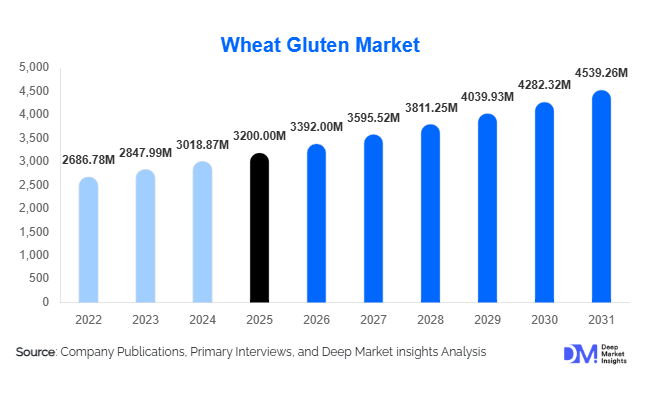
According to Deep Market Insights, the global wheat gluten market size was valued at USD 3,200 million in 2026 and is projected to grow from USD 3,392 million in 2026 to reach USD 4,539.26 million by 2031, expanding at a CAGR of 6.0% during the forecast period (2026–2031). The wheat gluten market growth is primarily driven by the rising demand for plant-based protein ingredients, increasing consumption of bakery and processed food products, and the rapid expansion of meat alternative and functional food industries worldwide.
Key Market Insights
- Plant-based protein demand is accelerating globally, positioning wheat gluten as a key functional ingredient in meat substitutes and hybrid protein formulations.
- Bakery and processed food industries dominate consumption, with wheat gluten widely used for improving texture, elasticity, and structural integrity.
- Asia-Pacific leads global demand, driven by strong food manufacturing bases in China and India.
- North America remains highly innovation-driven, with strong adoption in plant-based meat and premium bakery applications.
- Europe shows strong preference for clean-label and functional ingredients, supporting steady demand growth.
- Technological advancements in protein extraction are enhancing product purity and expanding application areas into nutraceuticals and specialty nutrition.
What are the latest trends in the wheat gluten market?
Expansion of Plant-Based Meat Applications
Wheat gluten is increasingly being used as a core structural protein in plant-based meat alternatives. Its elasticity and meat-like texture make it a preferred ingredient in burgers, sausages, and protein-based snacks. Manufacturers are combining wheat gluten with pea and soy proteins to improve amino acid profiles and enhance product appeal among flexitarian consumers. This trend is particularly strong in North America and Europe, where demand for sustainable protein alternatives continues to grow rapidly. Food innovators are also developing hybrid protein systems to balance taste, nutrition, and cost efficiency, further strengthening wheat gluten’s role in the alternative protein ecosystem.
Technological Advancements in Protein Processing
Advanced fractionation and enzymatic extraction technologies are significantly improving wheat gluten purity and functionality. These innovations allow manufacturers to produce highly refined gluten with improved solubility and elasticity, expanding its usage in pharmaceuticals, nutraceuticals, and specialty foods. Automation and AI-driven quality control systems are also being integrated into production facilities, ensuring consistent product quality and higher yield efficiency. These advancements are reducing production costs while increasing scalability for global suppliers.
What are the key drivers in the wheat gluten market?
Rising Demand for Plant-Based Protein
The growing global shift toward plant-based diets is one of the strongest drivers of the wheat gluten market. Consumers are increasingly adopting vegetarian, vegan, and flexitarian lifestyles, boosting demand for alternative protein sources. Wheat gluten serves as a cost-effective and highly functional protein ingredient, making it essential in meat substitutes and protein-enriched food products. Rising health awareness and sustainability concerns are further reinforcing this demand across developed and emerging markets.
Growth of Bakery and Processed Food Industry
The expansion of the global bakery and processed food industry is significantly contributing to wheat gluten consumption. Urbanization, busy lifestyles, and rising demand for convenience foods are driving the need for improved dough strength and product texture. Wheat gluten is widely used in bread, noodles, pastries, and packaged foods due to its binding and elasticity properties. Industrial bakery expansion in Asia-Pacific and Europe is particularly fueling long-term demand.
Increasing Demand from Pet Food Industry
Wheat gluten is gaining strong traction in the pet food industry due to its high protein content and digestibility. Premium and specialized pet food formulations increasingly use wheat gluten as a functional protein ingredient. Rising pet ownership globally, particularly in North America and Europe, is further accelerating demand in this segment.
What are the restraints for the global market?
Gluten Intolerance and Health Concerns
The increasing prevalence of gluten intolerance, celiac disease, and gluten sensitivity is a major restraint for market growth. Regulatory authorities have imposed strict labeling requirements, limiting wheat gluten usage in certain food applications. This has also driven consumer shift toward gluten-free alternatives, affecting demand in traditional food segments.
Volatility in Raw Material Prices
Fluctuations in wheat prices due to climate change, geopolitical instability, and supply chain disruptions significantly impact production costs. Since wheat is the primary raw material, price volatility directly affects manufacturer margins and product pricing stability, creating uncertainty in long-term contracts.
What are the key opportunities in the wheat gluten industry?
Expansion in Emerging Markets
Emerging economies such as India, China, Brazil, and Southeast Asian countries present significant growth opportunities due to rising urbanization and expanding food processing industries. Increasing disposable incomes and changing dietary habits are driving demand for bakery products and protein-rich foods, boosting wheat gluten consumption in these regions.
Growth in Nutraceutical and Specialty Nutrition Applications
Wheat gluten is gaining traction in nutraceuticals and functional foods due to its protein concentration and functional properties. It is increasingly used in dietary supplements, sports nutrition, and medical nutrition formulations. This diversification into high-value applications is expected to significantly improve market profitability.
Government Support for Food Processing Industry
Government initiatives such as “Make in India” and China’s food modernization programs are encouraging investments in food ingredient manufacturing. These policies are promoting domestic production of wheat gluten and improving supply chain infrastructure, attracting both local and international investors.
Report Scope
| Report Metric | Details |
|---|---|
| Market Size in 2025 | USD 3200.00 Million |
| Market Size in 2026 | USD 3392 Million |
| Market Size in 2031 | USD 4539.26 Million |
| CAGR | 6% (2026-2031) |
| Base Year for Estimation | 2025 |
| Historical Data | 2022-2024 |
| Forecast Period | 2026-2031 |
| Report Coverage | Revenue Forecast, Competitive Landscape, Supply Chain Disruption, Growth Factors, Environment & Regulatory Landscape and Trends |
| Geographies Covered | North America, Europe, APAC, Middle East and Africa, LATAM |
| Countries Covered | U.S., Canada, U.K., Germany, France, Spain, Italy, Russia, Nordic, Benelux, Rest of Europe, China, Korea, Japan, India, Australia, Singapore, Taiwan, South East Asia, Rest of Asia-Pacific, UAE, Turky, Saudi Arabia, South Africa, Egypt, Nigeria, Rest of MEA, Brazil, Mexico, Argentina, Chile, Colombia, Rest of LATAM |
Explore more data points, trends and opportunities Download Free Sample Report
Product Type Insights
The global wheat gluten market is prominently led by the vital wheat gluten segment, which accounts for the largest share owing to its high protein concentration, superior elasticity, and exceptional viscoelastic properties. Vital wheat gluten is extensively utilized across multiple food processing applications, particularly in bakery and meat substitute production, where its ability to enhance texture, improve dough strength, and provide structural integrity is critical. Its functional advantages, such as water absorption, binding strength, and extensibility, make it indispensable in industrial baking processes, where consistency and scalability are essential. The increasing global shift toward protein-enriched food products has further reinforced the dominance of vital wheat gluten, as manufacturers increasingly prioritize ingredients that can deliver both nutritional value and performance efficiency.Overall, the product type segmentation of the wheat gluten market is strongly influenced by the growing emphasis on clean-label ingredients, high-protein diets, and functional food formulations. Manufacturers are increasingly investing in product innovation and process optimization to enhance protein yield, improve functionality, and meet evolving consumer expectations. The continued dominance of vital wheat gluten, supported by its unmatched functional attributes and alignment with global food trends, is expected to remain a defining characteristic of the market over the forecast period.
Application Insights
The application landscape of the wheat gluten market is diverse, with the bakery and confectionery segment maintaining its position as the largest contributor to overall demand. This dominance is primarily driven by the critical role wheat gluten plays in improving dough elasticity, gas retention, and final product texture. In industrial baking, consistency and product quality are paramount, and wheat gluten serves as a key ingredient that ensures uniformity in bread, cakes, pastries, and other baked goods. The increasing consumption of convenience foods, coupled with the rapid expansion of quick-service restaurants and bakery chains, continues to fuel demand within this segment.The meat alternatives segment is experiencing the fastest growth within the application spectrum, driven by the increasing adoption of vegan, vegetarian, and flexitarian lifestyles. Wheat gluten, particularly in the form of vital wheat gluten, is a cornerstone ingredient in plant-based meat formulations due to its ability to replicate the texture and chewiness of animal protein. The leading driver in this segment is the global shift toward sustainable and environmentally friendly food systems, which has accelerated the demand for plant-based protein sources. As consumers become more conscious of the environmental and ethical implications of meat consumption, the demand for meat substitutes continues to rise, thereby creating significant growth opportunities for wheat gluten.Wheat gluten’s amino acid profile and functional properties make it suitable for inclusion in protein powders, bars, and medical nutrition products. As innovation continues to expand its application scope, wheat gluten is expected to play a more prominent role in high-value, health-oriented product categories.
End-Use Industry Insights
The food and beverage industry remains the dominant end-use sector for wheat gluten, accounting for the majority of global consumption. This dominance is driven by the extensive use of wheat gluten in bakery products, processed foods, and meat alternatives. The leading driver for this segment is the rapid expansion of the global processed food industry, fueled by urbanization, changing lifestyles, and increasing demand for convenience foods. Wheat gluten’s ability to enhance product quality, improve texture, and extend shelf life makes it an essential ingredient in large-scale food manufacturing.The nutraceutical industry represents a high-growth segment, driven by the rising focus on health, wellness, and preventive healthcare. Wheat gluten is used in protein supplements and functional foods, catering to consumers seeking high-protein and performance-enhancing products. The leading driver for this segment is the growing awareness of the importance of protein intake in maintaining overall health and fitness. As consumers increasingly adopt active lifestyles and prioritize nutrition, the demand for protein-rich supplements is expected to rise, thereby boosting the use of wheat gluten in this industry.Export-driven demand also plays a crucial role in shaping the wheat gluten market, with major production hubs supplying products to international markets. Countries with advanced processing capabilities and abundant wheat production are key exporters, catering to demand in regions such as Europe, North America, and Asia-Pacific. The integration of global supply chains and the expansion of international trade are supporting the steady growth of wheat gluten exports, further reinforcing its importance as a globally traded commodity.
Explore more data points, trends and opportunities Download Free Sample Report
Wheat Gluten Market Segmentations
By Form
- Vital Wheat Gluten
- Native Wheat Gluten
- Hydrolyzed Wheat Gluten
By Application
- Bakery & Confectionery
- Meat Alternatives & Plant-Based Foods
- Pet Food
- Processed Food Products
- Nutraceuticals & Functional Foods
By End-Use Industry
- Food & Beverage Industry
- Animal Feed Industry
- Nutraceutical & Dietary Supplements Industry
- Pharmaceutical Industry
By Distribution Channel
- Direct Industrial Sales (B2B)
- Food Ingredient Distributors
- Online B2B Platforms
Regional Insights
Asia-Pacific
Asia-Pacific leads the global wheat gluten market, driven by robust demand from countries such as China, India, and Japan. The region’s dominance is supported by a combination of large-scale food processing industries, abundant raw material availability, and rapidly growing consumer markets. China stands out as a major contributor, owing to its extensive wheat production and well-established processing infrastructure. The country’s growing focus on plant-based protein production and meat alternatives has significantly increased the demand for wheat gluten, particularly in industrial applications.The leading drivers for regional growth in Asia-Pacific include rapid urbanization, changing dietary patterns, increasing consumption of processed foods, and the expansion of plant-based protein markets. The region’s large population base and evolving consumer preferences make it a key growth engine for the global wheat gluten market.
Europe
Europe holds a significant share of the wheat gluten market, with countries such as Germany, France, and the Netherlands playing a central role. Germany’s strong bakery tradition and industrial baking sector drive substantial demand for wheat gluten, while France contributes through its diverse food processing industry. The Netherlands, known for its advanced agricultural and food processing capabilities, serves as a key hub for wheat gluten production and export.Regulatory support for food quality and safety, coupled with strong innovation in food processing technologies, continues to strengthen Europe’s position in the global market. The leading drivers for regional growth include the expansion of plant-based food markets, increasing demand for premium bakery products, and a strong focus on sustainability and clean-label ingredients.
North America
North America is characterized by high levels of innovation and technological advancement in the food processing industry, with the United States leading regional demand. The growing adoption of plant-based diets and the increasing popularity of meat alternatives are key factors driving the wheat gluten market in this region. Consumers are increasingly seeking protein-rich and functional food products, which has led to a surge in demand for wheat gluten across various applications.The presence of established food manufacturers and a well-developed supply chain further supports market growth. Additionally, the region’s focus on product innovation and the development of new food formulations is driving the adoption of wheat gluten in emerging applications. The leading drivers for regional growth include the rise of plant-based protein consumption, increasing demand for premium and functional foods, and continuous innovation in food processing technologies.
Latin America
Latin America is an emerging market for wheat gluten, with countries such as Brazil and Mexico showing increasing demand for processed foods and bakery products. The region’s growing urban population and rising middle class are driving changes in dietary habits, leading to higher consumption of convenience foods. Wheat gluten is increasingly being used in food processing applications to enhance product quality and meet consumer expectations.The leading drivers for regional growth include urbanization, increasing disposable incomes, and the gradual expansion of the food processing industry. As consumer awareness regarding nutrition and product quality continues to grow, the demand for wheat gluten is expected to increase steadily across the region.
Middle East & Africa
The Middle East and Africa region is witnessing moderate growth in the wheat gluten market, supported by increasing food imports and the expansion of the retail and hospitality sectors. Gulf countries, in particular, are experiencing higher consumption of processed and packaged foods, driven by a growing expatriate population and rising disposable incomes.The leading drivers for regional growth include the increasing reliance on imported food products, the development of modern retail infrastructure, and the expansion of the food service industry. As the region continues to urbanize and diversify its economy, the demand for wheat gluten is expected to grow, particularly in food processing and bakery applications. The gradual adoption of Western dietary patterns and the increasing focus on food quality further contribute to market expansion.
Key Players in the Wheat Gluten Market
- Roquette Frères
- Archer Daniels Midland Company
- Cargill Incorporated
- Manildra Group
- MGP Ingredients
- Tereos Group
- Südzucker AG
- Kerry Group
- Tate & Lyle PLC
- Wilmar International
- Bunge Global SA
- General Mills Inc.