Wakeboard Market Size
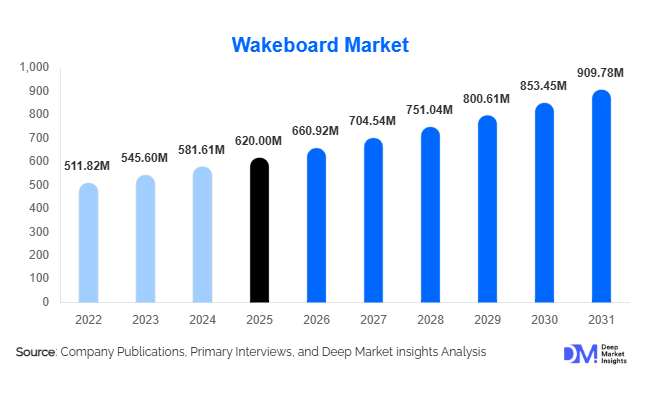
According to Deep Market Insights, the global wakeboard market size was valued at USD 620 million in 2025 and is projected to grow from USD 660.92 million in 2026 to reach USD 909.78 million by 2031, expanding at a CAGR of 6.6% during the forecast period (2026–2031). The wakeboard market growth is primarily driven by increasing participation in water sports, rising adventure tourism, and continuous innovation in board materials and design. The expansion of cable parks and artificial wakeboarding facilities is further enhancing accessibility, especially in urban areas where natural water bodies are limited.
Key Market Insights
- Recreational water sports participation is increasing globally, with wakeboarding emerging as a popular lifestyle activity among younger demographics.
- Mid-range wakeboards dominate sales, balancing affordability and performance for a broad consumer base.
- North America leads the global market, supported by a strong boating culture and established water sports infrastructure.
- Asia-Pacific is the fastest-growing region, driven by rising disposable incomes and tourism investments.
- Composite materials are gaining traction, offering lightweight and high-performance advantages.
- Offline retail continues to dominate, though online channels are rapidly expanding with D2C strategies.
What are the latest trends in the wakeboard market?
Expansion of Cable Wakeboarding Infrastructure
The rapid development of cable wakeboarding parks is transforming the accessibility of the sport. These facilities eliminate the need for motorboats, reducing costs and environmental impact while enabling operations in urban areas. Countries across Europe and the Asia-Pacific are witnessing significant investments in cable park infrastructure, making wakeboarding more inclusive and scalable. This trend is also supporting training academies and recreational centers, driving consistent equipment demand and encouraging repeat participation among users.
Shift Toward Advanced and Sustainable Materials
Manufacturers are increasingly focusing on high-performance materials such as carbon fiber composites and eco-friendly resins. These innovations improve durability, flexibility, and overall riding experience while reducing environmental impact. Sustainability is becoming a key differentiator, with brands introducing recyclable components and low-impact manufacturing processes. Consumers, particularly in developed markets, are showing a strong preference for lightweight, durable, and environmentally responsible products, pushing companies to innovate continuously.
What are the key drivers in the wakeboard market?
Rising Popularity of Adventure Tourism
The global shift toward experiential travel is significantly boosting demand for wakeboarding. Adventure tourism, valued at hundreds of billions globally, is expanding rapidly, with water-based activities playing a central role. Coastal destinations, resorts, and lake-based tourism hubs are integrating wakeboarding into their offerings, driving equipment sales and rentals. The increasing number of international sporting events is also enhancing visibility and participation.
Technological Advancements in Product Design
Continuous innovation in wakeboard design, including improved hydrodynamics and lightweight materials, is expanding the sport’s appeal. Advanced boards offer better control, stability, and performance, making them suitable for both beginners and professionals. These advancements are reducing the learning curve and enhancing user experience, contributing to higher adoption rates across different skill levels.
What are the restraints for the global market?
Seasonal and Weather Dependency
Wakeboarding is heavily dependent on favorable weather conditions, limiting year-round participation in many regions. Seasonal demand fluctuations impact sales cycles and create inventory management challenges for manufacturers and retailers. Regions with colder climates face shorter operating seasons, restricting overall market growth potential.
High Cost of Participation
The cost of wakeboarding equipment, training, and access to facilities remains relatively high, particularly for beginners. Premium wakeboards and associated gear can be expensive, limiting adoption in price-sensitive markets. Although rental services help mitigate this barrier, affordability remains a challenge for widespread market penetration in developing regions.
What are the key opportunities in the wakeboard industry?
Growth in Emerging Markets
Emerging economies in the Asia-Pacific and Latin America present significant growth opportunities. Rising disposable incomes, expanding tourism sectors, and government initiatives promoting sports infrastructure are driving demand. Early market entry and localized distribution strategies can help companies establish strong footholds in these high-growth regions.
Digital Commerce and Direct-to-Consumer Models
The rise of e-commerce platforms is enabling manufacturers to reach global audiences directly. Direct-to-consumer strategies reduce dependency on intermediaries and improve profit margins. Online platforms also allow customization, virtual product demonstrations, and personalized marketing, enhancing customer engagement and driving sales growth.
Report Scope
| Report Metric | Details |
|---|---|
| Market Size in 2025 | USD 620 Million |
| Market Size in 2026 | USD 660.92 Million |
| Market Size in 2031 | USD 909.78 Million |
| CAGR | 6.6% (2026-2031) |
| Base Year for Estimation | 2025 |
| Historical Data | 2022-2024 |
| Forecast Period | 2026-2031 |
| Report Coverage | Revenue Forecast, Competitive Landscape, Supply Chain Disruption, Growth Factors, Environment & Regulatory Landscape and Trends |
| Geographies Covered | North America, Europe, APAC, Middle East and Africa, LATAM |
| Countries Covered | U.S., Canada, U.K., Germany, France, Spain, Italy, Russia, Nordic, Benelux, Rest of Europe, China, Korea, Japan, India, Australia, Singapore, Taiwan, South East Asia, Rest of Asia-Pacific, UAE, Turky, Saudi Arabia, South Africa, Egypt, Nigeria, Rest of MEA, Brazil, Mexico, Argentina, Chile, Colombia, Rest of LATAM |
Explore more data points, trends and opportunities Download Free Sample Report
Product Type Insights
Boat wakeboards continue to dominate the global wakeboard market, accounting for approximately 48% of total market share in 2025. This leadership position is primarily driven by their strong alignment with the well-established recreational boating ecosystem, particularly in North America and Europe. Boat wakeboards are widely preferred due to their compatibility with motorized boats, superior wake performance, and versatility across skill levels. The growth of leisure boating, increasing ownership of personal watercraft, and rising participation in lake and coastal water sports are key drivers sustaining this segment’s dominance. Additionally, manufacturers are continuously innovating boat wakeboards with enhanced rocker designs, improved grip systems, and lightweight composite materials, further strengthening their appeal.
Cable wakeboards are emerging as the fastest-growing segment, supported by the rapid expansion of cable parks globally. These boards are specifically designed for durability and controlled environments, making them ideal for beginners and urban users. Hybrid wakeboards, which combine features of both boat and cable boards, are gaining popularity among experienced riders seeking versatility across multiple environments, although they currently hold a smaller share of the market.
Application Insights
Recreational users dominate the wakeboard market, contributing approximately 55% of total demand in 2025. This segment’s growth is driven by increasing consumer preference for lifestyle-oriented and experience-based leisure activities. Rising disposable incomes, particularly among millennials and Gen Z, are enabling greater participation in water sports, with wakeboarding becoming a popular choice due to its accessibility and social appeal. The expansion of water sports tourism and weekend recreational activities around lakes and coastal areas further reinforces demand in this segment.
Tourism operators and resorts represent the fastest-growing end-use segment, driven by the global boom in adventure tourism. Resorts are increasingly integrating wakeboarding into premium experience packages to attract high-spending travelers. Additionally, water sports training institutes and clubs are expanding, particularly in urban regions with cable park infrastructure. These institutions play a crucial role in onboarding new participants, thereby sustaining long-term market growth and increasing repeat equipment demand.
Distribution Channel Insights
Offline retail channels dominate the wakeboard market, accounting for nearly 60% of total sales in 2025. This dominance is driven by consumer preference for physical product evaluation, expert consultation, and personalized recommendations before purchase. Specialty sports stores and water sports outlets provide hands-on experience, which is particularly important for high-involvement products like wakeboards. Additionally, offline channels benefit from strong relationships with local sports communities and training centers, further driving sales.
However, online distribution channels are witnessing rapid growth, fueled by increasing digital adoption and the expansion of e-commerce platforms. Direct-to-consumer (DTC) models are enabling manufacturers to reach a broader global audience, reduce intermediary costs, and offer competitive pricing. Features such as product customization, virtual demonstrations, and customer reviews are enhancing online purchasing confidence. The shift toward omnichannel strategies is expected to redefine distribution dynamics over the forecast period.
Price Range Insights
Mid-range wakeboards, priced between USD 300 and USD 700, hold the largest market share at approximately 45% in 2025. This segment leads due to its ability to balance affordability with performance, making it accessible to both beginners transitioning to intermediate levels and recreational enthusiasts seeking quality upgrades. The increasing availability of technologically advanced features at mid-range price points is further strengthening demand.
Premium wakeboards are gaining traction among professional athletes and dedicated enthusiasts, driven by demand for high-performance materials such as carbon fiber composites and advanced design features. These boards offer superior durability, flexibility, and control, justifying their higher price points. Meanwhile, economy wakeboards cater primarily to entry-level users and rental markets, supporting initial adoption but contributing a relatively smaller share of overall revenue.
Explore more data points, trends and opportunities Download Free Sample Report
Wakeboard Market Segmentations
By Product Type
- Cable Wakeboards
- Boat Wakeboards
- Hybrid/All-Terrain Wakeboards
By Application
- Recreational Users
- Professional Athletes
- Water Sports Training Institutes & Clubs
- Tourism & Resort Operators
By Distribution Channel
- Online Retail
- Specialty Sports Stores
- Hypermarkets & Supermarkets
- Water Sports Equipment Stores
By Price Range
- Economy (Below USD 300)
- Mid-Range (USD 300–700)
- Premium (Above USD 700)
Regional Insights
North America
North America remains the largest regional market, accounting for approximately 38% of global demand in 2025, with the United States contributing nearly 30% of the total market. The region’s dominance is driven by a deeply rooted recreational boating culture, high disposable income levels, and widespread access to lakes and coastal water bodies. The presence of leading wakeboard manufacturers and strong distribution networks further supports market growth. Additionally, increasing participation in organized water sports events and the popularity of wakeboarding as a lifestyle activity are key drivers. Continuous innovation and premium product adoption also contribute to sustained regional leadership.
Europe
Europe holds around 28% of the global wakeboard market share, with major contributions from Germany, France, and the UK. The region’s growth is primarily driven by the rapid expansion of cable wakeboarding parks, which have significantly increased accessibility, particularly in urban areas. Government initiatives promoting outdoor sports and healthy lifestyles are further boosting participation. Additionally, strong environmental awareness among European consumers is driving demand for sustainable and eco-friendly wakeboard products. The presence of established tourism infrastructure and increasing cross-border travel within Europe also contribute to steady market growth.
Asia-Pacific
Asia-Pacific is the fastest-growing region, with a projected CAGR exceeding 8% during the forecast period. Countries such as China, Australia, Thailand, and India are leading growth, with China and Australia collectively accounting for over 60% of regional demand. Key growth drivers include rising disposable incomes, rapid urbanization, and increasing investment in tourism and sports infrastructure. Governments in several countries are actively promoting water sports as part of tourism development strategies. The expansion of artificial water sports facilities and cable parks is making wakeboarding more accessible to urban populations. Additionally, the growing influence of social media and youth-driven lifestyle trends is accelerating adoption across the region.
Latin America
Latin America is experiencing steady growth, particularly in Brazil and Mexico, supported by favorable climatic conditions and expanding tourism sectors. The region benefits from abundant natural water resources, making it conducive to water sports activities. Increasing middle-class income levels and growing interest in adventure tourism are key drivers of demand. Furthermore, international tourism inflows are encouraging resorts and recreational centers to incorporate wakeboarding into their offerings. While the market is still developing, improving infrastructure and rising awareness are expected to drive future growth.
Middle East & Africa
The Middle East & Africa region represents an emerging market for wakeboarding, with the UAE and South Africa leading adoption. Growth in this region is driven by significant investments in luxury tourism, including the development of artificial lakes and high-end water sports facilities. Government initiatives aimed at diversifying economies through tourism are playing a crucial role in market expansion. In the Middle East, high disposable incomes and demand for premium leisure experiences are supporting adoption, while in Africa, natural water resources and growing tourism activities are driving demand. The gradual development of infrastructure and increasing awareness of water sports are expected to accelerate growth in the coming years.
Key Players in the Wakeboard Market
- Hyperlite
- Ronix
- Liquid Force
- Slingshot Sports
- HO Sports
- O’Brien Watersports
- CWB Board Co.
- Connelly Skis
- Jobe Sports
- CTRL Wake
- Humanoid Wakeboards
- Byerly Boards
- Double Up Wakeboards
- Gator Boards
- O’Brien