Wagyu Beef Market Size
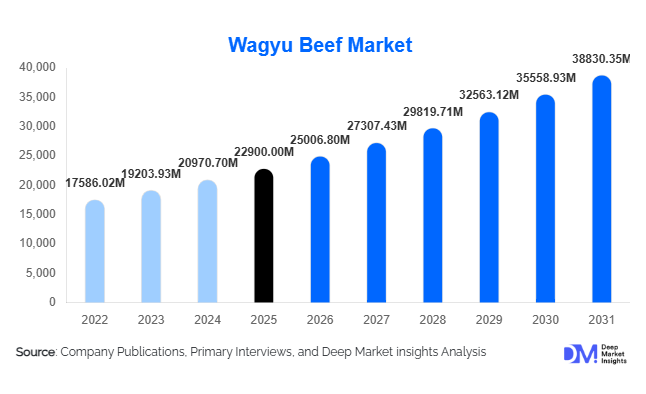
According to Deep Market Insights, the global Wagyu beef market size was valued at USD 22,900 million in 2025 and is projected to grow from USD 25,006.80 million in 2026 to reach USD 38,830.35 million by 2031, expanding at a CAGR of 9.2% during the forecast period (2026–2031). The Wagyu beef market growth is primarily driven by increasing global demand for premium meat products, expansion of fine dining culture, and rising consumer preference for high-quality, traceable protein sources. Growing international trade, improved cold-chain logistics, and the proliferation of gourmet retail channels are further strengthening global market penetration.
Key Market Insights
- Premiumization of meat consumption is accelerating globally, with consumers willing to pay higher prices for superior quality and provenance-certified beef.
- Foodservice dominates Wagyu consumption, particularly in luxury restaurants and steakhouses offering high-end culinary experiences.
- Asia-Pacific leads the global market, driven by strong production in Japan and Australia and rising consumption in China and South Korea.
- Crossbred Wagyu is expanding rapidly, enabling scalability and broader affordability compared to fullblood Wagyu.
- Online meat retail platforms are emerging as key distribution channels, improving accessibility for household consumers.
- Technological advancements in livestock breeding and traceability are enhancing quality consistency and consumer trust.
What are the latest trends in the Wagyu beef market?
Rising Demand for Traceability and Authenticity
Consumers are increasingly demanding transparency in meat sourcing, particularly in the premium segment. This has led to widespread adoption of traceability systems such as QR-based tracking, blockchain verification, and origin certification programs. Authentic Japanese Wagyu, in particular, is gaining traction among high-end consumers who value verified provenance. Producers are leveraging these technologies to differentiate their offerings, reduce counterfeiting risks, and build long-term brand trust. This trend is especially prominent in export-driven markets where product authenticity plays a critical role in pricing and purchasing decisions.
Expansion of Wagyu in Retail and E-Commerce
Traditionally limited to fine dining, Wagyu beef is increasingly entering retail and online channels. Premium supermarkets, gourmet stores, and direct-to-consumer platforms are offering a wide range of Wagyu cuts and value-added products. The growth of e-commerce meat platforms has enabled consumers to access high-quality Wagyu at home, supported by improved cold-chain logistics and packaging innovations. Subscription-based meat delivery services and curated gourmet boxes are also gaining popularity, expanding the consumer base beyond restaurants and driving household adoption.
What are the key drivers in the Wagyu beef market?
Growth of Premium Dining and Culinary Experiences
The expansion of global fine dining culture is a major driver for Wagyu beef demand. High-end restaurants and luxury hotels are increasingly incorporating Wagyu into their menus to cater to affluent consumers seeking unique gastronomic experiences. Culinary tourism and the globalization of Japanese cuisine have further strengthened demand, positioning Wagyu as a symbol of luxury and quality. This trend is particularly strong in urban centers across North America, Europe, and Asia-Pacific.
Rising Disposable Income and Changing Consumer Preferences
Increasing disposable incomes, particularly in emerging economies, are enabling consumers to spend more on premium food products. There is a growing shift toward quality over quantity in meat consumption, with consumers prioritizing taste, nutrition, and ethical sourcing. Wagyu beef, with its superior marbling and flavor profile, aligns well with these preferences, driving consistent growth across multiple regions.
What are the restraints for the global market?
High Production Costs and Premium Pricing
Wagyu beef production involves specialized breeding, feeding, and animal care practices, resulting in significantly higher costs compared to conventional beef. This translates into premium pricing, limiting accessibility to affluent consumers and restricting mass-market adoption. Price sensitivity in emerging markets further constrains volume growth.
Supply Constraints and Authenticity Challenges
Limited availability of genuine Wagyu cattle, particularly for high-grade Japanese Wagyu, creates supply bottlenecks. Additionally, the presence of mislabeled or counterfeit Wagyu products in international markets can undermine consumer confidence and impact brand integrity. Ensuring consistent quality and authenticity remains a key challenge for market participants.
What are the key opportunities in the Wagyu beef industry?
Expansion in Emerging Markets
Emerging economies such as China, India, and the Middle East present significant growth opportunities due to rising affluence and increasing exposure to global cuisines. The expansion of luxury hospitality and fine dining establishments in these regions is driving demand for premium meat products, including Wagyu. Market participants can capitalize on this trend by strengthening distribution networks and tailoring offerings to regional preferences.
Value-Added and Processed Wagyu Products
The development of value-added Wagyu products such as burgers, sausages, and ready-to-cook meals is opening new revenue streams. These offerings enable producers to reach a broader consumer base while maintaining premium positioning. Innovation in packaging and product formats is further enhancing convenience and appeal, particularly among younger consumers and urban households.
Report Scope
| Report Metric | Details |
|---|---|
| Market Size in 2025 | USD 22900.00 Million |
| Market Size in 2026 | USD 25006.80 Million |
| Market Size in 2031 | USD 38830.35 Million |
| CAGR | 9.2% (2026-2031) |
| Base Year for Estimation | 2025 |
| Historical Data | 2022-2024 |
| Forecast Period | 2026-2031 |
| Report Coverage | Revenue Forecast, Competitive Landscape, Supply Chain Disruption, Growth Factors, Environment & Regulatory Landscape and Trends |
| Geographies Covered | North America, Europe, APAC, Middle East and Africa, LATAM |
| Countries Covered | U.S., Canada, U.K., Germany, France, Spain, Italy, Russia, Nordic, Benelux, Rest of Europe, China, Korea, Japan, India, Australia, Singapore, Taiwan, South East Asia, Rest of Asia-Pacific, UAE, Turky, Saudi Arabia, South Africa, Egypt, Nigeria, Rest of MEA, Brazil, Mexico, Argentina, Chile, Colombia, Rest of LATAM |
Explore more data points, trends and opportunities Download Free Sample Report
Product Type Insights
The global Wagyu beef market is characterized by a diverse product mix, with crossbred Wagyu emerging as the dominant segment, accounting for approximately 52% of total market share in 2025. This dominance is primarily attributed to its scalability, cost efficiency, and broader accessibility compared to fullblood Wagyu. Crossbreeding programs, particularly in countries such as Australia and the United States, have enabled producers to replicate key attributes of Wagyu, including marbling and tenderness, while maintaining manageable production costs. This has made crossbred Wagyu highly attractive to mid-tier restaurants, retail consumers, and foodservice operators seeking to balance quality and affordability. The increasing global demand for premium meat products, combined with supply constraints associated with purebred Wagyu cattle, has further accelerated the adoption of crossbred variants. Additionally, improvements in breeding techniques, feed optimization, and traceability systems have enhanced the consistency and quality of crossbred Wagyu, strengthening its position as the leading segment.Purebred Wagyu occupies a niche yet increasingly important segment, offering a balance between quality and affordability. This category typically involves cattle with a high percentage of Wagyu genetics, delivering superior marbling compared to conventional beef while remaining more accessible than fullblood Wagyu. The segment is gaining traction in developed markets such as North America and Europe, where consumers are becoming more discerning and willing to explore premium meat options. The growing emphasis on quality differentiation, coupled with rising consumer awareness of Wagyu grading systems, has contributed to the steady expansion of the purebred segment. Furthermore, advancements in genetic selection and breeding programs are expected to enhance the quality and yield of purebred Wagyu, supporting its long-term growth potential.Overall, the product type landscape reflects a clear stratification of the Wagyu market, with crossbred Wagyu driving volume growth, fullblood Wagyu maintaining premium exclusivity, and purebred Wagyu bridging the gap between quality and accessibility. This segmentation enables producers and distributors to cater to a wide range of consumer preferences and price points, thereby supporting the sustained expansion of the global Wagyu beef market.
Application Insights
In terms of application, ribeye cuts dominate the Wagyu beef market, accounting for approximately 28% of total share, primarily driven by their exceptional marbling, juiciness, and flavor. Ribeye is widely regarded as the most desirable cut for showcasing the unique characteristics of Wagyu beef, making it a staple in high-end steakhouses and fine dining establishments. The growing popularity of experiential dining and premium steak offerings has significantly boosted demand for ribeye cuts. Additionally, the visual appeal of marbling in ribeye cuts enhances their desirability among consumers, particularly in markets where presentation and quality perception play a crucial role in purchasing decisions.Tenderloin and striploin cuts also represent significant segments within the market, catering to consumers seeking leaner yet tender options. These cuts are particularly favored in upscale dining environments and gourmet home cooking, where consistency, texture, and presentation are critical. The increasing adoption of Western dining habits in emerging markets has further contributed to the demand for these premium cuts. Moreover, the expansion of culinary education and the influence of celebrity chefs have played a role in promoting the use of high-quality Wagyu cuts across diverse cuisines.Specialty cuts and processed Wagyu products represent emerging segments within the market, driven by innovation and changing consumer preferences. Products such as Wagyu burgers, sausages, and ready-to-cook meals are gaining traction, particularly among younger consumers and urban households seeking convenience without compromising on quality. The integration of Wagyu beef into packaged and value-added products is expected to open new avenues for market growth, enabling producers to diversify their offerings and reach a broader consumer base. Overall, the application landscape highlights the versatility of Wagyu beef and its ability to adapt to evolving culinary trends and consumer demands.
Distribution Channel Insights
The distribution landscape of the Wagyu beef market is predominantly led by foodservice distributors, which account for approximately 46% of total sales. This dominance is largely due to the strong association of Wagyu beef with fine dining, luxury hospitality, and premium culinary experiences. Restaurants, hotels, and steakhouses serve as the primary consumption points for Wagyu, leveraging its premium positioning to attract high-value customers. The expansion of global tourism, coupled with the proliferation of high-end dining establishments, has further strengthened the role of foodservice channels in driving Wagyu consumption. Additionally, partnerships between producers and foodservice operators have facilitated the consistent supply of high-quality Wagyu products, ensuring reliability and traceability.Online meat retailers represent the fastest-growing distribution segment, driven by the rising preference for convenience and direct-to-home delivery. E-commerce platforms have enabled consumers to access a wide range of Wagyu products, including imported and specialty cuts, which may not be readily available in physical stores. The growth of digital platforms, coupled with advancements in logistics and temperature-controlled delivery systems, has significantly improved the accessibility of Wagyu beef. Furthermore, the COVID-19 pandemic accelerated the adoption of online shopping for food products, a trend that continues to influence consumer behavior.Direct farm-to-consumer sales are also gaining traction, supported by the increasing emphasis on transparency, traceability, and sustainability. Producers are leveraging digital platforms and social media to build direct relationships with consumers, offering premium products along with detailed information about sourcing and production practices. This approach not only enhances consumer trust but also allows producers to capture higher margins by eliminating intermediaries. Overall, the distribution channel landscape reflects a dynamic shift towards greater accessibility and diversification, enabling the Wagyu beef market to reach a wider audience while maintaining its premium appeal.
End-Use Insights
The foodservice industry remains the dominant end-use segment, accounting for over 65% of total Wagyu beef demand. This dominance is driven by the strong association of Wagyu with luxury dining and premium culinary experiences. High-end restaurants, luxury hotels, and specialized steakhouses serve as key consumption hubs, leveraging Wagyu’s unique attributes to differentiate their offerings and attract affluent customers. The growth of the global hospitality industry, particularly in emerging markets, has further fueled demand for premium meat products, including Wagyu beef. Additionally, the increasing popularity of chef-driven dining concepts and tasting menus has contributed to the sustained demand for high-quality ingredients.Household consumption is an emerging segment, supported by the growing interest in gourmet cooking and the increasing availability of Wagyu products through retail and online channels. Consumers are becoming more adventurous in their culinary choices, seeking to replicate restaurant-quality experiences at home. The rise of cooking shows, food blogs, and social media influencers has played a significant role in promoting the use of premium ingredients, including Wagyu beef, in home kitchens. Furthermore, improvements in packaging and portioning have made Wagyu more accessible to individual consumers, encouraging trial and adoption.
Explore more data points, trends and opportunities Download Free Sample Report
Wagyu Beef Market Segmentations
By Product Type
- Fullblood Wagyu Beef
- Purebred Wagyu Beef
- Crossbred Wagyu Beef
By Cut Type
- Ribeye
- Striploin
- Tenderloin
- Brisket
- Chuck
- Flank & Skirt
- Other Specialty Cuts
By Grading Level
- A5 Grade
- A4 Grade
- A3 and Below
By Distribution Channel
- Direct Sales
- Foodservice Distributors
- Supermarkets & Hypermarkets
- Specialty Gourmet Stores
- Online Meat Retailers
By End Use
- Fine Dining Restaurants
- Luxury Hotels
- Premium Steakhouse Chains
- Household Consumption
Regional Insights
Asia-Pacific
Asia-Pacific dominates the global Wagyu beef market, accounting for approximately 38% of total share in 2025. The region’s leadership is underpinned by a combination of strong production capabilities, cultural affinity for high-quality beef, and rising consumer affluence. Japan remains the cornerstone of the Wagyu industry, known for its stringent quality standards and heritage breeding practices. The country’s emphasis on authenticity and traceability has established Wagyu as a globally recognized premium product. Australia, on the other hand, has emerged as the largest exporter of Wagyu beef, leveraging its vast agricultural resources, advanced breeding programs, and favorable trade agreements to supply international markets.Key drivers for regional growth include rising disposable incomes, increasing consumer awareness of premium meat products, and the expansion of modern retail and foodservice sectors. Government support for agricultural innovation, along with investments in breeding and production technologies, further strengthens the region’s position in the global market. The integration of Wagyu into local cuisines and the growing influence of food tourism are also contributing to sustained demand across Asia-Pacific.
North America
North America accounts for approximately 27% of the global Wagyu beef market, with the United States serving as the primary contributor. The region benefits from a well-established premium meat market, characterized by high consumer purchasing power and a strong culture of steak consumption. The presence of renowned steakhouses and fine dining establishments has created a robust demand for high-quality beef, including Wagyu. Additionally, the expansion of American Wagyu production, driven by crossbreeding programs, has enhanced domestic supply and reduced reliance on imports.Key growth drivers in North America include increasing consumer awareness of Wagyu’s quality attributes, the expansion of premium dining experiences, and the growing influence of food media and culinary trends. The region’s strong emphasis on innovation and sustainability in agriculture also supports the development of high-quality Wagyu production systems, contributing to long-term market growth.
Europe
Europe holds approximately 20% of the global Wagyu beef market, with key markets including the United Kingdom, Germany, and France. The region’s rich culinary heritage and strong emphasis on quality and authenticity have created a favorable environment for premium meat products. Consumers in Europe are increasingly prioritizing ethically sourced and sustainably produced food, which aligns well with the traceability and quality standards associated with Wagyu beef.The expansion of fine dining establishments and gourmet retail outlets has significantly contributed to the growth of the Wagyu market in Europe. Additionally, the rising popularity of international cuisines and the influence of global culinary trends have increased the acceptance of Wagyu beef among European consumers. The development of local Wagyu production, particularly in countries such as the UK and Spain, has further supported market growth by reducing import dependency and enhancing product availability.Key drivers for regional growth include increasing consumer demand for premium and ethically sourced meat, the expansion of high-end foodservice sectors, and the growing influence of culinary tourism. Regulatory support for food quality and safety, along with investments in sustainable agriculture, also play a crucial role in shaping the market landscape in Europe.
Middle East & Africa
The Middle East & Africa region represents the fastest-growing market for Wagyu beef, with a CAGR exceeding 10%. This growth is primarily driven by high disposable incomes, a strong culture of luxury consumption, and the rapid expansion of the hospitality and tourism sectors. Countries such as the United Arab Emirates and Saudi Arabia have emerged as key markets, supported by the proliferation of luxury hotels, fine dining restaurants, and international food chains.The region’s growing expatriate population and increasing exposure to global culinary trends have further boosted demand for premium meat products. Additionally, government initiatives aimed at diversifying economies and promoting tourism have led to significant investments in hospitality infrastructure, creating new opportunities for Wagyu consumption. The development of modern retail channels and improvements in logistics have also enhanced the availability of imported Wagyu products.Key growth drivers include rising consumer spending on luxury goods, the expansion of premium dining experiences, and the increasing influence of global food culture. The region’s strategic position as a hub for international trade also facilitates the import and distribution of high-quality Wagyu beef, supporting market expansion.
Latin America
Latin America represents a smaller but steadily growing market for Wagyu beef, with countries such as Brazil and Chile leading the way. The region’s strong agricultural base and expertise in cattle farming provide a solid foundation for the development of Wagyu production. Increasing investments in breeding programs and the adoption of advanced farming practices are contributing to the growth of local Wagyu industries.Rising disposable incomes and the growing popularity of premium meat products are driving demand within the region. Additionally, the expansion of export opportunities, particularly to North America and Asia-Pacific, is supporting market growth. The influence of global culinary trends and the increasing presence of high-end restaurants are also contributing to the adoption of Wagyu beef in Latin America.Key drivers for regional growth include the development of local production capabilities, increasing consumer awareness of premium meat products, and the expansion of international trade. Government support for agricultural development and the growing integration of Wagyu into regional cuisines further enhance the market’s growth potential.
Key Players in the Wagyu Beef Market
- Snake River Farms
- Australian Agricultural Company
- Itoham Yonekyu Holdings
- Starzen Co., Ltd.
- NH Foods Ltd.
- Blackmore Wagyu
- Mayura Station
- Imperial Wagyu Beef
- Lone Mountain Wagyu
- Agri Beef Co.
- Rangers Valley
- Jack’s Creek
- Morgan Ranch
- Westholme Wagyu
- Stockyard Beef