Vitamin B3 (Niacin) Market Size
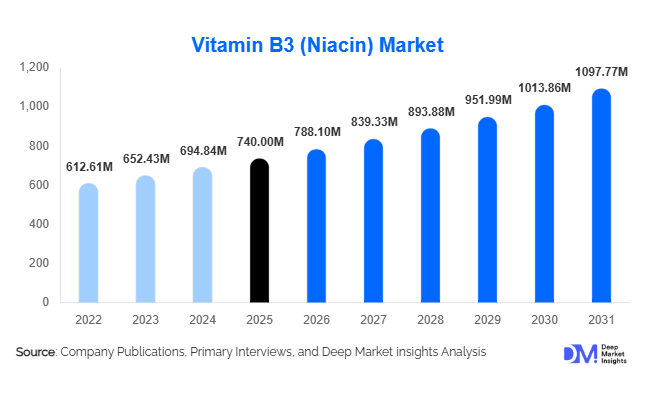
According to Deep Market Insights,the global Vitamin B3 (Niacin) market size was valued at USD 740 million in 2026 and is projected to grow from USD 788.10 million in 2026 to reach USD 1,079.77 million by 2031, expanding at a CAGR of 6.5% during the forecast period (2026–2031). The market growth is primarily driven by rising health consciousness among consumers, increasing adoption of dietary supplements, expanding animal nutrition applications, and growing demand for niacinamide in personal care and cosmetic formulations.
Key Market Insights
- Synthetic Vitamin B3 dominates global supply due to cost efficiency, consistent purity, and scalable production, serving feed, pharmaceutical, and nutritional applications.
- Niacinamide leads the product type segment, favored in human nutrition and skincare for its reduced side effects and multifunctional benefits.
- Dietary supplements and personal care segments are driving value growth, supported by preventive health trends and functional ingredient adoption.
- Animal feed applications maintain high-volume demand with Asia Pacific emerging as a major growth hub due to rising livestock production.
- Technological integration in delivery systems, including sustained-release formulations and liquid/encapsulated formats, is enhancing bioavailability and consumer acceptance.
- Asia Pacific leads in volume consumption, while North America exhibits strong value-driven growth in premium nutraceutical and personal care applications.
What are the latest trends in the Vitamin B3 market?
Cosmetic & Personal Care Integration
Niacinamide is increasingly incorporated into skincare formulations for its proven benefits in improving skin barrier function, reducing inflammation, and promoting anti-aging effects. Premium skincare brands are leveraging niacinamide in serums, creams, and masks, targeting growing consumer awareness of functional ingredients. Clean-label and ethically sourced formulations are gaining traction, driving demand for high-purity nutrition-grade niacinamide.
Fortification in Functional Foods & Beverages
Vitamin B3 is widely used for micronutrient fortification in cereals, dairy products, and functional drinks. Rising preventive healthcare trends, coupled with regulatory support in several regions, are fueling adoption. Manufacturers are focusing on enriched functional foods aimed at energy metabolism, cardiovascular health, and cognitive wellness, expanding the market beyond traditional supplement applications.
What are the key drivers in the Vitamin B3 market?
Increasing Health & Wellness Awareness
Consumers are increasingly incorporating micronutrients like Vitamin B3 into daily diets to prevent lifestyle-related diseases. This trend drives demand for supplements, fortified foods, and functional beverages. Awareness campaigns highlighting benefits for metabolism, skin, and cardiovascular health further encourage adoption across demographic groups, especially among aging populations.
Rising Dietary Supplement & Functional Food Consumption
The global supplement and functional food sectors are expanding, with e-commerce and direct-to-consumer distribution enabling wider access. Vitamin B3, included in multivitamins, B-complex, and standalone formulations, benefits from this growing health-conscious consumer base. Functional beverages and fortified snacks are increasingly positioned to meet daily micronutrient requirements, supporting market growth.
Expansion of Animal Nutrition Demand
Feed applications are key drivers as Vitamin B3 enhances livestock growth, immunity, and feed efficiency. The Asia Pacific region, particularly China and India, shows high feed-grade consumption due to rising meat and dairy demand. Investments in industrial livestock infrastructure further reinforce this trend, making animal feed a stable contributor to market growth.
What are the restraints for the global market?
Raw Material Price Volatility
Fluctuating prices of precursor chemicals and energy costs affect production costs for synthetic Vitamin B3. This volatility can compress margins and occasionally create supply shortages, especially for smaller producers with limited operational flexibility.
Regulatory Variability & Bioavailability Concerns
Diverse regulatory frameworks for allowable dosage, labeling, and clinical substantiation pose challenges for global distribution. High-dose niacin products can cause side effects like flushing, limiting consumer acceptance without advanced formulation technologies such as sustained-release or encapsulated delivery systems.
What are the key opportunities in the Vitamin B3 market?
Innovation in Delivery Technologies
Advanced formulations, including nano-encapsulation, liquid solutions, and sustained-release formats, improve bioavailability and reduce side effects. This enables broader adoption in therapeutic, cosmetic, and nutraceutical applications, opening new market segments for both established players and new entrants.
Expansion in Emerging Regions
Asia Pacific and Latin America offer significant growth potential. Rising urbanization, increasing disposable income, and growing awareness of health and nutrition drive higher consumption of supplements, functional foods, and fortified animal feed. Investments in livestock production and nutrition programs further enhance demand.
Growth in Cosmetic & Personal Care Segments
Niacinamide’s multifunctional benefits in skincare provide opportunities for expansion in premium and mid-range cosmetic segments. Partnerships with cosmetic brands and entry into emerging markets can enhance revenue streams and brand differentiation.
Report Scope
| Report Metric | Details |
|---|---|
| Market Size in 2025 | USD 740 Million |
| Market Size in 2026 | USD 788.10 Million |
| Market Size in 2031 | USD 1097.77 Million |
| CAGR | 6.5% (2026-2031) |
| Base Year for Estimation | 2025 |
| Historical Data | 2022-2024 |
| Forecast Period | 2026-2031 |
| Report Coverage | Revenue Forecast, Competitive Landscape, Supply Chain Disruption, Growth Factors, Environment & Regulatory Landscape and Trends |
| Geographies Covered | North America, Europe, APAC, Middle East and Africa, LATAM |
| Countries Covered | U.S., Canada, U.K., Germany, France, Spain, Italy, Russia, Nordic, Benelux, Rest of Europe, China, Korea, Japan, India, Australia, Singapore, Taiwan, South East Asia, Rest of Asia-Pacific, UAE, Turky, Saudi Arabia, South Africa, Egypt, Nigeria, Rest of MEA, Brazil, Mexico, Argentina, Chile, Colombia, Rest of LATAM |
Explore more data points, trends and opportunities Download Free Sample Report
Product Type Insights
Niacinamide continues to dominate the human nutrition and cosmetic applications segment, accounting for approximately 50% of the projected 2025 market value. Its widespread adoption is largely due to its reduced side effects compared to nicotinic acid, making it highly favorable for both dietary supplements and topical skincare formulations. Nicotinic acid retains its relevance in pharmaceutical applications, particularly in cholesterol management and cardiovascular therapies. Meanwhile, emerging derivatives such as nicotinamide riboside are gaining traction for specialized health applications, including energy metabolism support and anti-aging interventions, signaling potential growth in niche therapeutic segments.
Application Insights
Dietary supplements represent the leading application segment, capturing nearly 30% of market share, driven by preventive healthcare trends, the global rise of aging populations, and the rapid expansion of e-commerce channels that enhance accessibility. Animal feed continues to be the largest volume application, crucial for improving livestock growth performance and feed efficiency. The food and beverage fortification and personal care segments are witnessing accelerated growth, particularly in Asia Pacific and North America, propelled by increasing adoption of functional ingredients, rising consumer awareness of nutritional benefits, and the incorporation of niacinamide into high-value wellness and cosmetic products.
Distribution Channel Insights
Online platforms have emerged as the dominant distribution channel for dietary supplements and cosmetic products, offering consumers convenience, transparency, and access to premium formulations. Specialty distributors and B2B chemical suppliers remain critical for supplying the feed and pharmaceutical sectors, ensuring consistent quality and regulatory compliance. Additionally, direct manufacturer-to-consumer channels are gaining momentum, particularly for high-end skincare and nutraceutical products, allowing brands to strengthen customer engagement and enhance profitability through premium offerings.
End-Use Insights
Animal nutrition and dietary supplements remain the core end-use sectors, underpinned by steady demand for feed-grade and high-purity niacinamide products. The fastest-growing end-use segments include personal care and functional foods, driven by consumer preference for multifunctional ingredients that support wellness and beauty simultaneously. Export demand from Europe and North America for feed-grade niacinamide products reinforces global trade flows, while innovative applications in anti-aging cosmetics and wellness-oriented supplements present additional revenue opportunities, further diversifying end-use adoption.
Explore more data points, trends and opportunities Download Free Sample Report
Vitamin B3 (Niacin) Market Segmentations
By Product Type
- Niacinamide
- Nicotinic Acid
- Niacin Derivatives
- Feed-Grade Niacin
By Application
- Dietary Supplements
- Food & Beverage Fortification
- Animal Feed
- Cosmetic & Personal Care
- Pharmaceutical Formulations
By Distribution Channel
- Online Platforms & E-Commerce
- Specialty Distributors
- Direct-to-Consumer / Manufacturer Sales
- B2B Chemical Suppliers
- Retail Pharmacies & Health Stores
Regional Insights
North America
North America accounts for approximately 27% of the market share in 2025, with the United States and Canada as primary contributors. Strong consumer demand for dietary supplements, a well-established nutraceutical industry, and advanced personal care product formulations drive consistent market growth. The region also benefits from regulatory frameworks supporting high-quality nutrition-grade and cosmetic niacinamide products. Increasing awareness of preventive healthcare, coupled with rising disposable incomes, encourages adoption of premium and multifunctional formulations, sustaining growth across both dietary and topical applications.
Europe
Europe holds around 21% of the market share in 2025, with Germany, France, and the United Kingdom leading consumption. Regulatory emphasis on fortified foods, preventive healthcare measures, and functional cosmetic products provides a favorable environment for market expansion. The growing presence of younger, health-conscious, and eco-conscious consumers accelerates the adoption of clean-label Vitamin B3 products. Furthermore, innovations in functional foods and anti-aging personal care solutions drive regional demand, positioning Europe as a market for both high-quality nutraceuticals and premium cosmetic applications.
Asia-Pacific
Asia-Pacific is the largest regional market, accounting for roughly 41% of market share in 2025, led by China and India. Growth is fueled by expanding livestock industries, increasing adoption of dietary supplements, and surging demand for cosmetics. Countries such as Japan and South Korea are driving premium skincare and functional food consumption, supporting steady growth in high-value applications. Additional drivers include rising urbanization, expanding middle-class populations, growing health awareness, and the regional preference for multifunctional ingredients that support both beauty and wellness.
Latin America
Latin America is witnessing notable growth, driven by Brazil and Mexico. The region benefits from robust livestock production and an increasing awareness of human nutrition and preventive healthcare. Export opportunities for feed-grade niacinamide products enhance market potential, while premium dietary supplement adoption is gradually expanding, supported by growing e-commerce penetration and rising consumer interest in wellness and functional foods.
Middle East & Africa
Demand in the Middle East and Africa is steadily increasing, led by the Gulf Cooperation Council (GCC) countries and South Africa. Urbanization, rising health consciousness, and growing livestock feed requirements support market growth. High-income populations in the Middle East are increasingly adopting premium dietary supplements and cosmetic products, while in Africa, the market is primarily driven by feed-grade niacinamide demand. The combined effect of economic development, population growth, and awareness of functional nutrition underpins the region’s emerging market potential.
Key Players in the Vitamin B3 Market
- Lonza Group
- DSM-Firmenich
- BASF SE
- Jubilant Pharmova Ltd
- Vanetta Food Ingredients
- Brother Enterprises
- Vertellus Specialties
- Zhejiang Lanbo Biotechnology
- Tianjin Zhongrui Pharmaceutical
- Resonance Specialties
- Arxada
- Lasons India
- Fengchen Group
- NutraScience Labs
- Grahams Chemical