Vinegar Market Size
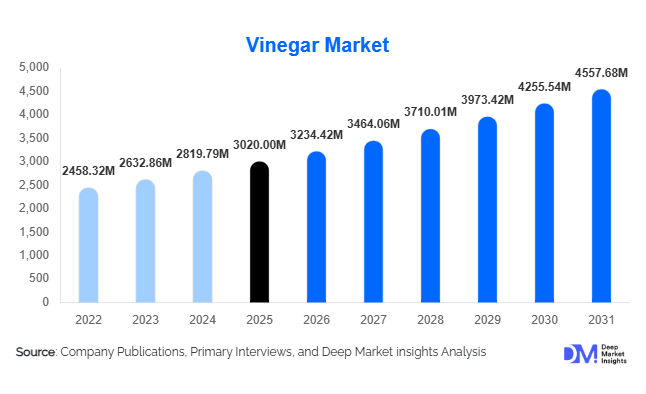
According to Deep Market Insights, the global vinegar market size was valued at USD 3,020 million in 2025 and is projected to grow from USD 3,234.42 million in 2026 to reach USD 4,557.68 million by 2031, expanding at a CAGR of 7.1% during the forecast period (2026–2031). The vinegar market growth is primarily driven by rising demand for natural food preservatives, increasing consumption of fermented and functional foods, and expanding applications across packaged food processing, wellness products, and eco-friendly cleaning solutions. Growing consumer preference for clean-label ingredients and natural acidity regulators continues to position vinegar as a versatile ingredient across both household and industrial applications.
Key Market Insights
- Natural and clean-label food preservation trends are accelerating vinegar adoption across processed food manufacturing globally.
- Apple cider vinegar demand is expanding rapidly due to increasing consumer focus on digestive health, metabolism management, and functional beverages.
- Asia-Pacific dominates global consumption, supported by strong culinary integration and expanding food processing industries.
- Premiumization trends in Europe and North America are driving demand for organic, artisanal, and balsamic vinegars.
- Foodservice expansion worldwide continues to boost bulk vinegar demand for sauces, dressings, and preservation applications.
- Technological improvements in fermentation processes are improving production efficiency and lowering manufacturing costs.
What are the latest trends in the vinegar market?
Functional and Wellness-Oriented Vinegar Products
The vinegar market is increasingly influenced by health-conscious consumers seeking functional foods and beverages. Apple cider vinegar drinks, detox tonics, and probiotic formulations are gaining widespread popularity across North America and Asia-Pacific. Manufacturers are launching ready-to-drink vinegar beverages combined with natural sweeteners, herbs, and botanical extracts to appeal to younger consumers. The shift toward preventive healthcare and digestive wellness has transformed vinegar from a traditional condiment into a lifestyle-oriented product category. Retail shelves now feature raw, unfiltered, and organic vinegar variants positioned as functional wellness products, creating higher-margin opportunities for producers.
Premiumization and Artisanal Fermentation
Premium vinegar varieties such as balsamic, wine, and aged specialty vinegars are witnessing strong growth, particularly in Europe and developed markets. Consumers increasingly value authenticity, geographical indication labeling, and traditional fermentation techniques. Artisanal production methods emphasizing aging processes and high-quality raw materials are enabling brands to command premium prices. Restaurants and gourmet food producers are contributing to this trend by incorporating specialty vinegars into premium culinary offerings, further expanding demand for differentiated products.
What are the key drivers in the vinegar market?
Growing Demand for Natural Food Preservation
Food manufacturers are shifting away from synthetic preservatives toward natural alternatives due to regulatory pressure and consumer preference for recognizable ingredients. Vinegar’s antimicrobial properties make it an effective natural preservative in pickles, sauces, ready meals, and processed meats. As global packaged food production expands, vinegar demand continues to rise as an essential functional ingredient.
Expansion of Packaged Food and Foodservice Industries
Rapid urbanization and changing consumption habits have increased reliance on convenience foods and restaurant dining. Vinegar plays a crucial role in condiments, marinades, and dressings used by quick-service restaurants and packaged food producers. The growth of global foodservice chains and ready-to-eat meal markets directly supports long-term vinegar consumption growth.
What are the restraints for the global market?
Raw Material Price Volatility
Vinegar production relies heavily on agricultural commodities such as apples, grapes, grains, and sugarcane. Climate variability, crop yield fluctuations, and supply disruptions can significantly impact production costs, creating margin pressure for manufacturers and price volatility across markets.
Commodity Perception and Pricing Pressure
In several developing regions, vinegar is still perceived as a low-cost commodity product, limiting premium pricing potential. Manufacturers must invest in branding, innovation, and product differentiation to avoid margin compression and maintain profitability.
What are the key opportunities in the vinegar industry?
Functional Beverage Integration
The integration of vinegar into functional beverages presents a major growth opportunity. Ready-to-drink formulations combining vinegar with fruit juices, probiotics, and botanical extracts are expanding shelf presence in health-focused retail channels. Companies entering this segment benefit from higher consumer engagement and premium pricing potential compared to traditional condiment categories.
Clean-Label Food Manufacturing Partnerships
Food manufacturers increasingly require natural acidity regulators to meet clean-label standards. Vinegar suppliers offering customized formulations for sauces, dressings, and preserved foods can secure long-term B2B contracts. This trend strengthens demand stability and encourages innovation in fermentation technology and ingredient customization.
Report Scope
| Report Metric | Details |
|---|---|
| Market Size in 2025 | USD 3020 Million |
| Market Size in 2026 | USD 3234.42 Million |
| Market Size in 2031 | USD 4557.68 Million |
| CAGR | 7.1% (2026-2031) |
| Base Year for Estimation | 2025 |
| Historical Data | 2022-2024 |
| Forecast Period | 2026-2031 |
| Report Coverage | Revenue Forecast, Competitive Landscape, Supply Chain Disruption, Growth Factors, Environment & Regulatory Landscape and Trends |
| Geographies Covered | North America, Europe, APAC, Middle East and Africa, LATAM |
| Countries Covered | U.S., Canada, U.K., Germany, France, Spain, Italy, Russia, Nordic, Benelux, Rest of Europe, China, Korea, Japan, India, Australia, Singapore, Taiwan, South East Asia, Rest of Asia-Pacific, UAE, Turky, Saudi Arabia, South Africa, Egypt, Nigeria, Rest of MEA, Brazil, Mexico, Argentina, Chile, Colombia, Rest of LATAM |
Explore more data points, trends and opportunities Download Free Sample Report
Product Type Insights
The global vinegar market demonstrates strong diversification across product types, with white or distilled vinegar continuing to dominate overall consumption patterns. This segment accounts for nearly 34% of global demand, primarily due to its cost efficiency, long shelf life, and wide applicability across both food processing and non-food applications. Its versatility as a preservative, acidity regulator, disinfectant, and cleaning agent makes it highly attractive for large-scale industrial usage as well as household consumption. The leading position of distilled vinegar is further supported by rising demand for natural and chemical-free cleaning solutions, particularly as consumers increasingly shift toward environmentally sustainable products.Apple cider vinegar represents the fastest-growing product category globally, driven by expanding consumer awareness regarding digestive health, weight management, and immunity support. The increasing popularity of functional foods and beverages has significantly strengthened demand, as manufacturers incorporate apple cider vinegar into wellness drinks, dietary supplements, and nutraceutical formulations. Social media influence and growing adoption of preventive healthcare practices are accelerating penetration across both developed and emerging economies, positioning apple cider vinegar as a major future growth driver.Balsamic vinegar maintains a strong presence within the premium and specialty segment, supported by longstanding European culinary traditions and rising global appreciation for gourmet cooking. Export demand from Italy and other European producers continues to expand as consumers seek authentic, high-quality ingredients. Premiumization trends in retail and foodservice sectors are encouraging higher-value product adoption, contributing to increased revenue share despite comparatively lower volume consumption.Rice vinegar and wine vinegar remain essential components of Asian culinary systems, sustaining stable demand across countries such as China, Japan, and South Korea. Growth within these categories is supported by expanding international popularity of Asian cuisines and increasing restaurant penetration worldwide. Meanwhile, flavored and specialty vinegars are gaining momentum as experimentation in home cooking and premium dining experiences expands. Infusions incorporating herbs, fruits, and spices are attracting health-conscious and gourmet consumers, driving innovation and product differentiation across global markets.
Application Insights
Food and beverage processing continues to represent the largest application segment, accounting for approximately 46% of global vinegar demand. The segment’s leadership is driven by vinegar’s multifunctional role as a natural preservative, flavor enhancer, antimicrobial agent, and acidity regulator across sauces, dressings, condiments, bakery products, and processed meals. Increasing consumer preference for clean-label ingredients has reinforced vinegar’s importance as a natural alternative to synthetic preservatives, strengthening its adoption among packaged food manufacturers.Household cooking applications provide a stable and consistent consumption base across regions, supported by vinegar’s integration into daily culinary practices. Growth in home cooking trends, particularly following increased health awareness and rising food costs, continues to sustain retail demand. Traditional pickling and preservation applications remain highly relevant in markets where seasonal food storage practices persist, ensuring steady long-term usage.Emerging applications are expanding the market scope beyond conventional food uses. Nutraceutical and functional beverage segments are incorporating vinegar for digestive and metabolic health benefits, while cosmetic and personal care industries utilize vinegar-based formulations for scalp care, skincare balancing, and natural beauty solutions. Additionally, natural cleaning products leveraging vinegar’s antimicrobial properties are gaining popularity as sustainability concerns encourage reduced reliance on harsh chemicals, further broadening application diversity.
Distribution Channel Insights
Supermarkets and hypermarkets remain the dominant distribution channels, accounting for nearly 39% of global vinegar sales. Their leadership is supported by extensive product availability, competitive pricing structures, and the strong presence of private-label offerings that appeal to price-sensitive consumers. Organized retail expansion in emerging economies continues to strengthen accessibility and brand visibility, reinforcing channel dominance.Online retail channels are experiencing rapid expansion, driven by increasing digital adoption and consumer preference for convenience-based purchasing. E-commerce platforms enable niche and premium brands, particularly organic, raw, and specialty vinegars, to directly reach targeted consumer segments. Subscription-based wellness products and direct-to-consumer marketing strategies are further accelerating online sales growth.Foodservice distributors play a critical role in ensuring consistent bulk supply to restaurants, hotels, and catering operators. Growth in quick-service restaurants and global cuisine chains is increasing demand for standardized vinegar products. Simultaneously, direct industrial supply agreements between vinegar producers and packaged food manufacturers ensure long-term procurement stability, supporting predictable demand volumes within the industrial segment.
End-Use Industry Insights
The foodservice industry represents a major end-use segment, contributing approximately 33% of global vinegar consumption. The segment’s leadership is driven by vinegar’s extensive usage in marinades, dressings, sauces, pickled ingredients, and flavor enhancement applications across restaurants and hospitality establishments. Expansion of global dining culture, increasing tourism activity, and rapid growth of quick-service restaurant chains continue to support demand growth.Packaged food manufacturers represent the fastest-growing end-use segment, fueled by rising global consumption of ready-to-eat and convenience foods. Vinegar’s functionality in extending shelf life while maintaining natural ingredient positioning aligns with evolving consumer expectations for minimally processed foods. Growth in meal kits, frozen foods, and processed condiments further strengthens industrial demand.The health and wellness industry is emerging as a significant growth avenue as vinegar-based beverages, tonics, and supplements gain traction among health-conscious consumers. Increasing focus on preventive nutrition and functional ingredients is encouraging product innovation across beverage and nutraceutical categories. In parallel, industrial and institutional cleaning applications are expanding steadily as organizations adopt environmentally friendly sanitation solutions, positioning vinegar as a sustainable alternative within commercial cleaning formulations.
Explore more data points, trends and opportunities Download Free Sample Report
Vinegar Market Segmentations
By Product Type
- White/Distilled Vinegar
- Apple Cider Vinegar
- Balsamic Vinegar
- Wine Vinegar
- Rice Vinegar
- Specialty & Flavored Vinegar
By Application
- Food & Beverage Processing
- Household Cooking & Consumption
- Pickling & Preservation
- Healthcare & Wellness Products
- Industrial & Cleaning Applications
By Distribution Channel
- Supermarkets & Hypermarkets
- Convenience Stores
- Online Retail & E-commerce
- Foodservice & B2B Industrial Supply
- Specialty & Gourmet Stores
Regional Insights
Asia-Pacific
Asia-Pacific leads the global vinegar market, accounting for approximately 41% of total market share in 2025, supported by deep-rooted culinary traditions and large-scale fermentation industries. China dominates both production and consumption due to centuries-old fermentation practices, strong domestic demand, and advanced manufacturing capacity. Japan contributes significantly through premium rice vinegar production, driven by high-quality culinary standards and export-oriented specialty products. India represents one of the fastest-growing markets within the region, supported by rapid urbanization, expanding middle-class populations, and increasing adoption of packaged and processed foods.Regional growth is further driven by rising disposable incomes, expansion of organized retail networks, and growing popularity of international cuisines across metropolitan areas. Increasing health awareness is also boosting demand for apple cider vinegar and functional beverage products. Additionally, strong agricultural raw material availability and lower production costs continue to position Asia-Pacific as a global manufacturing hub for vinegar exports.
North America
North America accounts for nearly 23% of global vinegar demand, led primarily by the United States. Regional growth is strongly supported by high consumer awareness regarding functional health products, particularly apple cider vinegar, which has gained widespread popularity within wellness and dietary supplement markets. The presence of advanced food processing industries and high consumption of packaged foods further strengthens vinegar utilization across industrial applications.Well-developed retail infrastructure, widespread e-commerce penetration, and increasing demand for organic and non-GMO food ingredients are accelerating premium product adoption. Sustainability trends and consumer preference for natural cleaning products are also contributing to expanding non-food applications, reinforcing steady regional growth prospects.
Europe
Europe holds approximately 22% market share, with Italy, Germany, and France serving as key consumption and production centers. Italy remains the global leader in balsamic vinegar exports, benefiting from protected geographical indications and strong international brand recognition. The region’s mature culinary culture sustains consistent demand across both household and foodservice sectors.Regional growth is increasingly driven by premiumization trends, rising consumer preference for organic and artisanal food products, and growing interest in traditional fermentation techniques. Expansion of gourmet dining experiences and specialty retail channels further supports higher-value vinegar categories. Environmental sustainability initiatives and clean-label regulations across the European Union are encouraging manufacturers to utilize natural preservatives such as vinegar, strengthening long-term demand.
Latin America
Latin America is experiencing steady vinegar market expansion, particularly in Brazil and Mexico, where rising urban populations and evolving dietary habits are increasing consumption of processed and convenience foods. Integration of vinegar into regional cuisines, combined with growing retail modernization, is improving product accessibility across both urban and semi-urban areas.Regional growth drivers include expanding food manufacturing industries, increasing foreign investment in packaged food production, and improving cold chain and logistics infrastructure. The growing influence of international cuisine trends and rising middle-class purchasing power are also encouraging adoption of premium and flavored vinegar varieties.
Middle East & Africa
The Middle East and Africa region represents an emerging growth market characterized by gradually increasing vinegar consumption levels. Expansion of hospitality and tourism sectors, particularly in the UAE and Saudi Arabia, is driving foodservice demand for dressings, marinades, and condiments. Rapid urbanization and shifting dietary preferences toward packaged foods are contributing to steady market development.Additional regional growth drivers include increasing supermarket penetration, rising expatriate populations introducing diverse culinary preferences, and growing awareness of natural food ingredients. The adoption of vinegar-based cleaning solutions and preservation applications is also expanding as sustainability awareness improves, supporting long-term market growth across the region.
Key Players in the Vinegar Market
- Mizkan Holdings Co., Ltd.
- Acetum S.p.A.
- Borges International Group
- Kühne Holding AG
- Marukan Vinegar Co., Ltd.
- De Nigris Group
- Ponti S.p.A.
- Fleischmann’s Vinegar Company
- Australian Vinegar
- Shanxi Mature Vinegar Group
- Hengshun Vinegar Industry Co., Ltd.
- Aspall Cyder Ltd.
- Carl Kühne KG
- Nakano Vinegar Co., Ltd.
- Burg Groep B.V.