Vermicompost, Vermicast and Worm Tea Market Size
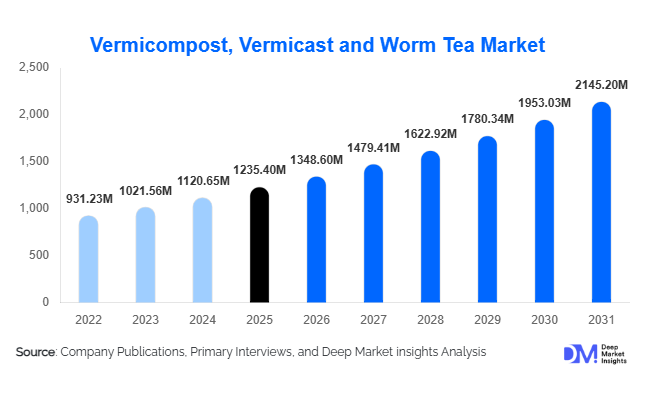
According to Deep Market Insights, the global vermicompost, vermicast and worm tea market size was valued at USD 1,235.4 million in 2025 and is projected to grow from USD 1,348.6 million in 2026 to reach USD 2,145.2 million by 2031, expanding at a CAGR of 9.7% during the forecast period (2026–2031). Market growth is primarily driven by accelerating adoption of regenerative agriculture practices, increasing global demand for organic food production, and rising restrictions on synthetic fertilizers across developed and emerging economies. Vermicompost-based soil amendments are increasingly recognized for improving soil microbiology, nutrient retention, and long-term crop productivity, positioning them as sustainable alternatives to chemical fertilizers.
Key Market Insights
- Organic agriculture expansion is the primary growth catalyst, with farmers transitioning toward biologically active soil inputs to improve yield sustainability.
- Liquid biofertilizers such as worm tea are witnessing rapid adoption due to ease of application through drip irrigation and precision farming systems.
- Asia-Pacific dominates production and consumption, supported by government-backed sustainable farming initiatives in India and China.
- Europe remains the fastest-growing region owing to stringent fertilizer regulations and strong organic certification frameworks.
- Urban composting and circular economy models are driving demand among municipalities and controlled-environment agriculture operators.
- Technological innovation in automated vermiculture systems is improving scalability and commercial viability of large-scale production.
What are the latest trends in the vermicompost, vermicast and worm tea market?
Shift Toward Regenerative Agriculture Practices
Farmers globally are moving beyond conventional organic farming toward regenerative agriculture models that emphasize soil biodiversity restoration. Vermicompost and vermicast products are increasingly used to enhance microbial populations, improve soil carbon sequestration, and restore degraded farmland. Agricultural cooperatives and sustainability certification bodies are promoting biological inputs as core components of climate-resilient farming systems. This trend is especially visible in large-scale horticulture and specialty crop production where soil health directly influences crop quality and export competitiveness.
Liquid Biofertilizer Adoption and Precision Farming Integration
Worm tea products are gaining popularity due to compatibility with modern irrigation infrastructure such as fertigation and hydroponic nutrient delivery systems. Growers prefer liquid formulations because they allow rapid nutrient absorption and microbial inoculation without altering soil structure. Precision agriculture platforms increasingly incorporate biological input schedules alongside conventional nutrient programs, improving adoption among commercial growers. The integration of IoT-based soil monitoring and biological amendments is creating a hybrid fertilization ecosystem combining data-driven farming with natural inputs.
What are the key drivers in the vermicompost, vermicast and worm tea market?
Rising Organic Food Consumption
Global organic food sales continue to expand as consumers prioritize chemical-free produce and environmentally responsible agriculture. Retailers and food processors increasingly require certified organic inputs, encouraging farmers to replace synthetic fertilizers with vermicompost-based solutions. Export-oriented agricultural economies are particularly driving adoption as organic certification enhances market access and pricing premiums.
Government Policies Supporting Sustainable Agriculture
Multiple governments are incentivizing biofertilizer adoption through subsidies, training programs, and soil-health initiatives. Programs promoting composting infrastructure and waste recycling support vermiculture expansion while reducing landfill dependency. National missions encouraging natural farming practices are accelerating commercialization of vermicast products among small and medium-scale farmers.
Soil Degradation and Chemical Fertilizer Fatigue
Declining soil fertility caused by prolonged chemical fertilizer usage has increased demand for organic soil conditioners. Vermicompost improves soil aeration, microbial diversity, and nutrient retention, helping restore productivity without environmental damage. Long-term yield stability benefits are encouraging adoption across plantation crops, horticulture, and greenhouse farming.
What are the restraints for the global market?
Production Scalability Challenges
Large-scale vermiculture requires controlled environmental conditions and consistent organic feedstock supply. Variability in raw material availability and climate sensitivity can limit production volumes and increase operational complexity.
Lack of Standardized Quality Regulations
Quality inconsistencies across producers create challenges in commercial adoption. Absence of universal nutrient benchmarks and microbial certification standards affects buyer confidence, particularly among large agribusiness operators.
What are the key opportunities in the vermicompost, vermicast and worm tea industry?
Urban Waste-to-Fertilizer Circular Economy Models
Municipal organic waste recycling programs present a major opportunity for vermiculture companies. Cities are increasingly converting food waste into vermicompost, reducing landfill emissions while producing commercial-grade fertilizers. Partnerships between local governments and private operators are expected to expand production capacity significantly.
Controlled Environment Agriculture and Hydroponics
Greenhouses, vertical farms, and hydroponic operations represent high-growth applications for worm tea and refined vermicast extracts. These systems demand biologically active nutrient inputs that improve plant resilience without chemical residues, creating premium market segments.
Carbon Credit and Climate Agriculture Programs
Soil carbon enhancement linked to vermicompost usage is gaining attention within carbon credit markets. Agricultural companies adopting biological soil amendments may monetize sustainability outcomes, creating additional revenue streams for producers and farmers.
Report Scope
| Report Metric | Details |
|---|---|
| Market Size in 2025 | USD 1235.4 Million |
| Market Size in 2026 | USD 1348.6 Million |
| Market Size in 2031 | USD 2145.2 Million |
| CAGR | 9.7% (2026-2031) |
| Base Year for Estimation | 2025 |
| Historical Data | 2022-2024 |
| Forecast Period | 2026-2031 |
| Report Coverage | Revenue Forecast, Competitive Landscape, Supply Chain Disruption, Growth Factors, Environment & Regulatory Landscape and Trends |
| Geographies Covered | North America, Europe, APAC, Middle East and Africa, LATAM |
| Countries Covered | U.S., Canada, U.K., Germany, France, Spain, Italy, Russia, Nordic, Benelux, Rest of Europe, China, Korea, Japan, India, Australia, Singapore, Taiwan, South East Asia, Rest of Asia-Pacific, UAE, Turky, Saudi Arabia, South Africa, Egypt, Nigeria, Rest of MEA, Brazil, Mexico, Argentina, Chile, Colombia, Rest of LATAM |
Explore more data points, trends and opportunities Download Free Sample Report
Product Type Insights
The global vermicompost market is characterized by diverse product offerings that cater to the varying requirements of modern agriculture, horticulture, and urban farming. Vermicompost remains the leading product type, commanding approximately 52% of the total market share in 2025. Its dominance is attributed to its broad applicability in open-field farming and horticultural practices, where its nutrient-rich composition and superior soil conditioning properties make it an essential input. Vermicompost improves soil structure, enhances water retention, and introduces beneficial microorganisms that facilitate nutrient availability, thereby supporting sustainable crop production. The consistency and ease of use of vermicompost in bulk quantities have further cemented its position as the preferred choice among large-scale farmers.Vermicast, accounting for nearly 28% market share, has emerged as a preferred product in high-value crop cultivation, particularly for fruits, vegetables, and specialty crops. Its higher concentration of nutrients, coupled with an increased density of beneficial microbes, makes it especially suitable for greenhouse operations and controlled-environment agriculture, where precision and productivity are paramount. Vermicast is increasingly adopted in organic and regenerative farming systems that emphasize soil health and long-term fertility.The liquid-based category, worm tea, represents approximately 20% share and is the fastest-growing product segment in the market. The rapid uptake of worm tea is driven by its compatibility with modern irrigation technologies, including drip irrigation and fertigation systems, which allow for efficient nutrient delivery directly to plant roots. The convenience of liquid formulations, coupled with their high microbial activity and immediate bioavailability, has made worm tea particularly attractive for high-density horticultural crops and urban farming applications where space and efficiency are critical.
Application Insights
In terms of applications, agriculture continues to dominate the global vermiculture input market, contributing nearly 46% of demand in 2025. This is supported by extensive adoption across cereals, fruits, and vegetable cultivation. Farmers are increasingly moving away from synthetic fertilizers due to rising awareness of soil degradation, water pollution, and long-term sustainability concerns. Vermicompost and vermicast have become integral components of organic certification programs and residue-free farming practices. Additionally, their adoption is driven by the growing global demand for organically produced cereals, fruits, and vegetables, as consumers prioritize health-conscious food choices.Horticulture constitutes approximately 24% of total applications, driven by the intensive cultivation of high-value crops in greenhouses and nurseries. In these controlled environments, biologically enriched soils with vermicompost inputs help optimize nutrient availability and enhance plant growth, flowering, and fruiting. The demand for vermiculture products in horticulture is further stimulated by the increasing importance of export-oriented farming, where compliance with residue-free and organic standards is mandatory to access international markets.Landscaping and turf management collectively contribute around 15% of the market demand, spurred by municipal initiatives for green urban spaces, sustainable parks, and eco-friendly golf courses. Governments and institutions are actively promoting sustainable landscaping practices to reduce chemical fertilizer usage, prevent nutrient runoff, and enhance the aesthetic and ecological quality of public spaces.Home gardening and urban farming together represent the remaining 15% of demand, reflecting the growing consumer shift toward self-sufficiency, sustainable food production, and the adoption of organic practices at the household level. Urban populations are increasingly investing in small-scale vermiculture systems for home gardening, balcony farms, and rooftop gardens, which contribute to a steady expansion of the consumer-oriented market segment.
Distribution Channel Insights
Distribution channels play a crucial role in the reach and adoption of vermiculture products. Direct farm sales and agricultural cooperatives continue to dominate with nearly 48% market share, enabling bulk procurement and fostering relationships between producers and farming communities. These channels provide the advantage of trust, guidance, and reliable supply, particularly in regions where commercial agriculture forms the backbone of the economy.Retail garden centers account for approximately 27% of market distribution, driven by rising home gardening trends and the availability of organic soil amendments at consumer-facing outlets. These channels offer convenience, product variety, and the opportunity for educational engagement, encouraging the adoption of vermiculture inputs among hobbyists and small-scale urban farmers.Online platforms and direct-to-consumer sales, representing 25% of the market, are witnessing rapid growth due to increased e-commerce penetration, subscription-based soil amendment delivery models, and digital awareness campaigns. These channels offer the advantage of wider reach, doorstep delivery, and the ability to cater to niche consumer segments seeking specialized vermiculture products such as worm tea or high-nutrient vermicast. The online market is particularly strong among tech-savvy consumers and regions where physical retail infrastructure is limited.
End-Use Insights
The commercial agriculture sector remains the largest end-use segment globally, driven by the continuous expansion of organic farmland and adoption of regenerative farming practices. Greenhouse farming and controlled-environment agriculture are emerging as the fastest-growing end-use segments, expanding at over 12% CAGR. The adoption of vermiculture products in these segments supports higher yields, disease resistance, and soil sustainability, enabling producers to meet stringent quality standards for domestic and export markets.Export-oriented horticulture, particularly in countries such as India, Spain, and Mexico, has created significant demand for vermicompost and vermicast, as residue-free and organically certified inputs are essential to meet international trade regulations. Landscaping, municipal parks, and golf courses are increasingly integrating vermiculture products into soil management practices to comply with sustainability mandates, reduce chemical fertilizer dependence, and enhance soil fertility for aesthetically valuable plantings. This trend is amplified by growing public awareness of the environmental impact of conventional fertilizers.
Explore more data points, trends and opportunities Download Free Sample Report
Vermicompost, Vermicast and Worm Tea Market Segmentations
By Product Type
- Vermicompost
- Vermicast
- Worm Tea
By Application
- Agriculture
- Horticulture & Greenhouse Crops
- Landscaping & Turf Management
- Urban & Home Gardening
By Distribution Channel
- Direct Farm & Cooperative Sales
- Retail Garden Centers
- Online & D2C Platforms
Regional Insights
Asia-Pacific
Asia-Pacific leads the global vermiculture market, holding approximately 41% share in 2025. The region’s dominance is primarily fueled by India, which is both the largest producer and consumer of vermicompost and associated products. Strong government initiatives supporting organic agriculture, such as the Paramparagat Krishi Vikas Yojana (PKVY), coupled with increasing awareness among farmers regarding natural farming practices, have driven large-scale adoption of vermiculture products. India’s diverse agro-climatic zones enable the cultivation of cereals, pulses, fruits, and vegetables, all of which benefit from nutrient-enriched vermicompost applications.China is experiencing rapid growth through the expansion of commercial vermiculture facilities, often integrated with municipal and agricultural waste recycling programs. This not only enhances soil fertility but also contributes to sustainable waste management and the reduction of environmental pollution. Southeast Asian countries, including Vietnam and Thailand, are increasingly using vermicompost to support export-oriented fruit and vegetable cultivation, particularly in mango, durian, and dragon fruit farms. Favorable climatic conditions, government subsidies, and international demand for organic produce collectively reinforce market growth across the region.
North America
North America accounts for nearly 22% market share, with the United States leading growth due to expanding organic farming acreage, regenerative agriculture programs, and consumer demand for sustainably produced food. Regions such as California and the Midwest, which are hubs for specialty crops including fruits, vegetables, and nuts, exhibit the highest demand for vermiculture products. State-level incentives for organic and sustainable farming, coupled with advanced agricultural practices, further propel the adoption of vermicompost, vermicast, and worm tea.Canada is witnessing strong growth in greenhouse vegetable production, urban horticulture, and sustainable landscaping. Adoption of vermiculture products is supported by federal and provincial programs that promote environmental stewardship, soil health improvement, and chemical fertilizer reduction. Additionally, awareness campaigns targeting home gardeners and small-scale farmers have further contributed to market penetration, reflecting North America’s diverse consumer and commercial base.
Europe
Europe represents approximately 21% of global demand and is recognized as the fastest-growing regional market with a CAGR exceeding 10.5%. Germany, France, Italy, and the Netherlands are the key drivers of this growth, primarily due to stringent regulations on synthetic fertilizers, widespread organic certification systems, and robust government-backed subsidies for sustainable agriculture. The region’s advanced agritech infrastructure allows for precision agriculture practices, greenhouse cultivation, and controlled-environment farming, all of which enhance the use of vermicompost and vermicast. The growing consumer preference for organic produce in Europe also serves as a critical demand driver, encouraging farmers to integrate biological soil amendments into traditional and high-value crop production.
Middle East & Africa
The Middle East and Africa collectively account for roughly 9% of market share. Israel and the United Arab Emirates are at the forefront of adopting worm tea and liquid vermiculture solutions due to their water-efficient agriculture practices and the necessity to maximize output from arid land. South Africa leads in horticultural exports, particularly in fruits and vegetables, where the use of vermicompost enhances soil fertility, reduces chemical residues, and supports compliance with international organic standards. Government-led sustainability initiatives, coupled with rising investments in precision agriculture, are further bolstering adoption across these regions.
Latin America
Latin America holds nearly 7% share of the global vermiculture market, with Brazil and Mexico leading adoption. The growing export-oriented cultivation of coffee, fruits, and vegetables is driving the need for biological soil amendments to meet residue-free standards. Brazil, with its diverse agro-ecosystems, is increasingly adopting vermicompost for both traditional row crops and high-value horticultural commodities. In Mexico, government programs promoting organic and sustainable farming practices, along with rising consumer demand for chemical-free produce, are accelerating the integration of vermiculture products. Additionally, climate-smart agriculture initiatives and the need for improved soil fertility under changing weather conditions contribute to market expansion in the region.Overall, the global vermiculture market is positioned for sustained growth, driven by increasing awareness of sustainable agricultural practices, government support for organic farming, rising consumer preference for residue-free and organic foods, and technological innovations in production and distribution. The synergy between product type, application, distribution channels, and end-use segments ensures that all stakeholders—from large-scale commercial farmers to urban gardeners—can benefit from the nutrient-enriched, environmentally friendly solutions offered by vermiculture products.
Key Players in the Vermicompost, Vermicast and Worm Tea Market
- NutriSoil
- MyNOKE
- Earthworm Technologies
- Davo’s Worm Farms
- SAOSIS
- Worm Power
- VermiCo
- Green Grower
- Bio-Organics India Pvt. Ltd.
- Organic Farming Systems
- Texas Worm Ranch
- Worm Farm Organics
- Earth Cycle
- Agro Organic Solutions
- VermiCrop Organics