Vegetarian Food Market Size
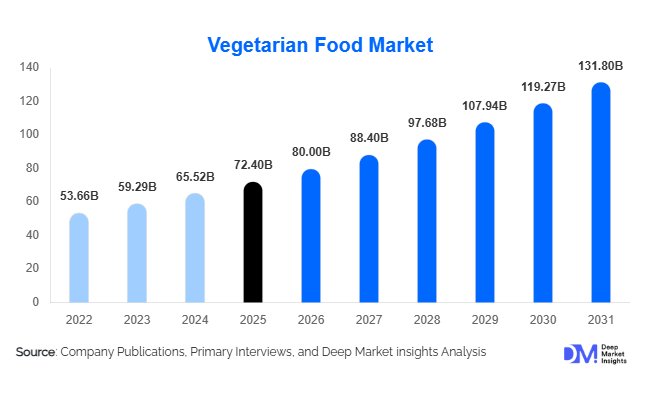
According to Deep Market Insights, the global vegetarian food market size was valued at USD 72.4 billion in 2025 and is projected to grow from USD 80.00 billion in 2026 to reach USD 131.80 billion by 2031, expanding at a CAGR of 10.5% during the forecast period (2026–2031). The vegetarian food market growth is primarily driven by increasing health consciousness, rising adoption of flexitarian diets, growing demand for sustainable food alternatives, and rapid innovation in plant-based protein and dairy substitute categories.
Key Market Insights
- Flexitarian consumers are becoming the largest demand group globally, significantly expanding the vegetarian food consumer base beyond traditional vegan and vegetarian populations.
- Plant-based dairy alternatives dominate the market, supported by rising lactose intolerance, clean-label demand, and strong retail penetration of oat, almond, and soy-based products.
- North America dominates the global vegetarian food market, driven by advanced retail infrastructure, strong consumer awareness, and extensive product innovation.
- Asia-Pacific remains the fastest-growing regional market, supported by urbanization, rising disposable incomes, and increasing awareness regarding sustainable and healthy eating.
- Foodservice adoption is accelerating rapidly, with restaurants, cafés, QSR chains, and institutional catering providers expanding vegetarian menu offerings globally.
- Advanced food technologies, including precision fermentation, extrusion processing, AI-driven flavor engineering, and next-generation protein isolation, are reshaping product innovation and manufacturing efficiency.
What are the latest trends in the vegetarian food market?
Clean-Label and Minimally Processed Vegetarian Foods Gaining Popularity
Consumers are increasingly shifting toward clean-label and minimally processed vegetarian foods as awareness regarding ingredient transparency and nutritional quality rises globally. While plant-based meat alternatives remain popular, demand is increasingly moving toward products made with recognizable ingredients such as chickpeas, lentils, oats, tempeh, tofu, mushrooms, and fermented proteins. Consumers are prioritizing lower sodium levels, reduced preservatives, and natural formulations, encouraging manufacturers to reformulate products and simplify ingredient lists. Organic and non-GMO certifications are becoming important differentiators, particularly in North America and Europe. Retailers are also allocating larger shelf space to minimally processed vegetarian snacks, frozen meals, and high-protein convenience products, reinforcing the shift toward healthier plant-based consumption.
Technology-Driven Innovation in Alternative Proteins
Food technology innovation is rapidly transforming the vegetarian food industry through the development of advanced protein extraction, fermentation, and texture enhancement technologies. Precision fermentation is enabling the production of dairy-identical proteins without animal inputs, while advanced extrusion technologies are improving the taste and texture of meat substitutes. AI-powered formulation systems are helping manufacturers optimize flavor profiles and nutritional composition more efficiently. Companies are also investing heavily in next-generation protein sources such as fava beans, mycoprotein, algae, and pea protein to reduce dependence on soy-based ingredients. These technological advancements are lowering production costs, improving scalability, and enabling wider mainstream adoption of vegetarian foods across retail and foodservice sectors.
What are the key drivers in the vegetarian food market?
Growing Consumer Focus on Preventive Healthcare
Rising awareness regarding the relationship between diet and chronic health conditions is a major driver supporting vegetarian food demand globally. Consumers are increasingly adopting plant-based diets to reduce risks associated with obesity, cardiovascular diseases, diabetes, and hypertension. Vegetarian foods are perceived as healthier alternatives due to their lower saturated fat content, higher fiber levels, and functional nutritional benefits. High-protein vegetarian products are gaining popularity among fitness-conscious consumers and aging populations seeking healthier lifestyles. Increasing healthcare expenditures and public health campaigns promoting balanced nutrition are further accelerating vegetarian food adoption across developed and emerging economies.
Rising Sustainability and Environmental Awareness
Environmental concerns surrounding livestock farming and greenhouse gas emissions are encouraging consumers to adopt more sustainable eating habits. Vegetarian food products are increasingly viewed as environmentally responsible alternatives due to their lower carbon footprint, reduced water consumption, and lower land-use intensity compared to traditional animal-based products. Governments, environmental organizations, and food companies are actively promoting sustainable diets and responsible food sourcing. Sustainability-focused branding, recyclable packaging, and carbon-neutral production strategies are becoming important competitive differentiators within the vegetarian food industry. Younger demographics, particularly millennials and Gen Z consumers, are significantly influencing this transition toward sustainable food consumption.
What are the restraints for the global market?
High Pricing of Premium Vegetarian Products
One of the major restraints affecting the vegetarian food market is the relatively high retail pricing of premium plant-based products compared to conventional animal-based foods. Advanced processing technologies, premium ingredient sourcing, smaller production scales, and higher research and development expenditures contribute to elevated manufacturing costs. In emerging economies and price-sensitive markets, affordability remains a critical challenge for mass adoption. While economies of scale are gradually improving cost structures, pricing disparities continue to limit penetration among middle-income consumers.
Consumer Concerns Regarding Ultra-Processed Foods
Growing skepticism regarding ultra-processed vegetarian foods is also restraining market expansion. Certain consumers perceive highly processed meat substitutes as containing excessive additives, preservatives, sodium, and artificial flavoring agents. This perception has prompted some retailers and foodservice operators to rationalize processed vegetarian product portfolios and shift toward whole-food-based alternatives. Manufacturers are increasingly under pressure to improve transparency, simplify formulations, and promote nutritional value in order to address evolving consumer expectations regarding healthier plant-based products.
What are the key opportunities in the vegetarian food industry?
Expansion of Vegetarian Food Demand in Emerging Markets
Emerging economies such as India, China, Brazil, Thailand, and the UAE present substantial growth opportunities for vegetarian food manufacturers. Rapid urbanization, rising disposable incomes, changing dietary habits, and growing exposure to global food trends are increasing demand for plant-based products in these regions. India, with its large traditional vegetarian population, offers particularly strong opportunities for localized product innovation. Manufacturers capable of developing affordable products tailored to regional taste preferences are expected to gain significant long-term market share across emerging markets.
Institutional and Foodservice Adoption
The increasing integration of vegetarian foods into institutional catering and foodservice operations represents a major growth opportunity for market participants. Schools, hospitals, airlines, hotels, corporate cafeterias, and quick-service restaurants are expanding vegetarian menu options to align with sustainability goals and evolving consumer preferences. Governments and educational institutions are also encouraging reduced meat consumption through sustainability initiatives and nutritional programs. This institutional adoption is expected to generate long-term volume demand for vegetarian ingredients, ready-to-eat meals, and protein alternatives globally.
Report Scope
| Report Metric | Details |
|---|---|
| Market Size in 2025 | USD 72.40 Billion |
| Market Size in 2026 | USD 80.00 Billion |
| Market Size in 2031 | USD 131.80 Billion |
| CAGR | 10.5% (2026-2031) |
| Base Year for Estimation | 2025 |
| Historical Data | 2022-2024 |
| Forecast Period | 2026-2031 |
| Report Coverage | Revenue Forecast, Competitive Landscape, Supply Chain Disruption, Growth Factors, Environment & Regulatory Landscape and Trends |
| Geographies Covered | North America, Europe, APAC, Middle East and Africa, LATAM |
| Countries Covered | U.S., Canada, U.K., Germany, France, Spain, Italy, Russia, Nordic, Benelux, Rest of Europe, China, Korea, Japan, India, Australia, Singapore, Taiwan, South East Asia, Rest of Asia-Pacific, UAE, Turky, Saudi Arabia, South Africa, Egypt, Nigeria, Rest of MEA, Brazil, Mexico, Argentina, Chile, Colombia, Rest of LATAM |
Explore more data points, trends and opportunities Download Free Sample Report
Product Type Insights
The global vegetarian food market is experiencing substantial diversification across product categories as consumers increasingly prioritize health, sustainability, ethical consumption, and convenience-oriented dietary choices. Among all product categories, plant-based dairy alternatives continue to dominate the global market, accounting for the largest share of overall revenue generation. The strong growth of oat milk, almond milk, soy milk, coconut milk, and plant-based yogurt products is being supported by rising lactose intolerance levels, increasing vegan adoption, and growing awareness regarding the environmental impact of conventional dairy farming. Consumers are increasingly shifting toward dairy-free alternatives due to concerns regarding cholesterol, hormones, and digestive health, while manufacturers continue to improve flavor profiles, nutritional composition, and texture consistency to strengthen mainstream acceptance. The expansion of café chains, coffee culture, and premium dairy-free beverage applications is also significantly accelerating demand for oat milk and almond-based beverages across developed and emerging markets.Functional vegetarian foods are becoming increasingly important within the broader market landscape as consumers seek products that provide additional health benefits beyond basic nutrition. Vegetarian products enriched with probiotics, omega-3 fatty acids, vitamins, minerals, adaptogens, and high-protein formulations are witnessing strong demand among wellness-focused consumers. The growing popularity of sports nutrition, digestive health management, immunity enhancement, and weight management programs is further strengthening the role of functional vegetarian foods in the global market. Manufacturers are increasingly combining plant-based nutrition with functional ingredients to position products within premium health and wellness categories, thereby improving profit margins and consumer retention.
Source Insights
Based on source type, soy-based vegetarian foods continue to dominate the global market owing to their high protein concentration, affordability, functional versatility, and long-standing presence within plant-based food manufacturing. Soy protein remains one of the most widely utilized ingredients across vegetarian meat substitutes, dairy alternatives, protein beverages, snacks, and nutritional supplements. Its strong amino acid profile, favorable emulsification properties, and scalable agricultural production make soy a preferred ingredient among manufacturers seeking cost-efficient large-scale production. In addition, decades of consumer familiarity with tofu, soy milk, tempeh, and soy-based protein foods continue to support stable global demand. The extensive availability of soy cultivation infrastructure across North America, Latin America, and Asia-Pacific further strengthens the segment’s commercial dominance within the vegetarian food industry.Nut-based ingredients, including almond, cashew, and coconut derivatives, continue to maintain strong market presence within premium vegetarian product categories. Almond milk remains one of the most recognized plant-based dairy alternatives globally, particularly among health-conscious consumers seeking low-calorie beverage options. Cashew-based cheese alternatives and coconut-derived yogurt products are also gaining traction due to their rich texture and premium positioning. Meanwhile, mycoprotein-based ingredients are increasingly being utilized in advanced meat substitute formulations because of their fibrous texture, high protein concentration, and ability to replicate meat-like sensory characteristics. Continuous innovation across alternative protein sources is expected to remain a key growth driver within the vegetarian food market throughout the forecast period.
Distribution Channel Insights
Offline retail channels continue to account for the largest share of global vegetarian food sales due to widespread consumer accessibility, strong retail penetration, and established purchasing behavior. Supermarkets, hypermarkets, specialty health stores, organic retailers, and convenience stores remain the primary distribution channels for vegetarian food products worldwide. Large retail chains are increasingly expanding dedicated plant-based product sections to accommodate rising consumer demand and improve product visibility. Retailers are also collaborating with vegetarian food manufacturers to introduce private-label plant-based products that offer competitive pricing while strengthening customer loyalty. In-store product sampling, promotional campaigns, and shelf expansion strategies continue to support strong offline sales performance across both developed and emerging economies.At the same time, online distribution channels are emerging as one of the fastest-growing sales platforms within the vegetarian food market. E-commerce platforms, digital grocery services, subscription meal programs, and direct-to-consumer vegetarian brands are transforming purchasing behavior across multiple consumer groups. Online retail provides consumers with broader product accessibility, transparent ingredient information, personalized recommendations, and convenient home delivery services. Smaller and premium vegetarian food companies are particularly benefiting from digital platforms because online channels enable faster geographic expansion without requiring extensive physical retail investments.Social media marketing, influencer collaborations, and digital wellness campaigns are increasingly shaping consumer purchasing decisions within the vegetarian food industry. Health influencers, fitness communities, and sustainability advocates are actively promoting vegetarian diets and plant-based lifestyles across social media platforms, thereby improving consumer awareness and accelerating product adoption. The integration of artificial intelligence-driven product recommendations, subscription-based nutrition plans, and personalized dietary applications is also enhancing customer engagement and strengthening long-term online market growth.
Consumer Type Insights
Flexitarian consumers represent the largest consumer category within the global vegetarian food market and continue to play a critical role in mainstream market expansion. The growing preference for flexible dietary habits rather than strict veganism or vegetarianism is significantly increasing demand for plant-based meat substitutes, dairy alternatives, and high-protein vegetarian snacks. Flexitarian consumers are motivated by multiple factors including health improvement, environmental sustainability, animal welfare concerns, and weight management objectives. Because this consumer group does not completely eliminate meat consumption, manufacturers are increasingly focusing on developing vegetarian products that closely mimic traditional meat and dairy experiences in terms of flavor, texture, and convenience.Vegan and vegetarian consumers continue to represent a stable and highly engaged core customer base within the market, particularly across North America and Europe. Ethical concerns regarding animal welfare, environmental conservation, and sustainable food production remain major factors influencing long-term adoption of vegetarian lifestyles. In addition, lactose-intolerant consumers are contributing significantly to the expansion of plant-based dairy alternatives including oat milk, soy milk, almond milk, and coconut yogurt products. Increasing diagnosis of lactose sensitivity across both developed and emerging economies continues to strengthen demand within this consumer category.Younger consumers, particularly millennials and Generation Z populations, are increasingly adopting vegetarian food products as part of broader wellness-oriented and environmentally conscious lifestyles. Social media exposure, fitness culture, sustainability awareness, and changing food preferences are strongly influencing purchasing behavior among younger demographics. Urban consumers with higher disposable incomes are also demonstrating growing interest in premium vegetarian foods, organic plant-based products, and innovative alternative protein categories.
End-Use Insights
Household retail consumption remains the dominant end-use segment within the global vegetarian food market due to increasing consumer awareness regarding healthy eating habits and expanding supermarket penetration worldwide. Consumers are increasingly incorporating vegetarian products into daily meal routines as part of broader dietary diversification strategies. Plant-based dairy beverages, meat alternatives, ready-to-cook meals, and protein snacks are becoming regular household purchases across multiple income groups. Rising demand for convenient, nutritious, and sustainable food solutions continues to support long-term household consumption growth.The foodservice industry is emerging as one of the fastest-growing end-use segments within the vegetarian food market. Restaurants, cafés, hotels, catering providers, and quick-service restaurant chains are significantly expanding vegetarian menu offerings to accommodate changing consumer preferences. Major international fast-food brands are increasingly introducing plant-based burgers, dairy-free beverages, vegetarian pizzas, and alternative protein menu items to attract flexitarian and health-conscious consumers. The integration of vegetarian options into mainstream dining experiences is helping normalize plant-based eating across broader consumer demographics.Sports nutrition and wellness applications are emerging as important growth areas within the vegetarian food market. Rising participation in fitness activities, bodybuilding, yoga, and wellness programs is significantly increasing demand for plant-based protein powders, energy bars, recovery beverages, and high-protein vegetarian supplements. Consumers increasingly associate plant-based nutrition with improved digestion, lean muscle development, and sustainable fitness lifestyles, thereby strengthening demand for advanced functional vegetarian products.
Explore more data points, trends and opportunities Download Free Sample Report
Vegetarian Food Market Segmentations
By Product Type
- Plant-Based Dairy Alternatives
- Meat Substitutes & Protein Alternatives
- Vegetarian Ready-to-Eat & Convenience Foods
- Plant-Based Protein Ingredients
- Vegetarian Bakery & Confectionery
- Functional & Fortified Vegetarian Foods
By Source
- Soy-Based
- Pea-Based
- Wheat-Based
- Oat-Based
- Rice-Based
- Nut-Based
- Mycoprotein-Based
- Mixed Plant Sources
By Nature
- Conventional
- Organic
By Distribution Channel
- Supermarkets & Hypermarkets
- Convenience Stores
- Specialty Health Food Stores
- Department Stores
- Online Retail & E-Commerce Platforms
By Consumer Type
- Vegan Consumers
- Vegetarian Consumers
- Flexitarian Consumers
- Lactose-Intolerant Consumers
- Health-Conscious Consumers
Regional Insights
North America
North America accounted for approximately 38% of the global vegetarian food market in 2025, making it the largest regional market worldwide. The United States dominates regional demand due to high consumer awareness regarding plant-based nutrition, advanced retail infrastructure, strong product innovation capabilities, and significant investments in alternative protein research and development. The region has witnessed rapid expansion in plant-based dairy alternatives, meat substitutes, and functional vegetarian foods as consumers increasingly prioritize health, sustainability, and ethical food choices. The growing popularity of flexitarian diets across the United States and Canada remains one of the primary growth drivers supporting long-term regional market expansion.Strong investments in food technology startups, cellular agriculture research, and plant-protein innovation are further strengthening North America’s leadership position within the global vegetarian food industry. Major food manufacturers and restaurant chains continue to expand vegetarian product portfolios in response to evolving consumer demand. In addition, increasing prevalence of obesity, cardiovascular diseases, and lactose intolerance is encouraging consumers to transition toward healthier plant-based dietary patterns. Canada’s role as a major producer of pea protein and alternative protein ingredients is also supporting regional supply chain development and manufacturing expansion. The widespread availability of vegetarian products across supermarkets, online grocery platforms, and foodservice channels continues to accelerate market penetration throughout the region.
Europe
Europe represented nearly 31% of the global vegetarian food market in 2025 and continues to maintain a strong position due to sustainability-focused consumer behavior, supportive regulatory frameworks, and growing environmental awareness. Countries including Germany, the United Kingdom, France, and the Netherlands are among the leading regional markets for vegetarian convenience foods, plant-based dairy alternatives, and meat substitute products. European consumers demonstrate particularly strong preference for clean-label, organic, non-GMO, and environmentally sustainable food products, thereby encouraging continuous innovation across the vegetarian food industry.Government-backed carbon reduction initiatives, climate policies, and sustainable agriculture programs are serving as major drivers supporting regional market growth. Several European governments are actively promoting reduced meat consumption and encouraging development of alternative protein industries to meet long-term environmental goals. Increasing investments in food technology, fermentation-based proteins, and sustainable packaging solutions are also contributing to market expansion. In addition, Europe benefits from strong retail penetration, high disposable incomes, advanced cold chain infrastructure, and widespread consumer acceptance of premium vegetarian food products. Growing awareness regarding animal welfare and ethical sourcing practices continues to strengthen long-term demand across the region.
Asia-Pacific
Asia-Pacific is projected to be the fastest-growing regional market within the global vegetarian food industry, with growth supported by rapid urbanization, rising disposable incomes, expanding middle-class populations, and increasing health awareness. China, India, Japan, South Korea, and Australia are among the key contributors driving regional demand expansion. India benefits significantly from its large traditional vegetarian consumer base and long-standing cultural acceptance of plant-based diets. Meanwhile, China is witnessing strong growth in demand for sustainable and health-oriented food alternatives as urban consumers increasingly adopt wellness-focused lifestyles.The rapid expansion of organized retail infrastructure, digital grocery platforms, and food delivery services is significantly improving accessibility to vegetarian food products across the region. Japan and South Korea are driving innovation in fermented plant proteins, functional nutrition, and advanced meat substitute technologies. In addition, growing concerns regarding food security, environmental sustainability, and chronic health conditions are encouraging governments and consumers across Asia-Pacific to support alternative protein development. Rising investments from multinational food companies and local startups are accelerating regional manufacturing capabilities, product innovation, and consumer awareness campaigns. The increasing influence of Western dietary trends combined with strong traditional plant-based food cultures is expected to create substantial long-term growth opportunities across the Asia-Pacific vegetarian food market.
Latin America
Latin America is experiencing steady growth within the vegetarian food market, particularly across Brazil and Mexico, where changing dietary preferences and increasing health consciousness are supporting industry expansion. Rising urbanization, improving retail infrastructure, and growing middle-class populations are contributing to increased consumer demand for plant-based dairy alternatives, vegetarian snacks, and meat substitute products. Younger consumers are increasingly adopting flexitarian eating habits, creating favorable opportunities for manufacturers introducing innovative plant-based convenience foods.The region’s strong agricultural capabilities, particularly soybean production, are supporting local manufacturing growth and strengthening Latin America’s role within global vegetarian ingredient supply chains. Export-oriented agricultural development and increasing investments in food processing infrastructure are also enhancing the region’s competitiveness within the alternative protein industry. In addition, social media influence, rising awareness regarding sustainability, and increasing penetration of international vegetarian food brands are accelerating market development across urban consumer populations.
Middle East & Africa
The Middle East & Africa vegetarian food market is witnessing gradual but consistent growth driven by rising health awareness, expanding tourism industries, and increasing demand for premium wellness-oriented food products. Countries including the United Arab Emirates, Saudi Arabia, and South Africa are emerging as important regional markets for vegetarian dairy alternatives, premium plant-based beverages, and meat substitute products. Affluent urban consumers within Gulf Cooperation Council countries are increasingly adopting plant-based lifestyles as part of broader wellness, fitness, and sustainability trends.The expansion of premium hospitality sectors, international restaurant chains, and modern retail infrastructure is significantly improving product accessibility throughout the region. Governments are also increasing investments in food security programs, sustainable agriculture initiatives, and local alternative protein manufacturing capabilities to reduce dependence on imported food products. Rising expatriate populations, international tourism growth, and increasing exposure to global dietary trends are further strengthening consumer awareness regarding vegetarian nutrition. As disposable incomes continue to improve and retail modernization expands across the Middle East & Africa region, demand for premium vegetarian foods is expected to accelerate steadily over the forecast period.
Key Players in the Vegetarian Food Market
- Nestlé S.A.
- Danone S.A.
- Beyond Meat, Inc.
- Impossible Foods Inc.
- The Kraft Heinz Company
- Conagra Brands, Inc.
- Kellogg Company
- Maple Leaf Foods Inc.
- Oatly Group AB
- Tyson Foods, Inc.
- Unilever PLC
- Amy's Kitchen Inc.
- SunOpta Inc.
- The Hain Celestial Group, Inc.
- Tofurky Company, Inc.