Tree Nuts Market Size
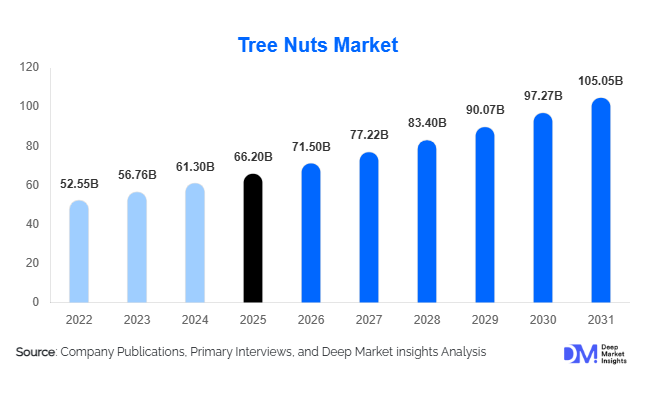
According to Deep Market Insights, the global tree nuts market size was valued at USD 66.2 billion in 2025 and is projected to grow from USD 71.50 billion in 2026 to reach USD 105.05 billion by 2031, expanding at a CAGR of 8.0% during the forecast period (2026–2031). Market growth is primarily driven by rising consumer preference for nutrient-dense foods, increasing adoption of plant-based diets, and expanding applications of nuts across snacks, dairy alternatives, bakery, and functional food industries. Growing awareness regarding cardiovascular health benefits, combined with premiumization trends in healthy snacking, continues to strengthen global consumption patterns. Increasing international trade, technological advancements in nut processing, and expansion of organized retail and e-commerce channels further support steady market expansion worldwide.
Key Market Insights
- Healthy snacking trends are transforming consumption patterns, with tree nuts increasingly replacing processed snacks due to their protein and healthy fat content.
- Plant-based dairy alternatives are accelerating almond and cashew demand, particularly in North America and Europe.
- North America dominates global production and exports, supported by large-scale almond and pistachio cultivation.
- Asia-Pacific is the fastest-growing consumption region, driven by rising disposable incomes and expanding urban retail markets.
- Premium flavored and roasted nut products are gaining traction, improving margins for manufacturers.
- Technological adoption in grading, sorting, and packaging is improving shelf life and export efficiency across global supply chains.
What are the latest trends in the tree nuts market?
Shift Toward Plant-Based Nutrition and Functional Foods
The rapid expansion of plant-based diets has significantly reshaped demand dynamics within the tree nuts industry. Almonds, cashews, and hazelnuts are increasingly used as base ingredients for plant-based milk, yogurt, spreads, and protein formulations. Food manufacturers are investing heavily in nut-derived ingredients to meet clean-label expectations and allergen diversification beyond soy. Functional food innovation incorporating nuts into protein bars, fortified cereals, and nutritional snacks is expanding consumer adoption across age groups. The trend toward preventive healthcare and wellness-focused consumption continues to position tree nuts as staple ingredients within daily diets rather than occasional snacks.
Premiumization and Value-Added Processing
Manufacturers are shifting from bulk commodity sales toward value-added offerings such as roasted, seasoned, organic, and flavored nuts. Premium packaging formats, portion-controlled snacks, and specialty nut blends are attracting urban consumers seeking convenience and quality. Innovations in roasting technologies and flavor infusion techniques allow brands to differentiate products while maintaining nutritional integrity. Additionally, traceability certifications and sustainably sourced nuts are gaining importance among retailers and environmentally conscious consumers, reinforcing premium pricing strategies and improving profitability across the value chain.
What are the key drivers in the tree nuts market?
Rising Health Awareness and Nutritional Benefits
Growing awareness regarding heart health, weight management, and protein-rich diets is a major driver supporting global nut consumption. Tree nuts contain unsaturated fats, fiber, vitamins, and antioxidants, aligning strongly with modern dietary recommendations. Public health campaigns and nutrition research endorsing nut consumption have increased daily intake levels across developed markets, contributing to sustained demand growth.
Expansion of Healthy Snacking Industry
The global shift toward convenient yet nutritious foods has positioned tree nuts as ideal snack alternatives. Busy lifestyles and on-the-go consumption habits encourage demand for portable, shelf-stable foods. Retailers are expanding shelf space dedicated to nut-based snacks, while private-label offerings are increasing accessibility and affordability. Growth of modern retail infrastructure further accelerates market penetration in emerging economies.
Industrial Demand from Food Processing Applications
Tree nuts are increasingly utilized across bakery, confectionery, cereals, and dairy substitute industries. Industrial buyers provide stable year-round demand, reducing reliance on seasonal retail sales. The rapid growth of plant-based beverages and premium confectionery products continues to strengthen ingredient-level demand globally.
What are the restraints for the global market?
Climate Dependency and Yield Volatility
Tree nut production depends heavily on favorable climatic conditions and water availability. Droughts, temperature fluctuations, and extreme weather events significantly influence yields, causing price volatility and supply uncertainties. Producers must increasingly invest in irrigation efficiency and climate-resilient farming practices to stabilize output.
High Cultivation and Resource Requirements
Certain nuts, particularly almonds, require substantial water and long cultivation cycles, raising environmental concerns and production costs. Increasing regulatory scrutiny related to sustainable agriculture and water usage may restrict expansion in water-stressed regions, posing long-term operational challenges.
What are the key opportunities in the tree nuts industry?
Expansion in Emerging Consumption Markets
Rapid urbanization and rising middle-class income levels across Asia-Pacific and the Middle East present major growth opportunities. Countries such as India and China are witnessing increasing adoption of premium snacks and imported food products. Localization strategies, smaller pack sizes, and culturally adapted flavors can significantly expand consumption penetration in these high-growth regions.
Technology Integration and Smart Agriculture
Precision agriculture technologies, AI-based crop monitoring, and automated grading systems are enabling producers to improve yields and reduce post-harvest losses. Blockchain-enabled traceability systems are also gaining traction, allowing exporters to meet strict international quality standards and access premium retail markets.
Report Scope
| Report Metric | Details |
|---|---|
| Market Size in 2025 | USD 66.20 Billion |
| Market Size in 2026 | USD 71.50 Billion |
| Market Size in 2031 | USD 105.05 Billion |
| CAGR | 8% (2026-2031) |
| Base Year for Estimation | 2025 |
| Historical Data | 2022-2024 |
| Forecast Period | 2026-2031 |
| Report Coverage | Revenue Forecast, Competitive Landscape, Supply Chain Disruption, Growth Factors, Environment & Regulatory Landscape and Trends |
| Geographies Covered | North America, Europe, APAC, Middle East and Africa, LATAM |
| Countries Covered | U.S., Canada, U.K., Germany, France, Spain, Italy, Russia, Nordic, Benelux, Rest of Europe, China, Korea, Japan, India, Australia, Singapore, Taiwan, South East Asia, Rest of Asia-Pacific, UAE, Turky, Saudi Arabia, South Africa, Egypt, Nigeria, Rest of MEA, Brazil, Mexico, Argentina, Chile, Colombia, Rest of LATAM |
Explore more data points, trends and opportunities Download Free Sample Report
Product Type Insights
The global tree nuts market is characterized by a diversified product portfolio, with almonds maintaining a dominant position and accounting for nearly 38% of total market value in 2025. The strong leadership of almonds is primarily attributed to their exceptional versatility across multiple food categories, including healthy snacks, plant-based beverages, breakfast cereals, confectionery, and functional food formulations. Increasing consumer preference for nutrient-dense foods rich in protein, fiber, and healthy fats has further strengthened almond consumption globally. In addition, continuous innovation in almond-based dairy alternatives, flavored snack formats, and clean-label ingredient applications has reinforced their market leadership.Cashews and pistachios represent high-growth segments supported by expanding export demand and rising consumption across emerging economies. Cashews benefit from their creamy texture and adaptability in vegan food applications, particularly plant-based cheeses and sauces, while pistachios are gaining popularity as premium snack options due to their perceived nutritional benefits and strong branding initiatives promoting portion-controlled snacking. Walnuts maintain stable demand driven by growing scientific awareness linking walnut consumption with cognitive health, heart health, and omega-3 fatty acid intake, making them highly attractive within aging populations and wellness-focused consumers.Specialty nuts such as macadamia and pecans are increasingly penetrating premium retail and gourmet food segments. Rising disposable incomes, growing interest in artisanal foods, and the expansion of specialty bakery and confectionery products are encouraging consumers to trade up toward premium nut varieties. Additionally, sustainability certifications and origin-based marketing strategies are supporting differentiation and value creation within the specialty nut category, contributing to overall market premiumization.
Application Insights
Direct consumption and snacking continue to represent the largest application segment, contributing approximately 48% of global demand. The leading driver for this segment is the global shift toward convenient yet healthy eating habits, as consumers increasingly replace traditional processed snacks with nutrient-rich alternatives. Busy lifestyles, rising urbanization, and growing awareness of protein-based diets have significantly accelerated demand for ready-to-eat nut products, roasted varieties, and portion-controlled packaging formats. Manufacturers are also introducing flavored, spiced, and functional snack variants to enhance consumer engagement and repeat purchases.Bakery and confectionery applications remain a critical pillar of demand, particularly across European markets where nuts are essential ingredients in premium chocolates, pastries, desserts, and seasonal baked goods. Nuts enhance texture, flavor complexity, and nutritional value, making them indispensable for premium product positioning. Increasing demand for indulgent yet healthier desserts is encouraging manufacturers to incorporate higher nut content into formulations.Plant-based dairy alternatives represent the fastest-growing application category, supported by rapid innovation in almond- and cashew-based beverages, yogurts, spreads, and frozen desserts. The expansion of vegan and flexitarian lifestyles, combined with lactose intolerance prevalence in several regions, is accelerating product development and retail penetration. Food companies are investing heavily in improving taste, texture, and nutritional fortification, further strengthening demand within this segment.Nutraceutical applications are expanding steadily as nuts become key ingredients in functional foods targeting immunity support, energy enhancement, weight management, and cardiovascular wellness. Increasing consumer focus on preventive healthcare and natural nutrition sources is encouraging the integration of nuts into protein bars, dietary supplements, and fortified food products, thereby broadening their application scope beyond traditional consumption.
Distribution Channel Insights
Supermarkets and hypermarkets dominate global distribution channels, accounting for roughly 44% of total sales. The leading growth driver for this segment is strong product visibility combined with extensive private-label expansion, enabling retailers to offer competitively priced nut products while maintaining quality standards. Organized retail environments allow consumers to compare product varieties, packaging formats, and nutritional claims, which enhances purchase confidence and supports higher sales volumes.Online retail channels are witnessing rapid expansion as digital commerce reshapes consumer purchasing behavior. Increasing internet penetration, convenient home delivery, subscription-based purchasing models, and availability of bulk purchase discounts are encouraging consumers to buy packaged nuts through e-commerce platforms. Digital marketplaces also allow niche and premium brands to reach wider audiences without heavy investment in physical retail infrastructure.Foodservice distribution channels remain essential, particularly for bakery chains, restaurants, hotels, and catering services where nuts are used extensively in desserts, sauces, salads, and gourmet culinary preparations. Growth in global tourism, café culture, and premium dining experiences continues to stimulate demand through this channel. Meanwhile, direct-to-consumer strategies are gaining traction as manufacturers leverage digital marketing, brand storytelling, and personalized offerings to strengthen customer loyalty and improve margins.
End-Use Industry Insights
The food and beverage manufacturing industry represents the largest end-use segment, contributing nearly 51% of global demand. The primary driver for this segment is the growing incorporation of nuts as functional ingredients across snacks, cereals, confectionery, dairy alternatives, and ready-to-eat foods. Manufacturers increasingly utilize nuts to enhance nutritional profiles, clean-label positioning, and premium product appeal, aligning with evolving consumer expectations for healthier processed foods.The nutraceutical industry is among the fastest-growing end users, supported by increasing adoption of protein-enriched diets, sports nutrition products, and preventive healthcare solutions. Nuts are widely recognized for delivering essential micronutrients, antioxidants, and healthy fats, making them valuable components in wellness-focused formulations. Rising aging populations and increased awareness of lifestyle-related diseases are further accelerating nutraceutical adoption.HoReCa demand continues to expand alongside the growth of premium desserts, artisanal bakery offerings, and gourmet cuisine trends. Nuts provide both flavor enhancement and visual appeal, making them popular ingredients in upscale culinary applications. Additionally, personal care and cosmetic industries are emerging as niche yet promising end-use sectors, as nut-derived oils such as almond and walnut oil gain popularity in skincare and haircare formulations due to their moisturizing and antioxidant properties.
Explore more data points, trends and opportunities Download Free Sample Report
Tree Nuts Market Segmentations
By Product Type
- Almonds
- Cashews
- Walnuts
- Pistachios
- Hazelnuts
- Pecans
- Macadamia Nuts
- Brazil Nuts
- Other Tree Nuts
By Application
- Direct Consumption Snacks
- Bakery and Confectionery
- Dairy Alternatives Plant-Based Products
- Nutraceuticals Functional Foods
- Foodservice Culinary Applications
By Distribution Channel
- Supermarkets Hypermarkets
- Convenience Stores
- Online Retail
- Specialty Health Food Stores
- Foodservice Distribution
- Direct-to-Consumer (D2C) Sales
Regional Insights
North America
North America accounted for approximately 29% of global market share in 2025, driven primarily by the United States, which leads global almond and pistachio production and exports. Regional growth is supported by strong consumer awareness of nutrition and wellness, high adoption of plant-based diets, and widespread availability of value-added nut products. Advanced agricultural technologies, efficient irrigation systems, and large-scale processing infrastructure enhance productivity and supply reliability. Furthermore, strong export networks and trade partnerships enable North American producers to maintain a dominant position in international markets while simultaneously meeting robust domestic demand for healthy snacks and plant-based foods.
Europe
Europe represents nearly 24% of global consumption, supported by mature food processing industries and deeply rooted culinary traditions incorporating nuts into bakery and confectionery products. Regional growth is driven by increasing consumer preference for organic, sustainably sourced, and ethically produced foods, alongside stringent regulatory standards that encourage premium product positioning. Rising vegan and flexitarian populations across Germany, Italy, France, and Spain are further stimulating demand for nut-based dairy alternatives and functional snacks. Additionally, innovation in premium chocolate manufacturing and artisanal bakery segments continues to reinforce steady regional consumption growth.
Asia-Pacific
Asia-Pacific is the fastest-growing regional market, expected to expand at over 9% CAGR during the forecast period. Rapid urbanization, expanding middle-class populations, and rising disposable incomes in countries such as China and India are significantly increasing consumption of packaged and premium food products. Cultural gifting traditions, particularly during festivals and celebrations, continue to drive seasonal demand for nuts. Western dietary influences, growing awareness of protein-rich diets, and the rapid expansion of organized retail and e-commerce platforms are further accelerating market penetration. Investments in food processing infrastructure and local packaging capabilities are also improving accessibility and affordability across the region.
Latin America
Latin America, led by Brazil and Mexico, is emerging as a promising growth market supported by increasing health awareness and rising consumption of nutritious snack alternatives. Expansion of modern retail formats, improvements in cold-chain logistics, and greater availability of imported nut varieties are encouraging broader consumer adoption. Growth in the regional food processing industry is also driving ingredient demand for bakery and confectionery applications. Although imports continue to dominate supply, gradual investments in domestic cultivation and processing capabilities are expected to enhance regional market stability over the long term.
Middle East & Africa
The Middle East & Africa region demonstrates strong per-capita consumption, particularly in the UAE and Saudi Arabia, where nuts hold cultural significance in traditional cuisine, hospitality, and festive gifting practices. Regional growth is supported by high purchasing power, expanding premium retail sectors, and increasing demand from tourism and hospitality industries. The Middle East also functions as a strategic global re-export hub, facilitating international trade flows between producing and consuming regions. In Africa, rising urbanization, improving retail infrastructure, and growing awareness of healthy eating habits are gradually expanding consumer adoption, creating long-term growth opportunities across both retail and foodservice channels.
Key Players in the Tree Nuts Market
- Blue Diamond Growers
- Olam Group Limited
- Wonderful Pistachios & Almonds
- John B. Sanfilippo & Son Inc.
- Mariani Nut Company
- Diamond Foods LLC
- Select Harvests Limited
- Borges Agricultural & Industrial Nuts
- Hines Nut Company
- Royal Nut Company
- Treehouse California Almonds
- Harris Woolf California Almonds
- Germack Pistachio Company
- Meridian Growers
- Mount Franklin Foods