Towel Rack Market Size
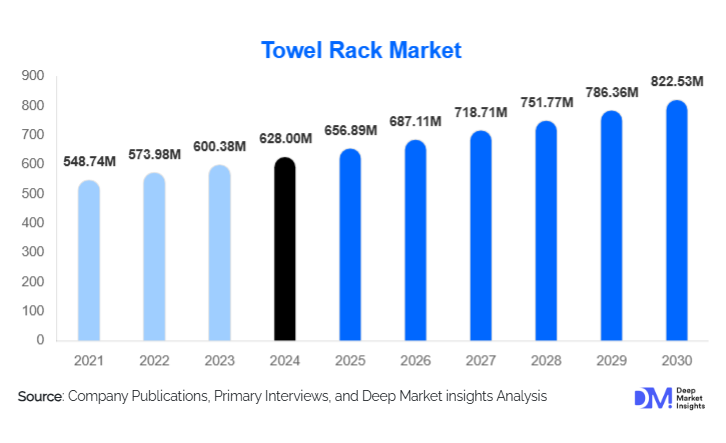
According to Deep Market Insights, the global towel rack market size was valued at USD 628 million in 2025 and is projected to grow from USD 656.89 million in 2026 to reach USD 822.53 million by 2031, expanding at a CAGR of 4.6% during the forecast period (2026–2031). The market growth is primarily driven by the rise in residential and commercial renovation activities, increasing luxury bathroom upgrades, and growing adoption of smart and heated towel racks across hospitality, healthcare, and wellness sectors.
Key Market Insights
- Smart and heated towel racks dominate demand, backed by growing integration of home automation and energy-efficient heating technologies.
- Residential sector contributes over 52% of total demand due to rising home remodeling, aesthetic advancements, and premium bathroom installations.
- Asia-Pacific is the fastest-growing region, driven by rapid urbanization, real estate development, and cost-effective manufacturing exports.
- North America leads in smart towel rack adoption due to strong penetration of IoT-based luxury bathroom fittings.
- Stainless steel remains the most preferred material, holding approximately 41% market share due to durability, hygiene, and aesthetic appeal.
- Online distribution channels are expanding rapidly, accounting for 28% of total sales as customers shift toward e-commerce and B2B sourcing platforms.
Towel Rack Market Trends
Smart and IoT-Enabled Heating Technology
Connected towel racks with programmable timers, temperature sensors, WiFi, and app-based controls are gaining traction in premium households and commercial establishments. These products integrate seamlessly with smart home ecosystems such as Alexa, Google Home, and Apple HomeKit. Manufacturers are exploring remote control functionality, energy efficiency optimization, and voice-command compatibility, appealing to tech-savvy consumers. Smart heated towel racks not only provide comfort and hygiene advantages but also prevent mold formation by ensuring controlled drying cycles.
Shift Toward Sustainable and Recyclable Materials
Consumers are increasingly opting for towel racks made using stainless steel 316 grade, bamboo, aluminum composites, and recycled metals due to their corrosion resistance, environmental friendliness, and longer lifecycle. Manufacturers in Europe and Australia are introducing FSC-certified wood and recyclable metals to cater to eco-conscious buyers. The premium hospitality sector is also adopting antimicrobial coated towel racks in wellness centers, healthcare facilities, and spas to support hygiene compliance and sustainability standards.
Towel Rack Market Drivers
Growing Bathroom Renovation and Smart Home Integration
The rise in smart home adoption and consumer preference for premium bathroom aesthetics are major demand drivers. In the U.S. alone, more than 60% of renovated homes in 2023 included upgraded bathroom fixtures, with heated towel racks gaining traction in luxury segments. Smart and electric models are valued for their utility, hygiene, and visual appeal, making them popular in residential upgrades and boutique hotels.
Rising Hospitality & Wellness Infrastructure Development
Increased construction of hotels, spas, resorts, senior care facilities, and fitness centers across Asia-Pacific, Middle East, and Europe has resulted in higher demand for commercial-grade stainless steel racks. These sectors prioritize hygiene, sustainability, and comfort, making heated racks crucial for providing a premium guest experience. Rapid tourism infrastructure expansion in UAE, Thailand, Indonesia, and Saudi Arabia is significantly driving volume adoption.
Towel Rack Market Restraints
High Material Cost and Profitability Pressure
Volatility in prices of key raw materials such as stainless steel, brass, and aluminum impacts manufacturing costs, limiting price competitiveness, especially in emerging markets. Premium heated and smart racks require complex assembly and electrical safety compliance, adding to cost challenges for manufacturers.
Fragmented Design Choices and Low Product Differentiation
Basic, non-heated towel racks face commoditization, leading to intense price competition. The presence of low-cost imports restricts margins for established brands, especially in regions with high DIY (do-it-yourself) adoption such as the U.S., UK, and Australia.
Towel Rack Market Opportunities
Smart Infrastructure Expansion and Real Estate Integration
With governments investing heavily in urban housing developments and commercial real estate projects in India, China, UAE, and Egypt, manufacturers have opportunities to collaborate directly with architects and developers. Smart city projects increasingly incorporate energy-efficient bathroom fittings, creating bulk demand for hardwired and recessed towel racks.
Growing Commercial Demand in Healthcare and Wellness Facilities
Hospitals, luxury clinics, physiotherapy centers, and senior living facilities are adopting antibacterial, heated towel racks to maintain hygiene and comfort. The healthcare segment is expected to grow at over 8% annually, offering long-term contract opportunities for bulk suppliers and OEMs.
Report Scope
| Report Metric | Details |
|---|---|
| Market Size in 2025 | USD 628 Million |
| Market Size in 2026 | USD 656.89 Million |
| Market Size in 2031 | USD 822.53 Million |
| CAGR | 4.6% (2026-2031) |
| Base Year for Estimation | 2025 |
| Historical Data | 2022-2024 |
| Forecast Period | 2026-2031 |
| Report Coverage | Revenue Forecast, Competitive Landscape, Supply Chain Disruption, Growth Factors, Environment & Regulatory Landscape and Trends |
| Geographies Covered | North America, Europe, APAC, Middle East and Africa, LATAM |
| Countries Covered | U.S., Canada, U.K., Germany, France, Spain, Italy, Russia, Nordic, Benelux, Rest of Europe, China, Korea, Japan, India, Australia, Singapore, Taiwan, South East Asia, Rest of Asia-Pacific, UAE, Turky, Saudi Arabia, South Africa, Egypt, Nigeria, Rest of MEA, Brazil, Mexico, Argentina, Chile, Colombia, Rest of LATAM |
Explore more data points, trends and opportunities Download Free Sample Report
Product Type Insights
Electric heated towel racks lead the market, holding 38% share in 2025 due to their increasing adoption in luxury homes, hotels, healthcare, and spas. Hydronic and electric plug-in variants are popular in European wellness spaces and premium residential installations. Non-heated racks such as wall-mounted and over-the-door racks continue to cater to budget, retail, and DIY-focused markets, especially in the U.S., Canada, and Germany.
Material Insights
Stainless steel dominates with 41% share in 2025 owing to corrosion resistance, durability, and premium finish. Aluminum and brass show rising momentum in mid-range and custom-designed residential applications, while bamboo and wood-based designs are gaining attention in eco-luxury hospitality spaces.
Distribution Channel Insights
Online platforms, including manufacturer websites, e-commerce marketplaces, and B2B procurement portals, account for 28% of sales and are gaining traction due to customizable ordering, design previews, and international shipping. Retail specialty stores and home improvement centers remain dominant in the mid-range non-heated rack segment.
End-Use Insights
The residential sector represents 52% of the global market due to renovations, smart home adoption, and premium upgrades in urban multi-family homes and villas. The hospitality sector holds approximately 24%, led by demand from hotels, resorts, spas, and vacation rentals. Healthcare and wellness facilities are expected to be the fastest-growing end-use during 2026–2031 with an estimated CAGR of 8.2%.
Explore more data points, trends and opportunities Download Free Sample Report
Towel Rack Market Segmentations
Product Type
- Electric Heated Towel Racks
- Hydronic Heated Towel Racks
- Non-Heated Wall-Mounted Towel Racks
- Freestanding & Floor-Mounted Towel Racks
- Over-the-Door Towel Racks
- Folding & Swivel Towel Racks
- Smart/IoT-Enabled Towel Racks
Material
- Stainless Steel
- Aluminum
- Brass
- Chrome-Plated Metal
- Plastic & Polymeric Composites
- Wood & Bamboo
End-Use Industry
- Residential
- Hotels & Resorts
- Hospitals & Healthcare Facilities
- Spas, Gyms & Wellness Centers
- Offices & Commercial Spaces
Regional Insights
North America
North America holds 28% market share, led by the United States, which accounts for 21% alone. High renovation spending, smart home penetration, and adoption of energy-regulated heated towel racks drive demand in the region.
Europe
Europe holds 24% market share, supported by strong demand in Germany, the UK, Italy, and France. Hydronic heating towel racks are highly popular in European wellness infrastructure, supported by energy efficiency regulations and hygiene standards.
Asia-Pacific
Asia-Pacific is the fastest-growing market with a projected CAGR of 8.4% during 2026–2031. China (11% share), India, Japan, and South Korea lead the region with expanding residential construction, commercial real estate investments, and export-based manufacturing.
Middle East & Africa
The UAE, Saudi Arabia, and South Africa are major contributors to demand, driven by luxury hotel expansion, spa culture, and real estate growth in wellness tourism-focused destinations.
Latin America
Brazil, Mexico, and Argentina represent emerging markets with moderate expansion in wellness-focused residential and hospitality infrastructure.
Key Players in the Towel Rack Market
- Kohler Co.
- Zehnder Group
- Roca Group
- WarmlyYours
- Amba Products
- Vogue UK
- Jeeves Heated Towel Rails
- Moen Incorporated
- Purmo Group
- Hudson Reed
- Häfele GmbH
- Vola A/S
- Myson
- Devon & Devon
- Jeeves