Tomato Sauce Market Size
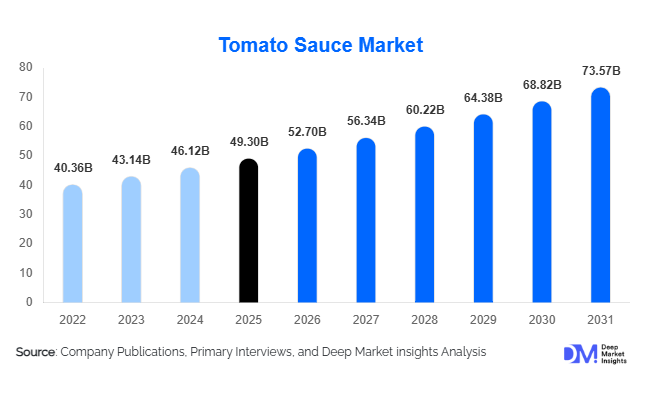
According to Deep Market Insights, the global tomato sauce market size was valued at USD 49.3 billion in 2025 and is projected to grow from USD 52.70 billion in 2026 to reach USD 73.57 billion by 2031, expanding at a CAGR of 6.9% during the forecast period (2026–2031). The tomato sauce market growth is primarily driven by rising consumption of convenience foods, increasing global penetration of quick-service restaurants, and strong demand for ready-to-eat and packaged meal solutions across developed and emerging economies.
Key Market Insights
- Clean-label and organic tomato sauce products are gaining strong traction globally, driven by rising consumer preference for healthier and preservative-free food products.
- Quick-service restaurants and frozen food manufacturers are significantly increasing industrial tomato sauce procurement, supporting long-term volume demand growth.
- Europe dominates the global tomato sauce market, supported by strong consumption in Italy, Germany, France, and the United Kingdom.
- Asia-Pacific is the fastest-growing regional market, fueled by urbanization, westernized food habits, and expanding middle-class consumption in China and India.
- E-commerce grocery retailing is reshaping consumer purchasing behavior, enabling premium and niche sauce brands to expand their market reach globally.
- Technological advancements in food processing and aseptic packaging are improving shelf life, production efficiency, and sustainability across tomato sauce manufacturing operations.
What are the latest trends in the tomato sauce market?
Premium and Clean-Label Tomato Sauces Gaining Popularity
Consumers are increasingly shifting toward premium tomato sauce products made with organic tomatoes, natural herbs, reduced sugar formulations, and preservative-free ingredients. Clean-label positioning has become a major purchasing factor, particularly in North America and Europe, where consumers actively seek transparency in food sourcing and ingredient labeling. Manufacturers are introducing gourmet sauces with region-specific flavor profiles such as roasted garlic, basil-infused, spicy chili, and Mediterranean herb blends to cater to evolving taste preferences. Premiumization is also encouraging higher-value product positioning, enabling manufacturers to improve margins while differentiating themselves in an increasingly competitive marketplace.
Technology-Driven Processing and Sustainable Packaging Adoption
Tomato sauce manufacturers are increasingly investing in advanced food processing technologies to improve product consistency, shelf life, and operational efficiency. Automated filling systems, AI-based demand forecasting, robotic bottling lines, and smart warehouse systems are becoming common across large-scale processing facilities. Sustainable packaging adoption is also accelerating as governments and consumers push for environmentally friendly solutions. Flexible pouches, recyclable PET bottles, lightweight glass containers, and bio-based packaging materials are witnessing increased deployment. Digital grocery ecosystems and direct-to-consumer sales channels are further enabling brands to personalize offerings and improve customer engagement through subscription models and online promotions.
What are the key drivers in the tomato sauce market?
Expansion of Convenience Food Consumption
The growing demand for convenience foods remains one of the strongest drivers of the global tomato sauce market. Urbanization, rising disposable incomes, dual-income households, and fast-paced lifestyles are increasing consumer dependence on packaged foods and quick meal preparation products. Tomato sauce serves as a core ingredient in pasta dishes, pizzas, snacks, sandwiches, frozen meals, and ready-to-eat products, ensuring broad consumption across retail and industrial applications. The increasing popularity of meal kits and instant cooking solutions is further accelerating demand for versatile tomato-based sauces globally.
Rapid Growth of Quick-Service Restaurants
The global expansion of quick-service restaurant chains is significantly boosting industrial demand for tomato sauce. Pizza chains, burger outlets, sandwich brands, and fast-food restaurants rely heavily on bulk tomato sauce procurement for standardized menu preparation. Emerging economies such as India, China, Indonesia, Brazil, and Vietnam are witnessing aggressive expansion of international and domestic QSR chains, creating sustained downstream demand for processed tomato products. Increasing food delivery penetration and digital ordering platforms are also amplifying consumption volumes across the commercial foodservice sector.
What are the restraints for the global market?
Volatility in Raw Material Prices
Tomato sauce manufacturers remain highly vulnerable to fluctuations in tomato prices caused by climate variability, drought conditions, water scarcity, crop diseases, and supply chain disruptions. Rising prices of packaging materials, sugar, transportation, and energy further increase operational costs and compress profit margins. Seasonal supply imbalances can significantly affect production planning and pricing strategies, particularly for small and medium-scale manufacturers with limited procurement leverage.
Stringent Food Safety and Labeling Regulations
Governments across multiple regions are implementing stricter food safety, labeling, and sustainability regulations, creating compliance challenges for manufacturers. Increasing restrictions on sugar content, preservatives, additives, and plastic packaging require continuous reformulation and packaging innovation investments. Companies must also comply with export quality certifications, traceability requirements, and recycling mandates, which can increase operational complexity and production costs.
What are the key opportunities in the tomato sauce industry?
Growth of Organic and Health-Focused Product Categories
The increasing global focus on health and wellness presents significant opportunities for manufacturers offering organic, non-GMO, low-sodium, and preservative-free tomato sauces. Consumers are increasingly willing to pay premium prices for healthier food alternatives with transparent sourcing and clean-label ingredients. This trend is creating strong demand for functional tomato sauce products enriched with natural herbs, antioxidants, and reduced sugar formulations. Companies investing in sustainable farming partnerships and certified organic tomato sourcing are expected to gain substantial competitive advantages in premium retail channels.
Emerging Market Expansion and Export Opportunities
Emerging economies across Asia-Pacific, Latin America, and the Middle East are becoming major consumption centers for tomato sauce products due to rising urbanization and changing food preferences. International cuisine adoption, increasing supermarket penetration, and expansion of fast-food chains are driving demand for packaged tomato-based condiments. Export-oriented processing hubs such as Italy, China, Turkey, Spain, and the United States are increasing global shipments of processed tomato products to meet rising international demand. Growing investments in food processing infrastructure and cold chain logistics are further supporting export-driven growth opportunities for global manufacturers.
Report Scope
| Report Metric | Details |
|---|---|
| Market Size in 2025 | USD 49.30 Billion |
| Market Size in 2026 | USD 52.70 Billion |
| Market Size in 2031 | USD 73.57 Billion |
| CAGR | 6.9% (2026-2031) |
| Base Year for Estimation | 2025 |
| Historical Data | 2022-2024 |
| Forecast Period | 2026-2031 |
| Report Coverage | Revenue Forecast, Competitive Landscape, Supply Chain Disruption, Growth Factors, Environment & Regulatory Landscape and Trends |
| Geographies Covered | North America, Europe, APAC, Middle East and Africa, LATAM |
| Countries Covered | U.S., Canada, U.K., Germany, France, Spain, Italy, Russia, Nordic, Benelux, Rest of Europe, China, Korea, Japan, India, Australia, Singapore, Taiwan, South East Asia, Rest of Asia-Pacific, UAE, Turky, Saudi Arabia, South Africa, Egypt, Nigeria, Rest of MEA, Brazil, Mexico, Argentina, Chile, Colombia, Rest of LATAM |
Explore more data points, trends and opportunities Download Free Sample Report
Product Type Insights
The global tomato sauce market demonstrates significant diversification across multiple product categories, with pasta sauce continuing to dominate overall revenue contribution due to the widespread global popularity of Italian cuisine and convenience-oriented meal preparation trends. Pasta sauce accounted for nearly 24% of total market revenue in 2025 and continues to benefit from rising consumption of ready-to-cook and ready-to-eat pasta meals across both developed and emerging economies. Increasing urbanization, busy consumer lifestyles, and growing demand for quick meal preparation solutions have substantially increased the use of packaged pasta sauces in household kitchens and commercial foodservice establishments. In addition, manufacturers are increasingly launching premium variants featuring imported herbs, olive oil blends, roasted garlic, basil, and gourmet cheese combinations to attract higher-income consumers seeking restaurant-style dining experiences at home.The rapid expansion of international quick-service restaurant chains and casual dining establishments has further accelerated demand for pizza sauce products worldwide. Pizza sauce remains one of the most commercially important tomato sauce categories because of the expanding frozen pizza industry, increasing online food delivery penetration, and growing popularity of western fast-food products among younger consumers. Industrial demand for pizza sauce from frozen food manufacturers and foodservice operators continues to rise significantly, particularly across North America, Europe, and Asia-Pacific. In addition, innovations in flavor intensity, spice levels, and preservative-free formulations are helping manufacturers differentiate products within an increasingly competitive marketplace.Tomato ketchup-style cooking sauces and multifunctional tomato-based condiments are also experiencing expanding demand due to their versatility in sandwiches, snacks, marinades, burgers, wraps, and street-food applications. Food manufacturers are increasingly developing hybrid sauce products that combine the characteristics of dips, cooking sauces, and condiments in order to maximize household usage occasions and improve repeat purchasing behavior. Growing adoption of convenient packaged foods among working populations, students, and nuclear families continues to strengthen long-term product demand across multiple application categories worldwide.
Packaging Type Insights
Packaging remains one of the most critical competitive factors influencing consumer purchasing decisions within the tomato sauce market. PET bottles continue to dominate the global packaging landscape with approximately 31% market share owing to their affordability, lightweight properties, durability, and broad retail compatibility. PET packaging offers significant logistical advantages for manufacturers and retailers due to reduced transportation costs, improved storage efficiency, and lower breakage risks compared to traditional glass containers. In addition, the convenience of squeezable PET bottles has enhanced consumer adoption in household kitchens and foodservice applications where ease of dispensing and portion control are highly valued.The growing penetration of modern retail infrastructure and supermarket chains across emerging economies has further accelerated the adoption of PET-based packaging formats. Manufacturers are increasingly utilizing transparent PET bottles to improve product visibility and enhance shelf appeal, while simultaneously introducing recyclable and lightweight materials to align with global sustainability initiatives. Advances in packaging technology have also enabled improved barrier protection, helping preserve flavor quality, shelf life, and product freshness over extended periods.Single-serve sachets and small packaging formats are gaining considerable momentum across developing economies where affordability and portion convenience remain major purchasing drivers. In densely populated urban markets throughout Asia-Pacific and Latin America, smaller packaging formats enable consumers to make low-cost daily purchases while minimizing food waste and refrigeration requirements. Foodservice operators, institutional kitchens, and takeaway restaurants also increasingly utilize sachet packaging for improved hygiene standards and operational efficiency. Manufacturers continue expanding packaging innovation strategies by incorporating easy-pour caps, tamper-proof seals, microwave-safe materials, and eco-friendly biodegradable alternatives to strengthen competitive differentiation and enhance overall consumer experience.
Distribution Channel Insights
Supermarkets and hypermarkets remain the dominant distribution channels within the global tomato sauce market, accounting for approximately 38% of total sales in 2025. The continued expansion of organized retail infrastructure, particularly across urban regions, has significantly strengthened product accessibility and brand visibility. These retail formats offer consumers extensive product variety, promotional discounts, bundled pricing strategies, and convenient one-stop shopping experiences, making them highly influential in driving volume sales. Large shelf spaces also enable manufacturers to introduce multiple product variants, premium offerings, and region-specific flavors to target diverse consumer preferences.Online retail and e-commerce grocery platforms are among the fastest-growing distribution channels due to rising internet penetration, smartphone adoption, and changing shopping behaviors worldwide. Consumers increasingly prefer online grocery shopping because of convenience, doorstep delivery, subscription-based purchasing options, and access to a wider range of premium and imported products. Digital platforms also enable manufacturers to directly engage with consumers through personalized marketing campaigns, product recommendations, and targeted promotional strategies. The COVID-19 pandemic significantly accelerated online grocery adoption globally, and many of these purchasing habits have continued even after the easing of restrictions.Direct-to-consumer business models are gaining traction among premium tomato sauce brands seeking stronger customer relationships and higher profit margins. Subscription-based meal kits, gourmet food delivery services, and specialty organic food platforms are increasingly incorporating tomato sauce products into curated offerings. Foodservice distribution channels also represent a substantial component of overall market demand as restaurants, hotels, cafes, and institutional kitchens require large-scale commercial tomato sauce supplies for daily operations. The expansion of international restaurant chains, cloud kitchens, and food delivery services continues creating significant long-term growth opportunities for commercial distribution networks.
End-Use Insights
Household retail consumption continues to represent the largest end-use segment within the global tomato sauce market, contributing nearly 43% of total demand in 2025. The widespread versatility of tomato sauce products across home cooking applications remains a major factor driving sustained household consumption. Consumers increasingly utilize tomato sauce in pasta dishes, pizzas, sandwiches, burgers, snacks, casseroles, marinades, soups, and ready-to-cook meals due to convenience, flavor enhancement, and ease of preparation. Rising urbanization and growing participation of working professionals in the labor force are further increasing demand for convenient cooking ingredients that reduce meal preparation time.Frozen food manufacturers also represent major industrial consumers of tomato sauce products. The growing frozen pizza, frozen pasta, and ready-meal industries rely heavily on standardized tomato sauce formulations for large-scale food production. Increasing consumer demand for convenience-oriented frozen meals, particularly among younger demographics and urban households, continues supporting industrial procurement volumes. Food manufacturers increasingly require customized sauce formulations that provide consistent flavor, texture, shelf stability, and ingredient compatibility within automated production environments.Hotels, institutional kitchens, catering companies, and hospitality operators continue generating stable tomato sauce demand globally. Tourism expansion, rising international travel, and growth in commercial foodservice establishments are strengthening long-term consumption across the hospitality sector. Institutional demand from schools, hospitals, cafeterias, and corporate dining facilities is also contributing steadily to overall market growth as large-scale meal preparation operations increasingly utilize packaged tomato-based products for operational consistency and efficiency.
Nature Insights
Conventional tomato sauce products continue dominating the global market with nearly 78% share due to widespread availability, affordable pricing structures, and established supply chain networks. Conventional variants remain highly preferred among mass-market consumers because they offer cost-effective solutions suitable for daily cooking and foodservice applications. Large-scale industrial tomato cultivation and processing operations enable manufacturers to maintain competitive pricing while ensuring consistent production volumes across multiple regions.Despite the continued dominance of conventional products, organic tomato sauce is projected to witness the fastest growth during the forecast period. Rising consumer awareness regarding food safety, environmental sustainability, and clean-label nutrition is significantly influencing purchasing behavior across developed and urbanizing economies. Consumers increasingly prefer products free from synthetic pesticides, genetically modified organisms, artificial preservatives, and chemical additives. As a result, manufacturers are investing heavily in organic farming partnerships, certification compliance, and transparent sourcing practices to capitalize on rapidly growing premium demand.Manufacturers are actively reformulating existing products to reduce sugar, sodium, and artificial additives while simultaneously improving nutritional value through the inclusion of herbs, spices, and functional ingredients. Sustainability concerns are additionally encouraging companies to adopt environmentally responsible sourcing practices, recyclable packaging materials, and carbon-reduction initiatives throughout production and distribution operations. Premiumization trends within the food industry continue supporting strong growth opportunities for organic and specialty tomato sauce products across both retail and foodservice sectors.
Explore more data points, trends and opportunities Download Free Sample Report
Tomato Sauce Market Segmentations
By Product Type
- Standard Tomato Sauce
- Pasta Sauce
- Pizza Sauce
- Marinara Sauce
- Barbecue Tomato Sauce
- Spicy Tomato Sauce
- Organic Tomato Sauce
- Premium Gourmet Tomato Sauce
- Ready-to-Cook Tomato Sauce
- Concentrated Tomato Sauce
By Packaging Type
- Glass Bottles
- PET Bottles
- Flexible Pouches
- Cans
- Sachets
- Tetra Packs
- Bulk Industrial Packaging
By Nature
- Conventional
- Organic
- Clean Label
- Non-GMO
By Distribution Channel
- Supermarkets & Hypermarkets
- Convenience Stores
- Specialty Food Stores
- Online Retail/E-commerce
- Foodservice Distributors
- Wholesale Clubs
By End Use
- Household/Retail Consumption
- Quick Service Restaurants (QSRs)
- Hotels & Catering
- Food Processing Industry
- Frozen Food Manufacturers
- Ready Meal Producers
Regional Insights
North America
North America accounted for nearly 29% of the global tomato sauce market in 2025, supported by strong processed food consumption patterns, high fast-food penetration, and well-established retail infrastructure across the region. The United States remains the largest regional contributor due to extensive demand from pizza chains, frozen meal manufacturers, quick-service restaurants, and packaged food companies. Tomato sauce consumption is deeply integrated into mainstream food culture across North America because of the widespread popularity of pizzas, burgers, pasta dishes, and convenience-oriented meal solutions.Strong e-commerce penetration and sophisticated cold-chain logistics networks are also driving regional market expansion by improving accessibility to premium and imported sauce products. In Canada, rising health consciousness and growing demand for sustainable food packaging are contributing significantly to organic tomato sauce adoption. Additionally, ongoing product innovation, expanding food delivery ecosystems, and rising multicultural culinary influence continue creating long-term growth opportunities across the North American tomato sauce market.
Europe
Europe represents the largest regional market with approximately 32% share of global revenue in 2025, supported by strong culinary traditions, advanced food manufacturing capabilities, and high consumer preference for packaged sauces and ready-to-eat meal products. Italy continues serving as a major processing and export hub because of its well-established tomato cultivation industry and global leadership in pasta sauce production. Italian tomato-based products maintain strong international demand due to their association with authenticity, premium quality, and Mediterranean cuisine traditions.The strong presence of multinational food companies, sophisticated retail networks, and advanced cold-chain infrastructure continues supporting consistent market expansion throughout Europe. In addition, rising vegan and plant-based food adoption is further strengthening demand for tomato-based sauces used in meat-free meal preparations. Tourism growth, café culture expansion, and increasing preference for Mediterranean dietary patterns are additional factors contributing to sustained regional market development.
Asia-Pacific
Asia-Pacific is projected to emerge as the fastest-growing regional tomato sauce market, expanding at a CAGR exceeding 8.2% during the forecast period. Rapid urbanization, rising disposable incomes, changing dietary habits, and expanding western food influence are major growth drivers across the region. China and India represent key growth engines due to their large population bases, expanding middle-class demographics, and rapidly growing quick-service restaurant industries.Government support for food processing industries, improvements in cold-chain logistics, and increasing foreign direct investment in food manufacturing are further strengthening regional growth prospects. Rising digital food delivery penetration and growing adoption of convenience foods among working populations continue supporting long-term demand acceleration across Asia-Pacific.
Latin America
Latin America is experiencing steady tomato sauce market growth led primarily by Brazil and Mexico. Expanding supermarket infrastructure, improving economic conditions, and rising packaged food consumption are major factors supporting regional demand expansion. Mexico demonstrates particularly strong demand for spicy tomato sauce variants and condiment-oriented applications due to the country’s established preference for bold flavor profiles and sauce-intensive cuisine traditions.The gradual modernization of retail infrastructure and rising availability of affordable packaged food products continue improving consumer access to branded tomato sauce offerings across both urban and semi-urban markets. Increasing investment in regional food processing industries and improving agricultural productivity are expected to further strengthen long-term market growth throughout Latin America.
Middle East & Africa
The Middle East & Africa tomato sauce market is witnessing growing demand due to rapid urbanization, rising disposable incomes, tourism expansion, and increasing western food consumption patterns. Countries such as Saudi Arabia and the UAE remain highly import-dependent markets supported by strong hospitality sector growth, premium food demand, and expanding international restaurant networks. Tomato sauce products are increasingly utilized across fast-food outlets, hotels, cafés, and institutional kitchens due to the growing popularity of pizzas, sandwiches, burgers, and international cuisines.South Africa continues emerging as a key regional production and distribution hub due to improving food manufacturing infrastructure and expanding retail networks. Across Africa, rising penetration of quick-service restaurant chains, increasing urban migration, and growing youth populations are creating additional long-term demand opportunities. Improvements in cold-chain logistics, retail modernization, and food import capabilities are expected to further support market expansion across the Middle East & Africa over the coming years.
Key Players in the Tomato Sauce Market
- The Kraft Heinz Company
- Nestlé S.A.
- Conagra Brands Inc.
- Del Monte Foods Inc.
- Campbell Soup Company
- Mutti S.p.A.
- Unilever PLC
- Kagome Co., Ltd.
- The Morning Star Company
- Bolton Group
- General Mills Inc.
- Barilla Holding S.p.A.
- Premier Foods plc
- Mizkan Holdings Co., Ltd.
- Chalkis Health Industry Co., Ltd.