Tomato Lycopene Market Size
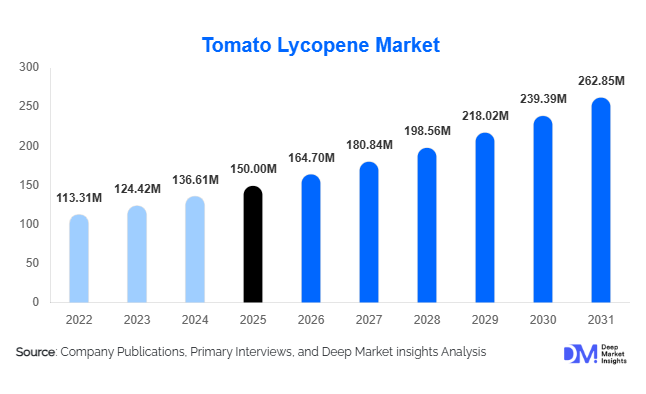
According to Deep Market Insights,the global tomato lycopene market size was valued at USD 150 million in 2025 and is projected to grow from USD 164.70 million in 2026 to reach USD 262.85 million by 2031, expanding at a CAGR of 9.8% during the forecast period (2026–2031). Market growth is primarily driven by rising global demand for natural antioxidants, increasing adoption of preventive healthcare supplements, and expanding applications of lycopene across functional foods, pharmaceuticals, and cosmetic formulations. Growing consumer preference for clean-label ingredients and plant-derived bioactives is accelerating the replacement of synthetic additives with natural tomato-derived compounds, strengthening long-term industry expansion.
Key Market Insights
- Natural tomato-derived lycopene dominates global demand, supported by clean-label and plant-based ingredient trends.
- Dietary supplements account for the largest application share, driven by cardiovascular and anti-aging health awareness.
- Asia-Pacific leads global production and consumption, benefiting from strong tomato-processing infrastructure and cost-efficient extraction.
- Supercritical CO₂ extraction technology adoption is increasing, improving purity levels and pharmaceutical-grade applications.
- Functional food fortification is emerging as a major growth avenue, particularly in beverages and nutrition products.
- Cosmetic industry adoption is accelerating, with lycopene gaining traction in anti-pollution and antioxidant skincare products.
What are the latest trends in the tomato lycopene market?
Shift Toward Natural and Clean-Label Ingredients
Food, nutraceutical, and cosmetic manufacturers are increasingly prioritizing natural ingredients to meet evolving consumer expectations. Lycopene derived from tomatoes is gaining preference over synthetic antioxidants due to regulatory acceptance and consumer trust in plant-based formulations. Clean-label product launches across functional beverages, dietary supplements, and fortified foods are driving ingredient innovation. Manufacturers are also emphasizing non-GMO and organic-certified extracts, positioning tomato lycopene as a premium functional ingredient aligned with global wellness trends.
Advanced Extraction and Microencapsulation Technologies
Technological advancements are reshaping the production landscape. Supercritical CO₂ extraction methods are improving product purity while reducing solvent residues, enabling pharmaceutical and high-performance nutraceutical applications. Microencapsulation technologies are enhancing lycopene stability and bioavailability, allowing incorporation into diverse product formats such as powdered drink mixes and functional snacks. These innovations reduce oxidation sensitivity and extend shelf life, enabling manufacturers to expand product applications while maintaining efficacy.
What are the key drivers in the tomato lycopene market?
Growing Preventive Healthcare Awareness
Consumers worldwide are increasingly adopting preventive health practices, boosting demand for antioxidant supplements. Lycopene’s scientifically supported role in reducing oxidative stress and supporting cardiovascular health has made it a key ingredient in dietary supplements. Aging populations across developed economies and rising healthcare awareness in emerging markets are accelerating consumption, particularly within nutraceutical formulations targeting heart health and immune support.
Expansion of Functional Foods and Fortified Products
The rapid expansion of functional food and beverage categories is another major growth driver. Manufacturers are incorporating lycopene into juices, dairy alternatives, nutrition bars, and ready-to-drink beverages to enhance nutritional value and natural coloration. Consumers seeking convenient health solutions are driving demand for fortified everyday products, positioning lycopene as a multifunctional ingredient combining nutritional benefits and natural pigmentation.
What are the restraints for the global market?
Raw Material Price Volatility
The tomato lycopene industry depends heavily on agricultural output, making it vulnerable to seasonal fluctuations, climate variability, and crop yield instability. Changes in tomato supply directly affect extraction costs and pricing stability, creating challenges for manufacturers attempting to maintain consistent margins and long-term supply agreements.
Formulation and Stability Challenges
Lycopene is highly sensitive to oxidation and light exposure, requiring specialized encapsulation and formulation technologies. Smaller manufacturers lacking advanced processing capabilities may face challenges in maintaining product stability and bioavailability, limiting broader commercialization across mass-market applications.
What are the key opportunities in the tomato lycopene industry?
Functional Nutrition and Personalized Health Products
Personalized nutrition trends present strong opportunities for lycopene integration into targeted health solutions. Companies are developing formulations tailored to specific health outcomes such as heart health, skin protection, and aging support. Customized supplement blends combining lycopene with other carotenoids and vitamins are gaining popularity, enabling premium product positioning and higher margins for manufacturers.
Agricultural Waste Valorization and Sustainable Production
Tomato-processing by-products represent a valuable raw material source for lycopene extraction. Increasing adoption of circular economy models allows producers to convert agricultural waste into high-value nutraceutical ingredients. Partnerships between tomato processors and extraction companies are reducing raw material costs while improving sustainability credentials, creating competitive advantages for vertically integrated players.
Report Scope
| Report Metric | Details |
|---|---|
| Market Size in 2025 | USD 150 Million |
| Market Size in 2026 | USD 164.70 Million |
| Market Size in 2031 | USD 262.85 Million |
| CAGR | 9.8% (2026-2031) |
| Base Year for Estimation | 2025 |
| Historical Data | 2022-2024 |
| Forecast Period | 2026-2031 |
| Report Coverage | Revenue Forecast, Competitive Landscape, Supply Chain Disruption, Growth Factors, Environment & Regulatory Landscape and Trends |
| Geographies Covered | North America, Europe, APAC, Middle East and Africa, LATAM |
| Countries Covered | U.S., Canada, U.K., Germany, France, Spain, Italy, Russia, Nordic, Benelux, Rest of Europe, China, Korea, Japan, India, Australia, Singapore, Taiwan, South East Asia, Rest of Asia-Pacific, UAE, Turky, Saudi Arabia, South Africa, Egypt, Nigeria, Rest of MEA, Brazil, Mexico, Argentina, Chile, Colombia, Rest of LATAM |
Explore more data points, trends and opportunities Download Free Sample Report
Product Type Insights
Natural tomato-derived lycopene dominates the global market, accounting for nearly 72% of total demand, as manufacturers increasingly prioritize plant-based bioactive ingredients that align with clean-label positioning, sustainability goals, and consumer preference for naturally sourced antioxidants. The strong dominance of natural lycopene is supported by expanding applications in nutraceuticals, functional foods, and cosmetic formulations, where transparency in ingredient sourcing plays a critical role in purchasing decisions. Synthetic lycopene continues to lose market share due to heightened regulatory scrutiny, evolving labeling requirements, and shifting consumer perceptions favoring naturally derived compounds over chemically synthesized alternatives. Within product forms, microencapsulated beadlets hold the leading position, primarily driven by their superior stability, enhanced bioavailability, protection against oxidation, and controlled release capabilities that improve shelf life and formulation performance. These functional advantages make beadlets highly suitable for dietary supplements and pharmaceutical preparations. Oil suspensions remain widely utilized in soft-gel capsules due to improved absorption efficiency and compatibility with lipid-based delivery systems, while powdered lycopene formats are increasingly adopted in functional foods and beverage applications requiring uniform dispersion, formulation flexibility, and scalable production integration.
Application Insights
Dietary supplements represent the largest application segment, contributing approximately 41% of total market revenue, driven by growing global awareness regarding antioxidant supplementation, cardiovascular health support, immune function enhancement, and preventive healthcare practices. The leading driver for this segment is the rising consumer shift toward proactive wellness management and daily supplementation routines, particularly among aging populations and health-conscious consumers. Functional foods and beverages are emerging as the fastest-growing application category, supported by innovation in fortified beverages, plant-based nutrition products, and convenience-oriented healthy snacks that integrate scientifically supported ingredients such as lycopene. Pharmaceutical applications are expanding steadily as clinical research continues to validate lycopene’s potential role in reducing oxidative stress and supporting therapies targeting chronic diseases, including cardiovascular disorders and metabolic conditions. In cosmetics and personal care, lycopene is gaining traction due to its anti-aging, anti-inflammatory, and UV-protective properties, driving its incorporation into advanced skincare formulations. Animal nutrition applications, although smaller in scale, are developing as a niche growth area, supported by lycopene’s benefits in improving oxidative stability, enhancing pigmentation, and supporting overall animal health performance.
Distribution Channel Insights
B2B ingredient supply dominates the tomato lycopene market, accounting for over 60% of global sales, as ingredient manufacturers primarily distribute standardized extracts to nutraceutical, pharmaceutical, and food processing companies. The dominance of this channel is driven by large-scale formulation requirements, long-term procurement contracts, and increasing demand for consistent ingredient quality and traceability. Contract manufacturing partnerships are expanding significantly, enabling consumer brands to outsource formulation, encapsulation, and production processes while focusing on branding and market expansion strategies. Direct sales relationships between ingredient suppliers and global supplement brands are strengthening as companies pursue supply chain stability and customized ingredient solutions. Additionally, digital ingredient marketplaces and online procurement platforms are emerging as transformative distribution mechanisms, improving pricing transparency, accelerating sourcing processes, and allowing small and mid-sized brands to access specialized bioactive ingredients previously limited to large manufacturers.
End-Use Industry Insights
The nutraceutical industry represents the largest end-use segment, contributing roughly 44% of total demand, primarily driven by increasing adoption of antioxidant-based supplements targeting heart health, immunity, and healthy aging. The leading driver for this segment is the global expansion of preventive healthcare and personalized nutrition trends, which continue to stimulate demand for scientifically validated plant-derived ingredients. The functional food industry is experiencing rapid growth as manufacturers integrate lycopene into everyday food products to enhance nutritional value without compromising taste or formulation stability. Pharmaceutical companies are increasingly exploring lycopene inclusion in therapeutic and adjunct formulations aimed at chronic disease management, supported by growing clinical validation and research investments. Cosmetic manufacturers are expanding antioxidant-rich skincare portfolios, leveraging lycopene’s protective properties against environmental stressors and skin aging. Export-oriented demand remains strong, particularly from North America and Europe, where supplement and functional food brands rely heavily on imported high-quality lycopene extracts to support large-scale production and meet stringent quality standards.
Explore more data points, trends and opportunities Download Free Sample Report
Tomato Lycopene Market Segmentations
By Product Type
- Natural Tomato-Derived Lycopene
- Synthetic Lycopene
- Fermentation-Based Lycopene
By Form
- Powder
- Oil Suspension
- Beadlets & Microencapsulated Forms
- Liquid Extracts
By Application
- Dietary Supplements & Nutraceuticals
- Functional Foods & Beverages
- Pharmaceuticals
- Cosmetics & Personal Care
- Animal Nutrition
By Distribution Channel
- B2B Ingredient Supply
- Direct Manufacturer Contracts
- Online Ingredient Platforms
- Specialty Nutraceutical Distributors
By End-Use Industry
- Nutraceutical Industry
- Food & Beverage Industry
- Pharmaceutical Industry
- Cosmetics & Personal Care Industry
- Animal Feed Industry
Regional Insights
North America
North America accounts for approximately 24% of the global tomato lycopene market, led by the United States, where high dietary supplement consumption and advanced nutraceutical innovation ecosystems sustain consistent demand. Regional growth is driven by strong consumer adoption of preventive healthcare practices, widespread awareness of antioxidant benefits, and increasing demand for clinically supported natural ingredients. The presence of established supplement brands, robust distribution networks, and ongoing product innovation in functional beverages and fortified foods further strengthens market expansion. Canada contributes steadily through rising clean-label product development, increasing functional food penetration, and supportive regulatory frameworks encouraging natural ingredient utilization.
Europe
Europe holds nearly 28% market share, supported by strong demand across Germany, Italy, France, and Spain. Regional growth is primarily driven by stringent regulatory standards favoring natural ingredients, increasing sustainability initiatives, and consumer preference for traceable botanical extracts. Italy benefits significantly from its integrated tomato-processing ecosystem, enabling efficient raw material sourcing and extraction capabilities, while Germany leads nutraceutical consumption supported by a mature supplement market and health-conscious population. Growing investments in plant-based nutrition, eco-friendly packaging, and functional food innovation further reinforce market development across the region.
Asia-Pacific
Asia-Pacific dominates the global tomato lycopene market with approximately 36% share and represents the fastest-growing region. Growth is driven by expanding middle-class populations, rising disposable incomes, and increasing awareness of preventive health and nutritional supplementation. China serves as both a major producer and exporter due to large-scale tomato cultivation, cost-efficient extraction infrastructure, and strong export-oriented manufacturing capabilities. India is experiencing rapid expansion supported by growing nutraceutical manufacturing capacity, increasing domestic supplement consumption, and government initiatives promoting food processing industries. Japan maintains stable demand through premium supplement markets emphasizing high-quality, scientifically validated ingredients and aging population health management.
Latin America
Latin America contributes around 7% of global demand, with Brazil and Mexico emerging as key markets supported by agricultural integration and improving processing capabilities. Regional growth is driven by expanding cultivation of tomatoes, increasing investments in botanical extraction technologies, and rising participation in global ingredient supply chains. Growing awareness of functional nutrition and export opportunities for natural extracts are encouraging regional manufacturers to enhance production quality and expand international trade partnerships.
Middle East & Africa
The Middle East & Africa region accounts for roughly 5% of global market share, with demand concentrated in the UAE and South Africa. Regional growth is supported by expanding wellness industries, increasing reliance on imported nutraceutical ingredients, and rising consumer awareness regarding preventive health and nutritional supplementation. Rapid urbanization, improving retail infrastructure, and the growing presence of international supplement brands are contributing to gradual market expansion, while increasing investments in healthcare and lifestyle-oriented products are expected to support long-term demand growth.
Key Players in the Tomato Lycopene Market
- Lycored Ltd.
- DSM-Firmenich
- BASF SE
- Divi’s Laboratories Ltd.
- Zhejiang NHU Co., Ltd.
- Allied Biotech Corporation
- Kagome Co., Ltd.
- Dohler Group
- Naturex (Givaudan)
- Synthite Industries Ltd.
- Xi’an Healthful Biotechnology
- AVT Natural Products Ltd.
- Chenguang Biotech Group Co., Ltd.
- Nutra Green Biotechnology Co., Ltd.
- Foodchem International Corporation