Thermal Slippers Market Size
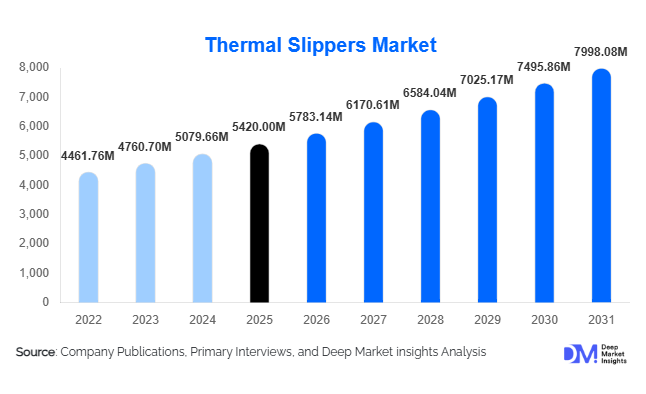
According to Deep Market Insights, the global thermal slippers market size was valued at USD 5,420 million in 2025 and is projected to grow from USD 5,783.14 million in 2026 to reach USD 7,998.08 million by 2031, expanding at a CAGR of 6.7% during the forecast period (2026–2031). The thermal slippers market growth is primarily driven by increasing consumer preference for home comfort products, rising demand for insulated footwear in colder climates, and the growing influence of remote work and indoor lifestyles.
Key Market Insights
- Thermal slippers are evolving into lifestyle comfort products, driven by increasing time spent indoors and rising demand for ergonomic footwear.
- Online retail dominates distribution, accounting for over 50% of global sales due to convenience, variety, and competitive pricing.
- North America leads the market, supported by cold climate conditions and high consumer spending on home comfort products.
- Asia-Pacific is the fastest-growing region, driven by rising middle-class income and expanding e-commerce penetration.
- Synthetic and fleece-based materials dominate production, owing to cost efficiency and scalability.
- Technological innovation, including heated slippers and advanced insulation materials, is creating premium product differentiation.
What are the latest trends in the thermal slippers market?
Shift Toward Smart and Heated Footwear
The integration of heating elements and smart temperature regulation technologies is emerging as a key trend in the thermal slippers market. Battery-powered heated slippers are gaining traction among consumers in colder regions and elderly populations with circulation issues. Manufacturers are focusing on lightweight designs, rechargeable systems, and adjustable temperature settings to enhance usability. This trend is particularly prominent in premium product categories, where consumers are willing to pay higher prices for enhanced comfort and functionality. Additionally, innovations in phase-change materials (PCM) are enabling temperature-adaptive slippers that provide consistent warmth without overheating, further driving product differentiation.
Rising Demand for Sustainable Materials
Sustainability is becoming a major focus area, with increasing adoption of eco-friendly materials such as organic wool, recycled polyester, and biodegradable fabrics. Consumers, especially in Europe and North America, are prioritizing environmentally responsible products. Manufacturers are responding by incorporating sustainable sourcing practices and transparent supply chains. Certifications related to sustainability and ethical production are also gaining importance, influencing purchasing decisions. This trend is expected to drive innovation in material science and reshape production processes across the value chain.
What are the key drivers in the thermal slippers market?
Growing Home-Centric Lifestyles
The shift toward remote work and increased time spent at home has significantly boosted demand for indoor comfort products, including thermal slippers. Consumers are investing in products that enhance comfort during daily home activities, making thermal slippers a staple household item. This trend is particularly strong in developed economies, where work-from-home culture remains prevalent.
Increasing Focus on Comfort and Foot Health
Consumers are increasingly prioritizing foot health, driving demand for slippers with memory foam, orthopedic support, and anti-slip soles. The growing geriatric population is a key contributor to this trend, as older consumers seek footwear that provides both warmth and support. Manufacturers are integrating ergonomic designs and advanced cushioning technologies to cater to this demand.
Expansion of E-commerce Platforms
The rapid growth of e-commerce has transformed the distribution landscape, enabling brands to reach global consumers with ease. Online platforms offer extensive product variety, customer reviews, and competitive pricing, driving higher sales volumes. Digital marketing and targeted advertising are further enhancing product visibility and consumer engagement.
What are the restraints for the global market?
Seasonal Demand Fluctuations
The thermal slippers market is highly seasonal, with demand peaking during winter months. This creates challenges in inventory management, production planning, and revenue stability for manufacturers and retailers. Off-season demand remains limited, particularly in warmer regions.
Intense Price Competition
The presence of numerous low-cost manufacturers, particularly in Asia, has intensified price competition. This limits profit margins, especially in the economy and mid-range segments. Premium brands must continuously innovate and differentiate to maintain pricing power and brand value.
What are the key opportunities in the thermal slippers industry?
Expansion in Emerging Markets
Emerging economies such as India, China, and Brazil present significant growth opportunities due to rising disposable incomes and increasing awareness of comfort-oriented products. Urbanization and exposure to global lifestyle trends are driving demand for premium and mid-range thermal slippers. Localized product designs and pricing strategies can help companies effectively penetrate these markets.
Product Innovation and Premiumization
There is strong potential for innovation in materials, design, and functionality. Features such as heated soles, antimicrobial fabrics, and ergonomic support are enabling manufacturers to target premium segments. Consumers are increasingly willing to pay higher prices for enhanced comfort and durability, supporting margin expansion.
Growth in Geriatric and Healthcare Segments
The aging global population presents a niche yet high-value opportunity. Thermal slippers designed for elderly users, with features such as anti-slip soles, easy wearability, and orthopedic support, are gaining popularity. Healthcare institutions and wellness centers are also emerging as new demand channels.
Report Scope
| Report Metric | Details |
|---|---|
| Market Size in 2025 | USD 5420 Million |
| Market Size in 2026 | USD 5783.14 Million |
| Market Size in 2031 | USD 7998.08 Million |
| CAGR | 6.7% (2026-2031) |
| Base Year for Estimation | 2025 |
| Historical Data | 2022-2024 |
| Forecast Period | 2026-2031 |
| Report Coverage | Revenue Forecast, Competitive Landscape, Supply Chain Disruption, Growth Factors, Environment & Regulatory Landscape and Trends |
| Geographies Covered | North America, Europe, APAC, Middle East and Africa, LATAM |
| Countries Covered | U.S., Canada, U.K., Germany, France, Spain, Italy, Russia, Nordic, Benelux, Rest of Europe, China, Korea, Japan, India, Australia, Singapore, Taiwan, South East Asia, Rest of Asia-Pacific, UAE, Turky, Saudi Arabia, South Africa, Egypt, Nigeria, Rest of MEA, Brazil, Mexico, Argentina, Chile, Colombia, Rest of LATAM |
Explore more data points, trends and opportunities Download Free Sample Report
Product Type Insights
Closed-toe thermal slippers dominate the market, accounting for approximately 38% of the global share in 2025, and are expected to maintain their leadership position throughout the forecast period. The primary driver for this segment is their superior insulation capability and full-foot coverage, which ensures optimal heat retention in cold climates across North America, Europe, and parts of Asia-Pacific. Increasing consumer preference for enhanced warmth, particularly in regions experiencing prolonged winters, continues to support strong demand. Additionally, the rising trend of home-based lifestyles has amplified the need for all-day comfort, further reinforcing the dominance of this segment.
Bootie-style and moccasin-style slippers are witnessing accelerated growth in the premium category, driven by design innovation, aesthetic appeal, and higher comfort levels. These styles are increasingly being positioned as lifestyle products rather than just functional footwear, appealing to younger and fashion-conscious consumers. Meanwhile, slip-on and open-toe variants cater to warmer climates and transitional weather conditions, particularly in regions such as Latin America and parts of Asia. Their lightweight design and ease of use make them suitable for indoor comfort, contributing to overall market diversification.
Material Insights
Synthetic materials, including polyester and fleece, lead the market with a share of around 42% in 2025, primarily driven by cost efficiency, scalability, and consistent performance. These materials allow manufacturers to produce thermal slippers at competitive price points while maintaining durability and thermal insulation. The ability to mass-produce synthetic-based slippers with varied designs and colors further enhances their appeal across price-sensitive and mid-range consumer segments.
Natural fibers such as wool are gaining traction in premium segments, supported by growing consumer awareness around sustainability and superior thermal properties. Wool-based slippers offer enhanced breathability and moisture control, making them highly desirable in colder climates. Additionally, the increasing shift toward eco-conscious consumption, particularly in Europe, is driving demand for biodegradable and responsibly sourced materials. Memory foam-based thermal slippers are emerging as a high-growth sub-segment, driven by rising demand for ergonomic comfort and foot health support. Consumers, especially in aging populations, are prioritizing cushioning, pressure distribution, and orthopedic benefits, positioning memory foam as a key differentiator in premium and mid-range offerings.
Distribution Channel Insights
Online retail dominates the thermal slippers market, accounting for approximately 52% of total sales in 2025, and continues to expand rapidly. The key driver for this segment is the increasing penetration of e-commerce platforms and direct-to-consumer (D2C) strategies, which provide convenience, wider product assortments, and competitive pricing. Consumers are increasingly relying on online channels for product comparisons, reviews, and seasonal discounts, particularly during winter sales cycles. Brand-owned websites are also gaining traction as companies focus on building direct customer relationships and improving margins. Advanced digital marketing strategies, including targeted advertising and influencer collaborations, are further boosting online sales.
Offline channels, including specialty footwear stores, supermarkets, and department stores, continue to hold relevance, especially in regions with lower internet penetration or strong traditional retail networks. However, the shift toward omnichannel retailing and digital-first strategies is expected to reshape distribution dynamics, with online channels continuing to outpace offline growth.
End-Use Insights
Women represent the largest end-user segment, accounting for around 40% of the market in 2025, driven by higher purchase frequency, greater product variety, and stronger engagement with fashion-oriented designs. Brands are increasingly introducing diverse styles, colors, and premium features targeting female consumers, further strengthening this segment’s dominance. The geriatric population is the fastest-growing segment, supported by rising global aging demographics and increasing demand for comfort-oriented and health-supportive footwear. Features such as anti-slip soles, orthopedic cushioning, and easy wearability are becoming essential, particularly in developed markets such as Japan, Germany, and the United States.
Residential use remains the primary application, with thermal slippers predominantly used for indoor comfort. However, emerging demand from hospitality, wellness centers, and healthcare facilities is creating new growth avenues. Luxury hotels and spas are increasingly incorporating premium thermal slippers into their guest experience offerings, while healthcare institutions are adopting them for patient comfort and safety.
Explore more data points, trends and opportunities Download Free Sample Report
Thermal Slippers Market Segmentations
By Product Type
- Closed-Toe Thermal Slippers
- Open-Toe Thermal Slippers
- Bootie-Style Thermal Slippers
- Moccasin-Style Thermal Slippers
- Slip-On Thermal Slippers
By Material Type
- Natural Fibers
- Synthetic Materials
- Blended Materials
- Memory Foam-Based Thermal Slippers
By Distribution Channel
- Online Retail
- Supermarkets/Hypermarkets
- Specialty Footwear Stores
- Department Stores
By End-User
- Men
- Women
- Kids
- Geriatric Population
By Usage Type
- Indoor Use
- Indoor-Outdoor Hybrid Use
Regional Insights
North America
North America accounts for approximately 28% of the global market in 2025, with the United States contributing the majority share. The region’s growth is primarily driven by prolonged winter seasons, high disposable incomes, and strong consumer inclination toward premium comfort products. The widespread adoption of remote work has further increased demand for indoor footwear, including thermal slippers. Additionally, high e-commerce penetration and advanced logistics infrastructure enable efficient product distribution, supporting market expansion. The growing popularity of technologically advanced products, such as heated slippers, is also a key regional growth driver.
Europe
Europe holds around 26% of the global market share, with Germany, the United Kingdom, and France leading demand. The region’s growth is driven by cold climatic conditions, strong sustainability regulations, and high consumer awareness regarding eco-friendly products. European consumers exhibit a strong preference for high-quality, durable, and sustainably sourced materials, particularly wool-based slippers. Additionally, government regulations promoting environmentally responsible manufacturing are encouraging brands to innovate in sustainable materials. The region’s mature retail infrastructure and high purchasing power further support steady demand growth.
Asia-Pacific
Asia-Pacific is the fastest-growing region, with a CAGR exceeding 7.5%, driven by rapid urbanization, rising disposable incomes, and expanding middle-class populations. China dominates global production due to its well-established manufacturing ecosystem and cost advantages, while India is emerging as a high-growth consumption market. The rapid expansion of e-commerce platforms, coupled with increasing smartphone penetration, is significantly boosting product accessibility. Additionally, colder regions in countries such as China, Japan, and South Korea are driving seasonal demand, while changing lifestyle patterns are increasing adoption in urban households.
Latin America
Latin America accounts for approximately 10% of the global market, with Brazil and Argentina as key contributors. Market growth is driven by urbanization, improving retail infrastructure, and increasing consumer awareness of comfort-oriented products. Seasonal demand during colder months in southern regions supports sales, while rising middle-class income levels are enabling greater adoption of mid-range and premium thermal slippers. However, relatively lower market penetration and economic volatility remain challenges to sustained growth.
Middle East & Africa
The Middle East & Africa region holds around 8% of the market share. Growth in this region is driven by rising disposable incomes, increasing adoption of premium lifestyle products, and expanding retail networks, particularly in countries such as the UAE and South Africa. While overall demand is limited by warmer climates, colder regions within Africa and high-income urban populations in the Middle East are supporting niche demand. Additionally, the growing influence of global fashion trends and increasing penetration of international brands are contributing to market expansion in this region.
Key Players in the Thermal Slippers Market
- Deckers Brands
- Skechers USA Inc.
- Nike Inc.
- Adidas AG
- Puma SE
- Columbia Sportswear Company
- VF Corporation
- Crocs Inc.
- Under Armour Inc.
- Wolverine World Wide Inc.
- Bata Corporation
- Relaxo Footwears Ltd.
- Li Ning Company Limited
- Anta Sports Products Limited
- Decathlon Group