Tertiary Butylhydroquinone (TBHQ) Market Size
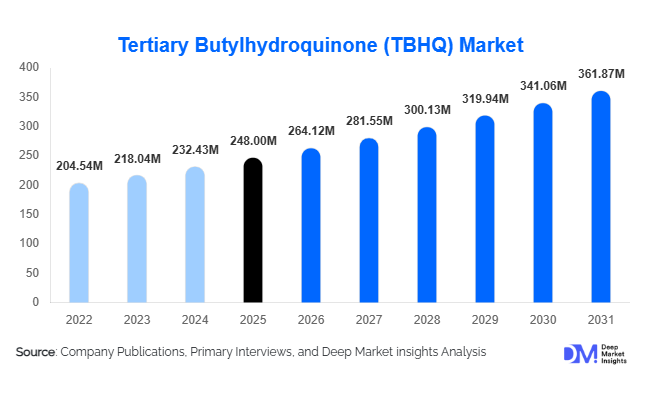
According to Deep Market Insights, the global tertiary butylhydroquinone (TBHQ) market size was valued at USD 248 million in 2025 and is projected to grow from USD 264.12 million in 2026 to reach USD 361.87 million by 2031, expanding at a CAGR of 6.6% during the forecast period (2026–2031). The TBHQ market growth is primarily driven by rising consumption of processed and fried foods, increasing global edible oil production, and expanding biodiesel blending mandates that require enhanced oxidative stability solutions.
Key Market Insights
- Food-grade TBHQ accounts for nearly 68% of total market demand, supported by its widespread use in edible oils, snacks, and instant foods.
- Edible oil stabilization remains the largest application segment, contributing approximately 45% of total market value in 2025.
- Asia-Pacific dominates the global market, holding around 42% share due to strong food processing and palm oil refining industries.
- The biofuel sector is the fastest-growing application, expanding at over 7% CAGR with increasing biodiesel mandates worldwide.
- Direct B2B sales channels account for nearly 70% of global distribution, reflecting procurement by large oil refiners and food manufacturers.
- Top five companies collectively control 55–60% of global market share, indicating moderate consolidation with strong regional leaders.
What are the latest trends in the TBHQ market?
Shift Toward High-Purity and Regulatory-Compliant Grades
Manufacturers are increasingly investing in high-purity TBHQ grades to meet evolving food safety standards in North America and Europe. Regulatory agencies such as the FDA and EFSA impose strict permissible limits on antioxidant use in food products, prompting suppliers to enhance purification processes and reduce residual impurities. Pharmaceutical-grade TBHQ, though smaller in share, is gaining traction in specialized formulations requiring higher compliance thresholds. Companies are also focusing on traceability and quality assurance certifications to differentiate themselves in mature markets.
Rising Adoption in Biodiesel Stabilization
The global push toward renewable energy has increased biodiesel blending mandates across the U.S., Brazil, Indonesia, and the EU. TBHQ plays a crucial role in improving oxidative stability during fuel storage and transport, particularly in tropical climates where degradation risks are higher. As biofuel production expands, industrial-grade TBHQ demand is rising steadily, diversifying the market beyond traditional food applications. Integration with fuel additive packages and customized antioxidant blends is emerging as a value-added strategy among producers.
What are the key drivers in the TBHQ market?
Growth in Processed and Packaged Food Consumption
The global packaged food industry is expanding at 5–6% annually, driven by urbanization, rising disposable incomes, and changing dietary habits. TBHQ is widely used to prevent oxidative rancidity in vegetable oils and fried snacks, ensuring longer shelf life and consistent taste. Increasing quick-service restaurant penetration in Asia-Pacific and Latin America further boosts edible oil usage, directly stimulating TBHQ demand.
Expansion of Global Edible Oil Production
Global edible oil output exceeds 220 million metric tons annually, led by palm oil in Southeast Asia and soybean oil in the Americas. Oxidation control during refining, storage, and export is critical, making TBHQ a cost-effective antioxidant solution. Export-driven oil trade from Indonesia, Malaysia, Argentina, and Ukraine continues to support stable market expansion.
What are the restraints for the global market?
Preference for Natural Antioxidants
Consumer demand for clean-label and naturally derived ingredients has led some food manufacturers to substitute synthetic antioxidants like TBHQ with tocopherols and rosemary extracts. While TBHQ remains more cost-effective, premium product segments are gradually shifting toward natural alternatives, potentially limiting growth in developed markets.
Raw Material Price Volatility
TBHQ production depends on petrochemical derivatives such as phenol and isobutylene. Fluctuations in crude oil prices and feedstock supply disruptions impact manufacturing costs and profit margins, posing a challenge for producers operating in price-sensitive markets.
What are the key opportunities in the TBHQ industry?
Emerging Market Food Processing Expansion
Rapid industrialization in India, Vietnam, Nigeria, and Brazil is boosting domestic food manufacturing capacity. Government initiatives promoting food processing infrastructure are creating opportunities for TBHQ suppliers to establish regional production facilities and secure long-term supply contracts.
Customized Antioxidant Blends for Industrial Applications
Beyond food preservation, TBHQ is increasingly used in polymers, resins, and biodiesel. Developing synergistic antioxidant blends tailored to specific industrial requirements can enhance performance and improve margins. This diversification reduces dependence on food-sector demand cycles.
Report Scope
| Report Metric | Details |
|---|---|
| Market Size in 2025 | USD 248 Million |
| Market Size in 2026 | USD 264.12 Million |
| Market Size in 2031 | USD 361.87 Million |
| CAGR | 6.6% (2026-2031) |
| Base Year for Estimation | 2025 |
| Historical Data | 2022-2024 |
| Forecast Period | 2026-2031 |
| Report Coverage | Revenue Forecast, Competitive Landscape, Supply Chain Disruption, Growth Factors, Environment & Regulatory Landscape and Trends |
| Geographies Covered | North America, Europe, APAC, Middle East and Africa, LATAM |
| Countries Covered | U.S., Canada, U.K., Germany, France, Spain, Italy, Russia, Nordic, Benelux, Rest of Europe, China, Korea, Japan, India, Australia, Singapore, Taiwan, South East Asia, Rest of Asia-Pacific, UAE, Turky, Saudi Arabia, South Africa, Egypt, Nigeria, Rest of MEA, Brazil, Mexico, Argentina, Chile, Colombia, Rest of LATAM |
Explore more data points, trends and opportunities Download Free Sample Report
Grade Insights
The global TBHQ market is segmented by grade into food-grade, industrial/technical-grade, and pharmaceutical-grade categories. Among these, food-grade TBHQ dominates the market, accounting for approximately 68% of the total market share in 2025. The dominance of this segment is primarily driven by the leading segment driver — the widespread use of TBHQ as a cost-effective and highly efficient antioxidant in edible oils and fats. Food manufacturers rely heavily on TBHQ to prevent oxidative rancidity, extend shelf life, and maintain product quality during storage and transportation. Rapid expansion of packaged foods, fried snacks, instant noodles, and ready-to-eat meals in emerging economies continues to reinforce demand.
Industrial/technical-grade TBHQ represents around 25% of the market and is primarily utilized in biodiesel stabilization, polymers, resins, and industrial lubricants. Growth in this segment is supported by rising biodiesel production mandates and the increasing need for fuel stability solutions to enhance storage life and oxidative resistance.Pharmaceutical-grade TBHQ accounts for the remaining market share, catering to niche but high-value applications where stringent regulatory compliance and high purity standards are required. Although smaller in volume, this segment benefits from steady demand in specialized formulations and high-margin pharmaceutical applications.
Application Insights
Based on application, edible oils and fats stabilization remains the largest segment, contributing nearly 45% of total market revenue in 2025. The leading driver for this segment is the growing global consumption of vegetable oils such as palm oil, soybean oil, and sunflower oil, particularly in high-temperature cooking and deep-frying applications. TBHQ’s superior heat stability compared to alternative antioxidants makes it particularly suitable for frying oils used in quick-service restaurants and food processing industries.Processed and packaged foods account for roughly 30% of market revenue. Rising urbanization, busy lifestyles, and increased penetration of organized retail channels are accelerating demand for shelf-stable snacks, baked goods, frozen foods, and convenience products. TBHQ plays a crucial role in maintaining flavor integrity and preventing oxidation in these products.
Biodiesel and fuel stabilizers represent approximately 12% of the market and are currently the fastest-growing application segment. Expansion of renewable fuel policies in North America, Europe, and parts of Asia is increasing biodiesel production, thereby driving demand for antioxidant additives that prevent fuel degradation during storage.Industrial chemicals, cosmetics, and pharmaceutical applications collectively account for the remaining share. These segments benefit from consistent demand for oxidation inhibitors in specialty chemical formulations and personal care products where stability and extended shelf life are essential.
End-Use Industry Insights
The food & beverage industry commands nearly 60% of overall TBHQ demand, making it the dominant end-use sector. The primary growth driver is large-scale edible oil refining and snack production across both developed and developing economies. Expanding fast-food chains, rising disposable incomes, and increasing demand for packaged consumables are further strengthening consumption.
The energy & biofuels sector is the fastest-growing end-use industry, projected to expand at over 7.5% CAGR through 2031. Government mandates promoting renewable energy adoption, coupled with growing investments in biodiesel infrastructure, are accelerating TBHQ usage as a fuel stabilizer.Animal nutrition and personal care industries contribute moderate yet stable demand. In animal feed, TBHQ helps preserve fat-rich formulations, while in cosmetics it supports product stability. Export-oriented economies particularly rely on TBHQ to ensure product durability across long supply chains.
Explore more data points, trends and opportunities Download Free Sample Report
Tertiary Butylhydroquinone (TBHQ) Market Segmentations
By Grade
- Food Grade TBHQ
- Industrial/Technical Grade TBHQ
- Pharmaceutical Grade TBHQ
By Application
- Edible Oils & Fats Stabilization
- Processed & Packaged Foods
- Animal Feed Preservation
- Biodiesel & Fuel Stabilizers
- Industrial Chemicals & Polymers
- Cosmetics & Personal Care
- Pharmaceutical Formulations
By End-Use Industry
- Food & Beverage Industry
- Animal Nutrition Industry
- Energy & Biofuels Industry
- Chemical & Petrochemical Industry
- Pharmaceutical Industry
- Personal Care & Cosmetics Industry
By Distribution Channel
- Direct Sales (B2B Contracts)
- Specialty Chemical Distributors
- Online Industrial Platforms
Regional Insights
Asia-Pacific
Asia-Pacific holds approximately 42% of the global TBHQ market share in 2025, making it the largest regional market. The region’s dominance is driven by rapid industrialization, large-scale edible oil production, and expanding packaged food consumption. China leads regional demand due to its extensive edible oil refining capacity, growing snack food industry, and strong domestic consumption. India follows closely, supported by rising urbanization, growth in organized retail, and government-backed food processing initiatives under “Make in India.”Indonesia and Malaysia remain strategically important markets due to their substantial palm oil production and export activities, which require oxidation control solutions. Additionally, rising middle-class populations and increasing disposable incomes across Southeast Asia continue to stimulate long-term market growth.
North America
North America accounts for approximately 25% of global market share, with the United States serving as the primary contributor. Growth in the region is supported by high consumption of processed and fried foods, well-established snack manufacturing industries, and strong biodiesel production capacity. Federal renewable fuel standards (RFS) continue to encourage biodiesel blending, driving TBHQ demand in fuel stabilization.Stable regulatory frameworks and advanced food safety standards ensure consistent usage levels. However, growing consumer preference for natural antioxidants may slightly moderate long-term growth in premium food segments.
Europe
Europe represents about 18% of the global market share, led by Germany, France, Spain, and Italy. The region benefits from a well-developed food processing sector and biodiesel industry, particularly in Germany and France. EU renewable energy directives support steady biodiesel production, indirectly stimulating TBHQ demand.However, stricter food additive regulations and increasing consumer inclination toward clean-label and natural ingredients present moderate growth constraints. As a result, regional expansion is steady but comparatively slower than Asia-Pacific.
Latin America
Latin America contributes nearly 7% of the global TBHQ market. Brazil and Argentina drive regional demand due to large-scale soybean oil production and strong biodiesel industries. Government policies promoting renewable fuels and expanding edible oil exports are key growth drivers.Growing urban populations and increasing consumption of packaged food products further support stable market expansion across the region.
Middle East & Africa
The Middle East & Africa region holds roughly 8% of global market share. Growth is supported by expanding food processing industries in Saudi Arabia, the UAE, and South Africa. Rising investments in domestic food manufacturing to reduce import dependency are boosting TBHQ demand.Additionally, increasing urbanization, population growth, and rising consumption of edible oils and packaged foods across Gulf Cooperation Council (GCC) countries are contributing to gradual but consistent market growth.
Key Players in the TBHQ Market
- Eastman Chemical Company
- Camlin Fine Sciences Ltd.
- SI Group Inc.
- LANXESS AG
- Anhui Jinhe Industrial Co., Ltd.
- Merisol Chemicals
- Finoric LLC
- Nanjing Datang Chemical Co., Ltd.
- Milestone Preservatives
- Merck KGaA
- Jiangsu Huanxin High-Tech Materials Co., Ltd.
- Shandong Linyi Sunny Wealth Chemicals