Temporary Tattoo Printer Market Size
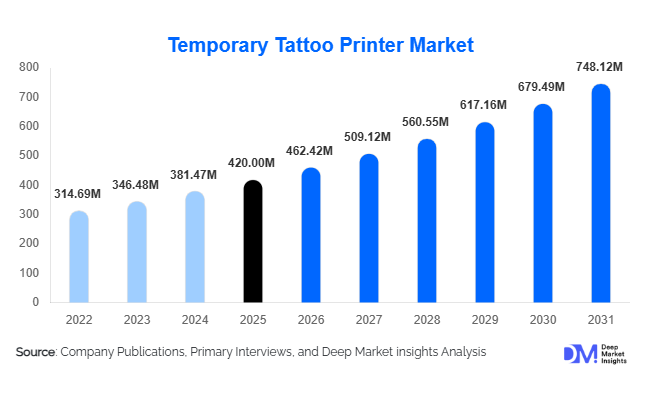
According to Deep Market Insights, the global temporary tattoo printer market size was valued at USD 420 million in 2025 and is projected to grow from USD 462.42 million in 2026 to reach USD 748.12 million by 2031, expanding at a CAGR of 10.1% during the forecast period (2026–2031). The market growth is primarily driven by rising demand for personalized body art, rapid expansion of experiential marketing campaigns, increasing adoption in entertainment and retail sectors, and continuous advancements in cosmetic-grade digital printing technologies.
The temporary tattoo printer market is transitioning from a niche entertainment segment into a mainstream personalization and branding solution across industries. Increasing consumer inclination toward non-permanent body art, combined with social media influence and festival culture, is accelerating adoption globally. Technological improvements such as inkjet-based high-resolution printing, AI-enabled design customization, and hypoallergenic ink formulations are significantly enhancing product appeal and safety compliance.
Asia-Pacific leads the market in terms of manufacturing and volume consumption, while North America dominates in premium adoption and technological innovation. Europe continues to grow steadily due to strict cosmetic safety regulations and strong fashion-driven demand. Overall, the market is evolving into a hybrid ecosystem combining entertainment, beauty technology, and digital customization platforms.
Key Market Insights
- Experiential marketing and live brand activations are the largest demand drivers, especially in the entertainment and retail industries.
- Inkjet-based tattoo printers dominate the market due to high-resolution output and affordability.
- The entertainment and events industry leads global demand, driven by festivals, concerts, and sports events.
- Cosmetic-grade inks account for the largest ink segment share due to regulatory compliance and skin safety.
- Asia-Pacific dominates production and consumption, supported by strong manufacturing ecosystems in China, Japan, and India.
- AI-based design tools and mobile integration are reshaping customer engagement and personalization trends.
What are the latest trends in the temporary tattoo printer market?
AI-Driven Customization and Digital Design Integration
The market is witnessing strong adoption of AI-powered design tools that allow users to create personalized tattoo patterns in real time. Mobile applications integrated with tattoo printers enable consumers to preview designs using augmented reality before printing. This trend is significantly enhancing customer engagement in retail stores, events, and e-commerce platforms. Businesses are increasingly leveraging cloud-based design libraries and automated personalization engines to improve efficiency and reduce design turnaround time.
Expansion of Experiential Marketing and Event-Based Usage
Temporary tattoo printers are increasingly being used in brand activations, music festivals, sports events, and product launches. Companies are using tattoos as interactive branding tools to enhance audience participation and recall. This trend is particularly strong in North America and Asia-Pacific, where event-driven marketing budgets are expanding. Portable and high-speed printers are becoming essential equipment for marketing agencies and event organizers.
What are the key drivers in the temporary tattoo printer market?
Rising Demand for Personalization and Self-Expression
Consumers, especially younger demographics, are increasingly seeking customizable and non-permanent body art solutions. Temporary tattoos offer a safe and flexible way to express identity without long-term commitment. Social media platforms are amplifying this trend, making tattoo-based aesthetics highly popular in festivals, fashion events, and influencer campaigns.
Advancements in Safe Printing Technologies
The development of cosmetic-grade inks and advanced inkjet printing systems has significantly improved safety and print quality. Hypoallergenic, water-based, and UV-responsive inks have enabled wider adoption across sensitive user groups. These innovations are also helping manufacturers comply with strict global regulatory standards.
What are the restraints for the global market?
Regulatory Compliance Challenges
Strict regulations regarding cosmetic inks and skin-contact materials increase production costs and limit market entry for smaller players. Compliance requirements vary across regions such as Europe and North America, creating complexity in global product standardization.
Limited Durability and Consumer Perception Issues
Temporary tattoos have short lifespans, which can reduce repeat usage in some applications. Additionally, concerns about skin allergies and durability under different environmental conditions may restrict adoption in certain consumer segments.
What are the key opportunities in the temporary tattoo printer industry?
Expansion into Healthcare and Dermatology Applications
Temporary tattoo printers are increasingly being used for medical marking, surgical planning, and dermatological testing. Hospitals and cosmetic clinics are adopting these systems due to their non-invasive and skin-safe characteristics. This opens a new high-value application segment beyond entertainment and retail.
Growth of Eco-Friendly and Sustainable Ink Technologies
Rising environmental awareness is driving demand for biodegradable inks and sustainable printing solutions. Companies investing in eco-friendly formulations are gaining a competitive advantage, particularly in Europe and North America, where sustainability regulations are strict.
Report Scope
| Report Metric | Details |
|---|---|
| Market Size in 2025 | USD 420 Million |
| Market Size in 2026 | USD 462.42 Million |
| Market Size in 2031 | USD 748.12 Million |
| CAGR | 10.1% (2026-2031) |
| Base Year for Estimation | 2025 |
| Historical Data | 2022-2024 |
| Forecast Period | 2026-2031 |
| Report Coverage | Revenue Forecast, Competitive Landscape, Supply Chain Disruption, Growth Factors, Environment & Regulatory Landscape and Trends |
| Geographies Covered | North America, Europe, APAC, Middle East and Africa, LATAM |
| Countries Covered | U.S., Canada, U.K., Germany, France, Spain, Italy, Russia, Nordic, Benelux, Rest of Europe, China, Korea, Japan, India, Australia, Singapore, Taiwan, South East Asia, Rest of Asia-Pacific, UAE, Turky, Saudi Arabia, South Africa, Egypt, Nigeria, Rest of MEA, Brazil, Mexico, Argentina, Chile, Colombia, Rest of LATAM |
Explore more data points, trends and opportunities Download Free Sample Report
Technology Type Insights
Inkjet temporary tattoo printers dominate the global market with approximately 52% share in 2025, primarily driven by their superior ability to deliver high-resolution, photo-realistic designs combined with cost efficiency and operational flexibility. These systems are widely preferred across entertainment events, retail customization stores, and promotional campaigns due to their compatibility with cosmetic-grade inks and ease of use. The leading position of inkjet technology is further reinforced by advancements in micro-nozzle printing, faster output speeds, and integration with AI-based design software, enabling real-time personalization at scale.
Thermal transfer and hybrid digital systems collectively account for a significant secondary share, particularly in industrial and high-volume promotional applications where durability and consistency are required. These technologies are often used in controlled environments such as branded merchandise production and bulk event printing. Meanwhile, laser-based tattoo printing systems, although currently limited in market penetration, are emerging in premium and niche segments due to their high precision and ability to produce intricate designs. Their adoption is expected to increase in high-end retail and cosmetic applications as technology costs decline and safety compliance improves.
Application Insights
The entertainment and events segment accounts for nearly 40% of global demand, making it the largest application category. This dominance is driven by the growing popularity of music festivals, sports events, brand activations, and experiential marketing campaigns, where temporary tattoos serve as interactive engagement tools. The increasing allocation of marketing budgets toward live experiences is further accelerating demand in this segment. Retail and fashion customization is the fastest-growing application area, supported by the rise of experiential shopping and personalized consumer experiences. Brands are integrating tattoo printers into stores to enhance customer interaction and differentiate their offerings. Advertising agencies also represent a significant share, leveraging temporary tattoos as cost-effective and memorable promotional tools in campaigns.
Healthcare applications are steadily emerging as a high-potential segment. Dermatology clinics and hospitals are adopting temporary tattoo printers for surgical markings, cosmetic testing, and skin mapping, driven by the need for non-invasive and safe marking solutions. This diversification into medical use cases is expected to create long-term growth opportunities beyond traditional entertainment-driven demand.
Distribution Channel Insights
Direct B2B sales dominate the market with approximately 55% share in 2025, driven by bulk procurement from event management companies, advertising agencies, beauty salons, and retail chains. The leading position of this channel is supported by the need for customized solutions, technical support, and long-term service contracts, which are typically offered through direct manufacturer relationships. Online e-commerce platforms are witnessing the fastest growth, fueled by increasing demand from small businesses, independent artists, and startups seeking affordable and accessible tattoo printing solutions. The availability of compact and user-friendly devices has significantly expanded the addressable market through online channels.
Specialty cosmetic equipment retailers continue to play a critical role in serving premium customers who require high-end systems and technical expertise. Additionally, rental service providers are gaining traction in event-based applications, offering short-term access to tattoo printers without requiring high upfront investment, thereby lowering entry barriers for smaller players.
Explore more data points, trends and opportunities Download Free Sample Report
Temporary Tattoo Printer Market Segmentations
By Technology
- Inkjet Temporary Tattoo Printers
- Thermal Transfer Tattoo Printers
- Laser-Based Tattoo Printing Systems
- Airbrush & Hybrid Digital Systems
By Ink Type
- Cosmetic-Grade Pigment Inks
- Hypoallergenic Water-Based Inks
- UV-Responsive & Glow Inks
- Organic/Natural Dye-Based Inks
By End User
- Entertainment & Events Industry
- Beauty & Cosmetic Salons
- Retail & Fashion Customization Stores
- Advertising & Brand Promotion Agencies
- Healthcare & Dermatology Applications
By Distribution Channel
- Direct B2B Sales
- Online E-commerce Platforms
- Specialty Cosmetic Equipment Retailers
- Rental Service Providers
Regional Insights
Asia-Pacific
Asia-Pacific leads the global temporary tattoo printer market with approximately 38% share in 2025, supported by strong manufacturing capabilities and expanding consumer demand. China dominates production due to its well-established electronics manufacturing ecosystem and cost advantages. India and Japan are key consumption markets, driven by rapid growth in entertainment industries, increasing disposable income, and a large youth population inclined toward personalized experiences. South Korea further strengthens regional demand through its advanced beauty technology sector and strong influence of K-pop and fashion trends. The region’s growth is also fueled by export-driven manufacturing and the rising adoption of cost-effective printing solutions across emerging economies.
North America
North America holds around 30% market share, led by the United States, which is a major hub for experiential marketing and entertainment events. The region’s growth is driven by high consumer spending, strong presence of global brands, and widespread adoption of advanced digital printing technologies. The increasing use of temporary tattoo printers in sports events, music festivals, and retail activations continues to boost demand. Additionally, the integration of AI-based customization tools and mobile applications is accelerating adoption among tech-savvy consumers. Canada contributes to regional growth through expanding retail customization and beauty service sectors.
Europe
Europe accounts for approximately 22% market share, with key contributions from Germany, the United Kingdom, and France. The region’s growth is driven by strict regulatory frameworks ensuring the use of safe and eco-friendly cosmetic inks, which has encouraged innovation in sustainable printing solutions. Strong integration with the fashion and luxury retail industries further supports demand, particularly in high-end customization applications. Additionally, Europe’s vibrant festival culture and tourism sector contribute significantly to the adoption of temporary tattoo printers in event-based applications.
Latin America and the Middle East & Africa
Latin America, led by Brazil and Mexico, is an emerging market characterized by the increasing adoption of temporary tattoos in entertainment and sports events. Rising urbanization, growing middle-class population, and expanding advertising industries are key drivers of regional growth. In the Middle East, countries such as the UAE and Saudi Arabia are witnessing strong demand due to large-scale tourism initiatives, entertainment infrastructure development, and increasing investment in global events and exhibitions. Africa shows steady adoption, particularly in event-based applications, supported by tourism growth and increasing exposure to global entertainment trends. Collectively, these regions present significant untapped potential, with growth driven by rising disposable income and expanding experiential marketing activities.
Key Players in the Temporary Tattoo Printer Market
- Epson Corporation
- Canon Inc.
- HP Inc.
- Brother Industries
- Roland DG Corporation
- Mimaki Engineering Co., Ltd.
- Ricoh Company Ltd.
- Zebra Technologies
- Primera Technology
- Xerox Holdings Corporation
- Kodak Alaris
- Seiko Instruments
- DNP Imagingcomm America Corporation
- Colorjet Group
- Sawgrass Technologies