Tamarind Seed Kernel Powder Market Size
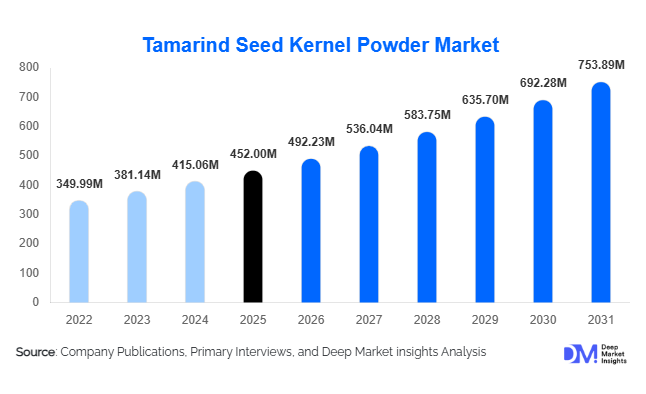
According to Deep Market Insights, the global tamarind seed kernel powder market size was valued at USD 452 million in 2025 and is projected to grow from USD 492.23 million in 2026 to reach USD 753.89 million by 2031, expanding at a CAGR of 8.9% during the forecast period (2026–2031). Market growth is primarily driven by rising adoption of bio-based industrial additives, expanding textile manufacturing activities, and increasing demand for natural stabilizers across food processing and pharmaceutical applications. Tamarind seed kernel powder (TSKP), derived from tamarind seeds through specialized processing, is gaining global relevance as industries increasingly shift toward sustainable and biodegradable raw materials.
Key Market Insights
- Industrial applications dominate global demand, particularly textile printing and paper processing, where TSKP functions as a cost-effective thickening and sizing agent.
- Asia-Pacific leads production and exports, supported by abundant tamarind cultivation and established agro-processing infrastructure.
- Food-grade applications are expanding rapidly, driven by clean-label trends and growing preference for plant-based stabilizers.
- Sustainability regulations in Europe and North America are accelerating adoption of biodegradable hydrocolloids.
- Modified TSKP variants with improved viscosity stability are gaining traction in high-performance industrial applications.
- Export-driven demand continues to shape pricing and supply dynamics, with India remaining the largest global supplier.
What are the latest trends in the tamarind seed kernel powder market?
Shift Toward Bio-Based Industrial Ingredients
Industries worldwide are transitioning away from synthetic polymers toward renewable alternatives. Tamarind seed kernel powder has emerged as a viable plant-derived hydrocolloid capable of delivering strong thickening and binding properties while remaining biodegradable. Textile manufacturers increasingly replace synthetic sizing agents with TSKP to meet environmental compliance standards. Paper and packaging industries are also adopting bio-based additives to reduce chemical usage and improve sustainability credentials. This transition is reinforcing long-term demand stability for TSKP, particularly in regions with strict environmental regulations.
Expansion of Modified and High-Performance Grades
Technological innovation is reshaping product development within the market. Chemically modified TSKP variants provide enhanced viscosity stability, improved compatibility with industrial chemicals, and better performance under high-temperature processing conditions. Manufacturers are investing in advanced milling, roasting, and modification technologies to produce standardized grades suitable for pharmaceuticals, oil drilling fluids, and specialty food applications. These value-added products command higher margins and enable suppliers to diversify beyond commodity-grade applications.
What are the key drivers in the tamarind seed kernel powder market?
Growing Demand from Textile Manufacturing
The textile industry remains the primary consumer of tamarind seed kernel powder, utilizing it extensively in fabric printing and yarn sizing processes. Rapid expansion of textile exports from countries such as India, China, Vietnam, and Bangladesh has sustained large-volume demand. TSKP’s ability to provide high viscosity while remaining easily washable makes it a preferred industrial additive. Continued modernization of textile processing facilities is further reinforcing consumption growth globally.
Rising Adoption in Clean-Label Food Processing
Food manufacturers are increasingly adopting natural ingredients that align with consumer demand for transparency and sustainability. Tamarind seed kernel powder functions as a plant-based stabilizer and thickener suitable for sauces, bakery fillings, and processed foods. Growth in vegan and allergen-free product categories has strengthened interest in alternative hydrocolloids, positioning food-grade TSKP as a rapidly expanding segment within the market.
What are the restraints for the global market?
Raw Material Supply Variability
Availability of tamarind seeds depends heavily on agricultural output and seasonal harvest cycles. Climate variability and inconsistent collection systems can lead to fluctuations in raw material supply and pricing volatility. These inconsistencies create challenges for manufacturers attempting to maintain standardized product quality, particularly for export markets requiring strict performance specifications.
Regulatory and Certification Barriers
Expansion into food and pharmaceutical applications requires extensive regulatory approvals and compliance documentation. Smaller manufacturers often face challenges in meeting international certification standards, slowing penetration into high-value developed markets. Differences in regulatory frameworks across regions further complicate global commercialization efforts.
What are the key opportunities in the tamarind seed kernel powder industry?
Expansion into Sustainable Packaging and Adhesives
The growing biodegradable packaging sector presents significant opportunities for TSKP as a natural binding and adhesive component. Increasing restrictions on petrochemical-based materials are encouraging manufacturers to explore plant-derived alternatives. TSKP’s compatibility with starch systems enables development of eco-friendly adhesives used in paper coatings and packaging applications, creating new revenue streams for producers.
Agro-Processing and Export Value Chain Development
Government initiatives promoting rural industrialization and agro-processing are unlocking supply-side opportunities. Tamarind seeds, once treated as agricultural waste, are now valuable industrial raw materials. Investments in mechanized processing facilities and export-oriented manufacturing clusters allow producers to enhance quality consistency and expand global reach. Emerging economies are increasingly supporting such initiatives to boost rural income generation and export earnings.
Report Scope
| Report Metric | Details |
|---|---|
| Market Size in 2025 | USD 452 Million |
| Market Size in 2026 | USD 492.23 Million |
| Market Size in 2031 | USD 753.89 Million |
| CAGR | 8.9% (2026-2031) |
| Base Year for Estimation | 2025 |
| Historical Data | 2022-2024 |
| Forecast Period | 2026-2031 |
| Report Coverage | Revenue Forecast, Competitive Landscape, Supply Chain Disruption, Growth Factors, Environment & Regulatory Landscape and Trends |
| Geographies Covered | North America, Europe, APAC, Middle East and Africa, LATAM |
| Countries Covered | U.S., Canada, U.K., Germany, France, Spain, Italy, Russia, Nordic, Benelux, Rest of Europe, China, Korea, Japan, India, Australia, Singapore, Taiwan, South East Asia, Rest of Asia-Pacific, UAE, Turky, Saudi Arabia, South Africa, Egypt, Nigeria, Rest of MEA, Brazil, Mexico, Argentina, Chile, Colombia, Rest of LATAM |
Explore more data points, trends and opportunities Download Free Sample Report
Product Grade Insights
The global tamarind seed kernel powder (TSKP) market demonstrates strong segmentation across product grades, reflecting diverse industrial and commercial applications. Industrial-grade tamarind seed kernel powder continues to dominate the market, accounting for nearly 38% of global demand, primarily due to its extensive utilization in textile printing, paper manufacturing, and adhesive production. The segment’s leadership is driven by its superior cost-performance ratio, high viscosity characteristics, and ability to function efficiently as a thickening and sizing agent in large-scale industrial processing environments. Textile manufacturers increasingly depend on industrial-grade TSKP to maintain print clarity, dye consistency, and operational efficiency, particularly in high-volume fabric processing across developing economies.Food-grade TSKP is witnessing accelerated adoption as food manufacturers globally shift toward clean-label and plant-based ingredient formulations. The growing consumer preference for natural stabilizers and minimally processed additives is encouraging manufacturers to replace synthetic hydrocolloids with tamarind-derived alternatives. Its functionality as a thickener, stabilizer, and texture enhancer in sauces, bakery fillings, and processed foods is expanding its commercial relevance. Pharmaceutical-grade variants are gradually gaining market penetration as advancements in purification technologies improve safety standards and regulatory compliance, enabling applications in controlled drug delivery systems and excipient formulations. Cosmetic-grade TSKP represents an emerging niche segment supported by rising demand for botanical-based personal care ingredients, where its moisturizing, film-forming, and viscosity-modifying properties align with the global shift toward sustainable and natural cosmetic formulations.
Processing Type Insights
Chemically modified tamarind seed kernel powder represents the leading processing category, holding approximately 34% market share. The dominance of this segment is primarily driven by its enhanced viscosity stability, improved solubility, and superior compatibility with industrial chemicals used in textile printing and paper coating applications. Modified variants provide consistent rheological performance under varying temperature and pH conditions, making them highly suitable for large-scale industrial operations requiring standardized processing outcomes. The increasing need for performance optimization in textile manufacturing continues to strengthen demand for chemically treated grades.Roasted kernel powder remains widely utilized in traditional textile applications due to its cost advantages and established processing familiarity among manufacturers in Asia-Pacific markets. Its affordability and acceptable functional performance sustain steady consumption, particularly among small and medium textile processors. Meanwhile, cold-processed and de-oiled variants are gaining traction in food, pharmaceutical, and specialty industrial applications where purity, low fat content, and enhanced functional consistency are critical. These processing types support improved shelf stability, better dispersion properties, and regulatory acceptance, thereby expanding adoption across high-value application industries seeking premium ingredient quality.
Functionality Insights
Thickening functionality accounts for approximately 41% of global consumption, making it the dominant functional application of tamarind seed kernel powder. The segment’s leadership is driven by TSKP’s exceptional water absorption capacity and ability to form stable, high-viscosity gels, which are essential for textile printing pastes, food formulations, and paper coating solutions. Its natural polysaccharide composition enables efficient viscosity control while maintaining product stability, positioning it as a preferred alternative to synthetic thickeners across multiple industries.Stabilizing and emulsifying functionalities are experiencing steady growth, particularly within processed food and beverage applications where manufacturers aim to enhance texture consistency and shelf life without compromising clean-label positioning. The increasing global demand for convenience foods and ready-to-eat products is reinforcing this trend. Binding and gelling properties are further expanding adoption in biodegradable adhesives, eco-friendly packaging materials, and specialty industrial formulations. As industries increasingly prioritize sustainability and renewable raw materials, TSKP’s multifunctional performance capabilities are enabling broader integration into next-generation industrial and food processing solutions.
End-Use Industry Insights
The textile industry remains the largest end-use sector, contributing nearly 36% of global market demand in 2025. The segment’s dominance is supported by growing apparel exports, expansion of textile manufacturing hubs in Asia, and rising demand for high-quality fabric printing solutions. Tamarind seed kernel powder plays a crucial role in improving dye penetration, print sharpness, and fabric finishing efficiency, making it indispensable for textile processors seeking cost-effective and natural thickening agents.The food and beverage industry represents the fastest-growing end-use segment, driven by increasing global consumption of packaged foods, plant-based formulations, and natural additives. Manufacturers are incorporating TSKP to enhance texture stability while meeting regulatory and consumer expectations for clean-label ingredients. Paper and packaging applications are expanding alongside the rapid growth of e-commerce and sustainable packaging initiatives, where TSKP functions as a biodegradable binder and coating additive. Additionally, emerging adoption in pharmaceutical formulations and oil drilling fluids is creating diversification opportunities, supported by growing industrial innovation and the search for environmentally compatible functional materials.
Distribution Channel Insights
Direct industrial supply contracts dominate the distribution landscape, accounting for approximately 47% of market share. Large textile mills, paper manufacturers, and industrial processors prefer long-term procurement agreements to ensure supply reliability, stable pricing, and consistent product specifications. These partnerships enable manufacturers to optimize inventory planning while minimizing raw material volatility risks.Ingredient distributors continue to play a critical role in serving small and medium-sized enterprises that require flexible purchasing volumes and technical support. Export trading companies facilitate cross-border market expansion by connecting producers in tamarind-growing regions with international buyers, strengthening global supply chain integration. Meanwhile, online B2B ingredient platforms are gradually emerging as alternative procurement channels, improving transparency, enabling supplier comparison, and enhancing accessibility for global buyers. Digitalization of ingredient sourcing is expected to accelerate market efficiency and support wider international adoption over the forecast period.
Explore more data points, trends and opportunities Download Free Sample Report
Tamarind Seed Kernel Powder Market Segmentations
By Product Grade
- Industrial Grade Tamarind Seed Kernel Powder
- Food Grade Tamarind Seed Kernel Powder
- Pharmaceutical Grade Tamarind Seed Kernel Powder
- Cosmetic & Personal Care Grade Tamarind Seed Kernel Powder
By Processing Type
- Natural/Plain Tamarind Kernel Powder
- Roasted Tamarind Kernel Powder
- Chemically Modified Tamarind Kernel Powder
- De-Oiled Tamarind Kernel Powder
- Cold Processed Tamarind Kernel Powder
By Functionality
- Thickening Agent
- Stabilizing Agent
- Binding Agent
- Gelling Agent
- Emulsifying & Film-Forming Agent
By End-Use Industry
- Textile Industry
- Food & Beverage Processing
- Paper & Packaging Industry
- Pharmaceutical Industry
- Oil Drilling & Mining Fluids
- Cosmetics & Personal Care
By Distribution Channel
- Direct Industrial Supply Contracts
- Ingredient Distributors & Traders
- Export Trading Companies
- Online B2B Ingredient Platforms
Regional Insights
Asia-Pacific
Asia-Pacific leads the global tamarind seed kernel powder market with nearly 52% share in 2025, supported by strong raw material availability, established processing infrastructure, and expanding industrial demand across multiple sectors. India serves as the largest producer and exporter due to abundant tamarind cultivation, competitive labor costs, and a mature processing ecosystem that supports large-scale production. Regional growth is further driven by the rapid expansion of textile manufacturing clusters, increasing apparel exports, and rising investments in food processing industries. China contributes significantly through its large textile and paper manufacturing base, where demand for cost-effective thickening agents remains strong. Southeast Asian economies such as Vietnam and Indonesia are witnessing accelerated growth due to rising foreign investments in garment manufacturing and export-oriented textile production. Additionally, increasing regional focus on natural and biodegradable industrial inputs is reinforcing long-term market expansion.
North America
North America accounts for approximately 18% of global demand, led primarily by the United States, where adoption is increasing across food processing, specialty chemicals, and eco-friendly industrial applications. Regional growth is driven by strong consumer preference for clean-label food ingredients and growing regulatory support for sustainable additives. Food manufacturers are increasingly incorporating plant-derived hydrocolloids to replace synthetic stabilizers, boosting demand for food-grade TSKP. The region’s high dependence on imports also supports consistent trade flows, while innovation in biodegradable packaging and green chemistry initiatives further strengthens market penetration. Rising research activities focused on natural polymers and functional ingredients are expected to create additional opportunities across pharmaceutical and cosmetic applications.
Europe
Europe holds around 16% market share, with Germany, France, and Italy serving as major consumption centers. Regional growth is strongly influenced by stringent environmental regulations encouraging the adoption of biodegradable and renewable raw materials in industrial processes. The European food industry is rapidly embracing natural stabilizers aligned with clean-label trends, supporting increased demand for food-grade TSKP. Expansion of sustainable packaging solutions and circular economy initiatives is further accelerating adoption in paper and adhesive applications. Additionally, increasing consumer awareness regarding environmentally responsible products and strong regulatory oversight promoting green alternatives continue to drive long-term regional market growth.
Latin America
Latin America contributes roughly 9% of global demand, led by Brazil and Mexico, where expanding food processing industries and improving industrial infrastructure are supporting gradual market development. Regional growth is driven by rising consumption of processed and convenience foods, increasing investments in local manufacturing, and growing adoption of natural additives within food formulations. Textile and packaging industries are also witnessing modernization, creating incremental demand for functional thickening agents. As regional manufacturers diversify sourcing strategies and seek cost-effective imported ingredients, tamarind seed kernel powder imports are expected to increase steadily, strengthening market expansion across the region.
Middle East & Africa
The Middle East and Africa region is emerging as a high-growth market supported by expanding food manufacturing capacity, infrastructure development, and diversification of industrial economies. Textile trade hubs in the United Arab Emirates and South Africa are driving demand for industrial-grade TSKP, while increasing investments in food processing sectors are accelerating adoption of natural stabilizers. Government-led industrial diversification initiatives aimed at reducing dependence on oil-based economies are encouraging the use of sustainable and bio-based materials across manufacturing sectors. Rising imports, improved trade connectivity, and growing awareness of environmentally friendly additives are collectively strengthening regional demand momentum and positioning the market for sustained long-term growth.
Key Players in the Tamarind Seed Kernel Powder Market
- Vishnu Gum & Chemicals Ltd.
- Altrafine Gums
- Premcem Gums Pvt. Ltd.
- Polygal AG
- Hindustan Gums & Chemicals Ltd.
- Lucid Colloids Ltd.
- Vikas WSP Ltd.
- Jai Bharat Gum & Chemicals Ltd.
- Shree Ram Industries
- Adachi Group
- Sarda Gums & Chemicals
- Agro Gums
- Supreme Gums Pvt. Ltd.
- Chemtex Speciality Ltd.
- Gayatri Psyllium Industries