Spirits Market Size
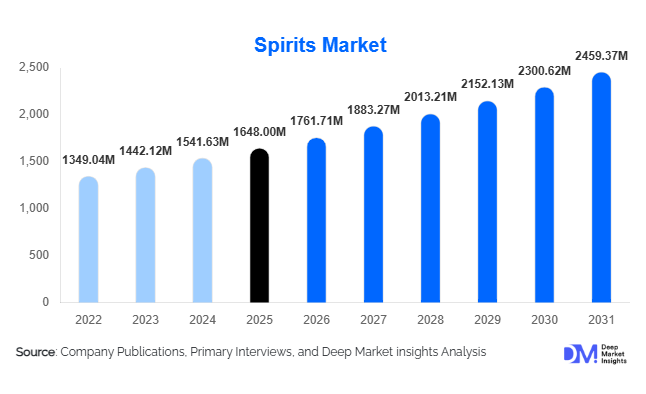
According to Deep Market Insights, the global spirits market size was valued at USD 1,648 billion in 2025 and is projected to grow from USD 1,761.71 billion in 2026 to reach USD 2,459.37 billion by 2031, expanding at a CAGR of 6.9% during the forecast period (2026–2031). The spirits market growth is primarily driven by premiumization trends, increasing urban consumption, expansion of hospitality and nightlife industries, and rising consumer preference for high-quality alcoholic beverages with authentic brand heritage and innovative flavor profiles.
Key Market Insights
- Premium and super-premium spirits are witnessing accelerated global demand, particularly across whisky, tequila, gin, and aged rum categories.
- Asia-Pacific is emerging as the fastest-growing spirits market, supported by rising middle-class income levels, urbanization, and westernized consumption habits.
- Off-trade retail channels dominate global spirits distribution, with supermarkets, liquor chains, and e-commerce platforms accounting for a majority share of sales.
- Millennials and Gen Z consumers are reshaping the market, driving demand for craft spirits, flavored products, and experiential cocktail culture.
- Sustainability and eco-friendly packaging are becoming critical purchasing factors, encouraging manufacturers to invest in carbon-neutral distillation and recyclable materials.
- Digital transformation is accelerating direct-to-consumer alcohol retailing, enabling brands to leverage AI-driven personalization, subscription models, and social media engagement.
What are the latest trends in the spirits market?
Premiumization and Luxury Spirits Expansion
The global spirits industry is increasingly shifting toward premium and ultra-premium product offerings. Consumers are prioritizing quality, authenticity, and heritage over high-volume alcohol consumption, leading to strong growth in premium whisky, tequila, cognac, and craft gin categories. Limited-edition releases, aged spirits, and luxury packaging are becoming major differentiators in competitive markets. Distillers are also introducing single-origin variants, collectible bottles, and artisanal production methods to attract affluent consumers seeking exclusivity and personalized experiences. This trend is particularly strong in North America, Europe, China, India, and travel retail markets, where luxury alcohol consumption continues to rise.
Rise of Craft Spirits and Flavor Innovation
Craft distilleries and flavored spirits are reshaping consumer preferences globally. Consumers are increasingly exploring botanical infusions, fruit-flavored spirits, low-calorie options, and locally inspired recipes that provide differentiated drinking experiences. Craft gin, small-batch whiskey, premium rum, and infused vodka products are experiencing particularly strong demand among millennials and younger legal-age consumers. Companies are investing heavily in experimental flavor development, local ingredient sourcing, and sustainable production techniques to strengthen brand identity. The growing cocktail and mixology culture across bars, restaurants, and home entertainment settings is also driving innovation in versatile spirits products tailored for premium cocktails and experiential consumption.
What are the key drivers in the spirits market?
Growing Demand for Premium Alcoholic Beverages
One of the strongest drivers of the global spirits market is the increasing consumer preference for premium alcoholic beverages. Consumers are increasingly willing to pay higher prices for premium whisky, tequila, cognac, and craft spirits due to superior quality perception, aging profiles, and brand heritage. Premiumization trends have significantly improved profit margins for leading spirits companies while encouraging investments in aged variants, luxury packaging, and limited-edition launches. Younger consumers in particular are shifting toward experiential and aspirational consumption patterns, fueling sustained growth in premium categories.
Expansion of Hospitality and Cocktail Culture
The rapid growth of hospitality, tourism, nightlife, and entertainment industries is significantly boosting global spirits consumption. Hotels, bars, restaurants, lounges, casinos, and premium dining establishments continue to drive demand for versatile spirits products used in cocktails and premium beverage experiences. Cocktail culture has become especially influential among urban millennials and Gen Z consumers, encouraging experimentation with gin, tequila, vodka, rum, and flavored spirits. International tourism recovery and rising spending on leisure experiences are further strengthening spirits demand through hospitality channels worldwide.
What are the restraints for the global market?
Stringent Government Regulations and High Taxation
The spirits market faces significant regulatory challenges globally due to strict government control over alcohol sales, advertising, and distribution. Excise duties, minimum pricing regulations, import restrictions, and licensing frameworks can substantially impact profitability and market expansion strategies. Advertising restrictions in several countries also limit promotional activities for spirits brands, particularly in emerging markets where regulatory frameworks remain highly controlled. Compliance costs and regional policy variations create operational complexity for multinational spirits manufacturers.
Health-Conscious Consumer Trends
Growing health awareness among consumers is creating challenges for traditional spirits consumption. Increasing concerns regarding alcohol-related health risks, obesity, and wellness-focused lifestyles are encouraging some consumers to reduce alcohol intake or shift toward low-alcohol and alcohol-free alternatives. Functional beverages, non-alcoholic cocktails, and wellness-oriented drink categories are becoming increasingly competitive substitutes. This trend is compelling spirits manufacturers to invest in low-calorie formulations, reduced-ABV products, and organic offerings to retain evolving consumer segments.
What are the key opportunities in the spirits industry?
Expansion in Emerging Markets
Emerging economies across Asia-Pacific, Latin America, and Africa represent significant growth opportunities for spirits manufacturers. Countries such as India, Vietnam, China, Brazil, and Nigeria are witnessing rapid urbanization, rising disposable incomes, and growing exposure to global drinking cultures. Younger populations in these regions are increasingly adopting premium alcoholic beverages and westernized consumption patterns. Manufacturers are expanding local production capacities, regional partnerships, and product customization strategies to capitalize on high-growth consumer markets. India, in particular, is expected to emerge as one of the largest long-term growth markets for premium whisky, gin, and rum products.
Sustainable and Organic Spirits Development
Sustainability-focused innovation is creating major opportunities for global spirits brands. Consumers are increasingly preferring environmentally responsible products featuring recyclable packaging, carbon-neutral production, renewable energy usage, and sustainably sourced ingredients. Distilleries investing in water conservation, circular economy practices, and biodegradable packaging are strengthening brand loyalty among environmentally conscious consumers. Organic spirits and clean-label alcoholic beverages are also gaining traction, especially in North America and Europe, where sustainability purchasing behavior is strongly influencing premium beverage consumption trends.
Report Scope
| Report Metric | Details |
|---|---|
| Market Size in 2025 | USD 1648.00 Million |
| Market Size in 2026 | USD 1761.71 Million |
| Market Size in 2031 | USD 2459.37 Million |
| CAGR | 6.9% (2026-2031) |
| Base Year for Estimation | 2025 |
| Historical Data | 2022-2024 |
| Forecast Period | 2026-2031 |
| Report Coverage | Revenue Forecast, Competitive Landscape, Supply Chain Disruption, Growth Factors, Environment & Regulatory Landscape and Trends |
| Geographies Covered | North America, Europe, APAC, Middle East and Africa, LATAM |
| Countries Covered | U.S., Canada, U.K., Germany, France, Spain, Italy, Russia, Nordic, Benelux, Rest of Europe, China, Korea, Japan, India, Australia, Singapore, Taiwan, South East Asia, Rest of Asia-Pacific, UAE, Turky, Saudi Arabia, South Africa, Egypt, Nigeria, Rest of MEA, Brazil, Mexico, Argentina, Chile, Colombia, Rest of LATAM |
Explore more data points, trends and opportunities Download Free Sample Report
Product Type Insights
The global spirits market is highly diversified across multiple product categories, with whisky continuing to maintain its position as the leading revenue-generating segment in 2025. Whisky accounts for nearly 28% of total global spirits revenue due to its strong premium appeal, long-standing heritage value, broad international consumer base, and increasing popularity among affluent consumers seeking luxury alcoholic beverages. The segment benefits significantly from premiumization trends, as consumers increasingly associate aged whisky products with craftsmanship, exclusivity, and investment value. Scotch whisky continues to dominate international exports due to its established authenticity and premium image, while bourbon has witnessed remarkable global expansion driven by growing consumer interest in American whiskey culture and barrel-aged premium spirits. Japanese whisky continues to gain strong traction in premium and ultra-premium categories due to limited supply, award-winning product quality, and increasing collector demand. Indian whisky is also experiencing rapid global recognition as domestic manufacturers improve production quality and expand export capabilities across North America, Europe, and Asia-Pacific.Gin continues to experience substantial global momentum due to expanding cocktail culture and ongoing botanical innovation. Craft distilleries are introducing region-specific botanical blends, herbal infusions, and flavored gin variants that appeal to experimental consumers seeking differentiated drinking experiences. Premium gin consumption is particularly strong across Europe, North America, and Asia-Pacific, where consumers increasingly value artisanal production methods and small-batch authenticity. The rapid growth of premium bars, mixology trends, and social drinking culture continues to support sustained demand for gin globally.Rum, cognac, liqueurs, and baijiu also maintain strong regional significance within the global spirits market. Rum consumption remains highly concentrated across Latin America and the Caribbean, where cultural traditions and tourism industries continue to support consistent demand. Premium dark rum and spiced rum categories are expanding internationally due to rising cocktail applications and growing consumer interest in tropical flavor profiles. Cognac maintains a highly profitable luxury niche supported by affluent consumers in North America, Europe, and Asia-Pacific. Chinese baijiu continues to dominate domestic spirits consumption in China due to its deep cultural relevance and strong association with corporate gifting, celebrations, and formal dining traditions.
Price Category Insights
Premium spirits continue to dominate the global spirits market, accounting for approximately 37% of total revenue in 2025. The premium segment benefits significantly from rising global disposable incomes, increasing luxury consumption patterns, and changing consumer preferences toward quality-focused alcoholic beverages. Consumers are increasingly prioritizing craftsmanship, authenticity, aged formulations, artisanal production techniques, and exclusive branding when selecting spirits products. This shift toward premiumization has become one of the most influential long-term drivers shaping the global alcoholic beverage industry.Economy spirits continue to maintain strong importance in highly price-sensitive markets where affordability remains a key purchasing factor. Despite slower revenue growth compared to premium categories, economy products continue to generate substantial consumption volumes across emerging economies. Local manufacturers often dominate this segment through extensive distribution networks and region-specific product offerings. However, even within economy segments, consumers are gradually demonstrating growing interest in improved packaging, quality enhancement, and locally authentic flavor profiles.Luxury packaging, sustainability integration, and brand storytelling are becoming increasingly critical competitive differentiators across all price categories. Consumers are paying greater attention to product presentation, environmental responsibility, and brand authenticity when making purchasing decisions. This trend is encouraging manufacturers to adopt eco-friendly packaging materials, recyclable glass solutions, and sustainable sourcing strategies while simultaneously strengthening premium brand perception.
Distribution Channel Insights
Off-trade distribution channels continue to dominate the global spirits market, accounting for nearly 61% of total sales in 2025. Supermarkets, hypermarkets, liquor stores, convenience retailers, and online alcohol platforms remain the primary purchasing channels for global consumers. The dominance of off-trade channels is primarily supported by consumer preference for convenience, wider product availability, competitive pricing, and increasing access to premium imported spirits products.The leading growth driver for the off-trade segment is the rapid expansion of e-commerce alcohol retailing and digitally integrated direct-to-consumer distribution models. Consumers increasingly prefer online purchasing platforms due to convenience, home delivery services, personalized product recommendations, and easier access to premium and international spirits brands. Digital retail platforms are enabling manufacturers to improve customer targeting through data-driven marketing strategies, subscription-based offerings, and customized promotional campaigns.Travel retail and duty-free channels are also experiencing strong recovery due to rising international tourism and business travel activity. Premium spirits gifting demand remains particularly strong within airports and international travel hubs where consumers frequently purchase luxury whisky, cognac, and tequila products. Manufacturers continue to launch exclusive travel-retail editions and limited-duty-free collections to capitalize on high-spending international travelers.
Consumer Demographic Insights
Millennials continue to represent the largest consumer demographic within the global spirits market, accounting for nearly 39% of total consumption in 2025. This demographic plays a central role in shaping premiumization trends, cocktail culture expansion, sustainability-focused purchasing behavior, and craft spirits adoption. Millennials generally demonstrate strong interest in unique drinking experiences, artisanal beverages, premium ingredients, and socially engaging consumption environments.The leading growth driver for the millennial segment is the increasing preference for experiential consumption and premium lifestyle-oriented alcoholic beverages. Millennials are highly influenced by authenticity, social media visibility, sustainability practices, and premium branding narratives when selecting spirits products. This demographic strongly supports demand for craft gin, small-batch whisky, premium tequila, and organic spirits products that offer differentiated experiences and brand storytelling.Female consumers are becoming an increasingly important growth segment within the global spirits industry. Rising female participation in premium spirits consumption is driving strong demand for flavored vodka, botanical gin, low-sugar cocktails, and premium ready-to-drink products. Manufacturers are increasingly developing gender-neutral branding strategies and wellness-oriented beverage innovations to attract broader female consumer participation.Older consumer demographics continue to support stable demand for aged whisky, cognac, premium rum, and luxury spirits products associated with tradition, craftsmanship, and heritage value. Mature consumers generally demonstrate strong brand loyalty and willingness to invest in premium alcoholic beverages for gifting, collecting, and fine dining experiences. The continued popularity of luxury hospitality and premium social gatherings among affluent older consumers remains supportive of sustained high-end spirits demand.
Packaging Insights
Glass bottles continue to dominate the global spirits packaging market, accounting for approximately 74% of total packaging share in 2025. Glass remains the preferred packaging material due to its premium appearance, strong product preservation capabilities, chemical stability, and high recyclability. Premium spirits brands particularly favor glass packaging because it enhances luxury positioning while supporting long-term product quality maintenance.The leading driver for the dominance of glass packaging is the strong association between premium spirits and luxury visual presentation. Consumers frequently associate heavyweight glass bottles, embossed labeling, customized closures, and artistic bottle designs with superior product quality and exclusivity. As premiumization continues to reshape the spirits industry, manufacturers are investing heavily in visually differentiated packaging formats to strengthen shelf visibility and enhance consumer perception.Sustainability trends are also increasingly influencing spirits packaging innovation globally. Manufacturers are adopting lightweight glass bottles, recyclable closures, biodegradable labels, and eco-friendly secondary packaging materials to reduce environmental impact and align with evolving consumer sustainability expectations. Regulatory pressure regarding packaging waste reduction is further accelerating investments in sustainable packaging technologies.Metal cans and ready-to-drink packaging formats are witnessing rapidly increasing popularity among younger consumers seeking portability, convenience, and casual consumption experiences. Ready-to-drink cocktails and canned spirit-based beverages are expanding strongly across music festivals, outdoor entertainment events, and convenience retail channels. These packaging formats are particularly attractive to Gen Z and millennial consumers due to ease of use, lower serving complexity, and modern product positioning.
Explore more data points, trends and opportunities Download Free Sample Report
Spirits Market Segmentations
By Product Type
- Whisky
- Vodka
- Rum
- Gin
- Tequila
- Brandy & Cognac
- Liqueurs & Cordials
- Baijiu
- Soju & Shochu
- Other Spirits
By Price Category
- Economy Spirits
- Mid-Range Spirits
- Premium Spirits
- Super-Premium Spirits
- Ultra-Premium & Luxury Spirits
By Distribution Channel
- Supermarkets & Hypermarkets
- Liquor Stores
- Convenience Stores
- Bars & Pubs
- Hotels & Restaurants
- Duty-Free Stores
- Online Retail & E-Commerce
By Consumer Demographics
- Gen Z Consumers
- Millennials
- Gen X
- Baby Boomers
- Male Consumers
- Female Consumers
By Packaging Type
- Glass Bottles
- PET Bottles
- Metal Cans
- Pouches
- Tetra Packs
- Luxury Packaging
Regional Insights
North America
North America accounted for approximately 31% of global spirits market revenue in 2025, making it one of the largest and most influential regional markets globally. The United States remains the dominant contributor due to strong consumer spending on premium alcoholic beverages, highly developed retail infrastructure, and extensive product innovation across whisky, tequila, vodka, and craft spirits categories. The region demonstrates exceptionally strong premiumization trends supported by rising disposable incomes, luxury dining culture, and expanding cocktail consumption.E-commerce alcohol retailing and direct-to-consumer sales channels are highly advanced across North America, enabling rapid penetration of premium imported spirits brands. Digital alcohol delivery platforms, subscription-based beverage services, and personalized online marketing strategies are further accelerating market expansion. In addition, celebrity-backed tequila brands and luxury whisky investments continue to influence consumer purchasing trends across the region.
Europe
Europe represented nearly 29% of the global spirits market in 2025 and remains one of the most mature premium alcohol markets worldwide. The region benefits from deep-rooted spirits production heritage, established export industries, and strong tourism-driven hospitality consumption. The United Kingdom continues to dominate premium gin consumption, while France remains the leading global producer and exporter of cognac. Germany, Italy, Spain, and Poland maintain substantial demand for whisky, vodka, herbal liqueurs, and regional specialty spirits.Tourism remains a major contributor to spirits consumption across Europe, particularly within luxury hospitality, nightlife, and fine dining sectors. International tourism activity across France, Italy, Spain, and the United Kingdom continues to support strong demand for premium wines and spirits products. In addition, expanding cocktail culture and rising popularity of craft distilleries are supporting long-term market growth throughout the region.
Asia-Pacific
Asia-Pacific is the fastest-growing regional spirits market globally and is projected to register a CAGR exceeding 8.5% through 2031. China, India, Japan, South Korea, Vietnam, and Southeast Asian economies are driving substantial market expansion due to rapid urbanization, rising middle-class populations, increasing disposable incomes, and evolving westernized drinking preferences. The region is witnessing strong growth across both domestic and imported premium spirits categories.China continues to dominate baijiu consumption while simultaneously increasing imports of premium whisky and cognac products. Corporate gifting culture, luxury dining, and rising affluent consumer populations continue to support premium spirits growth within the Chinese market. India is witnessing exceptional expansion across whisky, gin, and premium rum categories due to its young population, rising urbanization, and rapidly expanding nightlife industry. Japan remains globally recognized for premium whisky innovation and high-quality craft distillation practices.
Latin America
Latin America is experiencing rising demand for tequila, rum, cachaça, and premium imported spirits products. Mexico remains one of the world’s most important tequila production and export hubs, benefiting from growing international demand for premium agave-based spirits. Brazil and Argentina are witnessing increasing premiumization trends among urban consumers, particularly across upscale hospitality and nightlife channels.The key growth driver for the Latin American spirits market is the expansion of tourism, hospitality infrastructure, and urban cocktail culture. Rising disposable incomes among urban middle-class populations are increasing consumer spending on premium alcoholic beverages, imported spirits, and craft cocktails. Regional manufacturers are also expanding exports of local spirit categories into North America and Europe, strengthening international market visibility for Latin American spirits brands.
Middle East & Africa
The Middle East and Africa region represents an emerging growth market for the global spirits industry despite regulatory restrictions in several countries. South Africa remains the largest spirits market in Africa due to its strong tourism industry, urban nightlife culture, and expanding hospitality infrastructure. The UAE is rapidly developing into an important premium spirits hub supported by luxury tourism, international expatriate populations, and high-end hospitality investments.Luxury tourism development across the UAE and major African hospitality destinations continues to support premium spirits demand through hotels, resorts, fine dining establishments, and nightlife venues. In addition, expanding retail modernization, improving alcohol distribution infrastructure, and increasing international brand presence are contributing to long-term spirits market growth across the region.
Key Players in the Spirits Market
- Diageo plc
- Pernod Ricard SA
- Bacardi Limited
- Beam Suntory Inc.
- Brown-Forman Corporation
- Constellation Brands Inc.
- Rémy Cointreau SA
- Davide Campari-Milano N.V.
- Moët Hennessy
- William Grant & Sons Ltd.