Specialty Green Coffee Market Size
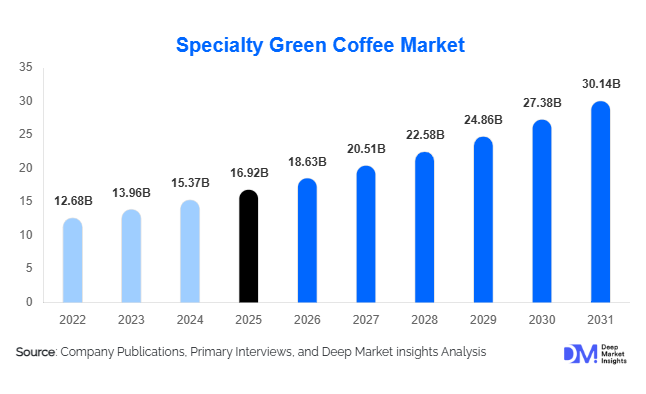
According to Deep Market Insights, the global specialty green coffee market size was valued at USD 16.92 billion in 2025 and is projected to grow from USD 18.63 billion in 2026 to reach USD 30.14 billion by 2031, expanding at a CAGR of 10.1% during the forecast period (2026–2031). The specialty green coffee market growth is primarily driven by rising consumer demand for premium and traceable coffee products, expansion of artisanal roasting businesses, growing sustainability awareness, and increasing preference for single-origin and ethically sourced coffee beans across global markets.
Key Market Insights
- Single-origin and traceable coffee beans are becoming mainstream, with consumers increasingly prioritizing transparency, terroir differentiation, and ethical sourcing practices.
- Specialty coffee roasters are rapidly expanding globally, especially in North America, Europe, China, South Korea, and India, boosting procurement of premium green coffee beans.
- North America dominates the global specialty green coffee market, supported by strong specialty café penetration, premium retail coffee demand, and advanced artisanal roasting infrastructure.
- Asia-Pacific is the fastest-growing regional market, driven by urbanization, rising disposable income, and rapid expansion of premium café culture.
- Sustainability certifications and regenerative agriculture are reshaping sourcing decisions, encouraging direct trade relationships between growers and specialty roasters.
- Advanced fermentation and post-harvest processing technologies, including anaerobic fermentation and carbonic maceration, are enabling premium pricing and flavor differentiation.
What are the latest trends in the specialty green coffee market?
Rise of Experimental Processing Techniques
Specialty coffee producers are increasingly adopting advanced fermentation and processing methods to create differentiated flavor profiles and command premium export prices. Techniques such as anaerobic fermentation, honey processing, carbonic maceration, and controlled microbial fermentation are becoming mainstream within premium coffee-producing regions including Colombia, Brazil, Ethiopia, and Costa Rica. These methods enhance flavor complexity, fruit-forward notes, acidity balance, and aroma characteristics, allowing specialty roasters to market unique coffees to premium consumers. Experimental processing is also strengthening auction-based coffee trading, where rare microlots achieve exceptionally high pricing. Producers investing in precision drying systems, moisture analytics, and controlled fermentation infrastructure are improving consistency and expanding access to high-value international buyers.
Growing Focus on Sustainable and Regenerative Coffee Farming
Sustainability has become a defining trend across the specialty green coffee industry. Global buyers increasingly prioritize environmentally responsible sourcing practices, including regenerative agriculture, shade-grown cultivation, biodiversity protection, and carbon-neutral farming initiatives. Specialty coffee cooperatives and exporters are implementing soil restoration techniques, water conservation systems, and agroforestry models to improve long-term production resilience amid climate change challenges. Direct trade partnerships between farmers and specialty roasters are also expanding, allowing greater pricing transparency and higher farmer incomes. Blockchain-enabled traceability systems are being integrated across supply chains, enabling buyers to verify sourcing practices, origin authenticity, and sustainability compliance. These trends are particularly strong in North America and Europe, where consumers are increasingly willing to pay premium prices for ethically sourced specialty coffee products.
What are the key drivers in the specialty green coffee market?
Expansion of Global Specialty Café Culture
The rapid expansion of specialty cafés and artisanal coffee chains globally is significantly accelerating demand for premium green coffee beans. Consumers increasingly seek differentiated coffee experiences involving single-origin products, artisanal brewing methods, and premium flavor profiles. Third-wave coffee culture has transformed coffee consumption patterns across North America, Europe, and Asia-Pacific, encouraging higher spending on quality coffee products. Independent micro-roasters and specialty café operators are aggressively expanding procurement of high-scoring Arabica coffees from Latin America and Africa. The rising popularity of pour-over brewing, siphon coffee, cold brew, and specialty espresso beverages continues to strengthen demand for traceable and premium-grade green coffee beans.
Growing Consumer Preference for Ethical and Traceable Sourcing
Consumers are becoming increasingly conscious regarding sustainability, ethical sourcing, and environmental impact within food and beverage supply chains. Specialty green coffee aligns strongly with these preferences by emphasizing direct trade relationships, fair compensation for farmers, and transparent sourcing practices. Certifications such as organic, Fair Trade, Rainforest Alliance, and regenerative agriculture standards are becoming critical purchasing criteria among specialty roasters and retail coffee brands. The willingness of consumers to pay premium prices for ethically sourced coffee is supporting strong profit margins and encouraging long-term investments in sustainable coffee production systems.
What are the restraints for the global market?
Climate Volatility and Crop Vulnerability
Climate change remains one of the largest challenges for the specialty green coffee market. Arabica coffee cultivation requires highly specific climatic conditions involving altitude, rainfall, and temperature stability. Rising global temperatures, erratic rainfall patterns, droughts, and increasing outbreaks of coffee leaf rust disease are negatively impacting production volumes and bean quality across major coffee-producing countries including Brazil, Colombia, Ethiopia, and Honduras. Specialty coffee is especially vulnerable because premium quality standards depend heavily on consistent environmental conditions. Climate-related disruptions also contribute to supply shortages and export price volatility.
High Production and Supply Chain Costs
Specialty green coffee production involves labor-intensive cultivation, advanced post-harvest processing, rigorous grading standards, and extensive quality-control procedures. These factors significantly increase production costs compared to conventional commodity coffee. Smallholder farmers frequently face challenges related to limited financing, inadequate infrastructure, and restricted access to modern agricultural technologies. Additionally, international freight volatility, export certification expenses, and foreign exchange fluctuations can reduce profitability for exporters and specialty coffee traders. These operational complexities remain barriers for scaling specialty coffee production globally.
What are the key opportunities in the specialty green coffee industry?
Emerging Demand Across Asia-Pacific Markets
Asia-Pacific presents substantial growth opportunities for specialty green coffee suppliers and roasters. Countries including China, India, South Korea, Indonesia, Thailand, and Vietnam are experiencing rapid urbanization, rising disposable income, and expanding premium café culture. Younger consumers in these markets are increasingly adopting western-style coffee consumption habits and are willing to pay premium prices for differentiated specialty beverages. International specialty coffee chains and independent artisanal cafés are aggressively expanding across tier-1 and tier-2 cities, creating long-term procurement opportunities for exporters and specialty producers globally.
Functional Beverage and Wellness Applications
The growing functional beverage and wellness industry is creating new opportunities for specialty green coffee products and extracts. Green coffee beans are rich in chlorogenic acids and antioxidants, making them increasingly attractive for nutraceutical formulations, wellness beverages, energy drinks, and ready-to-drink coffee applications. Beverage manufacturers are integrating premium specialty coffee into functional product portfolios targeting health-conscious consumers seeking natural energy and wellness benefits. This trend is expanding specialty coffee demand beyond traditional café consumption and opening new revenue streams for specialty green coffee exporters and processors.
Report Scope
| Report Metric | Details |
|---|---|
| Market Size in 2025 | USD 16.92 Billion |
| Market Size in 2026 | USD 18.63 Billion |
| Market Size in 2031 | USD 30.14 Billion |
| CAGR | 10.1% (2026-2031) |
| Base Year for Estimation | 2025 |
| Historical Data | 2022-2024 |
| Forecast Period | 2026-2031 |
| Report Coverage | Revenue Forecast, Competitive Landscape, Supply Chain Disruption, Growth Factors, Environment & Regulatory Landscape and Trends |
| Geographies Covered | North America, Europe, APAC, Middle East and Africa, LATAM |
| Countries Covered | U.S., Canada, U.K., Germany, France, Spain, Italy, Russia, Nordic, Benelux, Rest of Europe, China, Korea, Japan, India, Australia, Singapore, Taiwan, South East Asia, Rest of Asia-Pacific, UAE, Turky, Saudi Arabia, South Africa, Egypt, Nigeria, Rest of MEA, Brazil, Mexico, Argentina, Chile, Colombia, Rest of LATAM |
Explore more data points, trends and opportunities Download Free Sample Report
Species Insights
Arabica specialty green coffee continues to dominate the global specialty green coffee market, accounting for nearly 72% of total market share in 2025. The dominance of Arabica coffee is strongly supported by rising global consumer preference for premium-quality beverages that deliver superior aroma complexity, nuanced flavor profiles, balanced acidity, and refined mouthfeel characteristics. Specialty coffee consumers increasingly value traceability, terroir-driven taste differentiation, and high cupping scores, all of which position Arabica as the preferred species across premium cafés, artisanal roasters, and specialty beverage brands. High-end Arabica varieties including Geisha, Bourbon, Typica, SL28, Pacamara, and Caturra continue to command premium pricing within international auction markets due to limited production capacity and exceptional sensory attributes. These varieties are especially sought after by specialty roasters in North America, Europe, Japan, and South Korea, where consumers are willing to pay premium prices for rare single-origin coffees with distinctive flavor notes such as floral, citrus, berry, chocolate, and wine-like characteristics.Climate change is also influencing species diversification within the specialty coffee sector. Rising temperatures, irregular rainfall patterns, and increased disease outbreaks such as coffee leaf rust are affecting Arabica production across several traditional coffee-growing regions. As a result, producers and buyers are increasingly exploring climate-resilient Robusta varieties and hybrid cultivars capable of maintaining productivity under changing environmental conditions. This trend is expected to support long-term diversification within the specialty coffee species landscape while encouraging investments in sustainable farming methods, regenerative agriculture, and genetic innovation programs.
Processing Method Insights
Washed processing remains the leading processing method segment within the specialty green coffee market, representing approximately 46% of total market revenue in 2025. The dominance of washed coffees is primarily driven by strong specialty roaster preference for clean cup profiles, bright acidity, consistent flavor clarity, and enhanced transparency of origin characteristics. Specialty coffee consumers increasingly seek coffees that highlight regional terroir and varietal expression, making washed processing particularly attractive for premium single-origin offerings. Washed coffees are highly valued in competitive cupping environments because they allow flavor attributes such as floral notes, citrus acidity, sweetness, and balanced body to become more pronounced and distinguishable.The rapid emergence of experimental fermentation techniques including anaerobic fermentation, carbonic maceration, thermal shock processing, and controlled yeast inoculation is significantly transforming the premium specialty coffee segment. Producers are increasingly adopting innovative fermentation technologies to create highly differentiated flavor profiles capable of achieving premium prices within international coffee competitions and auction platforms. Experimental processing methods often generate exotic sensory characteristics including tropical fruit notes, enhanced sweetness, floral complexity, and champagne-like acidity, attracting high-end specialty roasters and luxury coffee brands globally.Technological advancements in post-harvest processing are also improving coffee consistency, traceability, and sustainability across the specialty coffee value chain. Automated drying systems, moisture monitoring technologies, precision fermentation equipment, and digital quality tracking tools are helping producers reduce defects while maximizing cup quality. Increasing producer education regarding fermentation science and quality optimization is expected to further accelerate innovation within specialty coffee processing methods during the forecast period.
Certification Insights
Organic-certified specialty green coffee accounts for nearly 29% of the global market and remains among the fastest-growing certification categories worldwide. Rising consumer awareness regarding pesticide exposure, food safety, environmental sustainability, biodiversity conservation, and regenerative agriculture practices is significantly driving demand for organic specialty coffee products. Consumers increasingly associate organic coffee with premium quality, healthier consumption habits, and environmentally responsible production systems. This trend is particularly strong among millennial and Gen Z consumers who actively prioritize ethical sourcing and sustainable consumption practices when purchasing premium beverages.Fair Trade and Rainforest Alliance certifications continue to gain strong traction among specialty coffee buyers in Europe and North America. Consumers increasingly seek transparency regarding labor conditions, farmer welfare, and sustainable sourcing practices throughout the coffee supply chain. Ethical certifications help strengthen brand credibility while supporting social responsibility objectives among specialty coffee retailers, cafés, and multinational beverage companies. Large specialty coffee roasters are also integrating sustainability commitments into procurement strategies to meet rising investor expectations and environmental governance targets.Direct trade sourcing models are becoming increasingly important within the specialty coffee industry because they improve pricing transparency, strengthen long-term producer relationships, and encourage higher quality standards. Direct trade allows specialty roasters to work closely with farmers and cooperatives while providing financial incentives for quality improvement and sustainable cultivation practices. These relationships often result in better traceability, consistent flavor quality, and improved farmer profitability. Increasing digitalization within coffee trading platforms is also making direct sourcing more accessible for small and medium-sized specialty roasters globally.
Distribution Channel Insights
Direct trade channels dominate the specialty green coffee distribution landscape, accounting for nearly 35% of global market volumes in 2025. The rapid expansion of direct sourcing relationships reflects growing industry emphasis on traceability, sustainability, supply chain transparency, and premium quality assurance. Specialty roasters increasingly prefer direct procurement arrangements because they allow closer collaboration with coffee producers while ensuring consistent access to differentiated high-quality beans. Direct trade models also enable roasters to communicate origin stories, farmer relationships, and sustainability credentials more effectively to consumers, strengthening brand positioning within competitive specialty coffee markets.Specialty coffee importers and exporters continue to play a critical role within the global supply chain, particularly for smaller cooperatives and independent producers lacking direct international market access. Importers provide essential logistics management, warehousing, financing, quality control, compliance support, and market intelligence services that facilitate global specialty coffee trade. Many specialty importers are also investing in sustainability partnerships, producer education programs, and long-term sourcing initiatives to strengthen supply chain resilience and ensure stable access to premium coffees.The increasing globalization of specialty coffee culture is further accelerating cross-border trade and diversified sourcing strategies. Specialty roasters increasingly seek exclusive micro-lots, seasonal offerings, and region-specific flavor profiles to differentiate product portfolios and attract premium consumers. This trend is encouraging broader participation of emerging coffee-producing regions within international specialty coffee markets.
End-Use Insights
Specialty coffee shops remain the largest end-use segment within the specialty green coffee market, supported by rapid expansion of premium cafés, artisanal roasting companies, and independent coffee chains worldwide. Consumers increasingly view specialty coffee consumption as a lifestyle experience centered around craftsmanship, authenticity, sustainability, and premium beverage quality. The growing popularity of café culture among urban consumers is significantly increasing demand for single-origin coffees, limited-edition micro-lots, and ethically sourced premium beans.The ready-to-drink coffee segment is emerging as one of the fastest-growing applications within the specialty coffee market. Rising demand for premium cold brews, nitro coffee beverages, canned lattes, and functional coffee drinks is encouraging beverage manufacturers to utilize high-quality specialty green coffee beans within product formulations. Younger consumers increasingly prefer convenient premium beverages that combine café-quality taste with portability and health-oriented ingredients.The nutraceutical and wellness beverage sector is also expanding rapidly, driven by increasing consumer interest in functional ingredients and antioxidant-rich beverages. Green coffee extracts containing chlorogenic acids are gaining popularity in dietary supplements, wellness products, sports nutrition applications, and functional beverage formulations. Rising awareness regarding metabolism support, antioxidant benefits, and clean-label ingredients is supporting broader integration of specialty coffee derivatives within the health and wellness industry.
Explore more data points, trends and opportunities Download Free Sample Report
Specialty Green Coffee Market Segmentations
By Species
- Arabica Specialty Green Coffee
- Robusta Specialty Green Coffee
- Liberica Specialty Green Coffee
- Excelsa Specialty Green Coffee
By Processing Method
- Washed/Wet Process
- Natural/Dry Process
- Honey/Pulped Natural Process
- Anaerobic Fermentation Process
- Carbonic Maceration Process
By Certification Type
- Organic Certified
- Fair Trade Certified
- Rainforest Alliance Certified
- Direct Trade Verified
- Shade-Grown Certified
By Origin Type
- Single-Origin Coffee
- Estate Coffee
- Cooperative Coffee
- Blend-Origin Green Coffee
By Distribution Channel
- Direct Trade
- Importers & Exporters
- Specialty Coffee Auctions
- Online B2B Platforms
- Farmer Cooperatives
Regional Insights
North America
North America accounted for approximately 31% of the global specialty green coffee market in 2025, making it the leading consumption region worldwide. The United States dominates regional demand due to the strong presence of specialty cafés, advanced artisanal roasting infrastructure, and high consumer awareness regarding premium coffee quality. Consumers increasingly prioritize single-origin beans, sustainable sourcing practices, organic certifications, and direct trade coffee products, driving continuous growth in specialty coffee imports.Sustainability concerns are becoming a major regional growth driver as consumers increasingly seek environmentally responsible and ethically sourced products. Specialty coffee brands are investing heavily in carbon-neutral sourcing, recyclable packaging, farmer support initiatives, and regenerative agriculture partnerships to strengthen market competitiveness. Rising popularity of ready-to-drink specialty beverages, cold brew products, and wellness-oriented coffee drinks is further expanding specialty coffee consumption across the region.
Europe
Europe represented nearly 29% of the global specialty green coffee market in 2025 and remains one of the most mature premium coffee consumption regions globally. Germany, Italy, France, the United Kingdom, the Netherlands, Sweden, Denmark, and Norway continue to demonstrate strong specialty coffee demand driven by sophisticated consumer preferences and deeply established café cultures.The growing popularity of artisanal brewing methods including pour-over, filter coffee, and specialty espresso beverages is strengthening demand for premium single-origin beans. Northern European countries particularly demonstrate high per-capita specialty coffee consumption and strong appreciation for light-roasted coffees that emphasize origin-specific flavor characteristics. The expansion of specialty café chains, independent micro-roasters, and premium coffee retail formats continues to support sustained market growth across Europe.
Asia-Pacific
Asia-Pacific is the fastest-growing regional specialty green coffee market and is projected to register a CAGR exceeding 12% during the forecast period. Rapid urbanization, rising disposable incomes, changing consumer lifestyles, and increasing Western cultural influence are significantly driving specialty coffee adoption across the region.India is emerging as a highly promising specialty coffee market due to increasing awareness regarding single-origin coffees, rising café penetration across metropolitan cities, and expanding domestic roasting capacity. Younger consumers are increasingly shifting toward premium café experiences and experimental coffee beverages, while domestic specialty coffee brands are actively promoting Indian-origin Arabica coffees within urban markets. Growing social media influence, café culture expansion, and rising premiumization trends are expected to further accelerate specialty coffee demand across Asia-Pacific.
Latin America
Latin America remains one of the most critical production and export hubs for specialty green coffee globally. The region benefits from highly favorable climatic conditions, extensive coffee cultivation expertise, and strong global recognition for premium Arabica production. Brazil continues to dominate specialty coffee exports due to its large-scale cultivation capacity, advanced farming technologies, and increasing investments in premium processing infrastructure.Regional growth is strongly supported by rising investments in specialty coffee cooperatives, export infrastructure modernization, and climate-resilient agricultural practices. Governments and international development organizations are increasingly supporting smallholder farmers through technical training, financing access, and sustainability initiatives aimed at improving productivity and export quality. The growing popularity of direct trade sourcing relationships is also improving farmer profitability while strengthening Latin America’s position within the global specialty coffee supply chain.
Middle East & Africa
The Middle East & Africa region is experiencing steadily rising specialty coffee demand, particularly across the UAE and Saudi Arabia where premium café culture is expanding rapidly. Increasing urbanization, rising disposable incomes, tourism growth, and strong youth consumer engagement are driving specialty coffee adoption throughout major Gulf cities. International specialty café chains and independent artisanal coffee brands are aggressively expanding regional operations to capitalize on rising premium beverage demand.Regional export growth is increasingly supported by direct trade partnerships, sustainability investments, specialty coffee auctions, and infrastructure development initiatives aimed at improving farmer profitability and export competitiveness. International buyers are increasingly investing in African coffee-producing communities through training programs, quality enhancement projects, and climate adaptation initiatives, strengthening long-term growth opportunities for the regional specialty coffee industry.
Key Players in the Specialty Green Coffee Market
- Olam Food Ingredients
- Neumann Gruppe
- ECOM Agroindustrial Corp.
- Volcafe Ltd.
- Sucafina
- Mercon Coffee Group
- Trabocca
- Caravela Coffee
- InterAmerican Coffee
- Nordic Approach
- Café Imports
- Ally Coffee
- Sustainable Harvest Coffee Importers
- Falcon Coffees
- Covoya Specialty Coffee