Specialty Enzymes Market Size
According to Deep Market Insights, the global specialty enzymes market size was valued at USD 6.1 billion in 2025 and is projected to grow from USD 6.53 billion in 2026 to reach USD 9.15 billion by 2031, expanding at a CAGR of 7.0% during the forecast period (2026–2031). The specialty enzymes market growth is primarily driven by increasing demand from pharmaceuticals and diagnostics, rising adoption in food processing and biofuels, and the growing need for sustainable and high-performance industrial biocatalysts.
Key Market Insights
- Pharmaceutical and biotech sectors dominate specialty enzyme consumption, fueled by the need for high-precision enzymatic synthesis in drug development and molecular diagnostics.
- Carbohydrases remain the leading product segment, widely adopted across food and biofuel industries for their role in enhancing process efficiency and product quality.
- North America holds the largest market share, driven by a mature biopharmaceutical ecosystem, high R&D expenditure, and strong regulatory support for enzyme-based applications.
- Asia-Pacific is the fastest-growing region, supported by government initiatives, expanding biotech infrastructure, and rising industrial enzyme production.
- Microorganism-derived enzymes dominate the source segment, due to scalable fermentation, broad functional diversity, and cost efficiency.
- Technological integration, including AI-based enzyme design and synthetic biology platforms, is accelerating innovation and new applications across sectors.
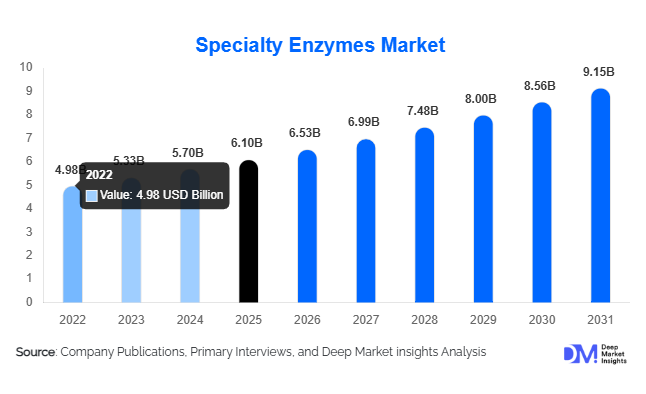
What are the latest trends in the specialty enzymes market?
Pharmaceutical and Diagnostics Adoption
Specialty enzymes are increasingly critical in pharmaceutical synthesis, biologics manufacturing, and molecular diagnostics. Polymerases, ligases, and other enzymes enable high-precision reactions, reducing errors and production times. The rise in chronic diseases and personalized medicine has amplified the demand for enzyme-based solutions. Enzyme manufacturers are now offering application-specific formulations to improve stability, yield, and regulatory compliance. Co-development partnerships between enzyme providers and pharmaceutical companies are gaining traction, further embedding specialty enzymes into advanced healthcare workflows.
Sustainable Industrial Biocatalysis
Industrial sectors are turning to specialty enzymes to replace chemical catalysts in biofuels, food processing, and green chemicals. Enzymatic processes are energy-efficient, reduce waste, and comply with sustainability standards. Carbohydrases, proteases, and lipases are widely used to optimize production while lowering environmental impact. Manufacturers are investing in enzyme engineering to create tailored biocatalysts with enhanced stability and activity under harsh industrial conditions, supporting a trend toward cleaner and more efficient production processes.
What are the key drivers in the specialty enzymes market?
Rising Pharmaceutical and Biotech Demand
The pharmaceutical and biotechnology sectors are the largest consumers of specialty enzymes. Enzymes are crucial in drug synthesis, diagnostics, and biopharmaceutical manufacturing, which is expanding globally. Increasing investment in biologics, personalized medicine, and molecular diagnostic tools is further boosting demand. The segment accounts for over 40% of the global specialty enzymes market, reflecting sustained high-value application adoption.
Food & Beverage Industry Growth
The growing global food and beverage sector drives enzyme adoption for process efficiency, product quality, and health-focused innovations. Carbohydrases and proteases improve texture, flavor, and digestibility, while enzymes like lactases enable lactose-free products. Rising consumer preference for protein-enriched and functional foods supports sustained market growth, particularly in North America, Europe, and the Asia-Pacific.
Green and Sustainable Industrial Processes
Industries are increasingly adopting specialty enzymes to reduce chemical usage, energy consumption, and environmental footprint. Enzymes enable biocatalysis in biofuels, specialty chemicals, and biopolymers. Governments in the Asia-Pacific and Europe are supporting bioeconomy initiatives, creating additional growth drivers. This trend positions specialty enzymes as critical enablers of sustainable industrial transformation.
What are the restraints for the global market?
High R&D and Manufacturing Costs
Developing high-performance specialty enzymes requires significant investment in research, bioprocessing infrastructure, and regulatory compliance. Smaller players may face challenges scaling production, which can slow overall market growth. Advanced enzyme engineering platforms are capital-intensive and require highly skilled personnel.
Supply Chain and Production Complexities
Consistency and scalability of enzyme production are constrained by raw material variability and stringent quality standards. Bioprocess optimization, fermentation management, and cold-chain logistics add operational complexities, particularly for novel or engineered enzymes. These challenges may limit market penetration in emerging regions and cost-sensitive industries.
What are the key opportunities in the specialty enzymes industry?
Expansion in Pharmaceutical and Diagnostic Applications
The surge in personalized medicine, molecular diagnostics, and biologics manufacturing presents significant growth opportunities. High-value enzymes such as polymerases, nucleases, and ligases are in strong demand, encouraging manufacturers to develop tailored, high-purity products. Strategic partnerships with pharmaceutical companies allow for the co-development of application-specific enzymes, enhancing adoption and profitability.
Technological Integration and Enzyme Engineering
Artificial intelligence, machine learning, and synthetic biology are transforming enzyme discovery and optimization. Predictive design enables the creation of enzymes with improved stability, specificity, and catalytic efficiency. These innovations expand use cases into industrial biotech, environmental remediation, and specialty chemical production, opening new revenue streams.
Regulatory and Sustainability Initiatives
Government programs supporting bioeconomy development, sustainable manufacturing, and local production of high-value enzymes present opportunities for both new entrants and established players. Initiatives in China, India, and Europe incentivize domestic enzyme production and adoption, reducing import dependence and encouraging environmentally responsible processes.
Report Scope
| Report Metric | Details |
|---|---|
| Market Size in 2025 | USD 6.1 Billion |
| Market Size in 2026 | USD 6.53 Billion |
| Market Size in 2031 | USD 9.15 Billion |
| CAGR | 7.0% (2026-2031) |
| Base Year for Estimation | 2025 |
| Historical Data | 2022-2024 |
| Forecast Period | 2026-2031 |
| Report Coverage | Revenue Forecast, Competitive Landscape, Supply Chain Disruption, Growth Factors, Environment & Regulatory Landscape and Trends |
| Geographies Covered | North America, Europe, APAC, Middle East and Africa, LATAM |
| Countries Covered | U.S., Canada, U.K., Germany, France, Spain, Italy, Russia, Nordic, Benelux, Rest of Europe, China, Korea, Japan, India, Australia, Singapore, Taiwan, South East Asia, Rest of Asia-Pacific, UAE, Turky, Saudi Arabia, South Africa, Egypt, Nigeria, Rest of MEA, Brazil, Mexico, Argentina, Chile, Colombia, Rest of LATAM |
Explore more data points, trends and opportunities Download Free Sample Report
Product Type Insights
Among product types, carbohydrases dominate the specialty enzymes market, accounting for approximately 38-42% of 2025 revenue. Their leadership is primarily driven by broad applicability across food processing, biofuel production, and industrial biotechnology. In food and beverage manufacturing, carbohydrases improve digestibility, enhance texture, and enable functional formulations such as lactose-free and protein-enriched products. In biofuels, they enhance biomass conversion efficiency, contributing to sustainable energy production. Industrial biotechnology applications benefit from carbohydrases’ ability to accelerate chemical reactions while minimizing energy and chemical inputs. Following carbohydrases, proteases, and lipases hold significant shares due to growing adoption in pharmaceutical synthesis, specialty chemicals, and detergents, where their specificity and efficiency improve process outcomes. Furthermore, the engineered enzymes segment is gaining traction as advanced protein engineering enhances enzyme stability, activity, and tolerance to extreme conditions, enabling more demanding industrial and therapeutic applications.
Application Insights
The pharmaceuticals and diagnostics segment accounts for roughly 40-42% of total market demand, reflecting the critical role of specialty enzymes in biopharmaceutical manufacturing, molecular diagnostics, and research assays. Enzymes such as polymerases, ligases, and nucleases are central to producing high-purity biologics, enabling rapid and precise drug development. The food & beverage sector is another major application area, particularly for functional foods, lactose-free products, and protein-enriched formulations, where carbohydrases and proteases improve product quality and shelf life. Emerging applications in industrial biotechnology, biofuels, and cosmetics are driving incremental growth, supported by sustainability initiatives, green chemistry adoption, and increasing consumer preference for high-performance, environmentally friendly products. The growth in applications is further supported by regulatory incentives and government programs promoting bio-based manufacturing in regions such as the Asia-Pacific and Europe.
Distribution Channel Insights
Direct sales and B2B partnerships dominate specialty enzyme distribution, particularly for high-purity and application-specific products where reliability and customization are critical. Online platforms and digital marketplaces are emerging as additional channels, facilitating global reach, real-time inventory management, and rapid response to industrial and pharmaceutical demand. Collaborations with pharmaceutical companies, research institutions, and industrial clients strengthen long-term supply agreements and ensure consistent product adoption. Additionally, subscription-based supply models and long-term enzyme procurement contracts are increasingly used to stabilize demand and secure high-value industrial partnerships.
End-Use Insights
The largest end-use segment is pharmaceuticals and biotech, reflecting the high dependency on enzymes for drug synthesis, diagnostics, and biomanufacturing processes. This segment benefits from sustained R&D investments, rising adoption of biologics, and expanding diagnostic infrastructure. The food processing industry is the second-largest end-use sector, where enzymes optimize production efficiency, product quality, and functional characteristics. Industrial applications such as biofuels, specialty chemicals, and environmental remediation represent emerging growth opportunities. Export-driven demand is particularly notable in Asia-Pacific and North America, where high-quality enzyme production caters to global pharmaceutical, industrial, and research requirements. Increasing cross-border collaboration, international regulatory alignment, and rising global biomanufacturing capacities support further expansion of these end-use segments.
Explore more data points, trends and opportunities Download Free Sample Report
Specialty Enzymes Market Segmentations
By Product Type
- Carbohydrases
- Proteases
- Lipases
- Engineered/Specialty Enzymes
- Other Specialty Enzymes
By Application
- Pharmaceuticals & Diagnostics
- Food & Beverages
- Industrial Biotechnology
- Biofuels & Energy
- Cosmetics & Personal Care
By Distribution Channel
- Direct Sales / B2B Partnerships
- Online Platforms & Marketplaces
- Industrial Suppliers & Distributors
By End-Use Industry
- Pharmaceutical & Biotech Companies
- Food Processing & Beverage Manufacturers
- Industrial Manufacturers
- Cosmetics & Personal Care Brands
- Biofuel Producers
Regional Insights
North America
North America dominates the global market with 38-42% of the 2025 share. The U.S. is the primary contributor due to strong biotech and pharmaceutical R&D, high adoption of enzyme-based processes, and mature industrial infrastructure. Drivers of regional growth include increasing biologics and molecular diagnostics production, high healthcare expenditure, and strong regulatory support for enzyme applications. In addition, continuous investment in enzyme engineering facilities, partnerships with research institutions, and integration of advanced bioprocess technologies further solidify North America’s leading position.
Europe
Europe holds a significant market share, led by Germany, France, and the U.K., driven by pharmaceutical innovation, sustainable food processing, and green industrial biotechnology initiatives. Growth is fueled by strict regulatory compliance requirements, government-backed bioeconomy programs, and increasing consumer preference for environmentally sustainable products. The region’s pharmaceutical and food manufacturing sectors continue to invest in specialty enzymes to improve product quality, reduce production costs, and enhance eco-friendly processes. High R&D intensity and strong integration of engineered enzyme technologies further support Europe’s market stability and growth trajectory.
Asia-Pacific
Asia-Pacific is the fastest-growing region, led by China and India, with expanding biotechnology hubs, industrial enzyme production capacities, and supportive government initiatives such as biotech innovation programs and manufacturing incentives. The pharmaceutical, diagnostics, and food processing sectors drive most of the regional demand, complemented by increasing adoption of sustainable and high-efficiency enzymatic processes in industrial applications. Rising middle-class wealth, growing healthcare infrastructure, and expanding export-oriented enzyme manufacturing further propel growth, making the region an attractive market for both local and global players.
Latin America
Latin America, including Brazil, Mexico, and Argentina, is witnessing steady growth due to emerging pharmaceutical, food processing, and industrial enzyme applications. The market is supported by increasing healthcare investments, rising industrialization, and imports of high-performance enzymes from North America and Europe. Expansion of local manufacturing facilities and partnerships with international enzyme producers are expected to further drive regional adoption and market development.
Middle East & Africa
MEA has a smaller but steadily growing market, mainly driven by pharmaceutical manufacturing, food processing, and industrial biotechnology initiatives. Government support for industrial biotechnology, diagnostics, and bio-manufacturing infrastructure is emerging, particularly in the UAE, Saudi Arabia, and South Africa. The development of free-trade zones, biotech hubs, and research collaborations enhances enzyme adoption. Rising healthcare investments, coupled with an increasing focus on sustainable industrial processes, provide long-term growth opportunities in the region.
Key Players in the Specialty Enzymes Market
- Novozymes A/S
- BASF SE
- DuPont de Nemours, Inc.
- Royal DSM N.V.
- Roche Holding AG
- Codexis, Inc.
- Advanced Enzyme Technologies Ltd.
- Amano Enzyme Inc.
- Biocatalysts Ltd.
- Specialty Enzyme & Probiotics
- Enzyme Development Corporation
- Amicogen Inc.
- Antozyme Biotech Pvt Ltd
- Dyadic International, Inc.
- F. Hoffmann-La Roche AG