Sleeping Bags Market Size
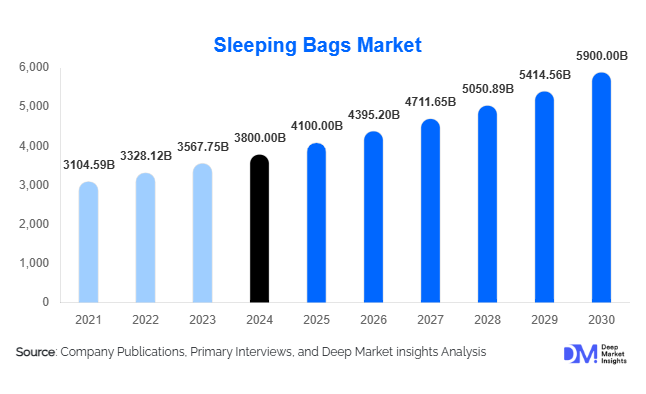
According to Deep Market Insights, the global sleeping bags market size was valued at USD 3,800 million in 2025 and is projected to grow from USD 4,100 million in 2026 to USD 5,900 million by 2031, registering a CAGR of 7.2% during the forecast period (2026–2031). The sleeping bags market growth is primarily driven by the increasing participation in outdoor recreational activities such as camping, trekking, and hiking, along with rising demand for lightweight, durable, and thermally efficient gear.
The market is witnessing steady expansion due to rising disposable income, particularly in emerging economies, and growing consumer inclination toward nature-based tourism and adventure travel. Technological advancements in insulation materials, including synthetic fibers and ethically sourced down, are improving product performance and driving premiumization. Additionally, the growth of e-commerce and direct-to-consumer channels has significantly enhanced product accessibility and global reach.
Key Market Insights
- Outdoor recreation participation is increasing globally, driving consistent demand for sleeping bags across both developed and emerging economies.
- Synthetic insulation dominates the market due to its affordability, moisture resistance, and ease of maintenance.
- North America leads the global market, supported by a strong camping culture and high consumer spending on outdoor gear.
- Asia-Pacific is the fastest-growing region, driven by rising middle-class income and expanding eco-tourism infrastructure.
- Mid-range products account for the largest share, balancing affordability with performance for mass-market consumers.
- Technological innovation, including ultralight materials and eco-friendly fabrics, is reshaping product development and consumer preferences.
Sleeping Bags Market Trends
Sustainable and Eco-Friendly Sleeping Bags
Sustainability is emerging as a defining trend in the sleeping bags market. Manufacturers are increasingly adopting recycled materials, biodegradable fabrics, and ethically sourced down insulation to cater to environmentally conscious consumers. Certifications such as Responsible Down Standard (RDS) and recycled polyester labeling are becoming key differentiators. Brands are also investing in circular economy models, including product recycling programs and reduced carbon footprint manufacturing processes. This trend is particularly strong in Europe and North America, where consumers are willing to pay a premium for eco-friendly products.
Ultralight and Compact Design Innovations
The growing popularity of backpacking and long-distance trekking has led to a surge in demand for ultralight and highly compressible sleeping bags. Innovations in material science, such as high-performance synthetic fibers and advanced down filling techniques, are enabling manufacturers to reduce weight without compromising thermal efficiency. Compact packing features and ergonomic designs are enhancing portability, making these products highly attractive for adventure travelers. This trend is also driving repeat purchases, as consumers upgrade to more advanced gear.
Sleeping Bags Market Drivers
Rising Demand for Outdoor and Adventure Activities
The global surge in outdoor recreational activities is a primary driver of the sleeping bags market. Camping, hiking, and trekking have gained significant popularity, particularly post-pandemic, as consumers seek nature-based experiences. Adventure tourism is expanding at a strong pace, creating sustained demand for sleeping bags across both personal and commercial use segments. This trend is especially prominent in North America and Europe, where outdoor culture is deeply ingrained.
Technological Advancements in Insulation Materials
Continuous innovation in insulation technologies is significantly enhancing product performance. Synthetic insulation materials now offer improved warmth-to-weight ratios and better moisture resistance, while advancements in down processing have increased durability and thermal efficiency. These innovations are encouraging consumers to upgrade their equipment, driving market growth and premium segment expansion.
Sleeping Bags Market Restraints
Seasonal Demand Variability
The sleeping bags market is highly seasonal, with demand peaking during specific outdoor activity periods. This creates challenges in inventory management and revenue consistency for manufacturers and retailers. Off-season demand remains limited, particularly in regions with extreme weather conditions, affecting overall market stability.
Price Sensitivity in Emerging Markets
While demand is growing in developing regions, affordability remains a significant constraint. Premium sleeping bags with advanced features are often priced beyond the reach of mass consumers in these markets. This limits penetration and slows the adoption of high-margin products, posing a challenge for global brands seeking expansion.
Sleeping Bags Market Opportunities
Expansion of Adventure Tourism Infrastructure
Government investments in eco-tourism and outdoor infrastructure are creating new growth opportunities for the sleeping bags market. Emerging destinations in Asia-Pacific and Latin America are witnessing increased campsite development and trekking routes, driving demand for both retail and rental sleeping bags. Partnerships with tourism operators can further enhance market penetration.
Institutional Demand from Military and Disaster Relief
Institutional buyers, including military organizations and disaster relief agencies, represent a stable and high-volume opportunity. These segments require durable, weather-resistant sleeping bags in bulk, providing long-term contracts and consistent revenue streams. The increasing frequency of natural disasters and geopolitical tensions is further driving demand in this segment.
Report Scope
| Report Metric | Details |
|---|---|
| Market Size in 2025 | USD 3800 Million |
| Market Size in 2026 | USD 4100 Million |
| Market Size in 2031 | USD 5900 Million |
| CAGR | 7.2% (2026-2031) |
| Base Year for Estimation | 2025 |
| Historical Data | 2022-2024 |
| Forecast Period | 2026-2031 |
| Report Coverage | Revenue Forecast, Competitive Landscape, Supply Chain Disruption, Growth Factors, Environment & Regulatory Landscape and Trends |
| Geographies Covered | North America, Europe, APAC, Middle East and Africa, LATAM |
| Countries Covered | U.S., Canada, U.K., Germany, France, Spain, Italy, Russia, Nordic, Benelux, Rest of Europe, China, Korea, Japan, India, Australia, Singapore, Taiwan, South East Asia, Rest of Asia-Pacific, UAE, Turky, Saudi Arabia, South Africa, Egypt, Nigeria, Rest of MEA, Brazil, Mexico, Argentina, Chile, Colombia, Rest of LATAM |
Explore more data points, trends and opportunities Download Free Sample Report
Product Type Insights
Mummy sleeping bags dominate the global market, accounting for approximately 38% of the total share in 2025, primarily due to their superior thermal efficiency, ergonomic fit, and lightweight construction. The tapered design minimizes air pockets, enabling better heat retention, which makes these sleeping bags the preferred choice for high-altitude trekking, mountaineering, and cold-weather expeditions. The increasing global interest in performance-driven outdoor activities, particularly in regions with colder climates, continues to drive demand for this segment. Additionally, advancements in fabric technology and insulation layering are further enhancing their appeal among professional and semi-professional users.
Rectangular sleeping bags cater largely to entry-level and casual campers who prioritize comfort and space over thermal efficiency. These products are particularly popular in family camping and car camping scenarios. Semi-rectangular (barrel-shaped) sleeping bags are gaining traction as a hybrid solution, offering a balance between comfort and heat retention. Double sleeping bags are witnessing growing demand among couples and family campers, especially in developed markets where leisure camping is a popular activity. However, the rising preference for compact, high-performance gear continues to reinforce the global leadership of mummy sleeping bags.
Insulation Type Insights
Synthetic insulation dominates the sleeping bags market with a share of approximately 55% in 2025, driven by its cost-effectiveness, durability, and superior moisture resistance. Synthetic materials, particularly polyester fiberfill, are widely used due to their ability to retain insulation properties even in damp conditions, making them ideal for diverse weather environments. This segment is especially popular among recreational users and budget-conscious consumers, as it requires minimal maintenance and offers consistent performance across varying climates.
Down insulation, while accounting for a smaller share, continues to gain momentum in the premium segment due to its exceptional warmth-to-weight ratio and compressibility. Goose and duck down sleeping bags are preferred by professional adventurers and extreme weather users. However, higher costs and sensitivity to moisture remain limiting factors. Hybrid insulation solutions, combining synthetic and down materials, are emerging as a niche but growing segment, offering optimized performance at relatively lower costs. Increasing consumer awareness regarding ethical sourcing and sustainability is also influencing purchasing decisions, particularly in developed markets.
Distribution Channel Insights
Offline retail channels continue to dominate the sleeping bags market, accounting for approximately 60% of total sales in 2025. Specialty outdoor stores and sporting goods retailers play a critical role in influencing purchase decisions, as consumers prefer to physically assess product attributes such as size, material quality, insulation thickness, and comfort. In-store expert guidance and product demonstrations further enhance consumer confidence, particularly for high-value purchases.
However, online distribution channels are witnessing rapid growth, driven by the expansion of e-commerce platforms and increasing adoption of direct-to-consumer (D2C) models by manufacturers. Online platforms offer advantages such as wider product selection, competitive pricing, and access to customer reviews, which are increasingly influencing buying behavior. The integration of digital tools such as virtual product demonstrations and AI-based recommendations is further accelerating online sales. As a result, while offline channels currently lead, the online segment is expected to gain significant share over the forecast period.
End-Use Insights
Recreational use remains the dominant end-use segment, contributing approximately 65% of the global market share in 2025. The increasing popularity of camping, trekking, and outdoor leisure activities is the primary driver of this segment. Rising disposable incomes, coupled with a growing preference for experiential travel, are encouraging consumers to invest in outdoor gear, including sleeping bags. The expansion of organized camping facilities and national parks is further supporting demand growth.
Commercial applications are steadily expanding, particularly across adventure tourism operators, military organizations, and disaster relief agencies. Adventure tourism companies require durable and high-performance sleeping bags for rental and guided expeditions, while military and defense sectors demand specialized products designed for extreme conditions. Additionally, humanitarian organizations are increasingly procuring sleeping bags for emergency relief operations, especially in disaster-prone regions. The diversification of end-use applications is enhancing market stability and reducing dependence on seasonal recreational demand.
Explore more data points, trends and opportunities Download Free Sample Report
Sleeping Bags Market Segmentations
By Product Type
- Lightweight Synthetic Sleeping Bags
- Down-Filled Sleeping Bags
- Smart/Connected Sleeping Bags
- Eco-Luxury Sleeping Bags
- Modular/Convertible Sleeping Bags
By End-User
- Recreational Campers
- Glamping & Wellness Tourists
- Extreme Outdoor Enthusiasts
By Distribution Channel
- Online Retail & DTC Platforms
- Specialty Outdoor Stores
- Department Stores
- Adventure/Travel Retailers
Regional Insights
North America
North America remains the largest market for sleeping bags, accounting for approximately 35% of global demand in 2025. The United States is the dominant contributor, supported by a deeply rooted outdoor culture, high participation in camping and hiking activities, and strong consumer spending on outdoor equipment. The presence of well-developed national parks and camping infrastructure further drives demand. Additionally, the growing trend of glamping and recreational vehicle (RV) travel is boosting the adoption of premium sleeping bags. Canada also contributes significantly due to its extensive wilderness areas and increasing interest in adventure tourism. The region’s growth is further supported by strong retail networks and high brand awareness.
Europe
Europe accounts for approximately 28% of the global market, with major demand coming from countries such as Germany, France, and the United Kingdom. The region is characterized by a strong emphasis on sustainability and eco-friendly products, driving demand for sleeping bags made from recycled and ethically sourced materials. Government initiatives promoting outdoor recreation, eco-tourism, and sustainable travel are key growth drivers. Additionally, the popularity of organized camping and hiking trails across countries such as Switzerland, Norway, and Austria is supporting market expansion. The presence of established outdoor brands and increasing consumer preference for high-quality gear further strengthen the regional market.
Asia-Pacific
Asia-Pacific is the fastest-growing region in the sleeping bags market, expanding at a CAGR of approximately 8%. Key markets include China, India, and Japan, where rising disposable incomes and increasing urbanization are driving demand for outdoor recreational products. Government initiatives to promote tourism, including eco-tourism and adventure tourism, are significantly boosting market growth. In China, the expansion of domestic tourism and camping culture is a major driver, while in India, increasing interest in trekking and nature-based travel is fueling demand. Japan represents a mature market with steady demand driven by technological innovation and high-quality product preferences. The rapid growth of e-commerce platforms in the region is also enhancing product accessibility.
Latin America
Latin America accounts for approximately 10% of the global market, with Brazil and Argentina leading regional demand. The market is driven by the growing popularity of adventure tourism and increasing investment in tourism infrastructure. Natural attractions such as rainforests, mountains, and national parks are encouraging outdoor activities, thereby boosting demand for sleeping bags. Rising consumer awareness and gradual improvements in disposable income are further supporting market growth. However, price sensitivity remains a key challenge, leading to higher demand for mid-range and economy products.
Middle East & Africa
The Middle East & Africa region holds approximately 7% of the global market share. In the Middle East, demand is primarily driven by desert tourism and outdoor recreational activities in countries such as the UAE and Saudi Arabia. Luxury camping and desert safari experiences are contributing to the adoption of premium sleeping bags. In Africa, demand is largely influenced by humanitarian applications, including disaster relief and refugee support, as well as adventure tourism in countries such as South Africa and Kenya. Increasing investments in tourism infrastructure and rising international tourist inflow are expected to support future market growth across the region.
Key Players in the Sleeping Bags Market
- The North Face
- Coleman
- Marmot
- Mountain Hardwear
- Kelty
- Big Agnes
- Nemo Equipment
- Sea to Summit
- Vaude
- Jack Wolfskin
- Decathlon
- ALPS Mountaineering
- Snugpak
- Vango
- Black Diamond