Single Malt Scotch Whisky Market Size
According to Deep Market Insights, the global single malt Scotch whisky market size was valued at USD 14.52 billion in 2025 and is projected to grow from USD 15.90 billion in 2026 to reach USD 25.03 billion by 2031, expanding at a CAGR of 9.5% during the forecast period (2026–2031). The single malt Scotch whisky market growth is primarily driven by rising premiumization trends in alcoholic beverages, increasing global demand for luxury spirits, growing collector interest in aged whisky expressions, and expanding consumption across Asia-Pacific and North America.
Key Market Insights
- Premium and ultra-premium whisky categories are witnessing rapid expansion, supported by affluent consumers seeking exclusivity, craftsmanship, and heritage-driven alcoholic beverages.
- Asia-Pacific is emerging as the fastest-growing regional market, led by rising demand from China, India, Taiwan, Singapore, and South Korea.
- Europe remains the dominant production and consumption hub, with Scotland continuing to lead global exports and premium whisky tourism.
- Online retail and direct-to-consumer whisky platforms are reshaping distribution channels, improving accessibility to limited-edition and collectible whisky releases.
- Luxury gifting culture is significantly boosting demand, particularly across emerging economies and corporate gifting segments.
- Sustainability-focused distillation and packaging innovations are increasingly becoming competitive differentiators among major whisky producers.
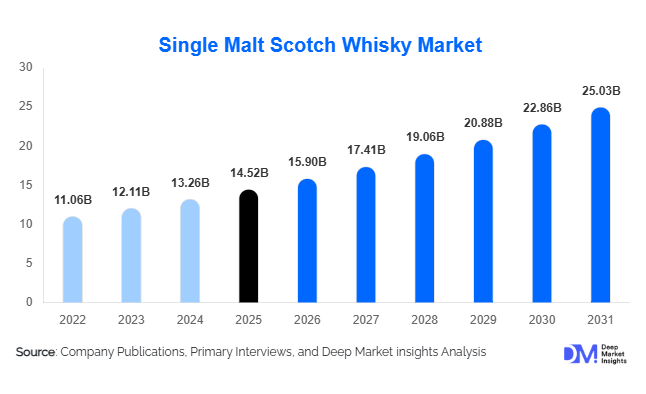
single malt scotch whisky market latest trends
Premiumization and Luxury Whisky Demand Accelerating
The global single malt Scotch whisky industry is increasingly shifting toward premium and luxury product positioning. Consumers are showing stronger preference for aged expressions, cask-finished variants, limited-edition collections, and collectible releases that emphasize authenticity and craftsmanship. High-net-worth individuals and younger affluent consumers are driving demand for ultra-premium bottles priced significantly above conventional whisky categories. Distilleries are responding by launching small-batch releases, experimental maturation techniques, and heritage-inspired packaging that elevate brand exclusivity. Luxury gifting culture across Asia-Pacific and the Middle East is also contributing to stronger sales of premium Scotch whisky portfolios.
Digital Commerce and Whisky Investment Platforms Expanding
The rapid expansion of online alcohol retail and whisky investment platforms is transforming consumer engagement within the market. E-commerce channels now allow consumers to access rare releases, virtual whisky tastings, and subscription-based whisky clubs globally. Digital auction platforms are further strengthening demand for collectible Scotch whisky, particularly among investors seeking alternative luxury assets. Distillers are increasingly leveraging AI-based consumer analytics, digital storytelling, and social media engagement to attract younger demographics. Additionally, blockchain-enabled traceability and authentication systems are gaining traction in the premium whisky segment to reduce counterfeiting risks and improve transparency for collectors and investors.
single malt scotch whisky market drivers
Growing Global Demand for Premium Spirits
The rising global preference for premium alcoholic beverages remains one of the strongest drivers of the single malt Scotch whisky market. Consumers are increasingly shifting from standard blended spirits toward high-quality, heritage-focused products that provide authenticity and exclusivity. Single malt Scotch whisky is particularly benefiting from this premiumization trend due to its strong geographical identity, aging process, and artisanal production methods. Millennials and affluent consumers are increasingly viewing premium whisky as a lifestyle product associated with sophistication and social status. Growing disposable income levels across emerging economies are further strengthening demand for luxury spirits globally.
Expansion of Whisky Consumption in Asia-Pacific
Asia-Pacific has emerged as a major growth engine for the single malt Scotch whisky market. Countries such as China, India, Taiwan, Singapore, and South Korea are witnessing substantial increases in premium whisky consumption due to urbanization, western lifestyle influence, and expanding middle-class wealth. Corporate gifting culture and rising demand for imported alcoholic beverages are further supporting market growth. Travel retail recovery across major airports in Asia is also contributing to increased premium whisky sales. Additionally, younger legal-age consumers in Asia-Pacific are showing strong interest in whisky tasting experiences, whisky lounges, and collectible limited-edition releases.
global market restraints
Long Aging Cycles and Inventory Constraints
The production of premium single malt Scotch whisky requires extended maturation periods that can span several years or decades. This creates inventory management challenges for distilleries and limits production flexibility during periods of rising demand. Warehousing costs, barrel storage requirements, and fluctuations in oak cask availability also increase operational expenses for manufacturers. The long aging cycle further exposes producers to risks associated with changing consumer preferences and economic conditions, making inventory planning a complex challenge across the industry.
High Import Duties and Regulatory Restrictions
The single malt Scotch whisky market is significantly influenced by alcohol taxation policies, import tariffs, and advertising regulations across different countries. High import duties in markets such as India and several Middle Eastern economies increase retail pricing and limit broader market accessibility. Strict alcohol marketing regulations in some developed countries also create promotional limitations for producers. Additionally, increasing health-consciousness trends and government initiatives aimed at reducing alcohol consumption may moderately restrain long-term growth prospects for premium spirits globally.
single malt scotch whisky industry key opportunities
Whisky Tourism and Experiential Luxury Consumption
The growing popularity of experiential luxury tourism presents major opportunities for single malt Scotch whisky producers. Distillery tours, whisky-tasting experiences, heritage museums, and premium hospitality offerings in Scotland are attracting international travelers seeking immersive cultural experiences. Whisky tourism is becoming a strategic revenue stream for producers while simultaneously strengthening global brand visibility. Investments in visitor centers, luxury tasting lounges, and experiential retail are expected to expand further as companies seek to deepen consumer engagement and strengthen premium brand positioning.
Emergence of Sustainable and Low-Carbon Distillation
Sustainability is becoming an increasingly important opportunity within the single malt Scotch whisky industry. Distilleries are investing heavily in renewable energy systems, water recycling technologies, carbon-neutral production facilities, and sustainable packaging innovations. Environmentally conscious consumers are showing growing preference for brands with strong ESG credentials. Governments across Europe are also encouraging industrial decarbonization through sustainability-focused initiatives and incentives. Companies that successfully integrate sustainability into production and branding strategies are likely to strengthen long-term competitiveness and premium market appeal.
Report Scope
| Report Metric | Details |
|---|---|
| Market Size in 2025 | USD 14.52 Billion |
| Market Size in 2026 | USD 15.90 Billion |
| Market Size in 2031 | USD 25.03 Billion |
| CAGR | 9.5% (2026-2031) |
| Base Year for Estimation | 2025 |
| Historical Data | 2022-2024 |
| Forecast Period | 2026-2031 |
| Report Coverage | Revenue Forecast, Competitive Landscape, Supply Chain Disruption, Growth Factors, Environment & Regulatory Landscape and Trends |
| Geographies Covered | North America, Europe, APAC, Middle East and Africa, LATAM |
| Countries Covered | U.S., Canada, U.K., Germany, France, Spain, Italy, Russia, Nordic, Benelux, Rest of Europe, China, Korea, Japan, India, Australia, Singapore, Taiwan, South East Asia, Rest of Asia-Pacific, UAE, Turky, Saudi Arabia, South Africa, Egypt, Nigeria, Rest of MEA, Brazil, Mexico, Argentina, Chile, Colombia, Rest of LATAM |
Explore more data points, trends and opportunities Download Free Sample Report
Product Type Insights
Speyside single malt Scotch whisky continues to dominate the global market, accounting for nearly 34% of total revenue share due to its approachable flavor profile, balanced sweetness, and strong international brand recognition. The region’s high concentration of globally established distilleries, extensive export networks, and long-standing heritage position Speyside as the preferred choice among both experienced whisky enthusiasts and first-time premium buyers. Demand for Speyside expressions is further supported by growing consumer preference for smooth and versatile whiskies that can be consumed neat, on the rocks, or within premium cocktail applications. Highland single malt whiskies also maintain a substantial share of the market owing to their broad diversity in flavor characteristics, ranging from light floral notes to richer and more robust profiles. Consumers seeking variety and regional authenticity continue to drive strong sales across Highland distilleries.Islay single malts are witnessing significant demand growth among premium consumers and collectors due to their distinct smoky and peated flavor profiles, which appeal strongly to experienced whisky drinkers seeking bold taste experiences. Increasing global interest in artisanal production methods and terroir-driven spirits has further strengthened Islay’s position within the ultra-premium whisky category. Campbeltown and Island whiskies continue to represent niche yet steadily expanding segments, supported by limited production exclusivity, rarity value, and increasing collector interest in small-batch and hard-to-find expressions. Meanwhile, Lowland whiskies are increasingly attracting younger and entry-level premium consumers because of their lighter, smoother, and more accessible flavor characteristics. Rising experimentation among new whisky drinkers and growing educational marketing initiatives by distilleries are supporting the expansion of Lowland whisky consumption worldwide.
Age Statement Insights
The 11–15 years category holds the leading market share at approximately 31% of global revenue, primarily driven by strong consumer preference for whiskies that balance maturity, flavor complexity, and relative affordability. This segment remains highly attractive to mainstream premium consumers because it delivers well-developed taste characteristics without reaching the significantly higher price points associated with ultra-aged expressions. Increasing global premiumization trends, rising consumer awareness regarding whisky aging, and growing demand for high-quality gifting products continue to strengthen the dominance of this age category. Distilleries also actively prioritize the 11–15 years segment because it enables scalability while maintaining premium positioning across international markets.No Age Statement (NAS) whiskies are witnessing rapid growth as producers increasingly utilize flexible aging strategies to address inventory constraints and rising global demand. NAS products allow distilleries to introduce innovative cask finishes, experimental flavor profiles, and contemporary branding strategies that resonate strongly with younger consumers and modern whisky enthusiasts. The 16–20 years category continues to experience stable growth due to increasing demand for more refined and luxurious whisky experiences among affluent consumers. Meanwhile, the 21 years and above category remains one of the most prestigious segments within the market, driven by rising interest in collectible and investment-grade whiskies. High-net-worth individuals, luxury gifting buyers, and whisky investors continue to support demand for rare aged bottles, particularly those associated with limited production runs and renowned distilleries.
Distribution Channel Insights
Specialty liquor stores dominate the global distribution landscape with nearly 33% market share, benefiting from their extensive premium product assortments, knowledgeable staff, and ability to provide personalized recommendations to consumers. These retail outlets continue to play a critical role in educating buyers about whisky origins, age statements, tasting notes, and investment-worthy releases, thereby strengthening customer engagement and repeat purchases. Increasing consumer preference for premium in-store experiences and curated whisky selections further supports the leadership of specialty liquor retailers in both developed and emerging markets.Duty-free and travel retail channels remain highly influential within the premium single malt Scotch whisky market, particularly for limited-edition launches, airport-exclusive expressions, and luxury gifting purchases. Rising international tourism, expanding airport retail infrastructure, and increasing spending by affluent travelers continue to support growth across travel retail channels. Online retail and direct-to-consumer platforms represent the fastest-growing distribution segment due to improving regulatory frameworks, wider product accessibility, and growing consumer comfort with digital purchasing. E-commerce platforms are increasingly leveraging virtual tasting events, subscription models, and personalized recommendations to enhance consumer engagement. Hotels, premium bars, whisky lounges, and fine-dining restaurants also contribute significantly to market expansion by increasing brand visibility and encouraging product trial through curated tasting experiences, premium hospitality partnerships, and experiential beverage programs.
Consumer Demographic Insights
Millennials represent the largest consumer demographic, accounting for approximately 39% of global single malt Scotch whisky demand. The segment’s dominance is primarily driven by increasing interest in premium lifestyle experiences, craft beverages, authenticity-focused branding, and experiential consumption trends. Younger consumers are increasingly drawn toward heritage-rich whisky brands that emphasize craftsmanship, sustainability, and unique flavor stories. Social media influence, digital marketing campaigns, and the growing popularity of whisky education content are also encouraging millennials to explore premium Scotch whisky categories more actively.Generation X consumers continue to drive strong premium sales due to their higher purchasing power, established appreciation for aged spirits, and greater willingness to spend on luxury alcoholic beverages. This demographic remains particularly important for ultra-premium and collectible whisky categories. High-net-worth collectors represent a smaller but highly profitable consumer group focused on rare releases, limited-edition bottles, and investment-grade whiskies that offer long-term appreciation potential. Meanwhile, Gen Z legal-age consumers are gradually entering the market through digital engagement, premium nightlife culture, and experiential hospitality environments such as whisky bars, tasting lounges, and immersive brand events. Increasing exposure to luxury consumption trends and premium beverage experimentation is expected to strengthen Gen Z participation over the forecast period.
End-Use Insights
Household consumption remains the leading end-use segment within the global single malt Scotch whisky market as premium alcohol consumption increasingly shifts toward home-based experiences, personal collections, and private social gatherings. Rising consumer preference for premium at-home entertainment, combined with the growing popularity of virtual whisky tastings and online whisky communities, continues to support strong household demand. Consumers are increasingly purchasing premium whisky products for personal enjoyment, gifting purposes, and long-term collection building, further reinforcing the segment’s market dominance.The hospitality sector, including luxury hotels, premium bars, fine-dining restaurants, and whisky lounges, represents one of the fastest-growing application segments due to increasing demand for curated premium beverage experiences. The expansion of luxury tourism, experiential dining concepts, and high-end nightlife culture continues to strengthen whisky consumption across hospitality channels. Corporate gifting programs are also contributing significantly to market growth, particularly across Asia-Pacific and the Middle East where premium Scotch whisky is widely perceived as a status-oriented and prestigious gift category. In addition, the whisky investment and auction industry is rapidly emerging as a lucrative niche application segment driven by rising collectible bottle values, increasing participation from alternative asset investors, and growing global interest in rare and limited-edition whisky releases.
Explore more data points, trends and opportunities Download Free Sample Report
Single Malt Scotch Whisky Market Segmentations
Diageo plc
Pernod Ricard SA
William Grant & Sons Ltd
Edrington Group
Beam Suntory Inc.
Bacardi Limited
Brown-Forman Corporation
Whyte & Mackay Ltd
Ian Macleod Distillers Ltd
Loch Lomond Group
Regional Insights
Europe
Europe remains the dominant regional market, accounting for nearly 36% of global market share in 2025. Scotland continues to serve as the global production and export hub for single malt Scotch whisky, supported by centuries-old distilling traditions, strong geographical indication protection, and extensive international distribution networks. The region benefits from a well-established premium spirits culture, high consumer awareness regarding whisky craftsmanship, and strong tourism-driven sales activity. France remains one of the largest importers of Scotch whisky globally due to strong consumer affinity for premium spirits and rising demand for luxury alcoholic beverages. Germany and Spain also contribute significantly through expanding hospitality sectors, increasing premium beverage consumption, and rising consumer preference for aged spirits.Regional growth is further supported by the expansion of whisky tourism across Scotland, where distillery visits, tasting experiences, and heritage-based tourism initiatives continue to drive direct-to-consumer sales and strengthen brand loyalty. Increasing investment in premium product innovation, cask finishing techniques, and sustainable distillation practices is also supporting long-term regional market expansion. In addition, Europe benefits from strong export-oriented production capabilities and established trade relationships that reinforce the region’s leadership position within the global single malt Scotch whisky industry.
North America
North America accounts for approximately 29% of the global market, led primarily by the United States. Rising premiumization trends, expanding luxury gifting culture, and increasing demand for brown spirits continue to drive strong regional consumption growth. American consumers are increasingly purchasing aged, rare, and collectible whisky expressions as premium spirits gain greater cultural and investment appeal. The growing popularity of whisky tasting events, premium cocktail culture, and luxury hospitality experiences is further accelerating market demand across the region.Regional growth is also supported by increasing disposable incomes, strong consumer interest in artisanal and heritage-driven alcoholic beverages, and expanding e-commerce penetration for premium spirits. The United States continues to witness rising participation in whisky auctions, collector communities, and private whisky clubs, contributing to stronger demand for limited-edition expressions. Canada also contributes steadily to regional growth through rising premium alcohol sales, expanding whisky enthusiast communities, and increasing consumer interest in imported luxury spirits. Furthermore, favorable retail infrastructure and strong marketing activities by global whisky brands continue to strengthen North America’s position within the global market.
Asia-Pacific
Asia-Pacific is the fastest-growing regional market and is projected to register a CAGR exceeding 12% during the forecast period. China and India are emerging as critical demand centers due to rapidly rising disposable incomes, urbanization, expanding middle-class populations, and growing luxury consumer bases. Increasing westernization of consumption habits and rising demand for premium international alcoholic beverages are significantly contributing to market expansion across the region. Taiwan and Singapore remain major hubs for premium whisky collectors and high-value imports due to strong investment interest in rare and aged whisky expressions.Regional growth is being strongly driven by rapid expansion of luxury retail infrastructure, increasing duty-free sales, and the growing influence of premium gifting culture across corporate and affluent consumer segments. South Korea and Japan continue to exhibit strong appreciation for aged and collectible Scotch whisky products, supported by mature premium spirits markets and sophisticated consumer preferences. The expansion of digital retail platforms, rising whisky education initiatives, and increasing participation in whisky tasting events are also encouraging broader consumer adoption throughout Asia-Pacific. Additionally, growing international tourism and the expansion of luxury hospitality industries are further accelerating regional demand for premium single malt Scotch whisky.
Latin America
Latin America is gradually emerging as a promising growth market led by Brazil, Mexico, and Chile. Increasing urbanization, expansion of premium nightlife culture, and rising awareness regarding imported luxury spirits are contributing significantly to regional demand growth. Consumers across major metropolitan areas are increasingly exploring premium Scotch whisky as part of broader international luxury consumption trends, particularly among affluent and younger professional demographics.Regional market expansion is further supported by improving retail accessibility for imported alcoholic beverages, growing tourism activity, and increasing investment in luxury hospitality infrastructure. Rising exposure to international premium beverage brands through social media, global travel, and digital marketing campaigns is also encouraging stronger adoption of premium whisky products across Latin America. In addition, increasing disposable incomes among upper-middle-class consumers and growing demand for premium gifting products continue to create favorable conditions for long-term market growth within the region.
Middle East & Africa
The Middle East & Africa region is witnessing moderate but steadily rising demand for single malt Scotch whisky, supported by growing luxury consumption trends and expanding premium hospitality industries. The UAE remains a major premium consumption center due to its world-class luxury hospitality infrastructure, strong tourism activity, and extensive duty-free retail operations. Premium hotels, fine-dining establishments, and luxury entertainment venues continue to drive strong demand for imported Scotch whisky products across the region.Regional growth is also being supported by rising affluent consumer spending, increasing expatriate populations, and the expansion of premium tourism destinations throughout the Middle East. South Africa continues to represent one of the largest whisky consumption markets within Africa due to its established premium spirits culture and expanding urban middle-class population. The increasing popularity of luxury gifting, premium nightlife experiences, and international travel retail is further contributing to market development across the broader region. Additionally, rising investments in tourism infrastructure and luxury retail development are expected to create sustained growth opportunities for premium single malt Scotch whisky
Key Players in the Single Malt Scotch Whisky Market
- Diageo plc
- Pernod Ricard SA
- William Grant & Sons Ltd
- Edrington Group
- Beam Suntory Inc.
- Bacardi Limited
- Brown-Forman Corporation
- Whyte & Mackay Ltd
- Ian Macleod Distillers Ltd
- Loch Lomond Group
- Gordon & MacPhail
- Douglas Laing & Co.
- The GlenAllachie Distillers Company
- Isle of Arran Distillers Ltd
- BenRiach Distillery Company Ltd