Scotch Whisky Market Size
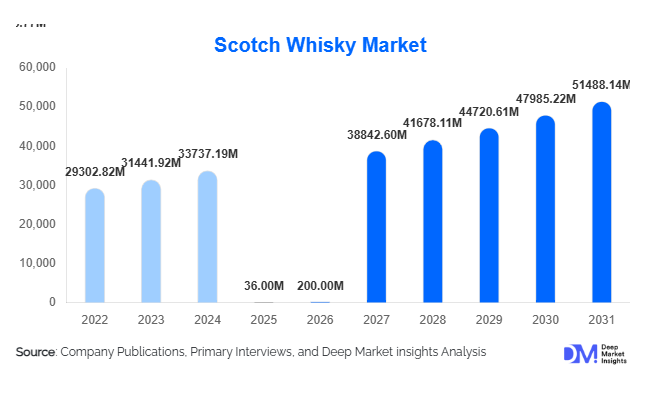
According to Deep Market Insights, the global Scotch whisky market size was valued at USD 36,200 million in 2025 and is projected to grow from USD 38,842.60 million in 2026 to reach USD 55,246.77 million by 2031, expanding at a CAGR of 7.3% during the forecast period (2026–2031). The Scotch whisky market growth is primarily driven by strong premiumization trends, rising global demand for aged spirits, and expanding export markets across Asia-Pacific and Latin America. Increasing consumer preference for high-quality, heritage-driven alcoholic beverages, combined with the growing appeal of whisky as a collectible and investment asset, is further supporting market expansion. Additionally, innovation in cask finishing, limited-edition releases, and sustainable distillation practices are enhancing brand differentiation and pricing power across premium segments.
Key Market Insights
- Premium and ultra-premium Scotch whisky segments are driving value growth, supported by increasing consumer willingness to trade up for quality and exclusivity.
- Asia-Pacific is emerging as the fastest-growing region, led by rising demand in India, China, and Southeast Asia.
- Europe dominates global consumption, benefiting from strong cultural affinity and established whisky traditions.
- Off-trade retail channels lead distribution, while e-commerce is rapidly gaining traction globally.
- Whisky as an investment asset is gaining popularity, particularly for rare and aged variants.
- Sustainability and eco-friendly production practices are becoming key differentiators among leading distilleries.
What are the latest trends in the Scotch whisky market?
Premiumization and Craft Positioning
The Scotch whisky market is experiencing a strong shift toward premium and ultra-premium offerings, driven by consumer demand for authenticity, heritage, and superior quality. Distilleries are increasingly focusing on small-batch production, unique cask finishes, and aged variants to cater to connoisseurs and high-income consumers. Limited-edition releases and collector series are gaining traction, often commanding significantly higher prices and generating strong secondary market demand. This trend is particularly prominent in emerging economies where rising affluence is fueling demand for luxury spirits. The emphasis on storytelling, provenance, and craftsmanship is helping brands create deeper emotional connections with consumers, reinforcing long-term loyalty.
Digital Transformation and Direct-to-Consumer Growth
Digitalization is reshaping the Scotch whisky market, with e-commerce and direct-to-consumer (DTC) channels gaining importance. Online platforms are enabling brands to reach global audiences, offer personalized experiences, and provide detailed product information. Virtual tastings, AI-driven recommendations, and digital marketing campaigns are enhancing consumer engagement. Additionally, blockchain technology is being explored for authentication of rare and collectible whiskies, ensuring transparency and trust. This shift is particularly appealing to younger, tech-savvy consumers who value convenience and digital interaction in their purchasing journeys.
What are the key drivers in the Scotch whisky market?
Rising Global Demand for Premium Spirits
The increasing preference for premium alcoholic beverages is a major driver of Scotch whisky market growth. Consumers are shifting from mass-produced spirits to high-quality, aged whiskies that offer distinctive flavor profiles and heritage value. This trend is boosting demand for single malt and aged Scotch whiskies, particularly in developed markets such as the United States and Europe, as well as in emerging economies where premiumization is accelerating.
Expansion of Export Markets
Scotch whisky exports are expanding rapidly, particularly in Asia-Pacific and Latin America. Countries such as India and China are witnessing strong demand growth due to rising disposable incomes, urbanization, and changing consumer preferences. Trade agreements and improved distribution networks are further facilitating market penetration, making Scotch whisky more accessible to new consumer segments globally.
What are the restraints for the global market?
Long Aging Cycles and Supply Constraints
The production of Scotch whisky requires extended maturation periods, often spanning several years or decades. This results in significant capital lock-in and limits the ability of producers to quickly respond to fluctuations in demand. Supply constraints can lead to inventory shortages and increased prices, posing challenges for both producers and consumers.
Regulatory and Taxation Challenges
The Scotch whisky market is subject to stringent regulations and high taxation in many countries. Import duties, excise taxes, and complex compliance requirements can increase retail prices and limit market accessibility. These challenges are particularly pronounced in emerging markets, where regulatory barriers can hinder growth potential.
What are the key opportunities in the Scotch whisky industry?
Growth in Emerging Markets
Emerging economies such as India, China, and Southeast Asian countries present significant growth opportunities for Scotch whisky producers. Rapid urbanization, rising middle-class incomes, and increasing exposure to global lifestyles are driving demand for premium spirits. Companies that invest in localized marketing strategies and distribution networks can capitalize on this expanding consumer base.
Expansion of Travel Retail and Duty-Free Channels
The recovery of global travel is boosting sales in duty-free and travel retail channels. Airports and international transit hubs are becoming key sales points for premium Scotch whisky, offering exclusive editions and attractive packaging. This channel also serves as an important platform for brand visibility and consumer acquisition.
Report Scope
| Report Metric | Details |
|---|---|
| Market Size in 2025 | USD 36200 Million |
| Market Size in 2026 | USD 38842.60 Million |
| Market Size in 2031 | USD 55246.77 Million |
| CAGR | 7.3% (2026-2031) |
| Base Year for Estimation | 2025 |
| Historical Data | 2022-2024 |
| Forecast Period | 2026-2031 |
| Report Coverage | Revenue Forecast, Competitive Landscape, Supply Chain Disruption, Growth Factors, Environment & Regulatory Landscape and Trends |
| Geographies Covered | North America, Europe, APAC, Middle East and Africa, LATAM |
| Countries Covered | U.S., Canada, U.K., Germany, France, Spain, Italy, Russia, Nordic, Benelux, Rest of Europe, China, Korea, Japan, India, Australia, Singapore, Taiwan, South East Asia, Rest of Asia-Pacific, UAE, Turky, Saudi Arabia, South Africa, Egypt, Nigeria, Rest of MEA, Brazil, Mexico, Argentina, Chile, Colombia, Rest of LATAM |
Explore more data points, trends and opportunities Download Free Sample Report
Product Type Insights
The global Scotch whisky market continues to be predominantly shaped by the enduring popularity of blended Scotch whisky, which accounts for nearly 65% of total consumption. This dominance is largely attributed to its affordability, consistency in taste, and widespread accessibility across both developed and emerging markets. Blended Scotch offers a balanced flavor profile that appeals to a broad spectrum of consumers, making it a staple in both casual and regular consumption occasions. Its versatility also makes it a preferred choice in cocktails and mixed drinks, further reinforcing its position in high-volume segments such as bars, restaurants, and retail outlets.Despite the dominance of blended Scotch, the single malt segment is witnessing the fastest growth trajectory within the product landscape. This growth is primarily driven by the increasing global inclination toward premiumization, where consumers are willing to pay higher prices for superior quality, authenticity, and heritage. Single malt Scotch whisky is often perceived as a symbol of craftsmanship and tradition, appealing to connoisseurs and enthusiasts who value origin, aging processes, and unique flavor characteristics. The rise of whisky tourism, distillery experiences, and storytelling around brands has further enhanced the appeal of single malts, particularly among younger affluent consumers.Blended malt and grain whiskies, although occupying smaller market shares, are steadily gaining traction among niche consumer groups. These categories offer distinctive taste profiles and innovative expressions that cater to evolving consumer preferences seeking novelty and experimentation. Additionally, the increasing prominence of craft distilleries and small-batch production is diversifying the product landscape. Producers are investing in limited-edition releases, cask experimentation, and regional variations to differentiate their offerings in a competitive market. The leading segment driver remains the affordability and mass appeal of blended Scotch, while the rapid expansion of premium segments is fueled by consumer aspirations toward luxury and authenticity.
Application Insights
In terms of application, individual consumption continues to dominate the Scotch whisky market, accounting for nearly 60% of total demand. This segment is primarily driven by the growing trend of at-home consumption, which has been reinforced by lifestyle changes, urbanization, and the increasing preference for private social gatherings. Consumers are investing in building personal collections and experimenting with premium spirits at home, often influenced by digital content, social media, and virtual tasting experiences. Gifting also plays a significant role in this segment, with Scotch whisky being widely regarded as a premium and culturally appropriate gift for various occasions.The hospitality sector, encompassing bars, restaurants, and hotels, remains a crucial application area, contributing significantly to overall market revenues. This segment benefits from the rising popularity of whisky-based cocktails, curated drinking experiences, and premium dining trends. High-end establishments are increasingly incorporating Scotch whisky into their offerings through specialized menus, tasting sessions, and pairing experiences, thereby enhancing consumer engagement and brand visibility. The leading driver for this segment is the experiential consumption trend, where consumers seek not just a product but an immersive and memorable experience.Corporate gifting and collectible investments are emerging as high-growth application areas within the Scotch whisky market. Companies are increasingly choosing premium and limited-edition whiskies as corporate gifts to reflect prestige and exclusivity. Simultaneously, whisky is gaining recognition as an alternative investment asset, with rare and aged bottles appreciating significantly in value over time. Collectors and investors are drawn to the scarcity, historical significance, and brand heritage associated with certain expressions. These segments are particularly attractive due to their high margins and strong growth potential, supported by increasing global awareness and the expansion of auction platforms and specialty retailers.
Distribution Channel Insights
The distribution landscape of the Scotch whisky market is led by off-trade channels, which account for approximately 55% of total sales. These include supermarkets, hypermarkets, and specialized liquor stores that provide consumers with convenient access to a wide variety of products at competitive prices. The dominance of this segment is driven by its extensive reach, promotional activities, and the ability to cater to both mass-market and premium consumers. Retailers are increasingly enhancing in-store experiences through product displays, sampling sessions, and personalized recommendations, further strengthening consumer engagement.On-trade channels, including bars, pubs, and restaurants, play a pivotal role in brand building and consumer education. These venues serve as important touchpoints where consumers can explore different whisky variants, learn about flavor profiles, and develop brand preferences. The leading driver for this segment is the experiential and social aspect of consumption, which cannot be replicated in off-trade settings. Premiumization trends are particularly evident in this channel, as consumers are more willing to experiment with high-end offerings in a social environment.Online retail is emerging as the fastest-growing distribution channel, driven by advancements in digital infrastructure, increased internet penetration, and changing consumer purchasing behavior. E-commerce platforms offer convenience, extensive product selection, and access to rare and exclusive releases that may not be available in physical stores. The integration of digital marketing strategies, personalized recommendations, and subscription-based models is further accelerating growth in this segment. Duty-free and travel retail channels are also gaining prominence, particularly for premium and luxury Scotch whisky offerings. These channels benefit from international travel trends and the appeal of exclusive, travel-only editions, making them a key driver of high-value sales.
End-Use Insights
The individual consumer segment remains the cornerstone of the Scotch whisky market, supported by rising disposable incomes, urbanization, and evolving lifestyle preferences. Consumers are increasingly viewing whisky as a lifestyle product, associated with sophistication, relaxation, and social status. The leading driver for this segment is the growing inclination toward premiumization, where consumers prioritize quality and brand heritage over price considerations. This trend is particularly strong among younger demographics who are exploring whisky as part of their lifestyle choices.The hospitality sector continues to experience steady growth, driven by the expansion of premium dining and nightlife establishments. Hotels, bars, and restaurants are investing in curated whisky experiences, including tasting events, masterclasses, and themed menus, to attract and retain customers. This segment benefits from the increasing demand for experiential consumption, where consumers seek unique and memorable experiences rather than مجرد product consumption.Corporate gifting and investment-driven purchases are emerging as significant contributors to market growth. Businesses are leveraging premium Scotch whisky as a tool for relationship building and brand positioning, while individual investors are recognizing its potential as a collectible asset. Export-driven demand is also playing a crucial role in shaping the market, with international trade facilitating the expansion of Scotch whisky into new and emerging markets. Asia-Pacific, in particular, has become a key destination for exports, contributing significantly to global consumption patterns.
Explore more data points, trends and opportunities Download Free Sample Report
Scotch Whisky Market Segmentations
By Product Type
- Single Malt Scotch Whisky
- Blended Scotch Whisky
- Blended Malt Scotch Whisky
- Single Grain Scotch Whisky
- Blended Grain Scotch Whisky
By Age Category
- No Age Statement
- Below 12 Years
- 12–18 Years
- Above 18 Years
By Price Range
- Economy
- Mid-Range
- Premium
- Ultra-Premium / Luxury
By Distribution Channel
- On-Trade
- Off-Trade
- Online Retail / E-commerce
- Duty-Free / Travel Retail
By End-Use
- Individual Consumption
- Hospitality Industry
- Corporate Gifting
- Investment / Collectibles
Regional Insights
North America
North America accounts for approximately 25% of the global Scotch whisky market, with the United States serving as one of the largest importers. The region is characterized by a mature consumer base with a strong preference for premium and single malt whiskies. High disposable incomes, coupled with a well-developed retail infrastructure, support sustained demand across various price segments. The growth of the craft spirits movement has also influenced consumer preferences, encouraging experimentation and appreciation for artisanal products. Additionally, the increasing popularity of whisky-based cocktails and the expansion of premium bars and restaurants are driving consumption in on-trade channels. The leading regional growth drivers include premiumization trends, strong distribution networks, and a growing culture of whisky appreciation supported by events, tastings, and educational initiatives.
Europe
Europe remains the largest market for Scotch whisky, holding around 35% of the global share. Countries such as the United Kingdom, Germany, and France are key contributors, benefiting from longstanding cultural ties to whisky consumption and a deep-rooted appreciation for the category. The region’s well-established distribution channels, including both on-trade and off-trade networks, ensure widespread availability and accessibility. Consumer awareness and familiarity with different whisky types further support market stability and growth. In addition, the presence of a large number of tourists and the popularity of whisky tourism in Scotland contribute to regional demand. The primary growth drivers in Europe include strong heritage and cultural affinity, high consumer awareness, robust retail infrastructure, and continuous innovation in product offerings, particularly in premium and limited-edition segments.
Asia-Pacific
Asia-Pacific holds approximately 30% market share and represents the fastest-growing region in the global Scotch whisky market. Countries such as India and China are at the forefront of this growth, driven by rising disposable incomes, rapid urbanization, and changing consumption patterns. The expanding middle class in these countries is increasingly adopting Western lifestyles, including the consumption of premium spirits. Additionally, younger consumers are showing a growing interest in whisky as a symbol of status and sophistication. The region is also witnessing increased marketing efforts, brand localization strategies, and the expansion of distribution networks, which are enhancing product accessibility. Key growth drivers in Asia-Pacific include rising affluence, demographic shifts, increasing acceptance of premium alcoholic beverages, and strong export penetration by global Scotch whisky producers.
Latin America
Latin America is an emerging market for Scotch whisky, with countries such as Brazil and Mexico demonstrating steady growth. The region is experiencing increased urbanization and a gradual rise in disposable incomes, which are contributing to higher consumption of premium alcoholic beverages. Consumers in Latin America are becoming more open to exploring international spirits, including Scotch whisky, driven by exposure to global trends and expanding retail channels. The growth of modern trade formats and the increasing presence of international brands are further supporting market expansion. The main growth drivers in this region include improving economic conditions, rising urban populations, increasing brand awareness, and the gradual shift toward premiumization in alcoholic beverage consumption.
Middle East & Africa
The Middle East & Africa region presents unique growth dynamics, driven primarily by duty-free retail, tourism, and expatriate populations. The United Arab Emirates, in particular, serves as a key hub for Scotch whisky distribution, benefiting from its strategic location and high influx of international travelers. The region’s demand is largely concentrated in premium and luxury segments, reflecting the preferences of high-income consumers and tourists. In Africa, improving economic conditions and a growing middle class are contributing to increased consumption of imported spirits. The primary growth drivers in this region include strong tourism activity, the prominence of duty-free channels, rising demand for luxury products, and the expanding presence of expatriate communities with established consumption habits.
Key Players in the Scotch Whisky Market
- Diageo
- Pernod Ricard
- William Grant & Sons
- Bacardi Limited
- Edrington Group
- Brown-Forman
- Beam Suntory
- Whyte & Mackay
- Loch Lomond Group
- Ian Macleod Distillers
- Douglas Laing & Co.
- Glenmorangie Company
- Chivas Brothers
- John Dewar & Sons
- Compass Box