Sake Market Size
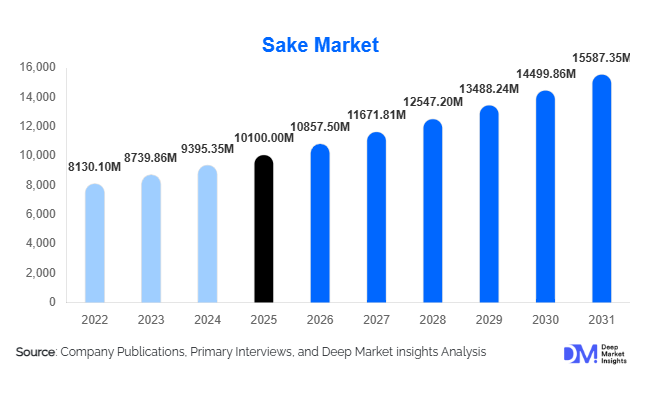
According to Deep Market Insights, the global sake market size was valued at USD 10,100 million in 2025 and is projected to grow from USD 10,857.50 million in 2026 to reach USD 15,587.35 million by 2031, expanding at a CAGR of 7.5% during the forecast period (2026–2031). The sake market growth is primarily driven by the globalization of Japanese cuisine, rising demand for premium and craft alcoholic beverages, and increasing consumer inclination toward authentic and heritage-based drinks. Expanding distribution channels, particularly e-commerce, and growing awareness of sake’s versatility in pairing with global cuisines are further accelerating market expansion.
Key Market Insights
- Premium and super-premium sake segments are expanding rapidly, driven by rising consumer willingness to pay for authenticity and craftsmanship.
- Asia-Pacific dominates the market, with Japan accounting for the majority of production and consumption.
- North America is the fastest-growing region, supported by increasing popularity of Japanese cuisine and craft beverages.
- On-trade channels remain dominant, with restaurants and hospitality sectors driving significant consumption.
- Product innovation, including sparkling and flavored sake, is attracting younger consumers globally.
- E-commerce and global logistics improvements are enhancing accessibility and export growth.
What are the latest trends in the sake market?
Premiumization and Craft Sake Expansion
The sake market is witnessing a strong shift toward premiumization, with consumers increasingly opting for high-quality variants such as Junmai Daiginjo and aged sake. Craft breweries are emphasizing traditional brewing techniques, regional rice varieties, and water sources to create differentiated products. Limited-edition releases and terroir-based branding are gaining traction, particularly in export markets. This trend is supported by rising disposable incomes and the growing appeal of artisanal alcoholic beverages, positioning premium sake as a luxury product in global markets.
Emergence of Innovative and Low-Alcohol Variants
Innovation is playing a key role in attracting new consumer segments. Sparkling sake, flavored variants, and low-alcohol options are gaining popularity among younger and health-conscious consumers. These products are often positioned as alternatives to wine and cocktails, expanding sake’s consumption occasions beyond traditional settings. Manufacturers are also experimenting with fruit infusions and modern packaging formats such as cans, enhancing convenience and appeal in retail channels.
What are the key drivers in the sake market?
Rising Global Popularity of Japanese Cuisine
The widespread adoption of Japanese cuisine, including sushi and fusion dishes, is a primary driver of sake demand. Restaurants worldwide are incorporating sake into their beverage menus, often pairing it with a variety of cuisines beyond traditional Japanese food. This cultural diffusion has significantly expanded sake’s consumer base, particularly in North America and Europe.
Growth in Premium Alcohol Consumption
Consumers are increasingly shifting toward premium and craft alcoholic beverages, driven by evolving tastes and higher disposable incomes. Sake aligns well with this trend due to its heritage, craftsmanship, and diverse flavor profiles. The premium segment is witnessing strong growth, supported by demand from fine dining establishments and luxury hospitality sectors.
What are the restraints for the global market?
Limited Consumer Awareness Outside Japan
Despite growing popularity, sake remains relatively unfamiliar to many consumers outside Japan. Lack of awareness regarding different types, serving methods, and flavor profiles can hinder market growth. Educational marketing and consumer engagement initiatives are required to overcome this challenge.
Dependence on Raw Materials and Production Constraints
Sake production relies heavily on high-quality rice and water, making it vulnerable to fluctuations in agricultural output and climate conditions. Additionally, traditional brewing processes are time-intensive, limiting scalability and increasing production costs, particularly for premium variants.
What are the key opportunities in the sake industry?
Expansion into Emerging Markets
Emerging economies such as India, Southeast Asia, and Latin America present significant growth opportunities due to rising disposable incomes and increasing exposure to international cuisines. Expanding distribution networks and localized marketing strategies can help producers tap into these high-potential markets.
Integration with Tourism and Cultural Experiences
Sake breweries are increasingly being promoted as cultural tourism destinations, offering tasting sessions, brewery tours, and immersive experiences. This trend not only boosts domestic consumption but also enhances global brand recognition as tourists become ambassadors for sake in their home countries.
Report Scope
| Report Metric | Details |
|---|---|
| Market Size in 2025 | USD 10100.00 Million |
| Market Size in 2026 | USD 10857.50 Million |
| Market Size in 2031 | USD 15587.35 Million |
| CAGR | 7.5% (2026-2031) |
| Base Year for Estimation | 2025 |
| Historical Data | 2022-2024 |
| Forecast Period | 2026-2031 |
| Report Coverage | Revenue Forecast, Competitive Landscape, Supply Chain Disruption, Growth Factors, Environment & Regulatory Landscape and Trends |
| Geographies Covered | North America, Europe, APAC, Middle East and Africa, LATAM |
| Countries Covered | U.S., Canada, U.K., Germany, France, Spain, Italy, Russia, Nordic, Benelux, Rest of Europe, China, Korea, Japan, India, Australia, Singapore, Taiwan, South East Asia, Rest of Asia-Pacific, UAE, Turky, Saudi Arabia, South Africa, Egypt, Nigeria, Rest of MEA, Brazil, Mexico, Argentina, Chile, Colombia, Rest of LATAM |
Explore more data points, trends and opportunities Download Free Sample Report
Product Type Insights
The global sake market continues to be strongly anchored by the dominance of Junmai sake, which accounts for approximately 28% of the global share in 2025. This leadership position is fundamentally driven by the product’s traditional brewing process, which uses only rice, water, yeast, and koji mold without the addition of distilled alcohol. In an era where consumers are increasingly gravitating toward clean-label and naturally derived beverages, Junmai sake resonates deeply with evolving preferences for authenticity, traceability, and purity. The rising awareness surrounding ingredient transparency and artisanal production methods has further elevated the appeal of Junmai sake, particularly among health-conscious and premium-oriented consumers. Its rich umami profile and versatility in food pairings also make it highly suitable for both traditional Japanese cuisine and fusion dining experiences, reinforcing its strong market position.Alongside Junmai, premium sake categories such as Ginjo and Daiginjo are witnessing accelerated growth trajectories, supported by their refined flavor profiles, meticulous brewing techniques, and strong association with luxury consumption. These categories require higher rice polishing ratios, resulting in lighter, more aromatic, and complex beverages that cater to sophisticated palates. The expansion of premium dining establishments, particularly in urban centers across developed and emerging economies, has significantly boosted the demand for high-grade sake variants. Additionally, increasing disposable incomes and the willingness of consumers to explore high-quality imported alcoholic beverages are driving the premiumization trend within the sake market. This shift is further amplified by the role of sommeliers and beverage experts who actively promote premium sake as an alternative to wine in fine dining settings.Emerging product segments, including sparkling and flavored sake, are also gaining traction, albeit from a smaller base. These innovative offerings are strategically positioned to attract younger consumers and individuals who may not traditionally consume sake. Sparkling sake, with its lighter alcohol content and effervescent characteristics, aligns well with celebratory occasions and casual social settings, making it particularly appealing in Western markets. Flavored variants, incorporating fruit infusions or botanical notes, cater to evolving taste preferences and the growing demand for experimental and hybrid alcoholic beverages. The increasing focus of manufacturers on product diversification and innovation is expected to further expand these segments, thereby enhancing the overall market landscape.
Application Insights
The foodservice industry remains the largest application segment in the global sake market, contributing nearly 46% of the global market share. This dominance is intrinsically linked to the cultural and experiential nature of sake consumption, which is often associated with dining occasions. Restaurants, bars, and hotels serve as critical touchpoints for introducing consumers to diverse sake varieties, enabling them to explore different flavor profiles and brewing styles in curated environments. The integration of sake into pairing menus, tasting experiences, and chef-driven culinary concepts has significantly elevated its role within the foodservice ecosystem. Moreover, the growing global popularity of Japanese cuisine, including sushi, ramen, and izakaya-style dining, has further reinforced the prominence of sake within restaurant settings.Household consumption is also emerging as a significant growth avenue, supported by increasing product availability across retail formats and the rising influence of e-commerce platforms. Consumers are becoming more inclined to experiment with sake at home, driven by greater awareness, improved accessibility, and the convenience of online purchasing. The COVID-19 pandemic acted as a catalyst for this shift, as at-home consumption patterns intensified and consumers sought premium beverage experiences within domestic settings. This behavioral transition has persisted post-pandemic, contributing to sustained growth in the household segment.In addition to traditional applications, sake is increasingly being utilized in corporate gifting, events, and celebrations, particularly within premium and luxury segments. The cultural significance and aesthetic presentation of sake bottles make them highly suitable for gifting purposes, especially in markets where Japanese culture is highly regarded. This emerging application segment is being further supported by customized packaging, limited-edition releases, and collaborations with luxury brands, which enhance the perceived value of sake as a premium gift item.
Distribution Channel Insights
On-trade channels continue to dominate the global sake market, accounting for approximately 58% of total share. This dominance is primarily driven by the experiential nature of sake consumption, where consumers prefer to explore and enjoy the beverage in social and hospitality settings such as restaurants, bars, and hotels. These venues not only provide access to a wide range of sake varieties but also offer expert guidance through sommeliers and trained staff, thereby enhancing the overall consumption experience. The proliferation of Japanese-themed restaurants and premium dining establishments across global markets has further strengthened the position of on-trade channels.Off-trade channels, including supermarkets, hypermarkets, specialty liquor stores, and convenience outlets, are witnessing rapid growth, fueled by increasing consumer demand for convenience and accessibility. The expansion of organized retail infrastructure, particularly in emerging economies, has played a pivotal role in driving the availability of sake across diverse consumer segments. Specialty stores, in particular, are gaining prominence as they offer curated selections of premium and imported sake, catering to niche consumer preferences.E-commerce platforms have emerged as a transformative force within the distribution landscape, significantly enhancing the global reach of sake products. Online retail channels enable consumers to access a broader assortment of domestic and imported sake brands, often accompanied by detailed product descriptions, reviews, and pairing recommendations. This digital transformation has not only facilitated market penetration in regions with limited physical retail presence but has also empowered smaller breweries to reach international audiences. The integration of advanced logistics, digital marketing strategies, and direct-to-consumer models is expected to further accelerate the growth of e-commerce within the sake market.
End-Use Insights
The foodservice and hospitality sectors remain the primary end-users of sake, driven by the continued expansion of the global restaurant industry and the resurgence of international tourism. Hospitality establishments are increasingly incorporating sake into curated dining experiences, positioning it as a premium beverage that complements a wide range of cuisines beyond traditional Japanese dishes. The growing emphasis on experiential dining and beverage pairing has further elevated the role of sake within high-end hospitality settings.Household consumption is gaining momentum as consumers become more familiar with sake and its versatility. The increasing availability of educational content, including online tutorials, tasting guides, and virtual events, has contributed to greater consumer awareness and confidence in selecting and consuming sake at home. This trend is particularly evident among younger demographics, who are more खुले to experimenting with diverse alcoholic beverages and incorporating them into social gatherings.Export-driven demand continues to play a critical role in shaping the global sake market, with countries such as the United States, China, and several European nations emerging as key importers. The globalization of Japanese culture, coupled with strategic marketing initiatives by producers and trade organizations, has significantly enhanced the international visibility of sake. Furthermore, the establishment of local breweries in overseas markets is contributing to the localization of production, thereby supporting market growth and reducing dependency on imports.
Explore more data points, trends and opportunities Download Free Sample Report
Sake Market Segmentations
By Product Type
- Junmai
- Ginjo
- Daiginjo
- Honjozo
- Nigori
- Futsushu
- Sparkling Sake
- Flavored Sake
By Application
- Household Consumption
- Foodservice Industry
- Hospitality & Tourism
- Corporate Gifting & Events
By Distribution Channel
- On-Trade
- Supermarkets & Hypermarkets
- Specialty Liquor Stores
- Convenience Stores
- Online Retail
Regional Insights
Asia-Pacific
Asia-Pacific dominates the global sake market, accounting for approximately 68% of the total share in 2025, with Japan serving as both the largest producer and consumer, contributing over 45% of global demand. The region’s dominance is deeply rooted in cultural heritage, where sake is an integral part of traditional ceremonies, festivals, and daily consumption. In Japan, continuous innovation in brewing techniques, coupled with strong domestic consumption, sustains market stability. Additionally, government support for the promotion of sake as a cultural export has strengthened its global positioning.China is emerging as a significant growth engine within the region, driven by rising disposable incomes, rapid urbanization, and an expanding middle-class population. The increasing appetite for premium and imported alcoholic beverages among Chinese consumers is creating substantial opportunities for sake producers. Furthermore, the proliferation of Japanese restaurants and the growing popularity of Asian cuisine across the region are contributing to heightened demand. Other markets such as South Korea, Australia, and Southeast Asian countries are also witnessing steady growth, supported by evolving consumption patterns and increasing exposure to international food and beverage trends.
North America
North America holds approximately 14% of the global sake market and represents the fastest-growing regional segment. The United States leads consumption in this region, driven by the widespread popularity of Japanese cuisine and the rapid expansion of sushi chains and izakaya-style dining establishments. The increasing interest in craft beverages and artisanal alcohol has also contributed to the growing acceptance of sake among American consumers. Local production of sake within the United States is gaining momentum, supported by the establishment of craft breweries that focus on high-quality, small-batch production.Another key growth driver in North America is the rising trend of premiumization, where consumers are willing to pay higher prices for authentic and high-quality products. Educational initiatives, tasting events, and collaborations between sake producers and restaurants are further enhancing consumer awareness and engagement. The integration of sake into mainstream retail channels and the expansion of e-commerce platforms are also facilitating broader market penetration across the region.
Europe
Europe accounts for nearly 10% of the global sake market, with countries such as the United Kingdom, France, and Germany leading regional demand. The region benefits significantly from strong premiumization trends and a well-established culture of wine appreciation, which has created a receptive environment for sake as an alternative premium beverage. Consumers in Europe are increasingly drawn to the unique flavor profiles and artisanal nature of sake, particularly within high-end dining contexts.The growing interest in Asian culinary culture, coupled with the expansion of Japanese restaurants across major European cities, is a key driver of market growth. Additionally, the presence of specialized importers and distributors has improved the availability of diverse sake varieties. Educational campaigns, including sake tasting events and certification programs, are playing a crucial role in building consumer awareness and fostering long-term demand.
Latin America
Latin America represents a smaller yet steadily growing market for sake, with Brazil emerging as a key contributor. The region’s growth is primarily driven by increasing urbanization, rising disposable incomes, and greater exposure to international food cultures. The presence of a significant Japanese diaspora in Brazil has also contributed to the cultural acceptance and consumption of sake.As consumers in Latin America become more adventurous in their beverage choices, there is a growing inclination toward exploring premium and imported alcoholic products. The expansion of modern retail channels and the gradual development of e-commerce infrastructure are further supporting market growth. Additionally, the increasing popularity of fusion cuisine and international dining experiences is creating new opportunities for sake within the region.
Middle East & Africa
The Middle East & Africa region is witnessing gradual growth in the sake market, led by countries such as the United Arab Emirates and South Africa. The expansion of the tourism sector, particularly in the UAE, has significantly contributed to the demand for premium alcoholic beverages, including sake. Luxury hotels, fine dining restaurants, and high-end bars are increasingly incorporating sake into their beverage offerings, catering to an international clientele.In South Africa, the growing interest in diverse culinary experiences and the expansion of the hospitality industry are supporting market development. While regulatory restrictions on alcohol consumption in certain parts of the region may limit growth, the increasing presence of expatriate communities and the rising influence of global food trends are expected to drive steady demand. The continued development of premium hospitality infrastructure and the promotion of international cuisines will play a crucial role in shaping the future trajectory of the sake market in the Middle East & Africa.
Key Players in the Sake Market
- Hakutsuru Sake Brewing Co.
- Gekkeikan Sake Co.
- Ozeki Corporation
- Takara Holdings Inc.
- Asahi Shuzo Co.
- Kizakura Co.
- Nihon Sakari Co.
- Tatsuuma-Honke Brewing Co.
- Sawanotsuru Co.
- Hakkaisan Brewery
- Kikusui Sake Co.
- Urakasumi Brewery
- Nanbu Bijin Brewery
- Dassai
- Sho Chiku Bai