Rotating Hot Pot Market Size
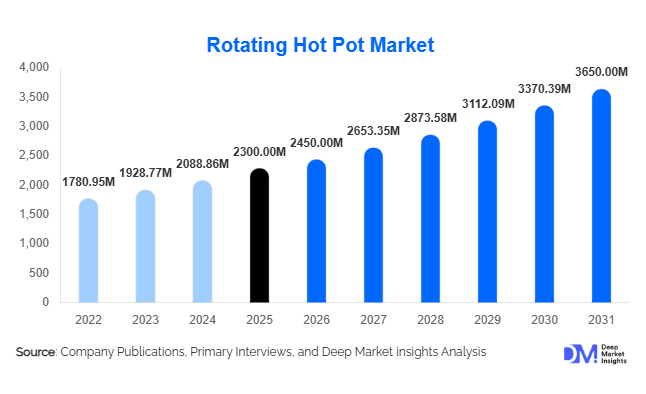
According to Deep Market Insights, the global rotating hot pot market size was valued at USD 2,300 million in 2025 and is projected to grow from USD 2,450 million in 2026 to reach USD 3,650 million by 2031, expanding at a CAGR of 8.3% during the forecast period (2026–2031). The market growth is primarily driven by the rising popularity of experiential dining formats, increasing adoption of automated kitchen appliances, and the rapid expansion of Asian cuisine-based restaurant chains across global urban centers.
Key Market Insights
- Experiential dining trends are reshaping restaurant infrastructure, with rotating hot pot systems becoming a key attraction in premium dining outlets.
- Asia-Pacific dominates global demand, driven by strong cultural adoption in China, Japan, and South Korea, and rapid restaurant expansion.
- North America is witnessing fast adoption due to increasing popularity of Asian cuisine and fusion dining experiences.
- Smart kitchen integration is accelerating growth, with IoT-enabled and automated hot pot systems gaining traction in urban households and commercial kitchens.
- Restaurant chains remain the largest end-use segment, accounting for nearly half of global demand due to large-scale procurement of standardized systems.
- Stainless steel and electric motor-based systems dominate due to durability, cost efficiency, and ease of maintenance in commercial applications.
What are the latest trends in the rotating hot pot market?
Smart and Automated Dining Systems Gaining Momentum
One of the most significant trends in the rotating hot pot market is the shift toward automation and smart dining systems. Manufacturers are increasingly integrating electric motor-driven rotation systems with app-based controls and temperature automation features. This transformation aligns with the broader smart kitchen ecosystem trend, especially in urban markets across North America, Europe, and Asia-Pacific. Restaurants are adopting these systems to improve operational efficiency, reduce labor dependency, and enhance customer engagement. Additionally, IoT-enabled monitoring allows restaurants to maintain consistent food quality, optimize energy consumption, and enable predictive maintenance of equipment. These advancements are making rotating hot pot systems more attractive for premium dining environments.
Expansion of Themed and Experiential Restaurant Concepts
The global rise of experiential dining is driving the popularity of rotating hot pot systems in themed restaurants. Operators are designing immersive dining environments where food presentation, movement, and interactivity enhance customer engagement. This trend is especially strong in metropolitan cities where consumers prefer unique social dining experiences over traditional formats. Rotating hot pot tables are increasingly being integrated into buffet chains, luxury restaurants, and franchise outlets to differentiate offerings. The trend is also influencing interior design and restaurant layout innovations, as operators seek to maximize table turnover while enhancing customer satisfaction.
What are the key drivers in the rotating hot pot market?
Rising Demand for Experiential Dining Culture
Consumers globally are shifting toward interactive and social dining formats, where food becomes part of an experience rather than just consumption. Rotating hot pot systems perfectly align with this demand by offering shared dining, variety, and engagement. This is particularly strong in urban Asia-Pacific markets and is rapidly expanding into Western economies through fusion cuisine trends. The rising number of millennials and Gen Z consumers is further accelerating this shift toward experience-driven food culture.
Expansion of Asian Cuisine Globally
The global popularity of Chinese, Korean, and Japanese cuisines is significantly driving demand for rotating hot pot systems. As hot pot restaurants expand into North America, Europe, and the Middle East, demand for standardized and scalable dining equipment is increasing. Franchise expansion is particularly strong in major metropolitan cities, where Asian food chains are rapidly scaling operations. This globalization of cuisine is a key structural growth driver for the market.
What are the restraints for the global market?
High Installation and Equipment Costs
Rotating hot pot systems involve advanced mechanical and heating components, making them significantly more expensive than traditional dining setups. High initial investment and maintenance costs restrict adoption among small and mid-scale restaurants, especially in price-sensitive markets. This limits penetration outside premium dining segments.
Limited Awareness in Emerging Economies
Despite strong growth potential, awareness of rotating hot pot systems remains limited in many developing regions. Traditional cooking and dining formats continue to dominate, slowing market expansion. Additionally, lack of technical expertise for installation and maintenance further restricts adoption in rural and semi-urban areas.
What are the key opportunities in the rotating hot pot industry?
Smart Kitchen and IoT Integration
The integration of IoT-enabled controls, mobile applications, and AI-driven cooking systems presents a major opportunity for manufacturers. Smart rotating hot pot systems can offer real-time temperature control, energy efficiency optimization, and predictive maintenance. This aligns with global smart home adoption trends, especially in North America and Europe, where consumers are willing to pay premium prices for connected kitchen appliances.
Expansion of Franchise Restaurant Chains
Global expansion of hot pot restaurant chains creates strong demand for standardized, scalable equipment. Franchises require uniform systems across locations to maintain consistent customer experience. This provides opportunities for large-scale contracts and long-term partnerships between manufacturers and restaurant groups, particularly in emerging urban markets.
Report Scope
| Report Metric | Details |
|---|---|
| Market Size in 2025 | USD 2300 Million |
| Market Size in 2026 | USD 2450 Million |
| Market Size in 2031 | USD 3650 Million |
| CAGR | 8.3% (2026-2031) |
| Base Year for Estimation | 2025 |
| Historical Data | 2022-2024 |
| Forecast Period | 2026-2031 |
| Report Coverage | Revenue Forecast, Competitive Landscape, Supply Chain Disruption, Growth Factors, Environment & Regulatory Landscape and Trends |
| Geographies Covered | North America, Europe, APAC, Middle East and Africa, LATAM |
| Countries Covered | U.S., Canada, U.K., Germany, France, Spain, Italy, Russia, Nordic, Benelux, Rest of Europe, China, Korea, Japan, India, Australia, Singapore, Taiwan, South East Asia, Rest of Asia-Pacific, UAE, Turky, Saudi Arabia, South Africa, Egypt, Nigeria, Rest of MEA, Brazil, Mexico, Argentina, Chile, Colombia, Rest of LATAM |
Explore more data points, trends and opportunities Download Free Sample Report
Product Type Insights
The product type segmentation of the rotating hot pot system market reveals a clear hierarchy of adoption patterns driven by technological sophistication, operational efficiency, and evolving consumer expectations within the foodservice industry. Fully automated rotating hot pot systems have emerged as the dominant segment, largely due to their ability to streamline restaurant operations while simultaneously elevating the dining experience. These systems integrate conveyor-based mechanisms with precise temperature control, automated ingredient circulation, and in many cases, touchless or app-based ordering features. Their widespread adoption is particularly evident in premium and high-traffic commercial dining environments, where speed, consistency, and hygiene are critical. The leading driver for this segment is the increasing demand for operational efficiency in restaurants, where labor costs are rising and customer expectations for seamless, interactive dining are intensifying. Fully automated systems reduce dependency on manual service, minimize errors, and enable restaurants to handle higher customer volumes without compromising service quality.The smart and IoT-enabled rotating hot pot system segment represents the fastest-growing category within the market, driven by the broader digital transformation of the foodservice industry. These advanced systems incorporate features such as real-time monitoring, predictive maintenance, automated inventory tracking, and integration with digital ordering platforms. Restaurants are increasingly leveraging data analytics to optimize operations, personalize customer experiences, and improve resource management. The leading driver for this segment is the growing emphasis on digitalization and customer experience enhancement, as operators seek to differentiate themselves in a highly competitive landscape. IoT-enabled systems also support sustainability initiatives by optimizing energy consumption and reducing food waste, aligning with global trends toward environmentally responsible operations. As technology costs continue to decline and adoption barriers diminish, this segment is expected to witness exponential growth, particularly in urban and technologically advanced markets.
Application Insights
The application landscape of rotating hot pot systems is heavily dominated by the restaurant sector, which serves as the primary driver of market demand. Restaurants, particularly those specializing in hot pot and buffet-style dining, have embraced rotating systems as a means of enhancing both operational efficiency and customer engagement. The leading driver for this segment is the rapid expansion of hot pot chains and experiential dining formats, which prioritize interactivity, variety, and convenience. Rotating systems enable continuous ingredient circulation, allowing diners to select items effortlessly while reducing the need for extensive service staff. This not only improves operational efficiency but also creates a unique and memorable dining experience, which is increasingly important in attracting and retaining customers in competitive urban markets.Emerging applications, including luxury dining events and experiential food festivals, are expanding the scope of the rotating hot pot system market. These events emphasize innovation, creativity, and sensory engagement, making rotating systems an ideal fit. The leading driver for these emerging applications is the growing trend toward experiential consumption, where consumers prioritize unique and immersive experiences over traditional dining formats. As the boundaries between dining, entertainment, and social interaction continue to blur, rotating hot pot systems are well-positioned to play a central role in shaping the future of the foodservice industry.
Explore more data points, trends and opportunities Download Free Sample Report
Rotating Hot Pot Market Segmentations
By Product Type
- Fully Automated Rotating Hot Pot Systems
- Semi-Automated Rotating Hot Pot Systems
- Manual Rotating Hot Pot Tables
- Smart / IoT-Enabled Rotating Hot Pot Systems
By Material Type
- Stainless Steel-Based Systems
- Ceramic-Coated Systems
- Glass & Hybrid Composite Systems
- Non-Stick Alloy Systems
By Technology
- Electric Motor Rotation Systems
- Induction Heating Systems
- Infrared Heating Systems
- Smart Sensor-Controlled Systems
By Distribution Channel
- Offline Retail
- Supermarkets & Hypermarkets
- Online E-commerce Platforms
- Direct B2B Sales
By End-Use Industry
- Household / Residential Use
- Restaurants
- Hotels & Hospitality Sector
- Catering & Events Industry
Regional Insights
Asia-Pacific
Asia-Pacific remains the dominant regional market for rotating hot pot systems, accounting for approximately 52% of the global market share in 2025. The region’s leadership is deeply rooted in the cultural significance of hot pot dining, which is an integral part of culinary traditions in countries such as China, Japan, and South Korea. The leading driver for regional growth is the strong cultural integration of hot pot cuisine combined with the rapid expansion of organized restaurant chains. Urbanization and rising disposable incomes have further accelerated the adoption of modern dining formats, particularly in metropolitan areas where consumers are increasingly seeking convenience and novelty.In addition to cultural factors, technological adoption is playing a crucial role in shaping the market in Asia-Pacific. Restaurants in the region are at the forefront of integrating advanced automation and IoT technologies, driven by intense competition and high customer expectations. Government initiatives supporting digital transformation and smart infrastructure development are also contributing to market growth. Furthermore, the presence of a large and diverse consumer base provides ample opportunities for innovation and product differentiation. As a result, Asia-Pacific is expected to maintain its dominance while also serving as a key hub for technological advancements in rotating hot pot systems.
North America
North America holds approximately 21% of the global market share, with the United States leading regional demand. The growth of the market in this region is primarily driven by the increasing popularity of Asian cuisine and the rise of fusion dining concepts. The leading driver for regional growth is the growing demand for experiential dining, particularly in urban centers where consumers are actively seeking unique and interactive restaurant experiences. Rotating hot pot systems align well with this trend, offering a blend of novelty and convenience that appeals to a diverse customer base.The region also benefits from a well-established foodservice industry and a high level of technological adoption. Restaurants are increasingly investing in automation to address labor shortages and rising operational costs. Additionally, the influence of social media and food culture has played a significant role in popularizing hot pot dining among younger consumers. As awareness and acceptance of Asian culinary traditions continue to grow, the market for rotating hot pot systems in North America is expected to expand steadily.
Europe
Europe accounts for approximately 17% of the global market share, with key contributions from countries such as the United Kingdom, Germany, and France. The region’s growth is driven by the increasing diversity of its culinary landscape, as well as the rising popularity of international cuisines. The leading driver for regional growth is the expansion of multicultural dining trends, which has created a favorable environment for the adoption of Asian restaurant formats, including hot pot dining.European consumers are increasingly open to trying new and innovative dining experiences, particularly in urban areas where cultural diversity is more pronounced. The integration of rotating hot pot systems into restaurant offerings aligns with this trend, providing a unique and engaging experience that differentiates establishments from traditional dining formats. Additionally, the emphasis on sustainability and energy efficiency in Europe is encouraging the adoption of advanced systems that optimize resource utilization. As the region continues to embrace global culinary influences, the market for rotating hot pot systems is expected to grow at a steady pace.
Middle East & Africa
The Middle East and Africa region accounts for approximately 6% of the global market share, with growth primarily driven by the expansion of the hospitality and tourism sectors. The leading driver for regional growth is the rapid development of luxury hospitality infrastructure, particularly in countries such as the United Arab Emirates and Saudi Arabia. These markets are characterized by a strong focus on premium experiences, making rotating hot pot systems an attractive addition to high-end dining establishments.The region’s growing expatriate population and increasing exposure to international cuisines are also contributing to market expansion. Restaurants and hotels are actively seeking innovative ways to cater to diverse customer preferences, and rotating hot pot systems offer a compelling solution. Additionally, large-scale events and tourism initiatives are creating opportunities for the adoption of advanced dining technologies. While the market is still in its early stages compared to other regions, the potential for growth is significant, particularly as economic diversification efforts continue to drive investment in the hospitality sector.
Latin America
Latin America holds approximately 4% of the global market share, with Brazil and Mexico emerging as key markets. The leading driver for regional growth is the increasing urbanization and the gradual expansion of international restaurant chains. As urban populations grow and disposable incomes rise, consumers are becoming more receptive to new dining experiences, including hot pot cuisine. Rotating hot pot systems are gaining traction as part of this broader trend, offering a novel and interactive dining option.The region is also witnessing a shift toward modern and organized foodservice formats, which is supporting the adoption of advanced dining technologies. While cultural familiarity with hot pot dining is relatively limited compared to Asia-Pacific, the influence of globalization and cross-cultural exchange is gradually bridging this gap. As awareness and acceptance continue to increase, the market for rotating hot pot systems in Latin America is expected to expand, albeit at a more moderate pace compared to other regions.
Key Players in the Rotating Hot Pot Market
- Haier Group
- Midea Group
- Panasonic Corporation
- LG Electronics
- Samsung Electronics
- Whirlpool Corporation
- Electrolux AB
- Xiaomi Corporation
- Breville Group
- Koninklijke Philips N.V.
- Supor (SEB China)
- Joyoung Co. Ltd.
- Zojirushi Corporation
- Tiger Corporation
- Bear Electric Appliance Co.