Rooibos Tea Market Size
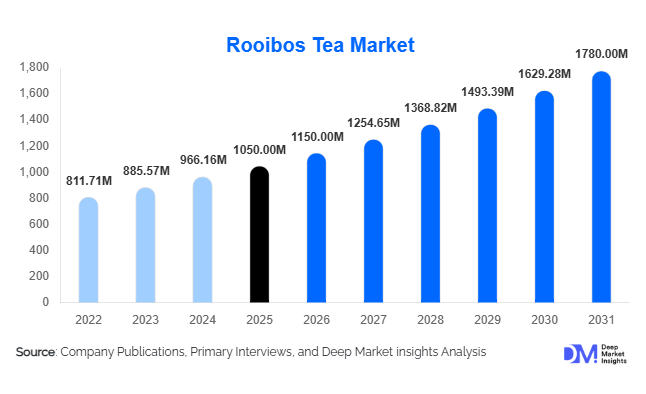
According to Deep Market Insights, the global rooibos tea market size was valued at USD 1,050 million in 2025 and is projected to grow from USD 1,150 million in 2026 to reach USD 1,780 million by 2031, expanding at a CAGR of 9.1% during the forecast period (2026–2031). The rooibos tea market growth is primarily driven by rising consumer preference for caffeine-free herbal beverages, increasing awareness of antioxidant-rich functional drinks, and expanding product innovations such as flavored blends and ready-to-drink (RTD) formats.
Key Market Insights
- Rooibos tea demand is increasingly driven by health-conscious consumers, particularly those seeking natural, caffeine-free alternatives to traditional tea and coffee.
- Organic and premium rooibos tea variants are gaining strong traction, supported by clean-label trends and sustainability concerns.
- Europe dominates the global market, led by strong consumption in Germany, the U.K., and the Netherlands.
- Asia-Pacific is the fastest-growing region, driven by rising herbal tea consumption in China, India, and Japan.
- Ready-to-drink (RTD) rooibos beverages are expanding rapidly, particularly in urban and on-the-go consumption segments.
- Applications in cosmetics and nutraceuticals are emerging, expanding rooibos beyond traditional beverage use.
What are the latest trends in the rooibos tea market?
Rising Popularity of Functional and Herbal Beverages
Consumers are increasingly shifting toward functional beverages that offer health benefits beyond basic nutrition. Rooibos tea, known for its antioxidant and anti-inflammatory properties, is gaining popularity as a wellness drink. This trend is particularly strong among urban populations and aging demographics seeking natural remedies for stress, digestion, and immunity. The integration of rooibos into functional beverages, including fortified drinks and herbal blends, is expanding its consumer base globally.
Growth of Ready-to-Drink (RTD) and Flavored Variants
Product innovation is a key trend shaping the market. RTD rooibos beverages are gaining traction due to convenience and changing consumption patterns. Additionally, flavored rooibos teas—such as fruit-infused and herbal blends—are attracting younger consumers. Companies are experimenting with exotic flavors and premium packaging to differentiate their offerings and increase shelf appeal, particularly in competitive retail environments.
What are the key drivers in the rooibos tea market?
Increasing Health Awareness and Demand for Caffeine-Free Alternatives
The growing awareness of the adverse effects of excessive caffeine consumption is driving demand for caffeine-free alternatives such as rooibos tea. Its natural composition, rich in antioxidants and minerals, makes it an attractive option for health-conscious consumers. This shift is particularly evident in North America and Europe, where wellness trends are strongly influencing beverage choices.
Expansion of Organic and Clean-Label Products
The demand for organic and sustainably sourced products is significantly boosting the rooibos tea market. Organic rooibos tea, in particular, is witnessing strong growth due to increasing concerns about pesticide use and environmental sustainability. Premium pricing and certification standards are further enhancing market value and consumer trust.
What are the restraints for the global market?
Limited Geographic Production and Supply Constraints
Rooibos tea is primarily cultivated in South Africa, making the supply chain highly dependent on a single geographic region. This creates vulnerabilities related to climate change, droughts, and geopolitical factors, which can impact production volumes and pricing stability.
Low Awareness in Emerging Markets
Despite growing global popularity, rooibos tea remains relatively unknown in several developing regions. Limited awareness and lack of strong marketing initiatives in these markets hinder adoption and restrict overall market growth potential.
What are the key opportunities in the rooibos tea industry?
Expansion into Nutraceutical and Functional Beverage Segments
The growing demand for functional beverages presents a significant opportunity for rooibos tea manufacturers. By integrating rooibos into health drinks, dietary supplements, and wellness products, companies can tap into high-growth segments and diversify their revenue streams.
Growing Demand in Asia-Pacific Markets
Asia-Pacific offers substantial growth potential due to rising herbal tea consumption and increasing disposable incomes. Markets such as China, India, and Japan are witnessing a shift toward natural and functional beverages, creating opportunities for rooibos tea brands to expand their footprint.
Report Scope
| Report Metric | Details |
|---|---|
| Market Size in 2025 | USD 1050 Million |
| Market Size in 2026 | USD 1150 Million |
| Market Size in 2031 | USD 1780 Million |
| CAGR | 9.1% (2026-2031) |
| Base Year for Estimation | 2025 |
| Historical Data | 2022-2024 |
| Forecast Period | 2026-2031 |
| Report Coverage | Revenue Forecast, Competitive Landscape, Supply Chain Disruption, Growth Factors, Environment & Regulatory Landscape and Trends |
| Geographies Covered | North America, Europe, APAC, Middle East and Africa, LATAM |
| Countries Covered | U.S., Canada, U.K., Germany, France, Spain, Italy, Russia, Nordic, Benelux, Rest of Europe, China, Korea, Japan, India, Australia, Singapore, Taiwan, South East Asia, Rest of Asia-Pacific, UAE, Turky, Saudi Arabia, South Africa, Egypt, Nigeria, Rest of MEA, Brazil, Mexico, Argentina, Chile, Colombia, Rest of LATAM |
Explore more data points, trends and opportunities Download Free Sample Report
Product Type Insights
The global rooibos tea market demonstrates a well-defined segmentation by product type, with organic rooibos tea emerging as the dominant category, accounting for approximately 32% of the global market share in 2025. The leadership of organic rooibos tea is primarily driven by the increasing consumer inclination toward clean-label products, which are perceived as safer, healthier, and environmentally sustainable. As awareness surrounding pesticide residues, soil health, and sustainable farming practices continues to grow, consumers are actively shifting toward organic alternatives. This trend is particularly pronounced in developed markets such as the United States, Germany, and the United Kingdom, where stringent regulatory frameworks and well-informed consumers support organic product adoption. Additionally, organic rooibos tea benefits from premium pricing, which enhances profitability for manufacturers and exporters, further reinforcing its market dominance.Conventional rooibos tea continues to maintain a significant share of the market, primarily due to its affordability and widespread availability. The leading driver for this segment is its accessibility across both developed and emerging economies. Conventional rooibos tea caters to price-sensitive consumers and mass-market demand, especially in regions where organic certification may not be a primary purchasing criterion. Additionally, its established presence in traditional retail channels and strong supply chain networks contribute to its sustained demand. While growth in this segment is relatively slower compared to organic and flavored variants, it remains an essential component of the overall market structure, ensuring volume stability and broad consumer reach.
Application Insights
In terms of application, household consumption remains the dominant segment, contributing nearly 50% of total global demand. The leading driver for this segment is the increasing incorporation of rooibos tea into daily dietary routines, supported by its naturally caffeine-free composition and associated health benefits. Consumers across various age groups are adopting rooibos tea as a regular beverage due to its antioxidant properties, potential to support heart health, and suitability for consumption at any time of the day. The versatility of rooibos tea, which can be consumed hot or cold and blended with other ingredients, further enhances its appeal in household settings. Additionally, rising health consciousness and the shift away from sugary beverages are reinforcing the demand for rooibos tea in everyday consumption.The cosmetics and personal care segment is emerging as a niche yet promising application area. The leading driver for this segment is the increasing use of natural and plant-based ingredients in skincare and beauty formulations. Rooibos extracts are valued for their anti-inflammatory, anti-aging, and antioxidant properties, making them suitable for use in creams, lotions, serums, and hair care products. As consumers become more conscious about ingredient transparency and sustainability, the demand for rooibos-based cosmetic products is expected to grow steadily. This segment also benefits from the premium positioning of natural skincare products, particularly in developed markets.
Distribution Channel Insights
Supermarkets and hypermarkets dominate the distribution landscape, accounting for approximately 38% of the global market share. The leading driver for this segment is the extensive product visibility and accessibility offered by these retail formats. Consumers prefer supermarkets and hypermarkets due to the convenience of one-stop shopping, availability of multiple brands, and the ability to physically evaluate products before purchase. These channels also benefit from strong supply chain integration and promotional activities, which enhance product reach and consumer engagement. In both developed and developing markets, supermarkets continue to serve as the primary point of sale for rooibos tea products.Specialty stores focusing on organic and health products also play a crucial role in the distribution ecosystem. The leading driver for this segment is the rising demand for premium and niche products. These stores cater to a targeted consumer base that prioritizes quality, sustainability, and authenticity. Specialty retailers often provide curated product selections and personalized customer experiences, which enhance brand loyalty and consumer trust. As the market for organic and functional beverages continues to expand, specialty stores are expected to maintain their relevance, particularly in urban and high-income regions.
End-Use Insights
The household segment dominates the end-use landscape, driven by consistent daily consumption patterns and increasing awareness of the health benefits associated with rooibos tea. The leading driver for this segment is the shift toward healthier lifestyle choices, which is encouraging consumers to replace traditional caffeinated and sugary beverages with herbal alternatives. Rooibos tea’s natural properties, including its caffeine-free nature and rich antioxidant content, make it an ideal choice for regular consumption across diverse consumer groups.Emerging applications in cosmetics and pharmaceuticals are further expanding the market scope. The leading driver for these segments is the growing emphasis on natural and plant-based ingredients in product development. Rooibos extracts are being explored for their therapeutic properties, including anti-inflammatory and antioxidant effects, which have potential applications in skincare and medicinal formulations. As research and development activities continue to advance, these segments are expected to contribute significantly to the long-term growth of the rooibos tea market.
Explore more data points, trends and opportunities Download Free Sample Report
Rooibos Tea Market Segmentations
By Product Type
- Pure Rooibos Tea
- Flavored Rooibos Tea
- Organic Rooibos Tea
- Conventional Rooibos Tea
By Form
- Loose Leaf Rooibos Tea
- Tea Bags
- Ready-to-Drink (RTD) Rooibos Beverages
- Powdered Rooibos
By Distribution Channel
- Supermarkets & Hypermarkets
- Convenience Stores
- Specialty Stores
- Online Retail
- Foodservice Channels
Regional Insights
North America
North America accounts for approximately 27% of the global rooibos tea market, with the United States leading regional consumption. The growth of the market in this region is driven by several key factors, including the increasing demand for herbal and functional beverages, a well-established retail infrastructure, and a high level of consumer awareness regarding health and wellness. Consumers in North America are actively seeking alternatives to traditional caffeinated beverages such as coffee and black tea, which has led to the growing adoption of rooibos tea. Additionally, the presence of major retail chains, strong e-commerce penetration, and the rising popularity of organic products are further supporting market expansion. The trend toward clean-label and sustainable products is also playing a significant role in driving demand for organic rooibos tea in this region.
Europe
Europe dominates the global rooibos tea market with a share of around 38%, led by countries such as Germany, the United Kingdom, and the Netherlands. Germany alone contributes nearly 12% of global demand, highlighting its significance as a key market. The growth in Europe is driven by strong consumer awareness, well-established import channels, and a high demand for organic and specialty products. The region’s stringent regulatory standards and emphasis on product quality and safety further enhance consumer confidence. Additionally, the popularity of herbal and wellness teas, coupled with a long-standing tea-drinking culture, supports the sustained demand for rooibos tea. The increasing focus on sustainability and ethical sourcing is also encouraging consumers to choose products that align with their values, further boosting the market.
Asia-Pacific
The Asia-Pacific region is the fastest-growing market, expanding at a CAGR of over 11%. Countries such as China, India, and Japan are witnessing a rapid increase in the adoption of herbal teas. The growth in this region is driven by rising disposable incomes, urbanization, and increasing health awareness among consumers. Additionally, the strong cultural affinity for tea consumption in countries like China and India provides a favorable environment for the introduction and expansion of rooibos tea. The growing middle-class population and the increasing influence of Western lifestyle trends are also contributing to market growth. Furthermore, the expansion of retail and e-commerce networks is improving product accessibility, enabling manufacturers to tap into previously underserved markets.
Latin America
Latin America exhibits moderate growth, with Brazil emerging as the leading market in the region. The growth is driven by increasing awareness of herbal and functional beverages, along with the gradual expansion of retail infrastructure. Consumers in Latin America are becoming more health-conscious, which is encouraging the adoption of natural and plant-based products such as rooibos tea. Additionally, the region’s favorable climate and agricultural potential present opportunities for local production and innovation. While the market is still in its early stages compared to other regions, the increasing availability of rooibos tea products and growing consumer interest are expected to support steady growth.
Middle East & Africa
The Middle East & Africa region plays a crucial role in the global rooibos tea market as the primary production hub, with South Africa dominating global supply. The growth of the market in this region is driven by strong export demand, government support for agricultural production, and the increasing recognition of rooibos tea as a valuable economic resource. South Africa’s favorable climatic conditions and established farming practices make it the ideal location for rooibos cultivation. Additionally, the government’s initiatives to promote exports and support local farmers are contributing to the growth of the industry. In the Middle East, increasing consumer awareness and the growing popularity of herbal beverages are further supporting market expansion. The region’s strategic position as a trade hub also facilitates the distribution of rooibos tea to international markets, reinforcing its importance in the global supply chain.
Key Players in the Rooibos Tea Market
- Rooibos Limited
- Twinings
- Celestial Seasonings
- Numi Organic Tea
- Yogi Tea
- Dilmah Tea
- Bigelow Tea Company
- Tazo Tea Company
- Republic of Tea
- Harney & Sons
- Davidson’s Organics
- Tick Tock Rooibos
- Freshpak Rooibos
- Clipper Teas
- Alvita Teas