Ready-to-Drink Formula Market Size
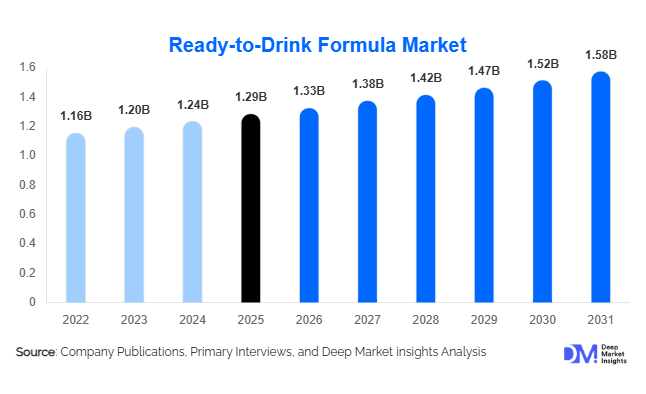
According to Deep Market Insights, the global ready-to-drink (RTD) formula market size was valued at USD 1.29 billion in 2025 and is projected to grow from USD 1.33 billion in 2026 to reach USD 1.58 billion by 2031, expanding at a CAGR of 3.47 % during the forecast period (2026–2031). The ready-to-drink formula market growth is primarily driven by rising demand for convenient infant nutrition solutions, increasing hospital adoption of sterile feeding systems, and growing parental preference for safe, pre-mixed nutritional products that reduce preparation errors and contamination risks.
Key Market Insights
- Ready-to-drink infant formula is rapidly gaining adoption due to convenience and hygiene advantages, particularly among working parents and urban households.
- Hospitals and neonatal care units are increasingly shifting toward sterile liquid feeding solutions, accelerating institutional demand globally.
- North America dominates the global market, supported by high healthcare spending and strong premium product penetration.
- Asia-Pacific is the fastest-growing region, driven by urbanization, rising disposable incomes, and expanding middle-class populations.
- Organic and hypoallergenic formulations are expanding rapidly, reflecting evolving consumer focus on clean-label infant nutrition.
- Advancements in aseptic packaging and shelf-life stabilization technologies are enabling broader distribution and improving product accessibility.
What are the latest trends in the ready-to-drink formula market?
Premium and Specialized Infant Nutrition Expansion
The RTD formula market is witnessing strong momentum toward premiumization, particularly through specialized nutrition products such as hypoallergenic, lactose-free, and amino-acid-based formulations. Parents increasingly prioritize scientifically backed nutrition solutions tailored to infant health needs, including digestive sensitivity and allergy management. Manufacturers are investing in clinical validation and pediatric partnerships to strengthen brand trust and justify premium pricing. Organic-certified and clean-label formulations are gaining traction, especially in developed markets where ingredient transparency influences purchasing decisions. The introduction of functional ingredients such as probiotics, DHA enrichment, and immune-support nutrients is further differentiating products and expanding market value.
Technology-Driven Packaging and Safety Innovation
Technological innovation in aseptic packaging and sterilization processes is reshaping the RTD formula landscape. Single-use sterile bottles and advanced carton systems extend shelf life without preservatives while ensuring nutritional stability. Smart packaging solutions incorporating QR-based traceability are emerging to address consumer concerns regarding authenticity and safety, particularly in Asia-Pacific markets. Automation in filling and sealing processes enhances manufacturing efficiency while maintaining strict hygiene standards. Digital retail platforms are also improving product accessibility through subscription-based delivery models and personalized feeding recommendations, strengthening customer engagement throughout early childhood nutrition stages.
What are the key drivers in the ready-to-drink formula market?
Growing Demand for Convenience-Based Infant Nutrition
Modern parenting lifestyles characterized by dual-income households and time constraints are driving demand for ready-to-consume infant feeding solutions. RTD formulas eliminate preparation steps such as mixing and sterilization, reducing feeding complexity and improving accuracy. Travel-friendly packaging and portability further enhance adoption among urban consumers seeking flexible feeding options.
Expansion of Neonatal Healthcare Infrastructure
Healthcare institutions increasingly prefer RTD formula due to its sterile nature and reduced contamination risk compared to powdered alternatives. Neonatal intensive care units (NICUs) rely on standardized feeding solutions to ensure nutritional consistency and infection control. Rising investments in maternal and child healthcare infrastructure globally continue to support institutional procurement growth.
What are the restraints for the global market?
Higher Cost Compared to Powdered Formula
RTD formulas are typically priced higher due to advanced packaging requirements, transportation costs, and manufacturing complexity. Price sensitivity in emerging markets limits adoption among lower-income consumers, creating a key barrier to mass-market penetration.
Logistics and Shelf-Life Challenges
Liquid formula distribution requires efficient supply chains and temperature-controlled logistics in certain environments. Infrastructure limitations in developing regions increase operational costs and restrict widespread availability, slowing expansion in price-sensitive markets.
What are the key opportunities in the ready-to-drink formula industry?
Medical Nutrition and Clinical Partnerships
Growing awareness of infant allergies and metabolic conditions presents opportunities for specialized RTD formula development. Partnerships with hospitals and pediatric healthcare providers enable manufacturers to establish long-term supply contracts and build strong brand credibility. Medical-grade nutrition solutions are expected to command premium pricing while ensuring recurring institutional demand.
Emerging Market Penetration and Affordable Packaging
Rapid urbanization across Asia and Latin America creates significant opportunities for RTD formula adoption. Manufacturers introducing smaller pack sizes and mid-tier pricing strategies can expand accessibility among growing middle-income populations. Localization of manufacturing and distribution networks is expected to improve cost efficiency and accelerate regional market growth.
Report Scope
| Report Metric | Details |
|---|---|
| Market Size in 2025 | USD 1.29 Billion |
| Market Size in 2026 | USD 1.33 Billion |
| Market Size in 2031 | USD 1.58 Billion |
| CAGR | 3.47% (2026-2031) |
| Base Year for Estimation | 2025 |
| Historical Data | 2022-2024 |
| Forecast Period | 2026-2031 |
| Report Coverage | Revenue Forecast, Competitive Landscape, Supply Chain Disruption, Growth Factors, Environment & Regulatory Landscape and Trends |
| Geographies Covered | North America, Europe, APAC, Middle East and Africa, LATAM |
| Countries Covered | U.S., Canada, U.K., Germany, France, Spain, Italy, Russia, Nordic, Benelux, Rest of Europe, China, Korea, Japan, India, Australia, Singapore, Taiwan, South East Asia, Rest of Asia-Pacific, UAE, Turky, Saudi Arabia, South Africa, Egypt, Nigeria, Rest of MEA, Brazil, Mexico, Argentina, Chile, Colombia, Rest of LATAM |
Explore more data points, trends and opportunities Download Free Sample Report
Product Type Insights
The standard infant ready-to-drink (RTD) formula segment continues to dominate the global market, accounting for the largest revenue share primarily due to universal newborn nutritional requirements and extensive adoption across hospitals and maternity care facilities. The segment’s leadership is supported by its role as the primary substitute or supplement to breastfeeding when medical, lifestyle, or professional circumstances limit breastfeeding duration. Increasing urbanization, rising participation of working mothers, and growing reliance on convenient feeding formats further strengthen demand for standard RTD formulations. Manufacturers are also enhancing nutritional composition through improved protein blends, fortified micronutrients, and digestion-friendly ingredients, reinforcing consumer confidence and sustaining segment growth.Follow-on and toddler RTD formulas are witnessing steady expansion as parents increasingly extend formula feeding beyond infancy stages to ensure consistent nutritional intake during early childhood development. Growth in this segment is driven by rising parental awareness regarding developmental nutrition, brain health, and immunity support during toddler years. Product innovation focused on DHA enrichment, probiotic inclusion, and reduced sugar formulations continues to support adoption among health-conscious families.
Specialized medical RTD formulas represent the fastest-growing product category, supported by increasing diagnoses of lactose intolerance, milk protein allergies, premature birth conditions, and gastrointestinal sensitivities among infants. The growing role of pediatricians and clinical nutrition recommendations is accelerating demand for hypoallergenic, extensively hydrolyzed, and amino-acid-based formulations. Hospitals and neonatal intensive care units increasingly rely on ready-to-feed sterile formats to ensure precise nutrition delivery and infection control, further strengthening growth momentum.Organic RTD formulas are gaining significant traction across developed economies as consumers prioritize clean-label nutrition, transparency in ingredient sourcing, and regulatory certification standards. Rising concerns over pesticide exposure and artificial additives are encouraging parents to shift toward certified organic alternatives. Manufacturers are responding by investing in traceable supply chains and sustainable sourcing practices, positioning organic formulations as premium yet trusted feeding solutions.Plant-based RTD formulations remain an emerging niche but are expected to expand steadily as sustainability awareness, dietary preferences, and allergy considerations evolve globally. Demand is particularly influenced by vegan lifestyles, dairy sensitivities, and environmental concerns associated with traditional dairy production. Continuous research into plant protein digestibility and nutritional equivalence is expected to enhance product acceptance over the forecast period.
Application Insights
Household consumption remains the dominant application segment, driven primarily by the growing preference for convenient, hygienic, and time-efficient infant feeding solutions among modern families. Increasing dual-income households, smaller family structures, and busy urban lifestyles are encouraging parents to adopt ready-to-consume nutrition products that eliminate preparation time while ensuring consistent quality. The leading driver for this segment is convenience combined with safety assurance, as RTD formulas reduce contamination risks associated with manual mixing and water sterilization.Hospital and neonatal applications are expanding rapidly due to rising emphasis on infection prevention, standardized feeding protocols, and improved neonatal care outcomes. Healthcare institutions increasingly prefer sterile, pre-measured RTD formulas to minimize preparation errors and maintain strict hygiene standards, particularly for premature or medically vulnerable infants. Growth in hospital births and improvements in neonatal healthcare infrastructure globally continue to strengthen this application segment.
Daycare centers and institutional childcare facilities are emerging as important application areas as workforce participation among parents increases worldwide. Organized childcare providers require safe, easy-to-administer feeding solutions that comply with health regulations and simplify feeding routines for caregivers. RTD formulas offer consistency and portion control, making them increasingly suitable for institutional environments.Travel and emergency feeding applications are also gaining momentum, supported by portable packaging formats, extended shelf life, and rising mobility among families. Parents increasingly rely on RTD formulas during travel, outdoor activities, and emergency preparedness scenarios where access to clean water or preparation equipment may be limited. These multi-use consumption scenarios are expanding the functional value proposition of RTD infant nutrition products.
Distribution Channel Insights
Supermarkets and hypermarkets continue to dominate global distribution channels due to strong consumer trust, extensive product visibility, and the ability to compare multiple brands within a single retail environment. The leading driver for this segment is accessibility combined with promotional pricing strategies, allowing parents to purchase infant nutrition products during routine shopping trips. Retailers are also expanding dedicated baby-care sections, enhancing brand exposure and consumer education.Pharmacies maintain a strong market position, particularly for medically recommended and specialized infant formulas. Consumers often associate pharmacies with safety, authenticity, and professional guidance, making them preferred channels for premium and therapeutic products. Pharmacist recommendations and healthcare-linked purchasing behavior further reinforce demand through this channel.
Online retail represents the fastest-growing distribution segment, fueled by subscription-based purchasing models, home delivery convenience, and the increasing influence of digital parenting communities. E-commerce platforms enable product comparison, access to international brands, and recurring delivery services that reduce supply disruptions for parents. The rapid expansion of digital payment systems and mobile commerce adoption continues to accelerate online sales growth.Specialty baby stores remain important for premium positioning, attracting consumers seeking personalized guidance, product demonstrations, and expert consultation. These outlets support brand differentiation through curated assortments and educational engagement with new parents. Meanwhile, hospital procurement channels remain strategically significant, ensuring stable institutional demand while introducing trusted brands to parents immediately after childbirth, often shaping long-term purchasing preferences.
End-User Insights
Household consumers account for the majority of market demand, reflecting a global shift toward convenience-oriented parenting practices and increased reliance on scientifically formulated infant nutrition. The leading growth driver within this segment is lifestyle transformation, particularly among urban families balancing professional commitments with childcare responsibilities. RTD formulas provide consistency, portability, and reduced preparation complexity, aligning with modern caregiving needs.Hospitals and neonatal care units represent the fastest-growing end-user segment as healthcare providers prioritize sterile feeding environments and clinically validated nutrition solutions. Rising preterm birth rates, expanding neonatal intensive care facilities, and stricter hygiene regulations are encouraging hospitals to adopt ready-to-feed formats that minimize contamination risks and improve feeding accuracy.Institutional childcare facilities are becoming increasingly important buyers as organized childcare systems expand globally. Growing enrollment in daycare programs and early education centers requires reliable and standardized feeding solutions, positioning RTD formulas as practical alternatives to prepared milk formulations.Emergency preparedness and travel-related consumption also contribute to incremental demand growth, particularly in developed markets where parents increasingly prioritize flexible feeding solutions. The portability and long shelf stability of RTD formulas make them suitable for unpredictable feeding environments, further diversifying end-user adoption.
Explore more data points, trends and opportunities Download Free Sample Report
Ready-to-Drink Formula Market Segmentations
By Type
- 2-6 FL OZ
- 6-8 (Including 8
By Application
- 0-6 Months
- 6-12 Months
- 12 Months Plus
Regional Insights
North America
North America holds the largest share of the global RTD infant formula market, supported by advanced healthcare infrastructure, high consumer purchasing power, and strong adoption of premium infant nutrition products. The United States leads regional demand due to widespread hospital-based feeding practices, high awareness of infant nutrition science, and extensive retail penetration across both physical and online channels. Regional growth is further driven by increasing preference for convenience products among working parents, rising demand for specialized medical formulas, and strong innovation pipelines from established manufacturers. Canada is experiencing growing adoption of organic and clean-label formulations, supported by regulatory transparency and consumer focus on sustainability and ingredient safety.
Europe
Europe represents a mature yet steadily expanding market led by Germany, France, and the United Kingdom. Strict infant nutrition regulations and high quality standards enhance consumer trust and encourage adoption of certified RTD products. Regional growth is driven by increasing demand for organic and sustainably sourced nutrition, government-supported parental welfare systems, and rising environmental consciousness influencing purchasing decisions. Consumers increasingly prioritize traceability, ethical sourcing, and eco-friendly packaging, prompting manufacturers to invest in recyclable materials and carbon-conscious production processes. Innovation in lactose-free and allergy-sensitive formulations further supports market expansion.
Asia-Pacific
Asia-Pacific is the fastest-growing regional market, driven by large birth populations, rapid urbanization, and expanding middle-class income levels across China, India, Japan, and Southeast Asia. China remains a major consumption hub due to strong safety awareness following historical food safety concerns, encouraging demand for premium and imported infant nutrition products. India is witnessing accelerated growth fueled by rising urban households, increasing female workforce participation, and expansion of modern retail and e-commerce infrastructure. Regional growth is also supported by improving healthcare access, rising pediatric nutrition awareness, and increasing acceptance of convenience-based feeding solutions among younger parents.
Latin America
Latin America demonstrates gradual but consistent market expansion, with Brazil and Mexico dominating regional demand. Urban population growth, strengthening pharmacy retail networks, and improving maternal healthcare awareness are key drivers supporting adoption. Increasing participation of women in the workforce and rising disposable income levels are encouraging demand for convenient feeding alternatives. Expansion of organized retail channels and improved product availability are further enhancing market penetration across metropolitan areas.
Middle East & Africa
The Middle East & Africa region is experiencing steady growth driven by rising healthcare investments and expanding premium consumer segments. The Middle East, particularly the UAE and Saudi Arabia, shows strong demand for imported premium RTD formulas supported by high-income populations, expatriate demographics, and increasing awareness of infant nutrition quality standards. In Africa, South Africa leads adoption due to improving healthcare access, growing urbanization, and expanding modern retail infrastructure. Government initiatives aimed at improving maternal and child health outcomes, along with increasing availability of fortified nutrition products, are expected to support long-term regional market development.
Key Players in the Ready-to-Drink Formula Market
- Nestlé S.A.
- Danone S.A.
- Abbott Laboratories
- Reckitt Benckiser Group plc
- Mead Johnson Nutrition
- Perrigo Company plc
- FrieslandCampina
- Arla Foods
- HiPP GmbH & Co. Vertrieb KG
- Beingmate Co., Ltd.
- China Feihe Limited
- Bellamy’s Organic
- Meiji Holdings Co., Ltd.
- Morinaga Milk Industry Co., Ltd.
- Bubs Australia Ltd.