Raspberry Juice Market Size
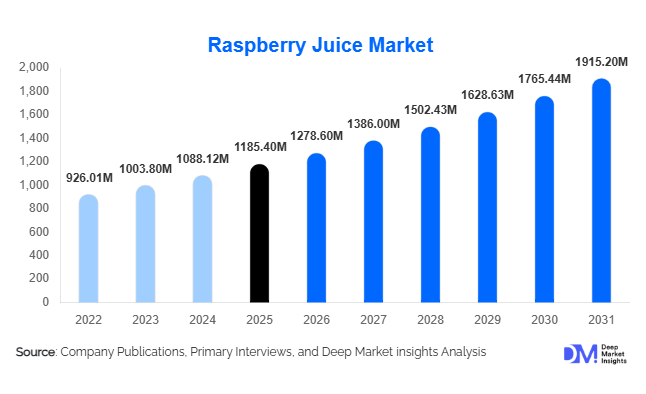
According to Deep Market Insights, the global raspberry juice market size was valued at USD 1,185.4 million in 2025 and is projected to grow from USD 1,278.6 million in 2026 to reach USD 1,915.2 million by 2031, expanding at a CAGR of 8.4% during the forecast period (2026–2031). Market growth is primarily supported by rising consumer preference for natural fruit beverages, increasing demand for antioxidant-rich functional drinks, and expanding applications of raspberry juice across food processing, nutraceuticals, and premium beverage categories. The shift toward clean-label formulations and reduced-sugar beverages has positioned raspberry juice as a premium ingredient within the global fruit juice industry.
Key Market Insights
- Functional beverage demand is accelerating adoption, as raspberry juice is widely perceived as a natural antioxidant and vitamin-rich ingredient.
- Premiumization trends are reshaping pricing structures, with organic and cold-pressed raspberry juice commanding higher margins globally.
- Europe leads global consumption, supported by established berry-processing industries and strong health-conscious consumer bases.
- Asia-Pacific is the fastest-growing region, driven by urbanization, rising disposable income, and expanding modern retail infrastructure.
- Foodservice and beverage innovation, including smoothies, craft beverages, and flavored functional drinks, is expanding application diversity.
- Technological advancements in cold-chain logistics and aseptic packaging are improving shelf stability and global export potential.
What are the latest trends in the raspberry juice market?
Shift Toward Functional and Immunity-Boosting Beverages
Consumers are increasingly prioritizing health-focused beverages that deliver nutritional benefits beyond hydration. Raspberry juice has gained traction due to its natural polyphenols, antioxidants, and vitamin content, positioning it within immunity-support and wellness beverage categories. Beverage manufacturers are incorporating raspberry juice into functional blends targeting digestive health, cardiovascular wellness, and energy enhancement. The trend is particularly strong in developed markets where consumers are transitioning away from carbonated drinks toward fruit-based alternatives with perceived health benefits. Functional positioning has also allowed producers to introduce fortified raspberry beverages combined with probiotics, collagen, and plant-based nutrients, expanding value-added product lines.
Growth of Premium and Organic Juice Offerings
The premiumization of fruit juices is redefining product differentiation across retail channels. Organic raspberry juice, cold-pressed variants, and minimally processed formulations are witnessing strong growth as consumers seek authenticity and transparency in sourcing. Brands are increasingly emphasizing traceability, sustainable farming practices, and non-GMO certifications. Premium packaging formats such as glass bottles and recyclable cartons are further enhancing product positioning. This trend supports higher average selling prices and improved profitability for producers compared to conventional fruit juices.
What are the key drivers in the raspberry juice market?
Rising Demand for Natural and Clean-Label Beverages
Global consumers are actively reducing consumption of artificial additives and synthetic ingredients, creating strong demand for natural fruit-based beverages. Raspberry juice aligns well with clean-label trends due to its recognizable ingredient profile and natural flavor appeal. Beverage companies are reformulating products to eliminate artificial coloring and sweeteners, increasing raspberry juice utilization as a natural flavoring and coloring agent.
Expansion of Functional Beverage and Nutraceutical Industries
The rapid growth of functional drinks, dietary supplements, and wellness products has significantly increased demand for berry-derived ingredients. Raspberry juice is widely incorporated into nutraceutical formulations because of its bioactive compounds and antioxidant properties. Health-focused startups and established beverage brands are introducing blended berry beverages targeting fitness-oriented consumers, accelerating ingredient demand globally.
Growth in Foodservice and Craft Beverage Innovation
Restaurants, cafes, smoothie chains, and craft beverage producers are increasingly using raspberry juice as a premium flavor base. Mixology trends, artisanal sodas, kombucha blends, and specialty teas are incorporating raspberry juice to enhance flavor complexity and visual appeal. Foodservice expansion, particularly in urban markets, continues to strengthen volume demand.
What are the restraints for the global market?
Seasonal Raw Material Supply Volatility
Raspberry cultivation is highly sensitive to climatic conditions, resulting in fluctuating yields and inconsistent raw material pricing. Weather disruptions in major producing regions can significantly impact supply availability, increasing procurement costs for juice manufacturers and limiting production scalability.
High Production and Processing Costs
Compared to citrus or apple juices, raspberry juice production involves higher fruit input requirements and processing complexity. Cold-chain storage, delicate handling requirements, and shorter shelf life contribute to elevated operational expenses, restricting price competitiveness in cost-sensitive markets.
What are the key opportunities in the raspberry juice industry?
Expansion into Emerging Asian Markets
Rapid urbanization and rising middle-class populations across Asia-Pacific present significant growth opportunities. Consumers in countries such as China, India, and Southeast Asia are increasingly adopting premium imported fruit beverages. Localization strategies, including smaller packaging sizes and blended fruit formulations, enable brands to capture new consumer segments.
Integration into Functional Nutrition and Sports Drinks
The sports nutrition industry offers strong expansion potential for raspberry juice as a natural flavoring and antioxidant ingredient. Manufacturers are developing hydration drinks, recovery beverages, and plant-based protein shakes incorporating raspberry juice to enhance nutritional positioning and taste appeal.
Innovation in Sustainable Processing and Packaging
Investment in sustainable processing technologies, including energy-efficient extraction and recyclable packaging solutions, creates differentiation opportunities. Companies adopting carbon-neutral production practices and sustainable sourcing certifications are gaining competitive advantages among environmentally conscious consumers and retail buyers.
Report Scope
| Report Metric | Details |
|---|---|
| Market Size in 2025 | USD 1185.4 Million |
| Market Size in 2026 | USD 1278.6 Million |
| Market Size in 2031 | USD 1915.2 Million |
| CAGR | 8.4% (2026-2031) |
| Base Year for Estimation | 2025 |
| Historical Data | 2022-2024 |
| Forecast Period | 2026-2031 |
| Report Coverage | Revenue Forecast, Competitive Landscape, Supply Chain Disruption, Growth Factors, Environment & Regulatory Landscape and Trends |
| Geographies Covered | North America, Europe, APAC, Middle East and Africa, LATAM |
| Countries Covered | U.S., Canada, U.K., Germany, France, Spain, Italy, Russia, Nordic, Benelux, Rest of Europe, China, Korea, Japan, India, Australia, Singapore, Taiwan, South East Asia, Rest of Asia-Pacific, UAE, Turky, Saudi Arabia, South Africa, Egypt, Nigeria, Rest of MEA, Brazil, Mexico, Argentina, Chile, Colombia, Rest of LATAM |
Explore more data points, trends and opportunities Download Free Sample Report
Product Type Insights
Concentrated raspberry juice continues to dominate the global market, holding approximately 42.3% of market share in 2025. Its widespread adoption is primarily attributed to its extended shelf life, which reduces spoilage, and its logistical advantages, allowing for lower transportation and storage costs compared to fresh or minimally processed alternatives. Concentrates are particularly favored by industrial beverage manufacturers, who leverage the product’s versatility to create smoothies, flavored beverages, ready-to-drink teas, and functional beverages with consistent quality and flavor profiles. Additionally, the concentrated form enables producers to standardize formulations, supporting large-scale production while maintaining taste and nutritional integrity. The economic efficiency of concentrated juice makes it a preferred choice for manufacturers aiming to balance cost and consumer appeal, particularly in regions with extensive beverage production infrastructure.Organic raspberry juice, while currently smaller in volume, is rapidly gaining traction, especially in specialty health and wellness markets. The growth of this segment is strongly tied to the global clean-label movement and rising awareness of sustainable farming practices. Organic juice appeals to consumers who prioritize chemical-free production, environmental sustainability, and non-GMO sourcing. Premium health retailers, e-commerce subscription services, and boutique beverage brands have embraced organic raspberry juice to meet the growing demand for functional, antioxidant-rich beverages. The combination of wellness trends and willingness to invest in higher-quality, responsibly sourced products is driving sustained growth in this segment.
Application Insights
Beverage manufacturing remains the largest application segment, accounting for nearly 48.7% of total market demand in 2025. Raspberry juice is a core ingredient in a wide array of beverages, including smoothies, flavored waters, ready-to-drink teas, and functional drinks fortified with vitamins, minerals, and antioxidants. The expansion of health-focused beverages, particularly those targeting immunity, digestion, and energy, has significantly fueled the demand for raspberry juice. The versatility of raspberry juice in blending with other fruits and functional ingredients enables manufacturers to innovate with new flavors and formulations that appeal to both adult and youth consumers. Additionally, the beverage sector benefits from ongoing advancements in packaging technology, such as aseptic processing and shelf-stable cartons, which extend product longevity and reduce waste, further driving market uptake.The nutraceutical and functional foods segment represents the fastest-growing application area for raspberry juice. Rising awareness of the health benefits associated with antioxidants, polyphenols, and bioactive compounds in raspberries has led to increased use in dietary supplements, energy shots, wellness shots, and fortified beverages. Formulators are integrating raspberry juice into immunity-boosting and anti-aging products, leveraging its natural health-promoting properties to appeal to the growing wellness-oriented consumer base. With innovation in functional ingredients and greater emphasis on preventive health, raspberry juice is positioned as a key ingredient in this high-growth segment.
Distribution Channel Insights
Offline retail channels, including supermarkets, hypermarkets, convenience stores, and traditional grocery stores, accounted for approximately 55.1% of global sales in 2025. Strong consumer preference for in-person shopping is driven by the ability to inspect product quality, check labeling claims, and access premium shelf positioning. The presence of tasting events, in-store promotions, and brand visibility further strengthens offline retail sales, particularly for concentrated and premium NFC juices. Retailers in North America and Europe have invested in marketing and merchandising strategies to highlight raspberry juice’s health benefits, which encourages consumer adoption and repeat purchases.Online retail channels, however, are experiencing the fastest growth, driven by the rise of direct-to-consumer beverage brands and subscription-based health drink services. E-commerce platforms enable niche and specialty raspberry juice brands to reach health-conscious consumers efficiently, offering convenience, product customization, and home delivery. The growth of social commerce, targeted digital advertising, and health-focused online marketplaces has accelerated online sales, particularly in regions such as Asia-Pacific, where smartphone penetration and digital payments are widespread. Online retail also facilitates consumer education regarding product sourcing, organic certifications, and functional benefits, enhancing consumer trust and brand loyalty.
Nature Insights
Conventional raspberry juice dominated the market with nearly 71.4% share in 2025, primarily due to its wider availability, lower price points, and established supply chains. Conventional juice remains accessible across all retail channels and is frequently incorporated into cost-sensitive beverage manufacturing processes. Its production scale and lower raw material costs make it suitable for mass-market beverages, including carbonated drinks, juice blends, and processed fruit beverages. Conventional juice also benefits from technological advancements in pasteurization, concentration, and flavor retention, ensuring high-quality products at competitive prices.Organic raspberry juice, although smaller in market volume, is growing rapidly, driven by rising consumer willingness to invest in health, sustainability, and ethical sourcing. Developed markets, particularly in North America and Europe, exhibit strong demand for certified organic juices that align with premium, clean-label trends. Consumer interest in plant-based diets, antioxidant-rich ingredients, and environmentally responsible production has created a positive market outlook for organic raspberry juice. Brands are leveraging this trend by emphasizing traceability, certification, and health benefits, allowing organic raspberry juice to command higher margins and brand prestige in both retail and e-commerce channels.
Explore more data points, trends and opportunities Download Free Sample Report
Raspberry Juice Market Segmentations
By Product Type
- Conventional Raspberry Juice
- Organic Raspberry Juice
- Concentrated Raspberry Juice
- Not-From-Concentrate (NFC) Raspberry Juice
- Cold-Pressed Raspberry Juice
By Nature
- Sweetened Raspberry Juice
- Unsweetened Raspberry Juice
By Packaging Type
- Bottles
- Cartons
- Cans
- Pouches & Flexible Packaging
- Bulk Packaging
By Distribution Channel
- Online Retail & E-Commerce
- Supermarkets & Hypermarkets
- Convenience Stores
- Specialty & Organic Stores
- Foodservice & HoReCa
- Direct Sales / B2B Industrial Supply
By End Use
- Retail Beverage Consumption
- Food & Beverage Processing Industry
- Nutraceuticals & Functional Foods
- Cosmetics & Personal Care Applications
Regional Insights
North America
North America accounted for approximately 24.6% of the global market in 2025, with the United States and Canada leading growth. The region’s demand is primarily driven by functional beverage innovation, clean-label adoption, and wellness-focused consumption patterns. Consumers in North America increasingly prefer smoothies, cold-pressed juices, and fortified beverages, creating strong demand for both NFC and organic raspberry juice. Advanced retail infrastructure, including large supermarket chains, premium health stores, and e-commerce platforms, enables wide product availability. In addition, investment in food technology and cold chain logistics ensures consistent product quality and accessibility, encouraging higher per-capita consumption. North American consumers also exhibit strong receptivity to product storytelling, including sourcing transparency, antioxidant content, and sustainability practices, which further fuels market growth.
Europe
Europe remains the largest regional market, capturing nearly 33.8% share in 2025. The continent benefits from robust raspberry cultivation in countries such as Poland, Serbia, and Germany, ensuring a steady supply of high-quality raw materials. European consumers demonstrate high awareness of natural nutrition and sustainable sourcing, driving the adoption of both NFC and organic raspberry juices. Regulatory frameworks promoting food safety and organic certifications support market confidence, while extensive distribution networks, including supermarkets, hypermarkets, and specialty health stores, provide broad accessibility. Additionally, rising interest in functional beverages and wellness products across Western Europe has contributed to increased market penetration. Countries such as Germany, France, and the UK show strong adoption of health-focused beverages, while Eastern European markets benefit from local production capabilities and growing disposable incomes, collectively supporting consistent regional growth.
Asia-Pacific
Asia-Pacific is the fastest-growing region, expanding at over 10% CAGR. Key markets include China, Japan, South Korea, and India, where rising disposable income, urbanization, and changing lifestyle patterns are driving demand for premium and imported fruit beverages. The growth of modern retail outlets, convenience stores, and e-commerce platforms facilitates consumer access to both conventional and organic raspberry juices. Rising health consciousness and adoption of functional beverages among middle- and upper-income consumers further stimulate regional demand. In addition, social media influence, product marketing, and trend-driven beverage consumption are creating a younger demographic of consumers who prioritize quality, flavor, and nutritional benefits. Local manufacturers are increasingly integrating raspberry juice into ready-to-drink teas, smoothies, and functional drinks, while importers focus on premium European and North American products, collectively boosting market expansion.
Latin America
Latin America exhibits steady growth, led by Brazil, Chile, and Mexico, with urbanization and rising disposable income supporting increased consumption of fruit-based beverages. The expanding café culture, juice bars, and specialty beverage outlets have further popularized raspberry-based products. Export-oriented processing facilities are emerging in countries with strong fruit production, enabling local processing for domestic and international markets. Consumers are showing growing interest in beverages that combine health benefits and authentic flavors, which has led to greater adoption of NFC and functional raspberry juices. The region’s proximity to key global markets also allows manufacturers to capitalize on trade opportunities, enhancing the availability of premium and organic juice variants.
Middle East & Africa
The Middle East & Africa region is experiencing gradual growth, with the United Arab Emirates, Saudi Arabia, and South Africa leading demand for premium and specialty juices. Health-conscious consumers, rising awareness of functional beverages, and the expansion of hospitality and foodservice sectors are driving consumption. Import-driven markets, such as the UAE and Saudi Arabia, show high receptivity to organic and NFC raspberry juices due to their premium positioning. The development of modern retail outlets, supermarkets, and e-commerce platforms further facilitates access, while high-income urban populations demonstrate a preference for imported, high-quality, and sustainable products. Additionally, tourism and hospitality growth in the region contribute to higher consumption of fruit juices in hotels, restaurants, and cafés, creating opportunities for both conventional and premium raspberry juice suppliers.
Key Players in the Raspberry Juice Market
- Döhler GmbH
- SVZ International B.V.
- AGRANA Beteiligungs AG
- Kerry Group plc
- Tree Top Inc.
- Rauch Fruchtsäfte GmbH & Co OG
- Ariza B.V.
- Symrise AG
- Ingredion Incorporated
- SunOpta Inc.
- Milne Fruit Products
- FruitSmart Inc.
- Louis Dreyfus Company
- Kanegrade Ltd.
- Grünwald Fruchtsaft GmbH