Rambutan Market Size
Key Market Insights
- Fresh rambutan remains the dominant product segment, accounting for more than 58% of global market revenue due to strong consumer preference for natural and minimally processed tropical fruits.
- Asia-Pacific dominates the global market, supported by large-scale cultivation and export operations across Thailand, Indonesia, Vietnam, Malaysia, and the Philippines.
- Processed rambutan applications are expanding rapidly, particularly in canned fruits, beverages, frozen desserts, smoothies, and nutraceutical ingredients.
- North America and Europe are emerging as high-growth import markets, driven by rising multicultural food consumption and increasing demand for premium exotic fruits.
- Organic rambutan demand is accelerating globally, especially among health-conscious consumers seeking pesticide-free and sustainably sourced fruit products.
- Cold-chain logistics and improved export infrastructure are significantly improving shelf life, global accessibility, and year-round availability of rambutan products.
What are the latest trends in the rambutan market?
Rising Demand for Functional and Exotic Fruits
Consumers globally are increasingly prioritizing fruits with high nutritional value, antioxidant content, and immune-supporting properties. Rambutan is gaining popularity as a functional tropical fruit due to its rich vitamin C, fiber, and polyphenol content. The fruit is increasingly positioned alongside dragon fruit, mangosteen, and lychee within premium exotic fruit categories in supermarkets and online retail platforms. Urban consumers in North America, Europe, and Asia-Pacific are driving demand for imported tropical fruits as dietary habits shift toward healthier snacking and natural food alternatives. Retailers are also expanding exotic fruit assortments to differentiate premium offerings and capitalize on rising consumer interest in globally sourced produce.
Expansion of Processed Rambutan Applications
The processed rambutan segment is witnessing strong momentum as food and beverage manufacturers increasingly incorporate rambutan into juices, smoothies, desserts, yogurts, confectionery, canned fruits, and frozen products. Processed products help reduce perishability concerns associated with fresh fruit trade while enabling year-round availability. Manufacturers are also exploring rambutan peel and seed extracts for cosmetic and nutraceutical applications due to their antioxidant and anti-inflammatory properties. Beverage brands are launching tropical fruit blends containing rambutan to cater to consumers seeking innovative flavor profiles and wellness-oriented drinks. This trend is creating opportunities for fruit processors to diversify revenue streams and improve profitability through value-added production.
What are the key drivers in the rambutan market?
Increasing Global Demand for Healthy Tropical Fruits
The rising global focus on preventive healthcare and healthy dietary habits is one of the strongest drivers for the rambutan market. Consumers are increasingly seeking nutrient-dense fruits containing natural antioxidants, vitamins, and minerals. Rambutan’s nutritional profile supports its growing popularity among health-conscious consumers looking for functional foods that promote immunity and digestive health. Demand is especially strong among younger urban populations and premium grocery shoppers seeking alternatives to traditional fruit categories. This health-oriented consumption trend is expected to continue supporting long-term market expansion.
Expansion of International Cold-Chain Infrastructure
Improved cold-chain logistics and refrigerated transportation systems have significantly expanded global trade opportunities for rambutan producers. Historically, the fruit’s short shelf life limited export potential beyond Southeast Asia. However, advancements in packaging technology, temperature-controlled shipping, and air freight logistics have enabled exporters to reach distant markets while maintaining product quality. Supermarkets and e-commerce grocery platforms are increasingly able to distribute fresh rambutan products efficiently, accelerating market penetration across developed economies. Governments in exporting countries are also investing heavily in post-harvest infrastructure to strengthen horticulture exports.
What are the restraints for the global market?
Short Shelf Life and High Perishability
Fresh rambutan is highly perishable and requires rapid transportation and controlled storage conditions to maintain quality. This creates substantial logistical challenges for exporters and distributors, particularly in developing countries with limited cold-chain infrastructure. Post-harvest losses remain a major concern for growers and traders, increasing operational costs and reducing profitability. Maintaining freshness during long-distance exports continues to be one of the primary challenges affecting global market expansion.
Stringent Export Regulations and Quality Standards
International rambutan exporters must comply with strict phytosanitary regulations, pesticide residue limits, packaging standards, and food safety requirements imposed by developed markets such as the United States and the European Union. Smaller growers often face difficulties meeting these standards due to limited financial and technological resources. Regulatory complexities can delay shipments, increase compliance costs, and restrict access to premium international markets. Inconsistent agricultural practices across producing countries also create challenges in maintaining standardized product quality.
What are the key opportunities in the rambutan industry?
Growth of Premium Organic Rambutan Products
The increasing consumer preference for organic and sustainably sourced food products presents significant opportunities for rambutan producers globally. Organic rambutan is gaining traction in premium retail markets across North America and Europe, where consumers are willing to pay higher prices for pesticide-free tropical fruits. Producers investing in certified organic cultivation practices and sustainable farming systems are expected to benefit from premium pricing and stronger retailer partnerships. Growing awareness regarding environmentally responsible agriculture is likely to accelerate adoption of organic rambutan production in export-focused countries.
Expansion into Nutraceutical and Cosmetic Applications
Rambutan-derived extracts are increasingly being explored for nutraceutical and cosmetic applications due to their antioxidant-rich composition. Rambutan peel extracts are being studied for skincare formulations, anti-aging products, and dietary supplements. This diversification beyond traditional food applications creates opportunities for ingredient manufacturers and specialty product developers. Companies investing in research and development for bioactive rambutan compounds may gain competitive advantages as demand for plant-based wellness ingredients expands globally. The integration of rambutan into functional beverages and supplement products is expected to create high-margin growth opportunities over the coming years.
Report Scope
| Report Metric | Details |
|---|---|
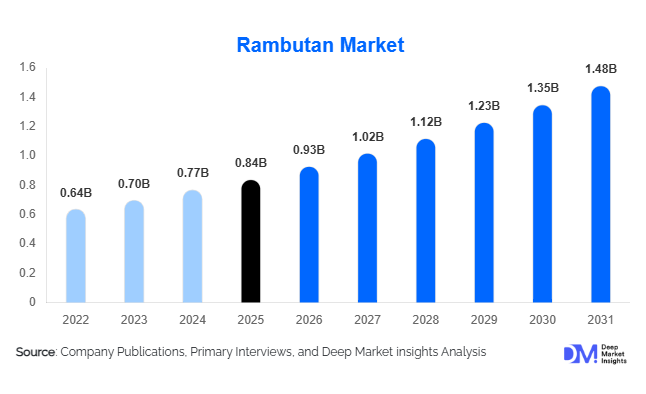
| Market Size in 2025 | USD 0.84 Billion |
| Market Size in 2026 | USD 0.93 Billion |
| Market Size in 2031 | USD 1.48 Billion |
| CAGR | 9.8% (2026-2031) |
| Base Year for Estimation | 2025 |
| Historical Data | 2022-2024 |
| Forecast Period | 2026-2031 |
| Report Coverage | Revenue Forecast, Competitive Landscape, Supply Chain Disruption, Growth Factors, Environment & Regulatory Landscape and Trends |
| Geographies Covered | North America, Europe, APAC, Middle East and Africa, LATAM |
| Countries Covered | U.S., Canada, U.K., Germany, France, Spain, Italy, Russia, Nordic, Benelux, Rest of Europe, China, Korea, Japan, India, Australia, Singapore, Taiwan, South East Asia, Rest of Asia-Pacific, UAE, Turky, Saudi Arabia, South Africa, Egypt, Nigeria, Rest of MEA, Brazil, Mexico, Argentina, Chile, Colombia, Rest of LATAM |
Explore more data points, trends and opportunities Download Free Sample Report
Product Type Insights
The fresh rambutan segment continues to dominate the global rambutan market, accounting for nearly 58% of total revenue in 2025, primarily driven by rising global consumer preference for natural, minimally processed, and nutrient-rich tropical fruits. Fresh rambutan remains highly attractive among consumers because of its juicy texture, sweet flavor profile, refreshing taste, and exotic visual appeal, making it increasingly popular across both domestic and international fruit markets. Growing health awareness among consumers has further strengthened demand for fresh rambutan as it contains essential vitamins, antioxidants, dietary fiber, and hydration properties that align with modern healthy eating trends. Increasing urbanization, rising disposable incomes, and growing interest in premium imported fruits are supporting the expansion of fresh rambutan consumption across developed and emerging economies alike.The growing popularity of convenience-oriented food consumption patterns is significantly driving demand for processed rambutan products globally. Consumers increasingly prefer ready-to-eat and easy-to-store fruit products that provide nutritional value while requiring minimal preparation time. Food manufacturers are also integrating rambutan into premium confectionery, bakery fillings, yogurt products, fruit cocktails, and functional beverages to capitalize on rising consumer interest in exotic tropical flavors. In addition, processed rambutan products help manufacturers minimize post-harvest losses while improving profitability across the value chain.Organic rambutan is gradually emerging as a high-value niche segment, especially across Europe and North America, where consumers are increasingly prioritizing clean-label, pesticide-free, and sustainably cultivated produce. Organic certification is becoming an important differentiating factor for exporters targeting premium international markets. Consumers are demonstrating growing willingness to pay higher prices for responsibly sourced tropical fruits that align with environmental sustainability and health-conscious lifestyles. As a result, producers are increasingly adopting sustainable farming practices, organic cultivation methods, and eco-friendly packaging solutions to strengthen competitiveness in premium retail channels.
Application Insights
The food and beverage segment remains the largest application category within the global rambutan market, contributing approximately 68% of total market revenue. Rambutan is increasingly utilized across a wide range of food and beverage products, including smoothies, fruit juices, flavored drinks, desserts, yogurts, jams, confectionery products, fruit salads, ice creams, frozen desserts, bakery products, and premium cocktails. The fruit’s naturally sweet flavor, refreshing taste, and attractive appearance make it highly suitable for innovative food formulations aimed at modern consumers seeking unique tropical experiences.Nutraceutical applications are witnessing steady expansion as manufacturers increasingly explore the health-promoting properties of rambutan extracts. Rambutan peel, seeds, and pulp contain bioactive compounds, antioxidants, and polyphenols that are gaining attention within dietary supplement and wellness product development. Nutraceutical companies are investing in tropical fruit-based formulations targeting immunity enhancement, digestive health, anti-inflammatory benefits, and overall wellness support. Growing consumer preference for plant-based nutrition and natural ingredients is expected to further strengthen rambutan utilization within the nutraceutical industry.The cosmetic and personal care sector is also emerging as a promising application area for rambutan-derived ingredients. Skincare manufacturers are increasingly incorporating rambutan peel extracts and antioxidant compounds into anti-aging creams, moisturizers, serums, and natural beauty products. Rising consumer preference for botanical and fruit-based cosmetic formulations is encouraging personal care companies to diversify ingredient sourcing from tropical fruits. Increasing awareness regarding sustainable beauty products and clean cosmetic labels is expected to support long-term growth within this segment.
Distribution Channel Insights
Supermarkets and hypermarkets continue to dominate the global rambutan distribution landscape, accounting for approximately 37% of total market sales. Large organized retail chains provide strong product visibility, efficient inventory management, reliable cold-storage systems, and wider accessibility to imported tropical fruits for urban consumers. The increasing expansion of modern retail infrastructure across emerging economies is further supporting the availability and commercialization of rambutan products in both developed and developing markets.Online retail and e-commerce grocery platforms are emerging as the fastest-growing distribution channels within the global rambutan market. Rapid digitalization, rising smartphone penetration, growing internet accessibility, and increasing consumer adoption of home-delivery grocery services are accelerating online fruit sales worldwide. E-commerce platforms enable consumers to access imported tropical fruits more conveniently while allowing suppliers to reach broader customer bases beyond traditional retail limitations. Subscription-based fresh produce delivery services are also contributing to growing online demand for exotic fruits.Foodservice distribution channels are experiencing notable expansion due to rising demand from hotels, restaurants, cafes, beverage chains, and dessert manufacturers. Foodservice operators increasingly utilize rambutan in beverages, desserts, tropical fruit platters, and fusion cuisine offerings to cater to changing consumer tastes and premium dining experiences. Strong tourism activity and increasing consumer interest in global cuisines are further supporting commercial demand across hospitality sectors worldwide.
End-Use Insights
Household consumers remain the dominant end-use segment in the global rambutan market, accounting for more than 52% of total demand. Consumers primarily purchase rambutan as a fresh snack fruit due to its nutritional value, unique taste, and exotic appeal. Increasing health awareness, rising disposable incomes, and growing demand for natural food products are encouraging consumers to incorporate tropical fruits into their daily diets. Urban consumers are particularly driving demand for premium imported fruits as part of evolving healthy lifestyle trends.The leading growth driver for the household segment is the increasing consumer shift toward healthy snacking and nutrient-rich fruit consumption. Consumers are actively reducing intake of processed snacks and sugary products while seeking fresh fruit alternatives that offer vitamins, antioxidants, hydration, and natural sweetness. Rambutan’s strong nutritional positioning supports its growing popularity among families, young professionals, fitness-conscious consumers, and premium fruit buyers globally.Beverage manufacturers are rapidly expanding rambutan utilization within juices, smoothies, flavored waters, cocktails, and functional wellness drinks. Rising global consumption of health-oriented beverages is encouraging manufacturers to incorporate nutrient-rich tropical fruits that provide both flavor enhancement and nutritional value. Demand for plant-based beverages and natural ingredient formulations is expected to create substantial opportunities for rambutan suppliers over the forecast period.Nutraceutical and cosmetic companies are also emerging as important end users due to growing research regarding the antioxidant and bioactive properties of rambutan-derived compounds. Increasing demand for natural wellness supplements, botanical skincare products, and plant-based cosmetic ingredients is expected to create long-term commercial opportunities for rambutan extract manufacturers. Export-oriented demand from premium hospitality and international foodservice sectors is also supporting diversification of end-use applications globally.
Explore more data points, trends and opportunities Download Free Sample Report
Rambutan Market Segmentations
By Product Type
- Fresh Rambutan
- Processed Rambutan
- Organic Rambutan
- Conventional Rambutan
By Application
- Food & Beverages
- Nutraceuticals & Dietary Supplements
- Cosmetics & Personal Care
- Pharmaceutical Preparations
- Animal Feed & By-products
By Distribution Channel
- Supermarkets & Hypermarkets
- Convenience Stores
- Specialty Fruit Stores
- Online Retail/E-Commerce
- Foodservice & HoReCa
- Wholesale Markets
- Direct Farm Sales
By End User
- Household Consumers
- Food Processing Companies
- Beverage Manufacturers
- Cosmetic Manufacturers
- Nutraceutical Companies
- Foodservice Industry
Regional Insights
Asia-Pacific
Asia-Pacific dominates the global rambutan market with nearly 72% market share in 2025 due to extensive cultivation, strong domestic consumption, favorable climatic conditions, and well-established export networks across Thailand, Indonesia, Malaysia, Vietnam, and the Philippines. Thailand remains the world’s leading exporter of rambutan owing to its advanced horticultural infrastructure, strong agricultural expertise, modern processing capabilities, and export-oriented farming systems. The region benefits significantly from ideal tropical weather conditions that support large-scale rambutan production throughout the year.China represents one of the fastest-growing import markets within the region due to rising middle-class incomes, increasing urbanization, and growing consumer demand for premium imported fruits. Chinese consumers are increasingly embracing tropical fruits through supermarkets, online retail platforms, and premium grocery chains. India is also witnessing rising rambutan demand through organized retail expansion, luxury hotels, modern fruit distribution networks, and increasing awareness regarding exotic fruit consumption. The rapid growth of e-commerce grocery platforms across Asia-Pacific is further strengthening market accessibility and cross-border fruit trade.
North America
North America accounts for approximately 10% of the global rambutan market and remains a high-growth import-driven region. The United States dominates regional demand due to rising multicultural food consumption, increasing interest in tropical fruits, and strong growth in health-conscious consumer segments. Consumers across major metropolitan areas are increasingly experimenting with international cuisines and exotic produce, creating substantial opportunities for imported rambutan suppliers.Canada is also experiencing steady growth in rambutan imports due to rising Asian immigrant populations, increasing multicultural food demand, and expansion of premium retail channels. Strong cold-chain logistics infrastructure, advanced food distribution systems, and high consumer purchasing power further support regional market expansion. Increasing popularity of tropical smoothies, wellness beverages, and plant-based diets is expected to strengthen rambutan demand across North America during the forecast period.
Europe
Europe holds nearly 9% of the global rambutan market, with significant demand concentrated in Germany, France, the United Kingdom, and the Netherlands. European consumers increasingly prefer sustainably sourced, organic, and ethically produced tropical fruits, supporting premium pricing opportunities for imported rambutan products. The Netherlands serves as a major import and re-export hub for tropical fruits throughout the European Union due to its advanced logistics and port infrastructure.Demand for processed rambutan products is also increasing steadily across premium beverage, confectionery, and foodservice applications. Rising popularity of international cuisine, functional beverages, and plant-based food trends is supporting broader commercial utilization of tropical fruit ingredients across Europe. Growth in specialty grocery retailers and gourmet food sectors is expected to further strengthen regional demand.
Latin America
Latin America is emerging as a promising production and export region for rambutan, particularly in Guatemala, Honduras, and Mexico. Favorable climatic conditions, lower production costs, and geographical proximity to North American markets provide significant competitive advantages for regional producers. Mexico is rapidly expanding rambutan exports to the United States due to shorter transportation times, logistical efficiency, and growing demand for tropical fruit imports.Domestic consumption of exotic fruits is also increasing across major urban centers in Brazil, Argentina, and other regional economies due to rising disposable incomes and growing consumer awareness regarding tropical fruit nutrition. Increasing supermarket penetration and organized retail development are expected to further support regional market expansion over the forecast period.
Middle East & Africa
The Middle East & Africa region is witnessing rising demand for imported premium fruits, particularly across the UAE and Saudi Arabia. High disposable incomes, expanding luxury retail sectors, strong tourism activity, and growing hospitality industries are driving increased imports of exotic tropical fruits such as rambutan. Premium hotels, fine-dining restaurants, and international foodservice operators are increasingly incorporating tropical fruit offerings into their menus to cater to affluent consumers and international tourists.South Africa is also gradually increasing tropical fruit imports through organized retail channels as consumer awareness regarding exotic fruits continues to improve. Expanding tourism activity, rising urbanization, and increasing premium food consumption are expected to strengthen long-term market opportunities across the broader Middle East & Africa region.
Key Players in the Rambutan Market
- Thai Agri Foods Public Company Limited
- Malee Group Public Company Limited
- PT Great Giant Pineapple
- Dole Food Company
- Del Monte Pacific Limited
- Yeshuv Agro Industries
- Siam Fresh Enterprise Co., Ltd.
- Guangxi Tianlong Food Co., Ltd.
- Miami Fruit
- Tropics Foods Ltd.
- Alfoocan S.A.
- JBT FoodTech
- Sunmoon Food Company Limited
- ABC Fruits
- Capexo Fruits Thailand