Rainbow Trout Market Size
According to Deep Market Insights, the global rainbow trout market size was valued at USD 4,982 million in 2025 and is projected to grow from USD 5,345.69 million in 2026 to reach USD 7,603.30 million by 2031, expanding at a CAGR of 7.3% during the forecast period (2026–2031). The market growth is primarily driven by rising global consumption of high-protein seafood, expansion of aquaculture production systems, and increasing consumer preference for sustainable and traceable fish products. Rainbow trout has gained significant traction across retail and foodservice channels due to its mild flavor, nutritional profile, and adaptability to controlled aquaculture environments.
Key Market Insights
- Aquaculture-produced rainbow trout dominates supply, accounting for the majority of global production due to controlled farming efficiency and predictable yields.
- Health-conscious consumption trends are boosting demand for omega-3 rich fish alternatives to red meat.
- Europe remains the largest consuming region, supported by established freshwater aquaculture infrastructure.
- Asia-Pacific is the fastest-growing region, driven by rising seafood consumption and expanding cold-chain logistics.
- Value-added trout products such as smoked, filleted, and ready-to-cook formats are gaining popularity in modern retail.
- Sustainability certifications and traceability technologies are becoming key purchasing criteria among retailers and institutional buyers.
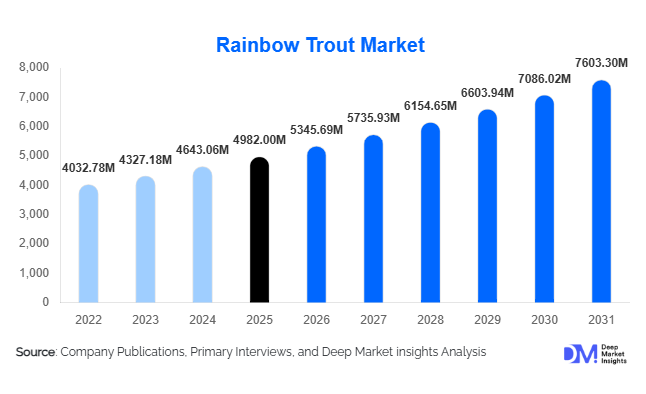
What are the latest trends in the rainbow trout market?
Shift Toward Sustainable Aquaculture Systems
Producers are increasingly adopting recirculating aquaculture systems (RAS), low-impact feed technologies, and water-efficient farming models to reduce environmental footprints. Governments across Europe and North America are incentivizing sustainable aquaculture investments to reduce reliance on marine capture fisheries. Certification programs emphasizing traceability and antibiotic-free farming are influencing procurement decisions among supermarkets and hospitality chains. This shift toward sustainability enhances price premiums while improving long-term supply stability.
Growth of Value-Added and Convenience Seafood Products
Consumer lifestyles are driving demand for processed rainbow trout products such as smoked fillets, frozen ready meals, marinated portions, and pre-seasoned cuts. Retailers are expanding private-label trout offerings targeting health-focused households. Innovations in packaging, including vacuum sealing and modified atmosphere packaging, are extending shelf life and enabling global export expansion. Online grocery platforms are also accelerating accessibility, particularly in urban markets where convenience seafood consumption is increasing rapidly.
What are the key drivers in the rainbow trout market?
Rising Global Demand for Healthy Protein Sources
Increasing awareness regarding cardiovascular health and protein-rich diets is pushing consumers toward lean seafood options. Rainbow trout offers high omega-3 fatty acid content and lower mercury levels compared to many marine species, making it attractive across developed markets. Growing adoption of flexitarian diets further supports consumption growth.
Expansion of Controlled Aquaculture Infrastructure
Technological advancements in hatcheries, feed optimization, and water recirculation systems are enabling year-round production. Countries investing in inland aquaculture are reducing climate dependency and stabilizing supply chains. Automation and digital monitoring systems have also improved survival rates and feed conversion efficiency, lowering operational costs.
Retail and Foodservice Channel Expansion
Modern retail expansion and increasing restaurant seafood menus are strengthening demand. Quick-service restaurants and premium casual dining chains increasingly incorporate trout dishes as sustainable alternatives to salmon, enhancing visibility and consumption frequency.
What are the restraints for the global market?
Feed Cost Volatility
Aquaculture profitability remains sensitive to fluctuations in fishmeal and plant-based feed prices. Rising raw material costs directly impact margins, particularly for small-scale farmers operating in developing markets.
Disease Management and Environmental Regulations
Strict environmental standards and disease outbreaks can disrupt production cycles. Compliance costs related to water discharge regulations and biosecurity investments remain key operational challenges, especially for expanding producers.
What are the key opportunities in the rainbow trout industry?
Expansion into Emerging Asian Markets
Rapid urbanization and rising disposable incomes in Asia-Pacific countries are creating new demand for premium freshwater fish. Governments encouraging domestic aquaculture production present opportunities for joint ventures and technology licensing. Imports into Southeast Asia and China are increasing as cold-chain infrastructure improves, enabling wider distribution.
Technology Integration and Smart Aquaculture
IoT sensors, AI-based feeding systems, and automated water monitoring solutions are improving productivity and reducing mortality rates. Digital aquaculture platforms allow producers to optimize feeding schedules and monitor fish health in real time, improving yield predictability and profitability.
Premium and Organic Trout Segments
Organic-certified and antibiotic-free trout products command premium pricing in Europe and North America. Retailers increasingly promote sustainable seafood categories, creating opportunities for producers to differentiate products through certifications and eco-labeling strategies.
Report Scope
| Report Metric | Details |
|---|---|
| Market Size in 2025 | USD 4982 Million |
| Market Size in 2026 | USD 5345.69 Million |
| Market Size in 2031 | USD 7603.30 Million |
| CAGR | 7.3% (2026-2031) |
| Base Year for Estimation | 2025 |
| Historical Data | 2022-2024 |
| Forecast Period | 2026-2031 |
| Report Coverage | Revenue Forecast, Competitive Landscape, Supply Chain Disruption, Growth Factors, Environment & Regulatory Landscape and Trends |
| Geographies Covered | North America, Europe, APAC, Middle East and Africa, LATAM |
| Countries Covered | U.S., Canada, U.K., Germany, France, Spain, Italy, Russia, Nordic, Benelux, Rest of Europe, China, Korea, Japan, India, Australia, Singapore, Taiwan, South East Asia, Rest of Asia-Pacific, UAE, Turky, Saudi Arabia, South Africa, Egypt, Nigeria, Rest of MEA, Brazil, Mexico, Argentina, Chile, Colombia, Rest of LATAM |
Explore more data points, trends and opportunities Download Free Sample Report
Product Type Insights
The global rainbow trout market is characterized by diverse product formats catering to varying consumer preferences. Fresh whole rainbow trout leads the market, accounting for approximately 32% of the 2025 global market, primarily driven by strong retail demand, cost-effective production, and minimal processing requirements. Consumers increasingly prefer fresh fish for home cooking, attributing health benefits and superior flavor to whole trout. Frozen trout products hold around 24% share, fueled by their extended shelf life and scalability in international trade, which makes them ideal for exporters targeting regions with less-developed cold-chain infrastructure. Smoked trout, representing 18% of the market, is witnessing accelerated growth in Europe, where processed seafood consumption is well-established, and consumers favor premium ready-to-eat options. Fillets and portioned cuts contribute 20% of the market share, reflecting rising demand for convenience and single-serving options, particularly among urban households with limited cooking time. Meanwhile, value-added ready-to-cook formats, although smaller at 6%, are the fastest-growing segment globally, supported by increasing urbanization, changing lifestyles, and the trend toward home-based gourmet meals.
Application Insights
Household retail consumption remains the dominant application segment, accounting for nearly 41% market share in 2025. Growth in this segment is underpinned by the expansion of modern supermarkets, hypermarkets, and grocery chains, which provide easy access to fresh and processed trout products, as well as rising consumer awareness of healthy and protein-rich diets. The foodservice sector contributes 34% to overall consumption, with premium dining establishments, hotels, and casual restaurants increasingly incorporating trout-based dishes into their menus to meet rising consumer demand for high-quality seafood. Industrial processing applications, representing 17%, continue to expand through the production of smoked, canned, and packaged trout products for retail and institutional use, supported by advancements in processing technologies and extended product shelf life. Institutional catering, including hospitals, schools, and corporate cafeterias, holds 8% of the market, driven by the adoption of nutritionally balanced menus and government-led health initiatives encouraging seafood consumption.
Distribution Channel Insights
Modern retail channels dominate the rainbow trout distribution landscape, capturing approximately 46% share. This dominance is reinforced by significant investments in cold-chain logistics, the proliferation of private-label seafood products, and rising consumer preference for one-stop shopping convenience. Foodservice distributors account for 28% of the market, providing a consistent supply of fresh, frozen, and processed trout to restaurants, hotels, and catering businesses. Direct farm sales and cooperative networks represent 15% of distribution, particularly in Europe, where traceability and sustainability initiatives encourage farm-to-table sales. Online seafood platforms, holding 11% of the market, are experiencing rapid growth due to increasing digital grocery adoption, home delivery convenience, and the popularity of subscription-based seafood services, especially among urban millennials and Gen Z consumers.
Explore more data points, trends and opportunities Download Free Sample Report
Rainbow Trout Market Segmentations
By Product Type
- Fresh Whole Rainbow Trout
- Frozen Rainbow Trout
- Smoked Rainbow Trout
- Fillets & Portioned Cuts
- Value-Added & Ready-to-Cook Trout Products
By Application
- Household Retail Consumption
- Foodservice & Hospitality
- Industrial Processing
- Institutional Catering
By Distribution Channel
- Supermarkets & Hypermarkets
- Foodservice Distributors
- Direct Farm Sales & Cooperatives
- Online Seafood Platforms
- Specialty Seafood Stores
Regional Insights
North America
North America is projected to account for nearly 22% of the global rainbow trout market by 2025. In the United States, growth is driven by a combination of health-conscious consumer trends, the popularity of home cooking, and menu diversification in restaurants offering high-quality seafood options. Investments in freshwater aquaculture and sustainable farming practices in Canada further strengthen regional production, meeting both domestic demand and export requirements. The region also benefits from advanced cold-chain infrastructure, which allows both fresh and frozen trout products to reach distant markets efficiently. Additionally, growing interest in ready-to-cook and value-added trout formats is supporting incremental demand.
Europe
Europe dominates the global rainbow trout market with approximately 38% share, led by countries such as Norway, Denmark, France, Italy, and Spain. The region's growth is propelled by established aquaculture systems, high seafood consumption traditions, and strong consumer preference for processed and premium seafood products. Germany and France remain major importers of smoked, filleted, and portioned trout, while demand for fresh whole trout continues to rise among households seeking sustainable and nutritious protein sources. Government support for aquaculture development, combined with widespread adoption of environmentally friendly practices, reinforces Europe’s leadership in both production and consumption. In addition, increasing consumer inclination toward ready-to-cook and gourmet trout meals is driving growth in urban markets.
Asia-Pacific
Asia-Pacific is the fastest-growing region in the rainbow trout market, with an expected CAGR exceeding 9%. China leads production expansion due to large-scale aquaculture operations, government support, and improving cold storage logistics. Japan and South Korea contribute significantly to premium consumption, with strong demand for smoked and filleted trout in urban households and high-end restaurants. Emerging markets such as India and Southeast Asia are experiencing growth driven by rising disposable incomes, growing awareness of health and wellness diets, and increased penetration of modern retail channels. Investments in cold-chain infrastructure and seafood processing facilities are enabling wider distribution, while urban consumers are adopting convenient ready-to-cook formats and pre-portioned fillets, further fueling regional growth.
Latin America
Latin America, primarily led by Chile and Peru, benefits from favorable freshwater conditions and a strong focus on export-oriented aquaculture. Regional growth is supported by rising supermarket penetration, partnerships with international seafood distributors, and investments in sustainable aquaculture practices that enhance production efficiency. Both domestic consumption and exports are on the rise, with processed and frozen trout products gaining traction in urban households. Additionally, value-added products such as smoked and ready-to-cook trout are increasingly adopted in regional hospitality and retail sectors, further strengthening market growth.
Middle East & Africa
In the Middle East and Africa, demand for rainbow trout is steadily growing, driven by rising seafood imports and expansion of the premium hospitality sector across countries such as the UAE, Saudi Arabia, and South Africa. Limited local freshwater farming infrastructure means that imports dominate the market, particularly for fresh and frozen trout products. The region is witnessing a surge in retail modernisation, including supermarkets and online seafood delivery platforms, which cater to urban consumers seeking high-quality and convenient seafood options. The growth of hotels, resorts, and fine-dining restaurants also supports increased consumption of premium and value-added trout products, while health-conscious eating trends among the affluent population further contribute to regional demand.
Key Players in the Rainbow Trout Market
- Mowi ASA
- Lerøy Seafood Group
- Grieg Seafood ASA
- Clear Springs Foods Inc.
- Selonda Aquaculture
- Cooke Aquaculture Inc.
- AquaChile
- Troutlodge Inc.
- Sanford Limited
- Nordic Trout AB
- Faroe Farming
- Pacific Seafood Group
- Eastern Fish Company
- Blue Ridge Aquaculture
- Spring Valley Trout Farm