Rabbit Meat Market Size
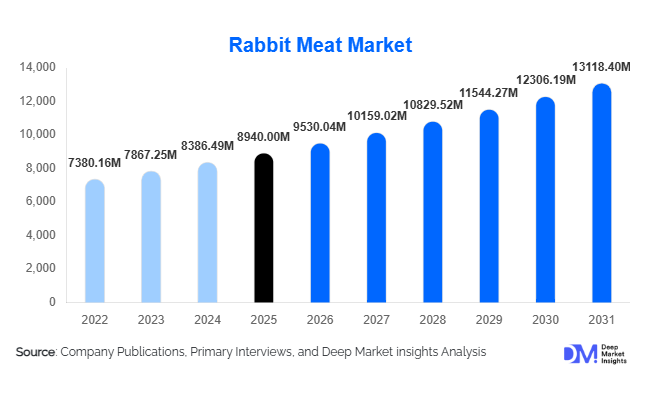
According to Deep Market Insights, the global rabbit meat market size was valued at USD 8,940 million in 2025 and is projected to grow from USD 9,530.04 million in 2026 to reach USD 13,118.40 million by 2031, expanding at a CAGR of 6.6% during the forecast period (2026–2031). The market growth is supported by increasing demand for lean protein alternatives, rising consumer preference for low-fat meats, and expanding commercial rabbit farming across Asia-Pacific and Europe. Rabbit meat is gaining recognition as a nutritionally dense protein source characterized by high digestibility, low cholesterol levels, and favorable feed conversion efficiency compared with traditional livestock.
Globally, the industry is transitioning from small-scale backyard production toward organized commercial farming supported by improved breeding techniques, cold-chain logistics, and export-oriented processing facilities. Growing health consciousness among consumers, particularly in urban markets, is encouraging diversification beyond poultry and red meat consumption. Additionally, culinary diversification and rising demand from gourmet restaurants and specialty meat retailers are expanding consumption bases across developed economies. While Asia-Pacific remains the production hub, Europe continues to lead premium consumption patterns, supported by established culinary traditions. Increasing investments in automated farming systems and sustainable livestock practices are expected to improve productivity and stabilize supply chains, positioning rabbit meat as an emerging niche within the global protein economy.
Key Market Insights
- Asia-Pacific dominates global production, accounting for the majority of farmed rabbit output due to established breeding ecosystems and cost-efficient farming.
- Health-conscious consumers are driving adoption of rabbit meat as a lean, high-protein alternative to beef and pork.
- Processed rabbit meat products are expanding rapidly, particularly in urban retail and foodservice channels.
- Export-oriented European producers are benefiting from premium pricing and specialty meat demand.
- Modern farming technologies, including automated feeding and climate-controlled housing, are improving yield efficiency.
- Foodservice and gourmet dining segments are emerging as key demand accelerators globally.
What are the latest trends in the rabbit meat market?
Shift Toward Commercialized Rabbit Farming
The rabbit meat industry is undergoing structural transformation from fragmented household production toward organized commercial farming operations. Large-scale farms equipped with automated feeding systems, genetic breeding programs, and veterinary monitoring are improving productivity and consistency in meat quality. Countries such as China, Spain, and France are investing heavily in standardized farming practices, enabling exporters to meet international food safety standards. This transition is reducing supply volatility and enabling producers to secure long-term contracts with retailers and foodservice providers. Integration of digital livestock monitoring and precision feeding technologies is further optimizing growth cycles and reducing mortality rates, improving profitability across the value chain.
Premiumization and Specialty Meat Consumption
Consumers in developed markets are increasingly exploring alternative meats aligned with wellness and sustainability goals. Rabbit meat is positioned as a premium specialty protein, particularly within gourmet cuisine and organic meat categories. Retailers are introducing vacuum-packed cuts, marinated products, and ready-to-cook formats to enhance accessibility. Culinary media exposure and chef-driven menus are also contributing to rising consumer awareness. Premium positioning enables producers to achieve higher margins compared to conventional meats, encouraging expansion into branded and value-added product portfolios.
What are the key drivers in the rabbit meat market?
Rising Demand for Lean and Functional Protein Sources
Global dietary trends increasingly favor lean meats with lower fat and cholesterol content. Rabbit meat contains high-quality protein and essential micronutrients while maintaining lower saturated fat levels than beef or lamb. Growing prevalence of lifestyle diseases and consumer awareness regarding nutrition are encouraging adoption among health-focused consumers. Fitness-oriented diets and protein diversification trends are expanding consumption beyond traditional markets.
Improved Feed Conversion and Sustainable Livestock Production
Rabbit farming requires significantly less land, water, and feed compared with conventional livestock. High reproductive rates and efficient feed conversion ratios make rabbit farming economically attractive for producers seeking sustainable protein solutions. Governments promoting climate-friendly agriculture are supporting diversification into smaller livestock species, indirectly boosting industry expansion.
Expansion of Export-Oriented Meat Processing Infrastructure
Processing facilities complying with international hygiene and cold-chain standards are enabling cross-border trade growth. European exporters are increasingly targeting Asian and Middle Eastern markets where protein demand is rising rapidly. Improvements in frozen meat logistics and packaging technologies are extending shelf life, facilitating long-distance exports and stabilizing global supply.
What are the restraints for the global market?
Limited Consumer Awareness in Emerging Markets
Despite nutritional advantages, rabbit meat consumption remains culturally limited in several regions. Consumer unfamiliarity and lack of standardized retail availability restrict demand expansion. Marketing efforts and culinary education remain necessary to broaden acceptance.
Fragmented Supply Chain and Disease Management Risks
Small-scale farming dominance in certain regions results in inconsistent quality and biosecurity challenges. Disease outbreaks can significantly disrupt production volumes. Investments in veterinary infrastructure and standardized farming protocols are required to maintain supply stability.
What are the key opportunities in the rabbit meat industry?
Expansion into Functional and Health-Focused Food Segments
Growing demand for functional foods presents strong opportunities for rabbit meat producers. Positioning rabbit meat as a heart-friendly and high-protein dietary option allows penetration into fitness nutrition markets, medical diets, and elderly nutrition categories. Product innovation such as low-sodium processed meat and protein-rich ready meals could unlock new consumer demographics.
Export Growth in Emerging Protein-Deficit Regions
Rapid population growth and urbanization in the Middle East, Africa, and Southeast Asia are increasing reliance on imported protein sources. Rabbit meat exporters can capitalize on this demand through halal-certified production and frozen product formats. Trade agreements and improved cold-chain logistics are expected to facilitate higher export volumes over the next decade.
Integration of Agri-Tech and Precision Livestock Systems
Technological integration in breeding analytics, automated housing, and feed optimization offers productivity improvements and cost reduction opportunities. Startups developing smart livestock monitoring platforms are enabling farmers to track growth performance and health metrics in real time. Such innovations are expected to improve scalability and attract institutional investment into rabbit farming.
Report Scope
| Report Metric | Details |
|---|---|
| Market Size in 2025 | USD 8940 Million |
| Market Size in 2026 | USD 9530.04 Million |
| Market Size in 2031 | USD 13118.40 Million |
| CAGR | 6.6% (2026-2031) |
| Base Year for Estimation | 2025 |
| Historical Data | 2022-2024 |
| Forecast Period | 2026-2031 |
| Report Coverage | Revenue Forecast, Competitive Landscape, Supply Chain Disruption, Growth Factors, Environment & Regulatory Landscape and Trends |
| Geographies Covered | North America, Europe, APAC, Middle East and Africa, LATAM |
| Countries Covered | U.S., Canada, U.K., Germany, France, Spain, Italy, Russia, Nordic, Benelux, Rest of Europe, China, Korea, Japan, India, Australia, Singapore, Taiwan, South East Asia, Rest of Asia-Pacific, UAE, Turky, Saudi Arabia, South Africa, Egypt, Nigeria, Rest of MEA, Brazil, Mexico, Argentina, Chile, Colombia, Rest of LATAM |
Explore more data points, trends and opportunities Download Free Sample Report
Product Type Insights
The global rabbit meat market is distinctly segmented by product type, with fresh rabbit meat emerging as the dominant category in terms of consumption and market value. Fresh rabbit meat has long been preferred across culinary cultures, particularly in Asia and Europe, where traditional recipes prioritize the use of freshly prepared ingredients. In countries such as China, Spain, and France, fresh rabbit is often the centerpiece of regional delicacies, reflecting deep-rooted gastronomic traditions. The growing appreciation for quality protein sources that offer both taste and nutritional value is further reinforcing this dominance. Moreover, the expansion of local farming initiatives that focus on controlled breeding and farm-to-table distribution models has significantly increased the availability of high-quality fresh rabbit meat, ensuring consistent supply and reinforcing consumer trust.Frozen rabbit meat is witnessing significant adoption within export markets due to its extended shelf life, ease of storage, and logistical flexibility. This segment is increasingly attractive to global traders and exporters seeking to maintain quality during international transit. Frozen meat allows suppliers to reach distant markets without compromising nutritional integrity, making it a viable solution for cross-border trade. The convenience factor offered by frozen rabbit meat also resonates with modern retail environments and e-commerce platforms, where consumers expect ready-to-use protein solutions with minimal handling requirements. Growth in this segment is also fueled by investment in advanced cold chain infrastructure and innovative packaging solutions that prolong shelf life and maintain product quality.Processed rabbit meat products, including sausages, smoked cuts, and ready-to-cook meals, are emerging as one of the fastest-growing categories within the industry. These value-added products cater to urban consumers who prioritize convenience, efficiency, and premium culinary experiences. The surge in processed rabbit meat consumption is closely tied to the rise of busy lifestyles, increasing numbers of dual-income households, and a growing preference for ready-to-eat or easy-to-cook protein options. In addition, processed products allow producers to achieve higher margins while expanding into modern retail channels, including supermarkets and hypermarkets. In regions such as Europe and Asia-Pacific, processed rabbit products are increasingly featured in gourmet menus and premium packaged food offerings, signaling strong consumer acceptance and long-term growth potential.
Application Insights
Household consumption continues to account for the largest application segment for rabbit meat globally. This is largely driven by traditional culinary practices and cultural acceptance, particularly in countries where rabbit has historically been a staple protein. Families prefer fresh or lightly processed meat for home cooking due to its versatility in a wide range of recipes, from stews and roasts to stir-fries and baked dishes. In addition, rising consumer awareness regarding the nutritional benefits of rabbit meat-such as its high protein content, low fat composition, and digestibility-is bolstering its household adoption, particularly among health-conscious populations.The foodservice industry is emerging as a significant growth driver, fueled by the global expansion of restaurants, gourmet bistros, and specialty dining establishments. Chefs in both urban and tourist-centric regions are increasingly experimenting with rabbit-based dishes to offer premium, unique dining experiences. This trend is particularly pronounced in Europe and Asia-Pacific, where culinary innovation and fine dining traditions converge. Moreover, the integration of rabbit meat into restaurant menus supports value-based consumption, positioning the product as a premium protein option that aligns with evolving consumer taste preferences and willingness to pay for high-quality ingredients.Pet food applications represent an emerging niche opportunity, driven by the rising demand for hypoallergenic protein sources for cats and dogs. Rabbit meat is particularly valued for its digestibility, low allergenic potential, and high protein content, making it a preferred ingredient in premium pet food formulations. As pet ownership increases globally, particularly in North America, Europe, and parts of Asia-Pacific, this segment is expected to witness steady growth over the coming decade.
Distribution Channel Insights
The distribution landscape of the global rabbit meat market is evolving to address consumer expectations and regional preferences. Traditional butcher shops and wet markets remain the primary source of rabbit meat in developing economies, where fresh, locally sourced products are highly valued. These channels support strong consumer trust through personalized service, fresh daily supply, and locally sourced products, which are particularly important in countries with deeply ingrained culinary traditions.Modern retail supermarkets are increasingly expanding their rabbit meat offerings, often featuring packaged formats that improve hygiene perception, ease of handling, and product safety. The growth of hypermarkets and retail chains in Europe, Asia-Pacific, and North America is enabling broader consumer access, particularly for processed and frozen meat products. Retailers are leveraging strategic shelf placement, promotional campaigns, and private-label offerings to attract health-conscious and convenience-seeking consumers.Online meat delivery platforms are emerging as one of the fastest-growing distribution channels, offering direct-to-consumer access and premium product positioning. E-commerce has provided producers and retailers with the opportunity to cater to tech-savvy consumers who prefer home delivery, customizable portions, and traceable sourcing. Online platforms are also facilitating international trade, particularly for frozen and processed rabbit meat, by integrating advanced cold-chain logistics and quality assurance protocols.Export distribution through frozen logistics networks remains critical for international trade expansion. Countries such as China, Spain, and Italy leverage advanced refrigerated transport systems to maintain product integrity while accessing distant markets. The integration of global supply chains, cold storage facilities, and compliance with international food safety standards are key enablers of cross-border growth, ensuring rabbit meat meets both quality and regulatory expectations in diverse regions.
End-Use Industry Insights
The foodservice industry represents one of the most dynamic end-use segments for rabbit meat, benefiting from global trends in culinary exploration, restaurant proliferation, and premium dining. Fine dining establishments and European-style cuisine restaurants are leading adoption, driven by consumer demand for novel proteins and elevated dining experiences. This segment is further supported by growing tourism in urban centers and resort destinations, which encourages menu diversification and gourmet offerings.The processed meat industry is integrating rabbit meat into its product portfolios to meet increasing consumer demand for healthier, high-protein processed foods. Rabbit meat is valued for its low fat content, high protein quality, and clean flavor profile, making it suitable for incorporation into sausages, cured meats, and ready-to-eat meals. Manufacturers in Europe and Asia-Pacific are particularly active in this space, leveraging rabbit meat to differentiate products in competitive markets while promoting nutritional value.Export-driven demand for rabbit meat is another key driver, as countries seek to diversify protein sources and ensure sustainable supply. Global importers in the Middle East, Africa, and North America are sourcing rabbit meat from leading producers to satisfy rising protein consumption, specialty meat requirements, and premium market trends. As a result, volume growth in processing and export industries is accelerating, reflecting both rising global demand and the increasing sophistication of supply chains.
Explore more data points, trends and opportunities Download Free Sample Report
Rabbit Meat Market Segmentations
By Product Type
- Whole Rabbit Meat
- Cut Portions
- Processed Rabbit Meat
- Frozen Rabbit Meat
- Organic & Premium Rabbit Meat
By Distribution Channel
- Foodservice & HoReCa Supply
- Modern Retail & Supermarkets
- Online Meat Delivery Platforms
- Specialty Butchers & Direct Farm Sales
By End Use
- Household Consumption
- Restaurants & Hospitality Industry
- Food Processing & Packaged Meat Industry
- Export & Institutional Buyers
By Processing Type
- Fresh/Chilled Rabbit Meat
- Frozen Processed Meat
- Value-Added Ready-to-Cook Products
By Farming Type
- Commercial Intensive Farming
- Smallholder & Backyard Farming
- Organic & Free-Range Farming
Regional Insights
Asia-Pacific
Asia-Pacific dominates the global rabbit meat market, accounting for approximately 56% of the global share in 2025. China is the clear leader, driving both production and consumption, underpinned by large-scale commercial farming, government support, and strong domestic demand. The region benefits from favorable climatic conditions, low labor costs, and a cultural preference for rabbit meat, which is considered a high-quality protein in many local cuisines. Rising urbanization, disposable incomes, and health awareness are further fueling consumption of fresh and processed rabbit meat. Additionally, emerging markets like Vietnam and Indonesia are experiencing rapid growth, supported by rising per capita protein intake, expanding middle-class populations, and government initiatives to diversify livestock production. Export potential is increasing, particularly for frozen and processed products, with regional producers investing in cold-chain infrastructure and international compliance certifications to access global markets.
Europe
Europe accounts for nearly 24% of the global rabbit meat market, driven by traditional consumption patterns in Spain, France, and Italy. Spain remains the largest producer and exporter within the region, benefiting from integrated farming cooperatives, advanced production practices, and strong international demand. Gourmet culinary demand, premium pricing, and the popularity of rabbit-based dishes in both domestic and restaurant markets sustain steady growth. Eastern European countries are expanding production capacity to tap export markets, supported by EU agricultural development programs, subsidies for modernized farming techniques, and increasing interest in specialty meat products. Rising awareness regarding animal welfare, traceable sourcing, and quality certifications further bolster market confidence, enabling the processed and frozen segments to grow alongside fresh meat demand.
North America
North America represents a smaller but steadily growing share of the global rabbit meat market. Demand in the United States and Canada is increasingly driven by niche consumer segments seeking organic, free-range, and farm-to-table meat products. Specialty meat retailers, gourmet restaurants, and health-focused food markets are fueling growth, while consumer campaigns emphasizing rabbit meat’s high protein, low fat, and hypoallergenic properties are gradually increasing adoption. Urban centers with a focus on alternative proteins and premium dining experiences are key growth hubs, and the expansion of online meat delivery platforms is accelerating accessibility for high-value products. Investment in domestic farming and awareness of sustainable protein sources is also contributing to market expansion.
Latin America
Latin America is emerging as an important growth region for rabbit meat, with Brazil and Mexico leading the market. Small-scale farming expansion, government agricultural diversification initiatives, and rural development programs are driving adoption. Rabbit farming is increasingly promoted as a low-investment, high-yield livestock alternative for income generation in rural areas. Growing urbanization, rising disposable income, and increasing awareness of alternative proteins are supporting demand in metropolitan markets. Additionally, efforts to standardize production practices, improve food safety, and integrate cold chain logistics are enabling regional producers to expand into processed and frozen rabbit meat segments, opening opportunities for both domestic and international markets.
Middle East & Africa
The Middle East & Africa is the fastest-growing region in the global rabbit meat market, projected to grow above 7.5% CAGR through 2031. Countries such as Egypt, Morocco, and the UAE are driving growth due to increasing protein consumption, limited domestic livestock production, and rising import dependence. Urbanization, dietary diversification, and higher disposable incomes are fueling consumer acceptance of premium proteins, while the hospitality and foodservice sectors are increasingly integrating rabbit meat into menus to cater to gourmet tastes. Investments in cold-chain infrastructure, import logistics, and partnerships with international suppliers are enhancing market accessibility. Additionally, government programs promoting sustainable agriculture and livestock alternatives are creating favorable conditions for small and medium-scale rabbit farming operations, supporting both local production and export-oriented growth.
Key Players in the Rabbit Meat Market
- Grupo Hermi
- Cunicarn
- Friselva SA
- Copreci Agroalimentaria
- PinoyRabbit Meat Corporation
- Qingdao Kangda Food Co., Ltd.
- Leporinus SAS
- Rabbitmart Ltd.
- Pel-Freez LLC
- De Jong Rabbit Meat
- Lapin de France
- Holland Rabbit BV
- Avinyó Group
- Flandrex NV
- WRSA (World Rabbit Science Association affiliated producers)