Protein Shakes Market Size
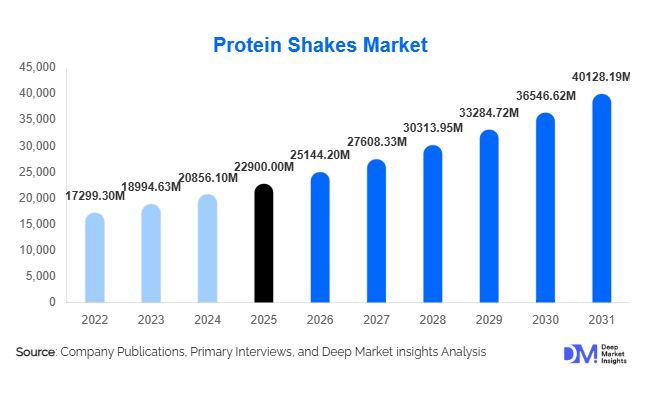
According to Deep Market Insights, the global protein shakes market size was valued at USD 22,900 million in 2025 and is projected to grow from USD 25,144.20 million in 2026 to reach USD 40,128.19 million by 2031, expanding at a CAGR of 9.8% during the forecast period (2026–2031). The protein shakes market growth is primarily driven by increasing health consciousness, rising adoption of fitness-oriented lifestyles, and growing demand for convenient, on-the-go nutrition solutions. The evolution of protein shakes from niche sports supplements to mainstream dietary products has significantly broadened their consumer base across multiple demographics, including working professionals, elderly individuals, and wellness-focused consumers.
Key Market Insights
- Ready-to-drink (RTD) protein shakes are gaining strong traction globally, driven by convenience and increasing demand for portable nutrition formats.
- Plant-based protein shakes are rapidly expanding, supported by vegan diets, lactose intolerance, and sustainability concerns.
- North America dominates the global market, with strong consumption across fitness, lifestyle, and clinical nutrition segments.
- Asia-Pacific is the fastest-growing region, fueled by rising disposable incomes and increasing awareness of protein consumption.
- Digital channels and direct-to-consumer models are reshaping distribution, offering higher margins and improved customer engagement.
- Innovation in flavors, formulations, and functional ingredients is enhancing product differentiation and premiumization.
What are the latest trends in the protein shakes market?
Rise of Plant-Based and Clean-Label Nutrition
The protein shakes market is witnessing a strong shift toward plant-based and clean-label products. Consumers are increasingly prioritizing transparency, natural ingredients, and sustainability in their dietary choices. This has led to a surge in demand for protein shakes derived from sources such as pea, soy, and rice protein. Manufacturers are focusing on improving taste profiles and texture while eliminating artificial additives, preservatives, and allergens. Clean-label positioning is becoming a key differentiator, particularly in premium segments, where consumers are willing to pay higher prices for healthier and ethically sourced products.
Functional and Personalized Nutrition Integration
Protein shakes are evolving into multifunctional nutritional products with added health benefits. Companies are incorporating ingredients such as probiotics, vitamins, minerals, and adaptogens to cater to specific health goals like immunity, gut health, and mental wellness. Personalized nutrition is also gaining traction, with brands leveraging digital tools and data analytics to offer tailored protein solutions. Subscription-based models and customized formulations are enabling deeper consumer engagement and creating new revenue streams within the market.
What are the key drivers in the protein shakes market?
Growing Fitness and Active Lifestyle Adoption
The global rise in fitness awareness and active lifestyles is a primary driver of protein shake consumption. Increasing gym memberships, sports participation, and social media influence have significantly boosted demand for protein-rich dietary supplements. Consumers are increasingly incorporating protein shakes into their daily routines for muscle recovery, performance enhancement, and overall wellness. This trend is particularly strong among younger demographics and urban populations.
Convenience-Driven Consumption Patterns
Modern consumers are seeking quick and convenient nutrition options, driving demand for ready-to-consume protein shakes. RTD formats eliminate preparation time and offer consistent quality, making them ideal for busy professionals and on-the-go consumption. The growing preference for meal replacement solutions is further supporting this trend, particularly in urban markets where time constraints influence dietary habits.
What are the restraints for the global market?
High Cost of Premium Protein Products
The relatively high cost of protein shakes, especially premium and plant-based variants, remains a significant barrier to widespread adoption. Price sensitivity in emerging markets limits accessibility for mass consumers, restricting market penetration. The premium pricing of functional and clean-label products further adds to this challenge.
Volatility in Raw Material Prices
Fluctuations in the prices of key raw materials such as whey and plant proteins can impact production costs and profit margins. Supply chain disruptions, agricultural dependencies, and global trade dynamics contribute to price instability, creating challenges for manufacturers in maintaining competitive pricing.
What are the key opportunities in the protein shakes industry?
Expansion in Emerging Markets
Emerging economies, particularly in Asia-Pacific and the Middle East, present significant growth opportunities. Rising disposable incomes, urbanization, and increasing health awareness are driving demand for protein shakes in countries such as India and China. Companies can capitalize on this trend by offering affordable and localized products tailored to regional preferences.
Integration of Functional Ingredients
The incorporation of functional ingredients such as vitamins, minerals, and probiotics into protein shakes is creating new product categories and expanding consumer appeal. These value-added formulations cater to specific health needs, enabling premium pricing and differentiation in a competitive market.
Report Scope
| Report Metric | Details |
|---|---|
| Market Size in 2025 | USD 22900 Million |
| Market Size in 2026 | USD 25144.20 Million |
| Market Size in 2031 | USD 40128.19 Million |
| CAGR | 9.8% (2026-2031) |
| Base Year for Estimation | 2025 |
| Historical Data | 2022-2024 |
| Forecast Period | 2026-2031 |
| Report Coverage | Revenue Forecast, Competitive Landscape, Supply Chain Disruption, Growth Factors, Environment & Regulatory Landscape and Trends |
| Geographies Covered | North America, Europe, APAC, Middle East and Africa, LATAM |
| Countries Covered | U.S., Canada, U.K., Germany, France, Spain, Italy, Russia, Nordic, Benelux, Rest of Europe, China, Korea, Japan, India, Australia, Singapore, Taiwan, South East Asia, Rest of Asia-Pacific, UAE, Turky, Saudi Arabia, South Africa, Egypt, Nigeria, Rest of MEA, Brazil, Mexico, Argentina, Chile, Colombia, Rest of LATAM |
Explore more data points, trends and opportunities Download Free Sample Report
Product Type Insights
The protein shakes market is characterized by a diverse product portfolio, with ready-to-drink (RTD) protein shakes emerging as the dominant segment, accounting for approximately 42% of the global market share in 2025. The leading position of RTD protein shakes is primarily driven by the increasing demand for convenience-oriented nutrition solutions among busy urban populations. Consumers are increasingly seeking products that require minimal preparation time while delivering consistent taste, nutritional balance, and portability. The growing prevalence of on-the-go consumption patterns, especially among working professionals and millennials, has significantly boosted the adoption of RTD products. Furthermore, advancements in packaging technologies, including aseptic packaging and extended shelf-life solutions, have enhanced product accessibility and distribution across retail and e-commerce platforms, further reinforcing the segment’s dominance.Smoothie blends are emerging as a niche yet rapidly growing segment within the protein shakes market. These products are increasingly positioned as premium, health-focused offerings enriched with functional ingredients such as fruits, vegetables, fibers, probiotics, and superfoods. The rising consumer inclination toward holistic wellness and clean-label nutrition is supporting the adoption of smoothie-based protein shakes. Additionally, the integration of functional benefits such as immunity support, digestive health, and energy enhancement is enabling manufacturers to differentiate their products in a highly competitive market landscape. As consumer awareness of nutritional quality continues to grow, smoothie blends are expected to gain further traction, particularly among health-conscious and premium-seeking consumers.
Application Insights
In terms of application, muscle gain and sports nutrition dominate the protein shakes market, contributing nearly 45% of the total demand. The leading position of this segment is primarily driven by the global surge in fitness participation, increased gym memberships, and the rising popularity of strength training and endurance sports. Consumers are increasingly incorporating protein shakes into their post-workout routines to support muscle recovery, enhance performance, and improve overall physical fitness. The influence of social media, fitness influencers, and professional athletes has also played a crucial role in promoting protein supplementation as an essential component of modern fitness lifestyles.Weight management and meal replacement applications are witnessing significant growth, supported by the increasing prevalence of obesity and lifestyle-related health conditions across both developed and developing regions. Protein shakes are widely recognized for their ability to promote satiety, reduce calorie intake, and support metabolic health, making them an attractive option for individuals seeking effective weight management solutions. The rising adoption of structured diet plans, including low-carb and high-protein diets, is further contributing to the expansion of this segment. Additionally, the convenience and portion control offered by protein shakes make them an ideal meal replacement option for time-constrained consumers.Clinical nutrition is emerging as a high-growth application segment, driven by the increasing prevalence of chronic diseases, aging populations, and rising demand for medical nutrition products. Protein shakes are being utilized in clinical settings to support patient recovery, manage malnutrition, and provide essential nutrients to individuals with specific dietary needs. The development of specialized formulations targeting conditions such as diabetes, sarcopenia, and gastrointestinal disorders is further expanding the scope of protein shakes in the healthcare sector. As healthcare systems increasingly emphasize nutritional intervention, the clinical nutrition segment is expected to experience robust growth over the forecast period.
Distribution Channel Insights
Supermarkets and hypermarkets currently hold the largest share of the protein shakes market, accounting for around 35% of the total market. The dominance of this distribution channel is attributed to its extensive retail network, wide product assortment, and the ability to offer consumers a hands-on shopping experience. These retail outlets provide a platform for brands to showcase diverse product ranges, enabling consumers to compare different options in terms of price, flavor, and nutritional content. Additionally, strategic product placement, promotional campaigns, and in-store sampling initiatives contribute to higher consumer engagement and purchase conversion rates.Direct-to-consumer (DTC) channels are gaining significant traction as brands increasingly focus on building stronger relationships with their customers while improving profit margins. Through dedicated websites and mobile applications, companies are able to offer personalized nutrition plans, subscription services, and exclusive product launches. This approach enables brands to gather valuable consumer data, enhance customer loyalty, and tailor their offerings to meet evolving consumer preferences. As digital transformation continues to reshape the retail landscape, DTC channels are expected to play a crucial role in the future growth of the protein shakes market.
Consumer Group Insights
Fitness enthusiasts represent the largest consumer group in the protein shakes market, contributing approximately 40% of the total market share. The dominance of this segment is driven by the increasing adoption of active lifestyles, growing awareness of protein’s role in muscle development, and the widespread availability of fitness facilities. Regular gym-goers, recreational athletes, and lifestyle users are incorporating protein shakes into their daily routines to support performance, recovery, and overall health. The influence of fitness trends and digital health platforms has further amplified demand within this segment.Pediatric and teenage consumption is also gaining momentum, supported by rising parental focus on nutrition, growth, and immunity. Manufacturers are introducing flavored, fortified, and age-specific formulations to cater to younger consumers, thereby expanding the market’s demographic reach. This trend is further reinforced by increasing awareness of childhood nutrition and the role of protein in physical and cognitive development.
Explore more data points, trends and opportunities Download Free Sample Report
Protein Shakes Market Segmentations
By Product Type
- Ready-to-Drink (RTD) Protein Shakes
- Protein Shake Powders
- Protein Smoothie Blends
By Protein Source
- Animal-Based Protein
- Plant-Based Protein
By Application
- Muscle Gain & Sports Nutrition
- Weight Management & Meal Replacement
- General Wellness & Nutrition
- Clinical & Medical Nutrition
By Distribution Channel
- Supermarkets & Hypermarkets
- Specialty Nutrition Stores
- Pharmacies & Drugstores
- Online Retail
- Direct-to-Consumer (D2C)
Regional Insights
North America
North America dominates the global protein shakes market, accounting for approximately 38% of the market share in 2025. The region’s leadership is primarily driven by the strong presence of health-conscious consumers, a well-established fitness culture, and advanced retail infrastructure. The United States remains the largest contributor, supported by high disposable incomes and widespread adoption of dietary supplements. The presence of leading market players and continuous innovation in product formulations, including plant-based and functional protein shakes, further strengthens market growth.Key drivers for regional growth include the increasing prevalence of obesity and lifestyle-related diseases, which is encouraging consumers to adopt healthier dietary habits. The growing popularity of high-protein diets, such as ketogenic and low-carb regimens, is also boosting demand. Additionally, the expansion of e-commerce platforms and subscription-based nutrition services is enhancing product accessibility. The rising influence of fitness influencers and digital health platforms is further shaping consumer behavior, making protein shakes an integral part of daily nutrition in North America.
Europe
Europe holds around 27% of the global protein shakes market share, with key markets including Germany, the United Kingdom, and France. The region is characterized by a strong preference for high-quality, clean-label, and sustainably sourced products. Increasing adoption of plant-based diets is a major factor driving demand, particularly among environmentally conscious consumers.Regional growth is supported by stringent regulatory standards that ensure product quality and safety, thereby enhancing consumer trust. The rising demand for functional foods and beverages, coupled with growing awareness of preventive healthcare, is further contributing to market expansion. Additionally, the increasing popularity of vegan and flexitarian lifestyles is driving innovation in plant-based protein formulations. The expansion of specialty health stores and online retail channels is also improving product availability across the region.
Asia-Pacific
Asia-Pacific accounts for approximately 22% of the global market and is the fastest-growing region, with a projected CAGR exceeding 11% during the forecast period. Rapid urbanization, rising disposable incomes, and increasing health awareness are key factors driving market growth in this region. China and India are the primary growth engines, supported by large population bases and expanding middle-class segments.Key regional drivers include the growing adoption of Western dietary habits, increasing participation in fitness activities, and the expansion of gym and wellness infrastructure. Government initiatives promoting health and nutrition are also playing a crucial role in raising awareness about protein consumption. Additionally, the rapid growth of e-commerce platforms and digital payment systems is facilitating easy access to protein shakes, particularly in urban areas. The increasing demand for affordable and locally produced protein products is further shaping market dynamics in Asia-Pacific.
Latin America
Latin America contributes approximately 6% of the global protein shakes market, with Brazil and Mexico serving as key markets. The region is experiencing steady growth, driven by rising interest in sports nutrition and increasing health awareness among consumers.Regional growth is supported by the expansion of the middle-class population and improving economic conditions, which are enhancing purchasing power. The growing popularity of fitness centers and organized sports activities is also contributing to increased demand for protein supplements. However, price sensitivity remains a key challenge, influencing consumer purchasing decisions. To address this, manufacturers are focusing on offering cost-effective products and smaller packaging formats. The gradual expansion of retail networks and online platforms is further supporting market growth in the region.
Middle East & Africa
The Middle East & Africa region accounts for approximately 7% of the global market share, with key markets including the UAE and Saudi Arabia. The region is witnessing increasing demand for protein shakes, driven by high disposable incomes, urbanization, and a growing focus on health and fitness.Key growth drivers include the rising prevalence of lifestyle-related diseases, which is encouraging consumers to adopt healthier dietary habits. The expansion of fitness centers, sports clubs, and wellness initiatives is further supporting market growth. In addition, the influence of Western dietary trends and the increasing availability of international brands are shaping consumer preferences. In Africa, gradual urbanization, improving economic conditions, and increasing awareness of nutritional products are contributing to market expansion. While the market is still in a developing stage, significant growth opportunities exist as awareness and accessibility continue to improve across the region.