Global Popsicle Market Size
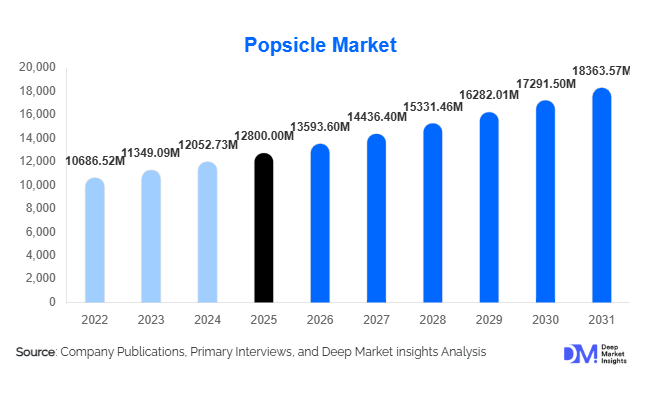
According to Deep Market Insights, the global popsicle market size was valued at USD 12,800 million in 2026 and is projected to grow from USD 13,593.60 million in 2027 to reach USD 18,363.57 million by 2031, expanding at a CAGR of 6.2% during the forecast period (2026–2031). The market growth is primarily driven by rising demand for convenient frozen snacks, increasing product innovation in health-focused and functional popsicles, and expanding penetration of organized retail and cold-chain infrastructure across emerging economies.
Key Market Insights
- Water-based popsicles dominate global consumption due to affordability, wide flavor adaptability, and strong penetration in mass retail channels.
- Health-focused innovation is reshaping the market, with rising demand for sugar-free, vitamin-enriched, and plant-based popsicles.
- Asia-Pacific leads global demand, supported by large youth populations, hot climates, and rapid retail expansion.
- North America remains a high-value premium market, driven by branded frozen desserts and strong per capita consumption.
- E-commerce and quick-commerce platforms are accelerating impulse purchases, especially in urban centers.
- Product premiumization is expanding adult consumption, shifting popsicles from seasonal treats to year-round snacks.
What are the latest trends in the Global Popsicle Market?
Functional and Health-Oriented Popsicles
The market is witnessing a strong shift toward functional popsicles enriched with vitamins, probiotics, protein, and natural sweeteners. These products are being positioned as healthy snacking alternatives rather than indulgent desserts. Manufacturers are investing heavily in clean-label formulations and plant-based ingredients to attract health-conscious consumers. This trend is particularly strong among millennials and urban populations, where wellness-driven consumption is rising. Functional popsicles are also gaining traction in fitness and dietary segments, further expanding their consumer base beyond traditional children’s snacks.
Premiumization and Flavor Innovation
Flavor diversification is a key trend, with manufacturers introducing exotic, tropical, and dessert-inspired variants such as mango-chili, matcha, and cheesecake popsicles. Premium popsicles made with natural fruit extracts and artisanal recipes are gaining popularity in developed markets. This premiumization trend is helping brands increase margins and expand into adult indulgence categories. Limited-edition seasonal flavors and celebrity collaborations are also being used as marketing strategies to drive impulse purchases and brand differentiation.
What are the key drivers in the popsicle market?
Rising Demand for Convenient Frozen Snacks
Urbanization and busy lifestyles are significantly increasing demand for ready-to-eat frozen desserts. Popsicles, being affordable, portable, and portion-controlled, are becoming a preferred snacking option across age groups. Their strong presence in supermarkets and convenience stores further boosts impulse purchases, particularly in warm climates and densely populated cities.
Retail Expansion and Cold Chain Development
The expansion of supermarkets, hypermarkets, and convenience stores is improving product accessibility. At the same time, investments in cold-chain logistics are enabling deeper penetration into semi-urban and rural markets. Emerging economies are witnessing rapid infrastructure development, which is directly supporting frozen dessert consumption growth.
Product Innovation and Branding Strategies
Continuous innovation in flavors, packaging, and health positioning is driving consumer interest. Strong branding, especially through character licensing and seasonal campaigns, is significantly influencing children’s consumption. Digital marketing and influencer-led promotions are further strengthening product visibility among younger demographics.
What are the restraints for the global market?
Seasonality of Demand
Despite increasing year-round consumption, popsicle sales remain highly seasonal in many regions. Demand peaks during summer months, leading to uneven revenue distribution for manufacturers and retailers. This seasonality poses challenges for inventory planning and production optimization.
High Cold Chain and Storage Costs
Popsicles require strict temperature-controlled storage and transportation, making logistics cost-intensive. Smaller players often struggle with infrastructure requirements, limiting their scalability in emerging markets. Energy costs and refrigeration maintenance further add to operational expenses.
What are the key opportunities in the popsicle industry?
Expansion in Emerging Markets
Rapid urbanization, rising disposable incomes, and growing exposure to global food trends are driving strong demand in countries such as India, Indonesia, Brazil, and Mexico. These markets offer significant untapped potential due to expanding modern retail and increasing youth populations. Localized flavor innovation tailored to regional tastes presents a major opportunity for market penetration.
E-commerce and Quick-Commerce Growth
The rise of online grocery platforms and quick-commerce delivery services is transforming frozen dessert distribution. Consumers in urban areas increasingly prefer doorstep delivery of frozen snacks. This channel allows brands to reduce dependence on traditional retail while improving margins and customer reach through subscription-based and direct-to-consumer models.
Report Scope
| Report Metric | Details |
|---|---|
| Market Size in 2025 | USD 12800.00 Million |
| Market Size in 2026 | USD 13593.60 Million |
| Market Size in 2031 | USD 18363.57 Million |
| CAGR | 6.2% (2026-2031) |
| Base Year for Estimation | 2025 |
| Historical Data | 2022-2024 |
| Forecast Period | 2026-2031 |
| Report Coverage | Revenue Forecast, Competitive Landscape, Supply Chain Disruption, Growth Factors, Environment & Regulatory Landscape and Trends |
| Geographies Covered | North America, Europe, APAC, Middle East and Africa, LATAM |
| Countries Covered | U.S., Canada, U.K., Germany, France, Spain, Italy, Russia, Nordic, Benelux, Rest of Europe, China, Korea, Japan, India, Australia, Singapore, Taiwan, South East Asia, Rest of Asia-Pacific, UAE, Turky, Saudi Arabia, South Africa, Egypt, Nigeria, Rest of MEA, Brazil, Mexico, Argentina, Chile, Colombia, Rest of LATAM |
Explore more data points, trends and opportunities Download Free Sample Report
Product Type Insights
The global popsicle market is witnessing strong diversification across product categories as consumer preferences continue to evolve toward affordability, indulgence, health consciousness, and premium experiences. Among all product categories, water-based popsicles continue to dominate the market and account for approximately 45% of the global market share in 2025. The strong leadership of this segment is primarily attributed to its low production cost, mass-market affordability, wide flavor availability, and strong consumer penetration across both developed and emerging economies. Water-based popsicles remain highly popular among children and price-sensitive consumers due to their refreshing taste profile and accessibility through supermarkets, convenience stores, local kiosks, and street retail formats. In tropical and high-temperature countries, especially across Asia-Pacific and Latin America, demand for water-based popsicles continues to rise because consumers seek inexpensive and convenient cooling snacks during extended summer seasons. Manufacturers are also continuously introducing innovative fruit flavors, colorful packaging, and limited-edition seasonal variants to maintain consumer engagement and strengthen repeat purchases.Fruit-based popsicles represent approximately 20% of the market share and are increasingly benefiting from the growing global shift toward clean-label and natural food consumption. Consumers are actively seeking products containing real fruit extracts, natural sweeteners, and reduced artificial additives, which has significantly improved the market position of fruit-based frozen snacks. The segment is particularly popular among millennials and health-conscious families that prefer minimally processed products with perceived nutritional benefits. Rising awareness regarding artificial colorants and preservatives has encouraged manufacturers to invest in organic fruit concentrates, tropical fruit blends, and vitamin-enriched formulations. Demand for fruit-based popsicles is also expanding rapidly in urban markets where premium frozen desserts are gaining visibility through specialty stores and digital grocery platforms. The popularity of exotic fruit flavors such as mango, passion fruit, berry mixes, kiwi, and dragon fruit is contributing to product innovation and higher consumer spending across premium categories.Alcohol-infused and novelty popsicles continue to remain relatively niche categories within the global market; however, they are experiencing notable growth in premium urban markets and tourism-driven economies. These products are increasingly popular among adult consumers seeking experiential and innovative dessert options. Premium bars, beach resorts, hospitality venues, and gourmet dessert retailers are introducing cocktail-inspired frozen products featuring flavors such as mojito, margarita, champagne berry, and tropical rum combinations. Novelty popsicles featuring layered textures, edible decorations, premium chocolate coatings, and unique shapes are also gaining popularity across social media-driven consumer segments. Although the segment currently represents a smaller portion of overall market revenue, strong premium pricing strategies and increasing demand for luxury dessert experiences are expected to support long-term growth potential.
Application Insights
Retail consumption remains the dominant application segment within the global popsicle market and continues to account for the majority of global demand. The leadership of the retail segment is largely driven by the widespread availability of popsicles through supermarkets, hypermarkets, convenience stores, grocery chains, and independent retail outlets. Consumers increasingly prefer ready-to-consume frozen snacks that are affordable, portable, and suitable for impulse purchases. Strong demand from households with children, combined with increasing urbanization and rising penetration of modern retail infrastructure, continues to strengthen the position of retail consumption globally. Seasonal demand spikes during summer months further support high retail sales volumes, particularly in densely populated urban markets.The health and wellness sector is creating new opportunities for specialized functional popsicle applications. Nutritional frozen products targeted toward athletes, gym consumers, and wellness-focused individuals are gaining visibility in fitness centers, wellness stores, and specialty nutrition channels. Functional products containing protein, hydration electrolytes, vitamins, and immunity-supporting ingredients are becoming increasingly popular as consumers seek healthier alternatives to traditional sugary snacks. Additionally, recovery-oriented frozen products designed for sports nutrition and post-workout consumption are expanding the application scope of popsicles beyond conventional dessert consumption.Premium artisanal popsicles are also gaining significant traction within gourmet dessert markets. Consumers are increasingly willing to spend on handcrafted frozen desserts made with natural ingredients, imported fruits, organic dairy, and innovative flavor combinations. Artisanal dessert brands are leveraging premium packaging, limited-edition offerings, and local ingredient sourcing to position popsicles as upscale indulgent products rather than low-cost snacks. This transition toward premium dessert positioning is particularly visible in metropolitan cities across North America, Europe, and Asia-Pacific.
Distribution Channel Insights
Supermarkets and hypermarkets continue to dominate the distribution landscape of the global popsicle market due to their extensive product visibility, large consumer footfall, and strong impulse purchasing behavior. These retail channels provide consumers with access to a broad variety of product categories, including economy, premium, organic, and functional popsicle products under one location. Strategic freezer placement, promotional campaigns, and seasonal discounts significantly contribute to higher sales volumes across supermarket chains. In developed economies, organized retail infrastructure continues to strengthen product penetration, while emerging economies are witnessing rapid expansion of modern grocery retail networks that support frozen food distribution.Specialty dessert stores and foodservice outlets continue to play a crucial role in driving premium segment sales. Artisanal dessert boutiques and gourmet frozen treat brands are focusing on experiential retail concepts that emphasize customization, handcrafted preparation, and premium ingredient quality. Consumers visiting specialty outlets are often willing to pay premium prices for unique flavors and aesthetic presentation. These channels are especially important for emerging premium brands seeking differentiation from mass-market competitors.Direct-to-consumer digital platforms are emerging as an increasingly strategic sales channel for both established companies and startup brands. Manufacturers are using digital platforms to strengthen brand loyalty, collect consumer preference data, launch limited-edition products, and improve profit margins by reducing intermediary costs. Subscription-based frozen dessert delivery models and customized flavor selections are also becoming more common in urban premium markets. As digital commerce ecosystems continue to mature globally, direct online engagement is expected to become a critical growth strategy for frozen dessert manufacturers.
Consumer Segment Insights
Children continue to represent the largest consumer segment in the global popsicle market, primarily driven by strong product affordability, colorful branding strategies, flavor variety, and widespread retail accessibility. Manufacturers heavily target younger demographics through cartoon-themed packaging, promotional campaigns, licensed entertainment partnerships, and seasonal product launches. Popsicles remain one of the most affordable frozen snack options for families, which supports consistently high consumption volumes among children across both developed and developing economies. School environments, recreational activities, and family-oriented retail purchases continue to reinforce demand within this segment.Health-conscious consumers are significantly influencing product innovation across the industry. Growing awareness regarding sugar intake, artificial additives, obesity, and overall nutritional wellness is driving demand for low-sugar, organic, plant-based, and functional frozen snacks. Consumers are increasingly reading ingredient labels and preferring products with clean-label claims, natural fruit content, and fortified nutritional benefits. This shift in purchasing behavior is encouraging companies to invest heavily in research and development focused on healthier product formulations.Institutional buyers, including schools, hospitals, corporate cafeterias, event organizers, and catering companies, also contribute significantly to stable market demand. Bulk purchasing agreements and recurring supply contracts help manufacturers maintain steady sales volumes throughout the year. In warmer regions, institutional demand for affordable frozen snacks remains particularly strong due to high daily consumption requirements and cost-effective product positioning.
Explore more data points, trends and opportunities Download Free Sample Report
Popsicle Market Segmentations
By Product Type
- Water-based Popsicles
- Dairy-based Popsicles
- Fruit-based Popsicles
- Functional & Fortified Popsicles
- Sugar-free / Low-calorie Popsicles
- Alcohol-infused Popsicles
- Novelty / Licensed Character Popsicles
By Flavor Type
- Fruit-flavored
- Citrus-based
- Chocolate & Cocoa-based
- Tropical Flavors
- Mixed / Hybrid Flavors
- Exotic & Seasonal Flavors
By Distribution Channel
- Supermarkets & Hypermarkets
- Convenience Stores
- Online Retail / E-commerce
- Specialty Dessert Stores
- Foodservice
- Vending & Institutional Channels
By Consumer Type
- Children
- Adults
- Health-conscious Consumers
- Institutional Buyers
Regional Insights
Asia-Pacific
Asia-Pacific dominates the global popsicle market and accounts for approximately 38% of the global market share in 2025. The region’s leadership is supported by its massive population base, long summer seasons, rising disposable incomes, and rapidly expanding urban retail infrastructure. China and India remain the primary growth engines due to increasing demand for affordable frozen snacks and rising urban consumption patterns. Rapid urbanization has significantly increased the penetration of supermarkets, convenience stores, and quick-commerce platforms, improving frozen product accessibility across metropolitan and semi-urban areas.The region also benefits from favorable climatic conditions that support year-round demand for refreshing frozen products. Rising middle-class populations, increasing youth demographics, and growing consumer spending on convenience foods are further accelerating market growth. In addition, strong expansion of cold-chain logistics and digital grocery delivery services is improving distribution efficiency across densely populated cities. Manufacturers are increasingly launching localized flavors inspired by regional fruits and traditional desserts to strengthen consumer engagement. The rising popularity of health-conscious and fruit-based popsicles among urban consumers is also supporting premium market growth across Asia-Pacific.
North America
North America accounts for nearly 30% of the global market share, with the United States representing the largest regional market. High per capita consumption of frozen desserts, strong brand penetration, and widespread retail availability continue to support regional market leadership. Consumers in North America increasingly prefer premium and functional frozen snacks that offer indulgence alongside nutritional benefits. This has encouraged manufacturers to introduce organic, low-sugar, dairy-free, and protein-enriched product formulations.The region benefits from highly developed cold-chain infrastructure, advanced retail systems, and strong consumer willingness to experiment with innovative flavors and premium dessert formats. Growing demand for artisanal and gourmet frozen desserts is also contributing significantly to market expansion, particularly among millennials and urban consumers. Canada continues to support regional growth through increasing preference for organic and health-oriented frozen snacks. The strong influence of wellness trends, coupled with rising demand for clean-label products, is expected to further strengthen innovation across the North American popsicle industry.
Europe
Europe holds approximately 22% of the global popsicle market share, led by Germany, the United Kingdom, and France. Consumer demand in the region is increasingly shifting toward organic, low-sugar, and environmentally sustainable frozen products. Strict food safety regulations and strong awareness regarding nutritional transparency are encouraging manufacturers to adopt cleaner ingredient profiles and sustainable packaging solutions.The region’s mature retail infrastructure and growing premium dessert culture continue to support demand for artisanal and gourmet popsicles. European consumers are increasingly attracted to natural fruit flavors, vegan alternatives, and dairy-free frozen desserts aligned with plant-based dietary trends. Rising environmental awareness is also driving investments in recyclable packaging materials and ethically sourced ingredients. Tourism-driven consumption across Southern European countries further contributes to seasonal demand growth, particularly during peak summer months.
Latin America
Latin America accounts for approximately 7% of the global market share, with Brazil and Mexico representing the leading regional markets. The region benefits from consistently warm climatic conditions and a strong cultural preference for frozen desserts and fruit-based snacks. Affordable water-based and fruit-based popsicles remain highly popular among mass-market consumers due to their accessibility and refreshing taste profiles.Increasing urbanization, expansion of modern retail channels, and growing youth populations are supporting regional market growth. Local manufacturers are introducing tropical fruit flavors and culturally inspired frozen products to strengthen consumer appeal. Rising tourism activity across beach destinations and hospitality centers is also contributing to higher seasonal demand for frozen treats. Additionally, improving cold-chain distribution networks are helping manufacturers expand product penetration into smaller cities and semi-urban markets.
Middle East & Africa
The Middle East & Africa region currently accounts for nearly 3% of the global popsicle market share, but the market is experiencing steady growth due to extreme climatic conditions, rising urbanization, and improving retail infrastructure. GCC countries, including Saudi Arabia and the UAE, are emerging as important growth centers due to increasing consumer spending on convenience foods and premium desserts.Tourism and hospitality sectors play a significant role in supporting frozen dessert consumption across the region, particularly in luxury hotels, resorts, entertainment venues, and shopping destinations. Rapid expansion of supermarkets, hypermarkets, and convenience retail chains is improving product accessibility for consumers. In Africa, rising youth populations and growing penetration of affordable frozen snacks are supporting long-term market expansion opportunities. The increasing availability of modern refrigeration infrastructure and cold-chain logistics is also expected to strengthen regional market development over the forecast period.
Key Players in the Global Popsicle Market
- Unilever
- Nestlé
- Froneri
- Lotte Confectionery
- Wells Enterprises
- General Mills
- Mars
- Ferrero Group
- Blue Bell Creameries
- Dreyer’s Grand Ice Cream
- Meiji Holdings
- Yili Group
- Morinaga Milk Industry
- Amul (GCMMF)
- Turkey-based Golf Ice Cream