Ping Pong Table Market Size
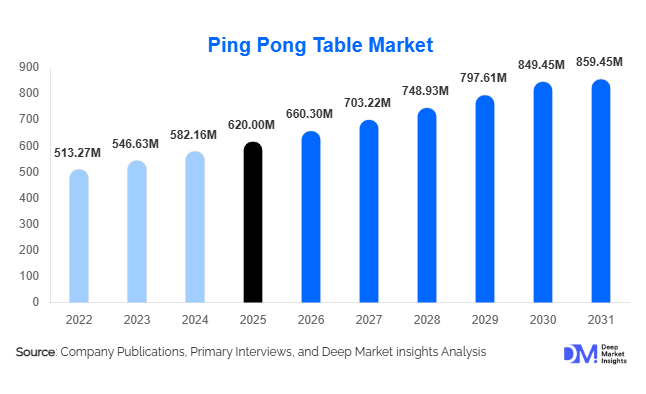
According to Deep Market Insights, the global ping pong table market size was valued at USD 620 million in 2025 and is projected to grow from USD 660.30 million in 2026 to reach USD 849.45 million by 2031, expanding at a CAGR of 6.5% during the forecast period (2026–2031). The market growth is primarily driven by increasing participation in recreational sports, rising adoption of home-based fitness equipment, and expanding investments in sports infrastructure across educational and commercial sectors. Additionally, the growing popularity of table tennis as a low-impact, accessible sport across all age groups is accelerating product demand globally.
Key Market Insights
- Indoor ping pong tables dominate the market, accounting for nearly 48% share due to strong residential and institutional demand.
- Asia-Pacific leads the global market, contributing approximately 45% of total revenue, supported by strong manufacturing and cultural affinity for table tennis.
- The mid-range price segment holds the largest share, around 45%, balancing affordability and durability for mass consumers.
- Offline retail channels remain dominant, with nearly 60% share, as consumers prefer physical product inspection.
- Residential users represent the largest end-use segment, accounting for about 40% of demand globally.
- Product innovation in foldable and multi-functional tables is emerging as a key growth trend in urban markets.
What are the latest trends in the ping pong table market?
Rise of Multi-functional and Space-saving Designs
Urbanization and shrinking living spaces are driving demand for compact and multi-purpose furniture. Ping pong tables that double as dining or work tables are gaining traction, particularly in metropolitan areas. Foldable and portable designs are also becoming popular among residential users who seek convenience without compromising functionality. Manufacturers are increasingly focusing on lightweight materials and easy storage mechanisms to cater to this demand. This trend is expected to significantly influence product development strategies, especially in the Asia-Pacific and Europe.
Growth of Outdoor and Weather-resistant Tables
Outdoor recreational activities are gaining momentum, leading to increased demand for weather-resistant ping pong tables. These tables are designed with anti-corrosion materials, UV-resistant coatings, and durable frames, making them suitable for public parks, schools, and commercial spaces. Governments investing in public recreational infrastructure are further boosting this segment. The trend aligns with the global push toward outdoor fitness and community engagement.
What are the key drivers in the ping pong table market?
Rising Popularity of Recreational Sports
The growing emphasis on physical fitness and mental well-being is driving participation in recreational sports such as table tennis. The sport’s accessibility, low cost, and minimal physical strain make it appealing to a wide demographic, including children, adults, and senior citizens. This has significantly boosted residential and institutional demand for ping pong tables.
Expansion of Sports Infrastructure
Governments and private institutions are investing heavily in sports infrastructure, including schools, colleges, and community centers. Table tennis is often included as a standard indoor sport, leading to consistent demand for professional-grade tables. Initiatives promoting grassroots sports development in countries like India and China are further accelerating market growth.
What are the restraints for the global market?
High Cost of Premium Tables
Premium ping pong tables with advanced materials and features are relatively expensive, limiting their adoption in price-sensitive markets. While economy options exist, they often lack durability, affecting long-term demand.
Space Constraints in Urban Areas
Full-size ping pong tables require significant space, which can be a barrier for urban households. Although foldable and compact options are available, they may not fully replicate professional playing conditions, impacting consumer preference.
What are the key opportunities in the ping pong table industry?
Integration of Smart Technologies
The incorporation of smart features such as digital scoring systems, sensors, and AI-based training tools presents a significant opportunity for market players. These innovations cater to professional training centers and premium consumers, enabling companies to differentiate their offerings and capture higher margins.
Expansion in Emerging Markets
Emerging economies in Asia, Latin America, and Africa offer strong growth potential due to rising disposable incomes and increasing sports participation. Localized manufacturing and affordable product offerings can help companies penetrate these markets effectively.
Report Scope
| Report Metric | Details |
|---|---|
| Market Size in 2025 | USD 620 Million |
| Market Size in 2026 | USD 660.30 Million |
| Market Size in 2031 | USD 859.45 Million |
| CAGR | 6.5% (2026-2031) |
| Base Year for Estimation | 2025 |
| Historical Data | 2022-2024 |
| Forecast Period | 2026-2031 |
| Report Coverage | Revenue Forecast, Competitive Landscape, Supply Chain Disruption, Growth Factors, Environment & Regulatory Landscape and Trends |
| Geographies Covered | North America, Europe, APAC, Middle East and Africa, LATAM |
| Countries Covered | U.S., Canada, U.K., Germany, France, Spain, Italy, Russia, Nordic, Benelux, Rest of Europe, China, Korea, Japan, India, Australia, Singapore, Taiwan, South East Asia, Rest of Asia-Pacific, UAE, Turky, Saudi Arabia, South Africa, Egypt, Nigeria, Rest of MEA, Brazil, Mexico, Argentina, Chile, Colombia, Rest of LATAM |
Explore more data points, trends and opportunities Download Free Sample Report
Product Type Insights
Indoor ping pong tables continue to dominate the global market, accounting for approximately 48% of total demand in 2025, primarily due to their widespread adoption across residential households, educational institutions, and indoor sports facilities. The leading driver for this segment is the controlled playing environment and superior performance consistency, which makes indoor tables the preferred choice for both recreational and semi-professional use. Additionally, the rise in home-based entertainment and indoor fitness activities post-pandemic has further strengthened demand. Institutions such as schools and training academies also prefer indoor tables due to their durability and compliance with standard playing conditions.
Outdoor ping pong tables are witnessing strong growth momentum, driven by increasing investments in public recreational infrastructure. Governments and municipalities are installing weather-resistant tables in parks, community centers, and urban open spaces to promote active lifestyles. These tables are designed with anti-corrosion coatings, UV resistance, and robust frames, making them suitable for long-term outdoor use.
Foldable and portable tables are gaining popularity, particularly among urban consumers, due to the growing need for space optimization in compact living environments. Their ease of storage and mobility makes them highly attractive for residential buyers. Meanwhile, competition-grade tables, although niche, represent a high-value segment driven by professional tournaments, sports federations, and elite training centers, where adherence to international standards is critical.
Application Insights
The residential segment leads the market, contributing approximately 40% of total demand, driven by the increasing trend of home-based recreation and family-oriented entertainment. The growing focus on indoor fitness, combined with the accessibility and affordability of table tennis, has significantly boosted adoption in households globally. The availability of compact and foldable designs further supports this segment’s expansion, particularly in urban regions.
Educational institutions represent a key demand driver, supported by the integration of sports into academic curricula and government-backed physical education programs. Schools and colleges are increasingly investing in sports infrastructure, including table tennis facilities, to promote holistic student development.
Sports clubs and training centers contribute significantly to the demand for professional-grade tables, driven by rising participation in competitive table tennis and the expansion of training academies. Additionally, commercial spaces such as hotels, corporate offices, and recreational centers are emerging as high-growth segments. The primary driver here is the increasing emphasis on employee wellness and customer engagement, with ping pong tables being used as a recreational and team-building tool. The hospitality sector is particularly leveraging these tables to enhance guest experiences and differentiate its offerings.
Distribution Channel Insights
Offline retail channels dominate the market, accounting for nearly 60% of total sales, primarily due to the consumer preference for physical inspection and product assurance. Ping pong tables are relatively bulky and high-involvement purchases, prompting buyers to evaluate build quality, stability, and material before making a decision. Specialty sports stores and large-format retail outlets play a critical role in influencing purchase decisions through product demonstrations and expert guidance.
However, online retail is rapidly gaining traction, driven by the expansion of e-commerce platforms, competitive pricing, and improved logistics capabilities. Consumers are increasingly turning to online channels for wider product selection, detailed reviews, and doorstep delivery. This trend is particularly strong in emerging markets, where digital penetration is rising. Manufacturers are also investing in direct-to-consumer (D2C) platforms, enabling better brand control and higher margins. The integration of augmented reality (AR) tools for product visualization is further enhancing the online buying experience.
Explore more data points, trends and opportunities Download Free Sample Report
Ping Pong Table Market Segmentations
By Product Type
- Indoor Ping Pong Tables
- Outdoor Ping Pong Tables
- Foldable/Portable Tables
- Convertible/Multi-purpose Tables
- Competition-grade Tables
By Application (End-Use)
- Residential/Household
- Educational Institutions
- Sports Clubs & Training Centers
- Commercial Spaces
- Professional Tournaments & Federations
By Distribution Channel
- Online Retail
- Specialty Sports Stores
- Hypermarkets/Supermarkets
- Direct-to-Consumer
- Institutional/Bulk Sales
Regional Insights
Asia-Pacific
Asia-Pacific dominates the global ping pong table market, accounting for approximately 45% of total revenue in 2025, with China, Japan, and India as key contributors. The primary growth driver in this region is the deep-rooted cultural affinity for table tennis, particularly in China, where the sport is widely played at both amateur and professional levels. China also serves as the largest manufacturing hub, benefiting from cost-efficient production and strong export capabilities. In India, the market is expanding rapidly due to government initiatives promoting sports participation, rising disposable incomes, and increasing urbanization. Japan contributes through high-quality manufacturing and strong domestic demand for premium tables. The region’s growth is further supported by expanding middle-class populations and increasing investments in sports infrastructure.
North America
North America holds around 20% of the global market share, led by the United States. The key driver in this region is the growing adoption of recreational and lifestyle-oriented sports within households and workplaces. The increasing popularity of ping pong in corporate offices, co-working spaces, and entertainment venues is significantly boosting demand. Additionally, the trend toward premiumization is strong, with consumers willing to invest in high-quality, aesthetically designed tables. Technological innovation, including smart tables and advanced materials, is also contributing to market growth in this region.
Europe
Europe accounts for approximately 25% of the global market, with Germany, France, and the UK as major contributors. The region benefits from a well-established sports culture and strong institutional support for recreational and competitive sports. Germany stands out as a leading manufacturing and export hub, particularly for premium and competition-grade tables. Growth in Europe is also driven by increasing demand for outdoor recreational infrastructure and eco-friendly products, as governments invest in public sports facilities. Additionally, the region’s focus on sustainability is encouraging the adoption of durable and recyclable materials in table manufacturing.
Latin America
Latin America represents a smaller but steadily growing market, with Brazil and Mexico leading demand. The primary growth driver is the rising awareness of sports and fitness, coupled with increasing disposable incomes. Governments and private organizations are investing in community sports programs, which is boosting demand for affordable ping pong tables. The region is also witnessing growth in school-level sports participation, further supporting market expansion.
Middle East & Africa
The Middle East & Africa region is gradually expanding, driven by urbanization, tourism development, and increasing investments in recreational infrastructure. Countries such as the UAE and Saudi Arabia are investing heavily in the entertainment and hospitality sectors, where ping pong tables are used to enhance customer experiences. In Africa, South Africa is a key market, supported by growing sports participation and government initiatives promoting youth engagement in sports. The region’s growth is further fueled by the expansion of hospitality and leisure industries, particularly in urban centers and tourist destinations.
Key Players in the Ping Pong Table Market
- Butterfly
- Stiga Sports
- Cornilleau
- Joola
- Donic
- Kettler
- DHS (Double Happiness)
- Killerspin
- Tibhar
- Xiom
- Andro
- Prince
- Escalade Sports
- Brunswick
- Sportcraft