Phytonutrients Market Size
According to Deep Market Insights,the global phytonutrients market size was valued at USD 7,620 million in 2025 and is projected to grow from USD 8427.72 million in 2026 to reach USD 13,947.16 million by 2031, expanding at a CAGR of 10.6% during the forecast period (2026–2031). The phytonutrients market growth is primarily driven by rising consumer demand for plant-based nutrition, increasing adoption of preventive healthcare solutions, and growing incorporation of bioactive botanical compounds across functional foods, dietary supplements, pharmaceuticals, and cosmetic formulations.
Key Market Insights
- Growing consumer preference for natural and clean-label ingredients is accelerating phytonutrient adoption across food, nutraceutical, and personal care industries.
- Dietary supplements remain the dominant application, supported by rising immunity, heart health, and cognitive wellness awareness globally.
- North America leads global consumption due to strong supplement penetration and advanced nutraceutical manufacturing infrastructure.
- Asia-Pacific is the fastest-growing regional market, driven by expanding middle-class populations and increasing demand for functional nutrition.
- Technological advancements in extraction and bioavailability enhancement are improving product efficacy and commercial scalability.
- Cosmetics and personal care applications are emerging as high-growth areas with increasing demand for plant-based antioxidants in skincare products.
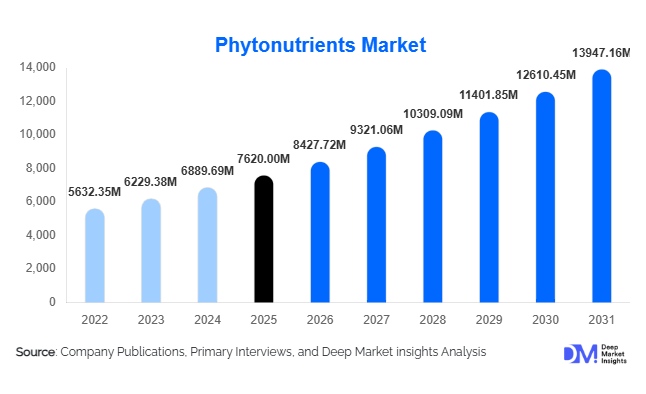
What are the latest trends in the phytonutrients market?
Shift Toward Functional and Preventive Nutrition
Consumers worldwide are increasingly prioritizing preventive healthcare, fueling demand for food products and supplements enriched with phytonutrients such as carotenoids, polyphenols, and phytosterols. Functional beverages, fortified snacks, and plant-based protein products are incorporating these compounds to enhance nutritional value and health positioning. Food manufacturers are reformulating existing products to meet clean-label standards while delivering scientifically supported health benefits. Immunity-focused and anti-inflammatory formulations have particularly gained traction following heightened global health awareness, driving long-term demand for standardized botanical ingredients.
Advanced Extraction and Bioavailability Technologies
Technological innovation is reshaping phytonutrient production through supercritical CO₂ extraction, enzyme-assisted processing, and fermentation-based biosynthesis. These technologies improve compound stability, purity, and absorption efficiency, enabling wider pharmaceutical and cosmetic applications. Microencapsulation and nanoemulsion techniques are increasingly used to enhance shelf life and bioavailability in beverages and supplements. Manufacturers are investing heavily in proprietary delivery systems to differentiate products and achieve premium pricing, while sustainable extraction methods are gaining importance to meet environmental and regulatory expectations.
What are the key drivers in the phytonutrients market?
Rising Demand for Plant-Based and Natural Ingredients
The global transition toward plant-based diets and natural health solutions is a major driver of market expansion. Consumers are actively replacing synthetic additives with plant-derived alternatives across food, supplement, and cosmetic products. Regulatory encouragement for botanical ingredients and clean-label formulations further supports adoption. Manufacturers increasingly use phytonutrients as natural colorants, antioxidants, and functional additives, expanding industrial usage beyond traditional supplement applications.
Expansion of the Global Nutraceutical Industry
The rapid growth of the nutraceutical sector has significantly increased demand for standardized phytonutrient ingredients. Aging populations and rising lifestyle diseases are encouraging daily supplement consumption, particularly for cardiovascular, cognitive, and immune health. E-commerce distribution channels have improved accessibility, enabling smaller brands to scale globally while increasing ingredient procurement volumes from phytonutrient producers.
What are the restraints for the global market?
Raw Material Price Volatility
Phytonutrient production depends heavily on agricultural raw materials such as fruits, vegetables, and botanicals. Climate variability, seasonal supply fluctuations, and crop yield instability can create pricing volatility, impacting manufacturing margins and long-term supply planning. Companies must invest in diversified sourcing strategies and contract farming to mitigate these risks.
Regulatory Complexity Across Regions
Regulatory frameworks governing botanical ingredients vary significantly across countries. Health claims approval processes and safety compliance requirements often increase commercialization timelines and development costs. Smaller market participants face challenges in funding clinical validation studies required for premium product positioning, slowing innovation adoption in certain regions.
What are the key opportunities in the phytonutrients industry?
Personalized Nutrition and Precision Wellness
The rise of personalized nutrition platforms presents a major growth opportunity for phytonutrient manufacturers. Customized supplement formulations targeting specific health outcomes—such as gut health, cognition, and metabolic wellness—are gaining popularity. Integration of AI-driven dietary recommendations with standardized plant compounds allows companies to create high-margin, subscription-based product ecosystems.
Emerging Market Expansion and Localized Production
Rapid urbanization and income growth across Asia-Pacific and Latin America are creating new demand centers for functional foods and dietary supplements. Countries such as China, India, Brazil, and Indonesia are witnessing strong adoption of immunity-support products. Establishing regional extraction and processing facilities reduces logistics costs while improving supply chain resilience, enabling faster market penetration.
Report Scope
| Report Metric | Details |
|---|---|
| Market Size in 2025 | USD 7620 Million |
| Market Size in 2026 | USD 8427.72 Million |
| Market Size in 2031 | USD 13947.16 Million |
| CAGR | 10.6% (2026-2031) |
| Base Year for Estimation | 2025 |
| Historical Data | 2022-2024 |
| Forecast Period | 2026-2031 |
| Report Coverage | Revenue Forecast, Competitive Landscape, Supply Chain Disruption, Growth Factors, Environment & Regulatory Landscape and Trends |
| Geographies Covered | North America, Europe, APAC, Middle East and Africa, LATAM |
| Countries Covered | U.S., Canada, U.K., Germany, France, Spain, Italy, Russia, Nordic, Benelux, Rest of Europe, China, Korea, Japan, India, Australia, Singapore, Taiwan, South East Asia, Rest of Asia-Pacific, UAE, Turky, Saudi Arabia, South Africa, Egypt, Nigeria, Rest of MEA, Brazil, Mexico, Argentina, Chile, Colombia, Rest of LATAM |
Explore more data points, trends and opportunities Download Free Sample Report
Product Type Insights
Carotenoids represent the leading product category, accounting for approximately 34% of global market revenue, primarily driven by rising demand for vision health supplements, natural food colorants, and antioxidant-rich formulations. The segment’s leadership is supported by increasing consumer preference for naturally derived ingredients over synthetic additives, alongside growing clinical validation of carotenoids such as lutein and beta-carotene for eye health and immune function. Expanding applications in functional beverages and fortified foods further strengthen market penetration. Polyphenols follow closely, supported by their extensive utilization in cardiovascular health products, anti-aging formulations, and metabolic wellness solutions, with scientific research increasingly validating their anti-inflammatory and antioxidant properties. Phytosterols continue to witness steady adoption in cholesterol-management foods and heart-health formulations as regulatory bodies increasingly recognize plant sterols for lipid reduction benefits. Meanwhile, organosulfur compounds are gaining traction in immune-support and detoxification applications, supported by rising interest in preventive healthcare and plant-based therapeutic compounds. Continuous advancements in extraction technologies and increasing investments in clinical research are driving innovation across all phytonutrient categories, enabling higher bioavailability and product differentiation.
Application Insights
Dietary supplements dominate the phytonutrients market with nearly 38% share, primarily driven by growing global awareness of preventive healthcare, aging populations, and increasing daily wellness consumption habits. Consumers are increasingly incorporating supplements into routine health management, supported by expanding digital health awareness and direct-to-consumer sales platforms. Functional foods and beverages represent the fastest-growing application segment as manufacturers introduce nutrient-fortified beverages, plant-based dairy alternatives, and performance nutrition products designed to deliver health benefits alongside convenience. The leading growth driver for this segment is the shift toward functional nutrition, where consumers seek immunity enhancement, digestive health, and energy support through everyday food products rather than traditional supplementation. Pharmaceutical applications are expanding through botanical drug development and adjunct therapies, as phytonutrients gain recognition for their anti-inflammatory and therapeutic potential. Cosmetics and personal care companies are increasingly integrating phytonutrients into formulations targeting anti-aging, UV protection, and skin repair, reflecting strong consumer demand for clean-label and plant-based beauty solutions.
Distribution Channel Insights
Direct B2B ingredient supply remains the dominant distribution channel, accounting for over 60% of market revenue, as large food, pharmaceutical, and nutraceutical manufacturers procure standardized plant extracts in bulk to ensure quality consistency and cost efficiency. The leading driver for this channel is the increasing industrial-scale production of functional foods and supplements, which requires reliable sourcing partnerships and traceable supply chains. Contract manufacturing partnerships are expanding rapidly as emerging brands outsource formulation, encapsulation, and production processes to specialized manufacturers, allowing faster market entry and reduced capital investment. Meanwhile, e-commerce channels are experiencing accelerated growth for finished phytonutrient-based products, supported by rising digital adoption, personalized nutrition trends, and enhanced consumer education through online health platforms. The integration of subscription-based supplement models and global logistics networks is further strengthening online distribution growth.
End-Use Industry Insights
The nutraceutical industry represents the largest end-use segment, contributing roughly 35% of global demand, primarily driven by increasing consumer focus on preventive healthcare and natural health optimization solutions. The segment’s leadership is reinforced by growing acceptance of plant-based bioactives as daily health supplements addressing immunity, cardiovascular wellness, and cognitive health. Food and beverage manufacturers are increasingly incorporating phytonutrients into fortified snacks, beverages, and plant-based products to enhance nutritional value and product differentiation in competitive markets. Cosmetics and personal care companies continue to expand the use of botanical antioxidants to align with clean beauty trends and consumer preference for natural skincare ingredients. Pharmaceutical companies are actively exploring phytonutrients as complementary therapeutic agents and adjunct treatments, supported by expanding clinical trials and regulatory acceptance of botanical compounds. Additionally, animal nutrition applications are emerging as a niche but promising growth segment, where phytonutrients are used to naturally enhance livestock immunity, gut health, and productivity while reducing reliance on synthetic additives.
Explore more data points, trends and opportunities Download Free Sample Report
Phytonutrients Market Segmentations
By Product Type
- Carotenoids
- Polyphenols
- Phytosterols
- Organosulfur Compounds
- Phytoestrogens
- Other Botanical Phytonutrients
By Application
- Dietary Supplements
- Functional Food & Beverages
- Pharmaceutical Applications
- Cosmetics & Personal Care
- Animal Nutrition
By Distribution Channel
- Direct B2B Ingredient Supply
- Contract Manufacturing Organizations (CMOs)
- Online Retail
- Specialty Health Stores
- Pharmacies & Wellness Chains
Regional Insights
North America
North America accounts for approximately 32% of global market share, led by the United States, where dietary supplement consumption and functional food innovation remain highly advanced. Regional growth is driven by strong consumer awareness regarding preventive healthcare, widespread adoption of personalized nutrition, and significant investments in nutraceutical research and development. Well-established regulatory frameworks supporting dietary supplements and natural ingredients provide market stability and encourage product innovation. The expansion of clean-label food trends, increasing aging populations, and rising healthcare expenditure further accelerate demand. Canada contributes through growing adoption of natural health products, expanding plant-based diets, and increasing government support for health-focused food innovation.
Europe
Europe holds nearly 27% market share, driven by Germany, France, Italy, and the United Kingdom, where consumers demonstrate strong preference for organic, sustainable, and ethically sourced ingredients. Regional growth is supported by stringent clean-label regulations and transparency requirements that encourage manufacturers to adopt plant-derived functional ingredients. Increasing environmental awareness and demand for traceability certifications strengthen premium phytonutrient adoption across food, supplement, and cosmetic sectors. Additionally, rising demand for preventive healthcare solutions amid aging demographics and expanding vegan and vegetarian populations continues to stimulate market expansion across the region.
Asia-Pacific
Asia-Pacific is the fastest-growing region, expanding at over 12% CAGR, supported by rapid urbanization, rising disposable incomes, and increasing health awareness among expanding middle-class populations. China dominates regional demand through large-scale functional beverage production and supplement manufacturing supported by strong domestic consumption and export activity. India benefits from its extensive botanical heritage, expanding nutraceutical industry, and growing acceptance of traditional plant-based wellness systems integrated into modern products. Japan and South Korea maintain steady demand driven by innovation in anti-aging solutions, functional foods, and advanced cosmetic formulations. Government initiatives promoting health foods and growing e-commerce penetration further accelerate regional market growth.
Latin America
Latin America is experiencing gradual expansion, led by Brazil and Mexico, where growing health consciousness and improving economic conditions support increased supplement consumption. Regional growth is driven by abundant agricultural biodiversity that enables cost-effective sourcing of plant raw materials and supports local extraction industries. Expanding middle-class populations, urban dietary transitions, and rising demand for fortified foods contribute to increased phytonutrient adoption. Export-oriented food processing industries and strengthening trade partnerships are also increasing demand for standardized phytonutrient ingredients across the region.
Middle East & Africa
The Middle East & Africa region is emerging as a growth market, supported by rising lifestyle disease awareness, increasing healthcare spending, and expanding premium wellness markets. Countries such as the UAE and Saudi Arabia are witnessing growing imports of dietary supplements driven by high disposable incomes and strong demand for preventive health solutions. The expansion of modern retail infrastructure and e-commerce platforms improves accessibility to phytonutrient-based products. South Africa plays a key role as a regional processing and distribution hub, supported by improving manufacturing capabilities and growing interest in natural health and nutrition products across the continent.
Key Players in the Phytonutrients Market
- DSM-Firmenich
- BASF SE
- Givaudan
- Kerry Group plc
- Archer Daniels Midland Company
- International Flavors & Fragrances Inc.
- Kemin Industries
- Lycored Ltd.
- Chr. Hansen Holding A/S
- Sabinsa Corporation
- Indena S.p.A.
- Herbalife Ltd.
- Amway Corporation
- Nature’s Sunshine Products
- Naturex (Givaudan Group)