Physiotherapy Equipment Market Size
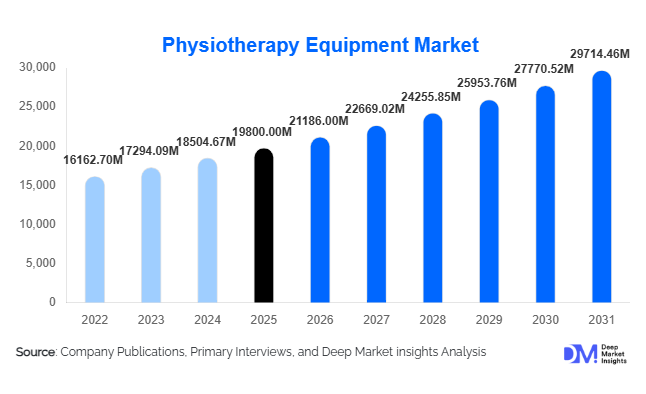
According to Deep Market Insights, the global physiotherapy equipment market size was valued at USD 19,800 million in 2025 and is projected to grow from USD 21,186.00 million in 2026 to reach USD 29,714.46 million by 2031, expanding at a CAGR of 7.0% during the forecast period (2026–2031). The market growth is primarily driven by the rising prevalence of musculoskeletal disorders, increasing geriatric population, and the growing adoption of advanced rehabilitation technologies such as robotics and AI-enabled therapy systems.
Key Market Insights
- Electrotherapy equipment dominates the market, accounting for nearly 28% of total revenue due to its widespread clinical use and cost efficiency.
- Hospitals remain the largest end-use segment, contributing around 40% of demand owing to high patient inflow for post-surgical rehabilitation.
- North America leads the global market with approximately 38% share, driven by advanced healthcare infrastructure and high technology adoption.
- Asia-Pacific is the fastest-growing region, supported by healthcare investments and rising awareness of physiotherapy services.
- Home-based rehabilitation is gaining traction, with increasing demand for portable and user-friendly physiotherapy devices.
- Technological integration, including robotics, wearables, and AI-driven therapy systems, is reshaping treatment efficiency and outcomes.
What are the latest trends in the physiotherapy equipment market?
Shift Toward Home-Based Rehabilitation
The physiotherapy equipment market is witnessing a strong shift toward home-based care models. Patients increasingly prefer rehabilitation in home settings due to convenience, cost savings, and reduced hospital visits. This trend has accelerated demand for compact, portable, and easy-to-use devices such as TENS units, resistance bands, and digital therapy tools. Manufacturers are responding by developing connected devices that enable remote monitoring by healthcare professionals. Tele-rehabilitation platforms integrated with physiotherapy equipment are also gaining traction, allowing real-time tracking of patient progress. This trend is particularly prominent in developed markets but is rapidly expanding in emerging economies as well.
Adoption of Robotics and AI in Rehabilitation
Advanced technologies such as robotic exoskeletons, AI-assisted therapy systems, and smart rehabilitation devices are transforming physiotherapy practices. These technologies enhance precision, reduce therapist workload, and improve patient outcomes, particularly in neurological and post-stroke rehabilitation. AI-enabled systems can personalize treatment plans based on patient data, while robotic devices assist in repetitive motion therapy. The integration of wearable sensors further enables real-time feedback and progress tracking. Although currently concentrated in developed markets, these technologies are gradually penetrating emerging regions through public-private partnerships and cost optimization strategies.
What are the key drivers in the physiotherapy equipment market?
Rising Prevalence of Chronic and Musculoskeletal Disorders
The increasing incidence of conditions such as arthritis, spinal injuries, and neurological disorders is a primary driver of market growth. These conditions require long-term rehabilitation, leading to sustained demand for physiotherapy equipment across hospitals, clinics, and home care settings. The growing burden of lifestyle-related diseases further contributes to this trend.
Aging Global Population
The expanding elderly population worldwide is significantly boosting demand for physiotherapy services. Older individuals are more susceptible to mobility issues, joint disorders, and chronic conditions, necessitating regular physiotherapy interventions. This demographic shift is particularly evident in regions such as North America, Europe, and Japan, where aging populations are driving healthcare demand.
What are the restraints for the global market?
High Cost of Advanced Equipment
Advanced physiotherapy equipment, particularly robotic and AI-enabled systems, involves high acquisition and maintenance costs. This limits adoption among smaller healthcare facilities and in developing regions, where budget constraints are significant. The high upfront investment required for such technologies remains a major barrier to widespread adoption.
Shortage of Skilled Professionals
The effective use of advanced physiotherapy equipment requires trained professionals. However, there is a global shortage of skilled physiotherapists and technicians, particularly in rural and underdeveloped areas. This gap limits the utilization of sophisticated equipment and slows market growth.
What are the key opportunities in the physiotherapy equipment industry?
Expansion in Emerging Markets
Emerging economies such as India, China, and Brazil present significant growth opportunities due to increasing healthcare investments and improving infrastructure. Government initiatives aimed at expanding rehabilitation services are driving demand for both basic and advanced physiotherapy equipment. Manufacturers can benefit by establishing local production facilities and leveraging favorable policies.
Integration of Digital Health and Tele-Rehabilitation
The integration of digital health technologies with physiotherapy equipment offers substantial growth potential. Remote monitoring, AI-driven analytics, and teleconsultation platforms enable continuous patient engagement and improved treatment outcomes. Companies investing in connected devices and digital ecosystems are well-positioned to capitalize on this trend.
Report Scope
| Report Metric | Details |
|---|---|
| Market Size in 2025 | USD 19800 Million |
| Market Size in 2026 | USD 21186 Million |
| Market Size in 2031 | USD 29714.46 Million |
| CAGR | 7.0% (2026-2031) |
| Base Year for Estimation | 2025 |
| Historical Data | 2022-2024 |
| Forecast Period | 2026-2031 |
| Report Coverage | Revenue Forecast, Competitive Landscape, Supply Chain Disruption, Growth Factors, Environment & Regulatory Landscape and Trends |
| Geographies Covered | North America, Europe, APAC, Middle East and Africa, LATAM |
| Countries Covered | U.S., Canada, U.K., Germany, France, Spain, Italy, Russia, Nordic, Benelux, Rest of Europe, China, Korea, Japan, India, Australia, Singapore, Taiwan, South East Asia, Rest of Asia-Pacific, UAE, Turky, Saudi Arabia, South Africa, Egypt, Nigeria, Rest of MEA, Brazil, Mexico, Argentina, Chile, Colombia, Rest of LATAM |
Explore more data points, trends and opportunities Download Free Sample Report
Product Type Insights
Electrotherapy equipment continues to lead the physiotherapy equipment market, accounting for approximately 28% of total revenue in 2025. Its dominance is primarily driven by its wide applicability across pain management, neuromuscular stimulation, and post-operative rehabilitation. The relatively lower cost, ease of use, and strong clinical validation of modalities such as TENS, EMS, and ultrasound therapy make electrotherapy a preferred choice across hospitals, clinics, and increasingly, home-care settings. Additionally, growing cases of chronic pain disorders and sports injuries have significantly boosted demand for these devices globally.
Exercise therapy equipment is witnessing robust growth, supported by the increasing emphasis on active rehabilitation and physical conditioning. The rising adoption of resistance bands, balance trainers, and continuous passive motion (CPM) devices in both clinical and home environments is accelerating this segment. Rehabilitation robotics, although currently accounting for a smaller share, represents the fastest-evolving segment due to rapid advancements in AI, machine learning, and sensor-based technologies. Increasing demand for precision-driven therapy, especially in neurological rehabilitation, is propelling investments in robotic exoskeletons and gait training systems. Meanwhile, hydrotherapy and thermotherapy equipment maintain steady demand, particularly in specialized rehabilitation centers and sports medicine facilities, where water-based therapy and heat/cold treatments are integral to recovery protocols.
Application Insights
Orthopedic rehabilitation dominates the market, capturing approximately 35% of total demand in 2025, primarily due to the high global incidence of fractures, osteoarthritis, joint replacements, and sports-related injuries. The growing number of orthopedic surgeries, including knee and hip replacements, has significantly increased the need for post-operative physiotherapy, thereby sustaining demand for rehabilitation equipment.
Neurological rehabilitation is emerging as one of the fastest-growing segments, driven by the increasing prevalence of stroke, Parkinson’s disease, and spinal cord injuries. The adoption of advanced technologies such as robotic-assisted therapy and neurostimulation devices is further enhancing growth prospects in this segment. Sports injury rehabilitation is also gaining strong traction, fueled by the expansion of the global sports and fitness industry and rising participation in professional and recreational sports. Additionally, geriatric rehabilitation remains a critical application area, reflecting the needs of the rapidly aging global population, which requires continuous physiotherapy support for mobility, balance, and chronic disease management.
Distribution Channel Insights
Direct sales channels dominate the physiotherapy equipment market, accounting for approximately 55% of the total market share. Large hospitals and healthcare institutions prefer direct procurement from manufacturers due to advantages such as bulk purchasing, cost optimization, product customization, and after-sales support. This channel is particularly strong in developed markets where institutional procurement frameworks are well established.
Distributor and dealer networks continue to play a vital role in expanding market reach, particularly in emerging economies and rural areas where direct manufacturer presence is limited. These networks facilitate access to a wide range of products for smaller clinics and independent practitioners. Meanwhile, online channels are rapidly gaining momentum, driven by the growing popularity of e-commerce platforms and direct-to-consumer models. The increasing demand for home-use physiotherapy devices, coupled with digital marketing strategies and improved logistics infrastructure, is significantly boosting online sales globally.
End-Use Insights
Hospitals remain the largest end-use segment, contributing approximately 40% of the global market share in 2025. Their dominance is attributed to the high volume of patients requiring acute care, post-surgical rehabilitation, and multidisciplinary treatment approaches. Hospitals are also early adopters of advanced physiotherapy technologies, including robotic systems and AI-enabled devices. Physiotherapy clinics and rehabilitation centers are experiencing steady growth, driven by the increasing shift toward outpatient care and specialized rehabilitation services. These facilities offer cost-effective and focused treatment, making them a preferred option for long-term therapy.
Home care settings represent the fastest-growing segment, expanding at a CAGR exceeding 8%. This growth is fueled by the rising preference for decentralized healthcare, the increasing geriatric population, and advancements in portable and user-friendly devices. Additionally, sports and fitness centers are emerging as a niche but rapidly growing segment, supported by rising awareness of injury prevention, performance optimization, and recovery management among athletes and fitness enthusiasts.
Explore more data points, trends and opportunities Download Free Sample Report
Physiotherapy Equipment Market Segmentations
By Product Type
- Electrotherapy Equipment
- Exercise Therapy Equipment
- Cryotherapy & Thermotherapy Equipment
- Hydrotherapy Equipment
- Manual Therapy Aids
- Rehabilitation Robotics & Advanced Systems
By Application
- Orthopedic Rehabilitation
- Neurological Rehabilitation
- Cardiopulmonary Rehabilitation
- Pediatric Rehabilitation
- Sports Injury Rehabilitation
- Geriatric Rehabilitation
By End-Use
- Hospitals
- Physiotherapy Clinics & Rehabilitation Centers
- Home Care Settings
- Sports & Fitness Centers
By Distribution Channel
- Direct Sales
- Distributor/Dealer Networks
- Online Channels
Regional Insights
North America
North America dominates the global physiotherapy equipment market, accounting for approximately 38% of total revenue in 2025, with the United States as the primary contributor. The region’s leadership is driven by advanced healthcare infrastructure, high healthcare expenditure, and strong adoption of technologically advanced rehabilitation solutions. Favorable reimbursement policies and a well-established physiotherapy ecosystem further support market growth. Additionally, the high prevalence of chronic diseases, sports injuries, and an aging population significantly contribute to sustained demand. The presence of leading manufacturers and continuous innovation in rehabilitation technologies also strengthens North America’s market position.
Europe
Europe holds around 27% of the global market share, with key countries including Germany, the UK, and France. The region’s growth is primarily driven by its rapidly aging population, which increases demand for long-term rehabilitation services. Strong government support for healthcare systems, including reimbursement for physiotherapy treatments, further enhances market expansion. Additionally, Europe’s focus on preventive healthcare and early rehabilitation, along with widespread adoption of advanced medical technologies, supports steady demand. Increasing investments in rehabilitation infrastructure and growing awareness of physiotherapy benefits are also key growth drivers.
Asia-Pacific
Asia-Pacific is the fastest-growing region, with a CAGR exceeding 8.5%, driven by rapidly expanding healthcare infrastructure and rising awareness of physiotherapy services. China and India are major growth engines due to large patient populations, increasing healthcare spending, and government initiatives aimed at improving medical access. Japan contributes significantly due to its aging population and high adoption of advanced medical technologies. Additionally, the growing middle class, rising incidence of lifestyle-related diseases, and increasing penetration of private healthcare providers are accelerating demand across the region. Localization of manufacturing and cost-effective product offerings further support market expansion in the Asia-Pacific.
Latin America
Latin America is experiencing moderate growth, led by Brazil and Mexico. The region’s expansion is driven by improving healthcare infrastructure, increasing government healthcare expenditure, and rising awareness of rehabilitation services. Growing incidences of chronic diseases and road accidents are also contributing to the demand for physiotherapy equipment. However, economic constraints and uneven access to advanced healthcare facilities may limit growth in certain areas. Despite these challenges, increasing private sector investments and the expansion of healthcare services are expected to support long-term market development.
Middle East & Africa
The Middle East and Africa region is witnessing gradual growth, particularly in countries such as the UAE and Saudi Arabia. Government-led healthcare infrastructure development, coupled with rising investments in medical tourism, is driving demand for advanced physiotherapy equipment. The increasing prevalence of lifestyle-related diseases and growing awareness of rehabilitation services are further supporting market growth. In Africa, improving access to healthcare services and international aid programs are gradually enhancing the adoption of physiotherapy solutions. Although the market remains at a nascent stage compared to developed regions, ongoing investments and policy support are expected to drive future expansion.
Key Players in the Physiotherapy Equipment Market
- DJO Global
- Zimmer Biomet
- BTL Industries
- Enraf-Nonius
- EMS Physio
- Patterson Medical
- Dynatronics Corporation
- Mectronic Medicale
- ITO Co. Ltd.
- Chattanooga Group
- Whitehall Manufacturing
- Performance Health
- Richmar
- HMS Medical Systems
- Rehabtronics