Pet Skin and Coat Supplements Market Size
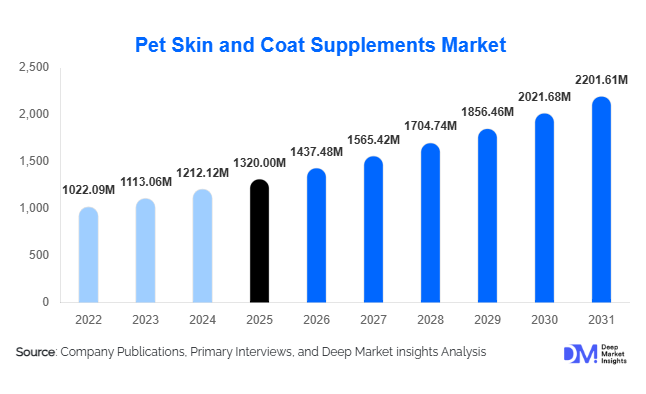
According to Deep Market Insights,the global pet skin & coat supplements market size was valued at USD 1,320 million in 2025 and is projected to grow from USD 1,437.48 million in 2026 to reach USD 2,201.61 million by 2031, expanding at a CAGR of 8.9% during the forecast period (2026–2031). Market growth is primarily driven by the rising prevalence of dermatological disorders in companion animals, increasing pet humanization trends, and growing adoption of preventive nutritional supplementation. Expanding e-commerce penetration and premium product innovation are further accelerating global demand for omega-based and functional skin health formulations.
Key Market Insights
- Omega fatty acid–based formulations dominate globally, accounting for nearly 47% of total market revenue in 2025 due to strong clinical backing for allergy and inflammation management.
- Dogs represent the largest consumer segment, contributing approximately 68% of overall demand, supported by higher dermatological sensitivity and ownership rates.
- North America leads the global market, holding nearly 38% share in 2025, driven by premiumization and strong veterinary recommendation networks.
- Asia-Pacific is the fastest-growing region, expanding at over 11% CAGR due to rising urban pet ownership in China and India.
- Online retail channels account for 36% of sales, fueled by subscription-based delivery models and direct-to-consumer brands.
- Premium-priced supplements represent 44% of total revenue, reflecting consumer preference for clean-label, sustainable, and clinically validated products.
What are the latest trends in the pet skin & coat supplements market?
Shift Toward Clean-Label and Sustainable Ingredients
Pet owners are increasingly scrutinizing ingredient lists, favoring supplements free from artificial preservatives, fillers, and synthetic additives. Sustainable omega-3 sources such as algal oil are gaining traction as alternatives to fish-derived oils, addressing both environmental concerns and supply chain volatility. Brands are investing in traceability systems, third-party certifications, and transparent labeling to build trust. Plant-based formulations and hypoallergenic blends are also emerging as differentiated offerings, particularly in developed markets where premiumization trends are strong.
Personalized and Subscription-Based Supplementation
The expansion of digital retail platforms has enabled companies to offer customized supplement regimens based on breed, age, weight, and specific skin conditions. Subscription-based delivery models are becoming mainstream, enhancing customer retention and stabilizing recurring revenue streams. AI-driven recommendation engines and tele-veterinary consultations are further improving consumer engagement, positioning supplements as part of an integrated preventive pet healthcare ecosystem rather than occasional purchases.
What are the key drivers in the pet skin & coat supplements market?
Rising Prevalence of Dermatological Disorders
Food sensitivities, environmental allergens, and climate variability have increased the incidence of itching, dermatitis, and dry skin among companion animals. Veterinary professionals increasingly recommend omega-3 fatty acids, biotin, and zinc supplementation as preventive or supportive solutions. Growing awareness of seasonal allergies and chronic skin inflammation continues to expand consumer demand for functional nutraceuticals.
Pet Humanization and Preventive Healthcare Adoption
Pet owners increasingly treat animals as family members, driving spending patterns similar to human wellness categories. Preventive supplementation is no longer limited to therapeutic use but is widely adopted for daily maintenance of coat shine, shedding control, and skin barrier support. Rising disposable income and urban pet ownership further reinforce this long-term growth trajectory.
What are the restraints for the global market?
Raw Material Price Volatility
Marine-derived omega oils are subject to fluctuations in fisheries output, environmental regulations, and global trade dynamics. Variability in fish oil pricing can impact manufacturer margins and retail pricing consistency. Companies are responding by diversifying sourcing strategies and exploring plant-based omega alternatives to mitigate supply risks.
Regulatory Variability Across Regions
Pet nutraceuticals occupy a regulatory gray area between food and pharmaceuticals in several countries. Differences in labeling requirements, health claims approvals, and compliance standards create operational complexities for global brands. Harmonizing regulatory frameworks remains a challenge that may slow cross-border expansion.
Report Scope
| Report Metric | Details |
|---|---|
| Market Size in 2025 | USD 1320 Million |
| Market Size in 2026 | USD 1437.48 Million |
| Market Size in 2031 | USD 2201.61 Million |
| CAGR | 8.9% (2026-2031) |
| Base Year for Estimation | 2025 |
| Historical Data | 2022-2024 |
| Forecast Period | 2026-2031 |
| Report Coverage | Revenue Forecast, Competitive Landscape, Supply Chain Disruption, Growth Factors, Environment & Regulatory Landscape and Trends |
| Geographies Covered | North America, Europe, APAC, Middle East and Africa, LATAM |
| Countries Covered | U.S., Canada, U.K., Germany, France, Spain, Italy, Russia, Nordic, Benelux, Rest of Europe, China, Korea, Japan, India, Australia, Singapore, Taiwan, South East Asia, Rest of Asia-Pacific, UAE, Turky, Saudi Arabia, South Africa, Egypt, Nigeria, Rest of MEA, Brazil, Mexico, Argentina, Chile, Colombia, Rest of LATAM |
Explore more data points, trends and opportunities Download Free Sample Report
Product Type Insights
The product landscape is led by omega fatty acid supplements, which account for nearly 47% of total market revenue in 2025, positioning them as the dominant segment. Their leadership is primarily driven by strong clinical validation supporting anti-inflammatory benefits, enhanced skin hydration, and improved coat luster, making them a preferred choice among veterinarians and pet owners alike. Increasing prevalence of allergic dermatitis and chronic skin conditions further reinforces demand for omega-3 and omega-6 formulations. Vitamins and mineral-based supplements, particularly those containing biotin, zinc, and vitamin E, form a substantial secondary segment supported by their role in strengthening the skin barrier and promoting cellular repair. Rising awareness around micronutrient deficiencies in pets has amplified adoption of these formulations in preventive care routines. Herbal and plant-based extracts are gaining traction in premium product portfolios as consumers increasingly seek natural, clean-label, and hypoallergenic alternatives. Ingredients such as turmeric, chamomile, and flaxseed are being incorporated to appeal to health-conscious pet parents. Collagen and protein complexes are emerging as complementary solutions, particularly for aging pets experiencing coat thinning, dryness, and reduced skin elasticity, with demand supported by the broader humanization trend in pet nutrition.
Form Insights
Soft chews lead the market with approximately 42% share in 2025, driven primarily by superior palatability, convenience, and improved compliance among pets. The leading segment’s growth is supported by increasing preference for treat-format supplements that simplify administration without causing stress to animals. Tablets and capsules maintain relevance, especially within veterinary-recommended channels where dosage precision and therapeutic positioning are prioritized. Powders continue to gain adoption due to their flexibility in mixing with daily meals, making them suitable for multi-pet households and customized feeding routines. Liquid supplements and topical oils, while comparatively niche, are expanding steadily as pet owners seek faster absorption, targeted dermatological relief, and localized application for acute skin concerns. Innovation in flavor masking, texture enhancement, and easy-dispense packaging continues to influence form-based competition across the market.
Distribution Channel Insights
Online retail accounts for around 36% of total sales, making it the leading distribution channel. Its dominance is supported by the rapid expansion of e-commerce platforms, subscription-based replenishment models, competitive pricing strategies, and access to a broader assortment of domestic and international brands. The convenience of home delivery and increasing digital literacy among consumers further accelerate online penetration. Veterinary clinics and hospitals contribute nearly 30% of total revenue, benefiting from strong professional endorsement and consumer trust in medically guided product selection. Pet specialty stores remain essential for premium product positioning, offering personalized recommendations and curated assortments that appeal to informed buyers. Supermarkets and hypermarkets focus on mid-range and mass-market offerings, leveraging high foot traffic and impulse purchases to capture value-conscious consumers. The integration of omnichannel strategies is becoming increasingly important in enhancing brand visibility and consumer engagement.
End-Use Application Insights
Allergy and itch management leads application demand with approximately 38% share in 2025, driven by the rising incidence of allergic dermatitis, environmental sensitivities, and food-related intolerances among pets. The leading segment’s growth is reinforced by increasing veterinary diagnoses and heightened owner awareness regarding early symptom management. Coat shine and fur health applications represent a substantial share of preventive supplementation, supported by growing emphasis on aesthetics and overall pet appearance as part of the humanization trend. Skin barrier repair solutions targeting chronic dryness, flakiness, and sensitivity are witnessing steady expansion, particularly among senior pets and breeds predisposed to dermatological conditions. Shedding control continues to serve as an important seasonal driver, especially in temperate climates where coat transitions during spring and autumn stimulate short-term spikes in supplement demand.
Explore more data points, trends and opportunities Download Free Sample Report
Pet Skin and Coat Supplements Market Segmentations
By Pet Type
- Dogs
- Cats
- Other Companion Animals
By Product Form
- Soft Chews
- Tablets & Capsules
- Powders
- Liquid Supplements
- Topical Oils & Sprays
By Ingredient Type
- Omega Fatty Acids
- Vitamins & Minerals
- Herbal & Plant Extracts
- Probiotics & Functional Additives
- Collagen & Protein Complexes
By Distribution Channel
- Online Retail
- Veterinary Clinics & Hospitals
- Pet Specialty Stores
- Supermarkets & Hypermarkets
By Application
- Allergy & Itch Management
- Coat Shine & Fur Health
- Skin Barrier Repair & Dermatitis Support
- Shedding Control
Regional Insights
North America
North America holds approximately 38% of the global market in 2025, with the United States accounting for nearly 82% of regional demand. Growth in this region is driven by high pet ownership rates, strong disposable income levels, and the continued premiumization of pet nutrition products. Well-established veterinary infrastructure and widespread professional endorsement significantly influence purchasing decisions. The region also benefits from advanced e-commerce ecosystems and subscription-based supplement models that encourage recurring revenue streams. Increasing demand for clean-label, non-GMO, and sustainably sourced ingredients further supports innovation and product differentiation across the North American market.
Europe
Europe represents around 27% of global revenue, led by Germany, the United Kingdom, and France. Regional growth is driven by strong regulatory frameworks that ensure product safety and formulation transparency, fostering consumer trust. A pronounced preference for eco-certified, organic, and sustainably sourced ingredients influences purchasing behavior, particularly in Western Europe. Rising awareness of preventive pet healthcare and increasing expenditure on companion animals contribute to steady demand expansion. The presence of established pet specialty retail networks and veterinary pharmacies further strengthens distribution efficiency and market penetration across the region.
Asia-Pacific
Asia-Pacific is the fastest-growing regional market, expanding at over 11% CAGR. China and India serve as primary growth engines due to rapid urbanization, rising middle-class income, and increasing pet humanization trends. Growing awareness of preventive pet healthcare and expanding access to veterinary services are accelerating supplement adoption. In addition, the proliferation of online marketplaces and cross-border e-commerce platforms enhances product availability in emerging urban centers. Japan and Australia represent mature yet stable markets characterized by demand for premium, scientifically formulated, and veterinary-recommended products. The region’s expanding pet population and evolving lifestyle patterns continue to create substantial long-term growth opportunities.
Latin America
Latin America accounts for approximately 6% of global market share, with Brazil and Mexico leading regional demand. Growth is supported by increasing urban pet ownership, gradual expansion of veterinary infrastructure, and improving consumer awareness regarding skin and coat health management. Rising disposable incomes and greater penetration of organized retail channels are enhancing accessibility to both mid-range and premium supplement offerings. While price sensitivity remains a consideration, demand for functional and preventive pet health solutions continues to strengthen across major metropolitan areas.
Middle East & Africa
The Middle East & Africa region holds about 4% share of the global market, with the UAE and South Africa emerging as high-potential growth centers. Market expansion is driven by rising disposable incomes, increasing adoption of companion animals, and a growing inclination toward premium pet care products. Expansion of modern retail infrastructure and veterinary services in urban hubs is improving product accessibility. Additionally, the influence of expatriate populations and exposure to Western pet care trends are contributing to gradual but steady growth in supplement consumption across the region.
Key Players in the Pet Skin & Coat Supplements Market
- Nutramax Laboratories
- Virbac
- Zoetis
- Vetoquinol
- NOW Foods
- Zesty Paws
- PetHonesty
- NaturVet
- Ark Naturals
- Beaphar
- Himalaya Wellness Company
- Ceva Santé Animale
- Bayer AG
- Swedencare
- Blackmores