Pet GPS Trackers Market Size
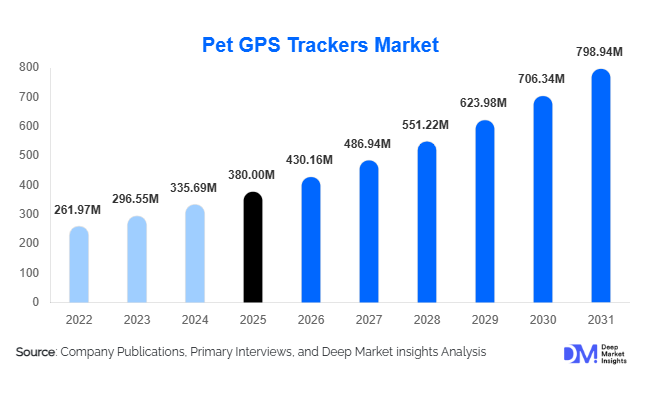
According to Deep Market Insights, the global pet GPS trackers market size was valued at USD 380 million in 2025 and is projected to grow from USD 430.16 million in 2026 to reach USD 798.94 million by 2031, expanding at a CAGR of 13.2% during the forecast period (2026–2031). The pet GPS trackers market growth is primarily driven by rising pet humanization, increasing concerns around pet safety and theft prevention, rapid adoption of smart pet wearables, and continuous advancements in GPS, cellular, and IoT connectivity technologies.
Key Market Insights
- Pet GPS trackers are rapidly evolving into smart connected wearables by integrating real-time tracking, health monitoring, and behavioral analytics.
- Subscription-based service models are reshaping revenue structures, enabling recurring income through mobile apps, cloud platforms, and premium analytics.
- North America dominates the global market, supported by high pet ownership rates and strong adoption of connected devices.
- Asia-Pacific is the fastest-growing region, driven by rising middle-class incomes, urbanization, and expanding pet ownership in China and India.
- Dogs account for the majority of demand due to higher outdoor activity levels and increased owner concern around loss prevention.
- Advancements in LTE-M, NB-IoT, and satellite-assisted GPS are improving battery life, coverage accuracy, and device reliability.
What are the latest trends in the pet GPS trackers market?
Integration of Health and Activity Monitoring
Pet GPS trackers are increasingly being designed as multifunctional wearables that go beyond location tracking. Manufacturers are integrating activity monitoring, sleep analysis, calorie tracking, and behavioral insights to provide a holistic view of pet wellness. These features allow owners to detect unusual activity patterns that may indicate health issues, driving adoption among health-conscious pet parents. The convergence of GPS tracking with preventive pet healthcare is positioning these devices as essential tools rather than optional accessories.
Expansion of Subscription-Based Digital Ecosystems
The market is witnessing a strong shift toward subscription-driven business models. Pet GPS trackers are bundled with mobile applications that offer real-time alerts, historical movement data, geofencing notifications, and cloud-based analytics. Premium subscription tiers provide advanced features such as veterinary insights, multi-pet management, and international roaming coverage. This trend is improving customer retention while enabling manufacturers to generate stable, recurring revenue streams.
What are the key drivers in the pet GPS trackers market?
Rising Pet Humanization and Safety Concerns
Pets are increasingly considered family members, leading owners to invest more in their safety and well-being. Rising cases of lost pets, urban living constraints, and higher outdoor mobility of companion animals have amplified demand for real-time tracking solutions. Pet GPS trackers offer peace of mind by enabling instant location access and escape alerts, making them highly attractive to modern pet owners.
Advancements in Connectivity and Battery Technology
Technological improvements in GPS accuracy, low-power wide-area networks, and battery efficiency are accelerating market growth. LTE-M and NB-IoT technologies enable longer battery life and broader coverage, even in semi-rural locations. These advancements address earlier limitations of frequent charging and unreliable connectivity, improving user experience and expanding adoption.
What are the restraints for the global market?
High Total Cost of Ownership
Despite declining device prices, the combined cost of hardware and recurring subscription fees remains a challenge in price-sensitive markets. Monthly connectivity charges and premium feature subscriptions can deter adoption among cost-conscious consumers, particularly in emerging economies.
Data Privacy and Security Concerns
Pet GPS trackers collect continuous location and behavioral data, raising concerns around data privacy and cybersecurity. Increasing regulatory scrutiny related to data protection and cross-border data transfers can increase compliance costs for manufacturers and slow down product launches.
What are the key opportunities in the pet GPS trackers industry?
Emerging Market Expansion in Asia-Pacific and Latin America
Rapid growth in pet ownership across China, India, Brazil, and Southeast Asia presents significant opportunities. Localized pricing strategies, regional language support, and partnerships with local e-commerce platforms can help manufacturers penetrate these high-growth markets effectively.
Integration with Veterinary and Pet Insurance Ecosystems
There is growing potential to integrate pet GPS trackers with veterinary services and pet insurance platforms. Health and activity data collected through trackers can support preventive care, risk profiling, and personalized insurance premiums, creating new revenue channels and strategic partnerships.
Report Scope
| Report Metric | Details |
|---|---|
| Market Size in 2025 | USD 380 Million |
| Market Size in 2026 | USD 430.16 Million |
| Market Size in 2031 | USD 798.94 Million |
| CAGR | 13.2% (2026-2031) |
| Base Year for Estimation | 2025 |
| Historical Data | 2022-2024 |
| Forecast Period | 2026-2031 |
| Report Coverage | Revenue Forecast, Competitive Landscape, Supply Chain Disruption, Growth Factors, Environment & Regulatory Landscape and Trends |
| Geographies Covered | North America, Europe, APAC, Middle East and Africa, LATAM |
| Countries Covered | U.S., Canada, U.K., Germany, France, Spain, Italy, Russia, Nordic, Benelux, Rest of Europe, China, Korea, Japan, India, Australia, Singapore, Taiwan, South East Asia, Rest of Asia-Pacific, UAE, Turky, Saudi Arabia, South Africa, Egypt, Nigeria, Rest of MEA, Brazil, Mexico, Argentina, Chile, Colombia, Rest of LATAM |
Explore more data points, trends and opportunities Download Free Sample Report
Product Type Insights
GPS trackers with cellular connectivity dominate the pet GPS trackers market, accounting for nearly 46% of total revenue in 2025. This leadership is primarily driven by their ability to deliver real-time, wide-area location tracking using cellular networks, which offers superior reliability compared to Bluetooth- or short-range solutions. Cellular-enabled GPS trackers are especially preferred by urban pet owners and those with highly mobile pets, as they provide continuous location updates, live tracking features, and instant alerts through smartphone applications. The increasing availability of LTE-M and NB-IoT connectivity has further strengthened this segment by improving battery efficiency while maintaining high tracking accuracy.
GPS trackers integrated with health and activity monitoring represent the fastest-growing product segment, supported by rising demand for multifunctional smart pet wearables. These devices combine location tracking with activity metrics such as steps, sleep patterns, calorie burn, and behavioral insights, positioning them as preventive pet healthcare tools. Growing awareness of pet wellness, coupled with integration of AI-driven analytics and veterinary insights, is accelerating adoption in premium consumer segments.
Application Insights
Real-time location tracking remains the leading application area, representing approximately 41% of total market demand in 2025. This dominance is driven by heightened concerns over pet loss, theft prevention, and outdoor safety, particularly in densely populated urban regions. Live tracking capabilities, location history, and instant notifications provide pet owners with peace of mind and have become core value propositions for GPS tracker adoption.
Geofencing and escape alerts are widely adopted in urban and suburban settings, where pets are more likely to encounter traffic, construction zones, or restricted areas. These features allow owners to set virtual boundaries and receive real-time alerts if a pet exits predefined zones, making them particularly valuable for apartment dwellers and households without enclosed outdoor spaces. Activity, fitness, and behavioral monitoring applications are witnessing rapid growth, driven by increasing focus on pet health and preventive care. When combined with AI-driven analytics, these applications are evolving into high-value use cases that support early detection of health issues, weight management, and behavioral changes, strengthening long-term consumer engagement and subscription renewals.
Distribution Channel Insights
Online direct-to-consumer (D2C) channels dominate the pet GPS trackers market, accounting for nearly 38% of global sales. Brand-owned websites and mobile applications enable manufacturers to control customer experience, bundle subscription services, and provide seamless onboarding for connected features. D2C models also support recurring revenue through subscription renewals and firmware updates.
E-commerce platforms play a critical role in expanding market reach, particularly in emerging economies where digital marketplaces offer wider accessibility and price transparency. Online reviews, product comparisons, and promotional pricing strategies have significantly influenced purchasing decisions, especially among younger, tech-savvy pet owners. Despite the growth of online sales, specialty pet stores and veterinary clinics remain important offline channels. These outlets are particularly relevant for premium, medically oriented, and health-integrated GPS trackers, as veterinary recommendations and in-store demonstrations help build consumer trust and justify higher price points.
End-User Insights
Individual pet owners account for over 72% of total market demand, driven by increasing awareness of pet safety, emotional attachment to companion animals, and growing willingness to invest in smart pet technologies. Rising adoption among millennials and Gen Z pet owners, who are highly receptive to app-based and connected solutions, continues to strengthen this segment.
Professional breeders and pet shelters are increasingly adopting GPS trackers to manage multiple animals, prevent loss, and improve operational efficiency. Bulk purchasing and institutional contracts are supporting steady growth in this segment, particularly in regions with strong animal welfare regulations. Working dogs and service animal organizations represent a niche but high-value end-user segment. These users require rugged, high-accuracy, and long-battery-life GPS trackers capable of operating in demanding environments. Applications in law enforcement, rescue operations, and assistance services are driving demand for advanced tracking and performance monitoring solutions.
Explore more data points, trends and opportunities Download Free Sample Report
Pet GPS Trackers Market Segmentations
By Product Type
- Standalone GPS Trackers
- GPS Trackers with Cellular Connectivity
- GPS + Health & Activity Monitoring Trackers
- Hybrid GPS-RFID Trackers
By Application
- Real-Time Location Tracking
- Geofencing & Escape Alerts
- Activity & Fitness Monitoring
- Behavioral & Health Monitoring
By Distribution Channel
- Online Direct-to-Consumer (Brand Websites)
- E-commerce Platforms
- Specialty Pet Stores
- Veterinary Clinics & Pet Hospitals
By End User
- Individual Pet Owners
- Professional Pet Breeders
- Pet Shelters & Rescue Organizations
- Working Dogs & Service Animal Organizations
Regional Insights
North America
North America leads the global pet GPS trackers market with approximately 39% share in 2025, with the United States accounting for the majority of regional demand. Key growth drivers include high pet ownership rates, elevated disposable income levels, and early adoption of subscription-based smart devices. Strong consumer awareness of pet safety technologies, widespread smartphone penetration, and a mature IoT ecosystem further support market dominance. Additionally, the presence of leading market players and strong veterinary networks accelerates product adoption and innovation.
Europe
Europe represents nearly 28% of the global market, led by the U.K., Germany, and France. Growth in this region is driven by a strong regulatory focus on animal welfare, mandatory pet identification practices in several countries, and high consumer acceptance of connected devices. Increasing demand for health-integrated GPS trackers and rising emphasis on preventive pet care are further supporting steady market expansion across Western and Northern Europe.
Asia-Pacific
Asia-Pacific is the fastest-growing regional market, registering a CAGR exceeding 20%. Rapid urbanization, expanding middle-class populations, and rising pet adoption rates in China and India are primary growth drivers. Increasing awareness of pet safety, improving digital infrastructure, and growing penetration of e-commerce platforms are accelerating adoption. In developed markets such as Japan and South Korea, demand is further supported by strong interest in premium smart pet wearables and technologically advanced tracking solutions.
Latin America
Latin America accounts for approximately 6% of global demand, with Brazil and Mexico emerging as key growth markets. Rising pet ownership, increasing disposable income among urban households, and expanding access to online retail platforms are supporting market growth. As awareness of pet safety solutions improves, adoption of entry-level and mid-range GPS trackers is expected to increase steadily.
Middle East & Africa
The Middle East & Africa region holds around 4% of the global market, led by the UAE and Saudi Arabia. Growth is driven by premium pet ownership trends, rising adoption of smart home and IoT devices, and increasing disposable income in Gulf countries. In parts of Africa, demand is gradually emerging through working dogs, security applications, and growing urban pet ownership, supported by improving mobile connectivity.