Packaged Rice Snacks Market Size
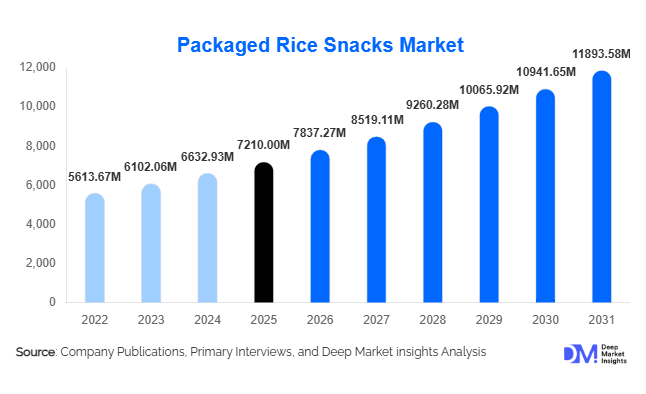
According to Deep Market Insights, the global packaged rice snacks market size was valued at USD 7,210 million in 2025 and is projected to grow from USD 7,837.27 million in 2026 to reach USD 11,893.58 million by 2031, expanding at a CAGR of 8.7% during the forecast period (2026–2031). The packaged rice snacks market growth is primarily driven by increasing consumer preference for healthier snack alternatives, rising demand for gluten-free and plant-based products, and continuous innovation in flavor profiles and processing technologies. Growing urbanization, expansion of modern retail infrastructure, and the rising popularity of convenient on-the-go snacking formats are further accelerating global adoption of rice-based snack products.
Key Market Insights
- Health-oriented snacking trends are reshaping product positioning, with rice snacks increasingly marketed as low-fat, gluten-free, and clean-label alternatives to traditional fried snacks.
- Product innovation through global flavor diversification is expanding consumer appeal, particularly through Asian-inspired and regional seasoning profiles.
- Asia-Pacific dominates global consumption, supported by strong rice production ecosystems and established snack consumption cultures.
- North America represents a high-value premium market, driven by functional snacks and dietary-specific product demand.
- E-commerce and direct-to-consumer sales channels are accelerating market penetration for emerging brands globally.
- Processing technology advancements, including air-popping and baked extrusion methods, are improving product texture while reducing oil content.
What are the latest trends in the packaged rice snacks market?
Premiumization and Functional Snack Innovation
Packaged rice snacks are increasingly transitioning from traditional staple-based snacks into premium health-oriented products. Manufacturers are introducing fortified variants enriched with plant proteins, dietary fiber, probiotics, and micronutrients to attract wellness-focused consumers. Functional positioning allows brands to command higher price points while expanding beyond traditional snack aisles into health and nutrition categories. Clean-label formulations with reduced sodium, organic ingredients, and non-GMO certifications are becoming industry norms, particularly in developed markets where transparency and ingredient sourcing significantly influence purchasing decisions.
Globalization of Asian Snack Formats
The globalization of Asian culinary culture has significantly boosted demand for rice crackers, puffed rice snacks, and seasoned rice crisps worldwide. Consumers are increasingly drawn toward ethnic flavors such as teriyaki, kimchi, masala, and seaweed, transforming rice snacks into culturally diverse offerings. This trend is enabling multinational brands to localize flavors while maintaining scalable manufacturing models. Social media exposure and cross-border retail expansion are further accelerating adoption, allowing regional snack styles to achieve global popularity.
What are the key drivers in the packaged rice snacks market?
Growing Demand for Gluten-Free and Better-for-You Snacks
The rising prevalence of gluten sensitivity and lifestyle-driven dietary preferences has positioned rice-based snacks as a preferred alternative to wheat-based products. Rice’s naturally gluten-free composition provides manufacturers with a strong health positioning advantage. Retailers are expanding shelf space for gluten-free snacks, increasing product visibility and driving consistent growth. Consumers increasingly associate rice snacks with lightness, digestibility, and calorie control, strengthening repeat purchase behavior across multiple regions.
Expansion of Convenience and On-the-Go Consumption
Urban lifestyles and evolving eating habits are driving multiple daily snacking occasions. Single-serve packaged rice snacks cater effectively to busy consumers seeking convenient and portable food options. Growth in workplace snacking, travel retail, and vending channels has amplified demand for lightweight and shelf-stable snack formats. Manufacturers are responding through portion-controlled packaging innovations that balance convenience with health-conscious consumption patterns.
What are the restraints for the global market?
Volatility in Raw Rice Prices
Fluctuations in global rice production caused by climate variability, export policies, and agricultural disruptions can significantly impact manufacturing costs. Since rice remains the primary raw material, price instability directly affects profit margins and pricing strategies for snack producers. Companies must increasingly adopt diversified sourcing strategies and long-term procurement contracts to manage cost risks.
Perception of Limited Indulgence Compared to Traditional Snacks
Despite health advantages, rice snacks are sometimes perceived as less indulgent compared to potato chips or corn-based snacks. This perception limits penetration among consumers seeking bold flavors or indulgent textures. Continuous innovation in seasoning, texture engineering, and hybrid snack formats remains essential to broaden consumer appeal and overcome this restraint.
What are the key opportunities in the packaged rice snacks industry?
Functional and Protein-Enriched Rice Snacks
The convergence of snacking and nutrition presents major growth opportunities. Brands integrating plant-based proteins, ancient grains, and fortified ingredients are expanding rice snacks into sports nutrition and wellness segments. This evolution enables market participants to attract health-conscious millennials and fitness-oriented consumers while achieving higher margins through premium positioning.
Emerging Market Consumption Growth
Rapid urbanization and rising disposable incomes across India, Southeast Asia, and Latin America are creating new demand pools for packaged snacks. Modern retail expansion and increasing exposure to international brands are accelerating consumer adoption. Localized flavor innovation combined with affordable pricing strategies provides strong opportunities for both multinational corporations and regional manufacturers.
Report Scope
| Report Metric | Details |
|---|---|
| Market Size in 2025 | USD 7210 Million |
| Market Size in 2026 | USD 7837.27 Million |
| Market Size in 2031 | USD 11893.58 Million |
| CAGR | 8.7% (2026-2031) |
| Base Year for Estimation | 2025 |
| Historical Data | 2022-2024 |
| Forecast Period | 2026-2031 |
| Report Coverage | Revenue Forecast, Competitive Landscape, Supply Chain Disruption, Growth Factors, Environment & Regulatory Landscape and Trends |
| Geographies Covered | North America, Europe, APAC, Middle East and Africa, LATAM |
| Countries Covered | U.S., Canada, U.K., Germany, France, Spain, Italy, Russia, Nordic, Benelux, Rest of Europe, China, Korea, Japan, India, Australia, Singapore, Taiwan, South East Asia, Rest of Asia-Pacific, UAE, Turky, Saudi Arabia, South Africa, Egypt, Nigeria, Rest of MEA, Brazil, Mexico, Argentina, Chile, Colombia, Rest of LATAM |
Explore more data points, trends and opportunities Download Free Sample Report
Product Type Insights
The packaged rice snacks market is characterized by diverse product offerings catering to evolving consumer preferences for healthier, convenient, and culturally familiar snack options. Rice chips and crisps represent the leading product category, accounting for nearly 28% of global demand. Their dominance is primarily driven by their resemblance to traditional potato chips while offering perceived health advantages such as gluten-free formulations, lower oil absorption during processing, and cleaner ingredient positioning. Manufacturers continue to innovate within this segment through flavor diversification, baked processing technologies, and fortified variants enriched with protein, fiber, or plant-based ingredients, further strengthening consumer adoption.Rice crackers maintain strong and consistent demand, particularly across Asia-Pacific markets where they are deeply rooted in traditional snacking cultures. Their popularity is supported by long shelf life, portion control convenience, and growing premiumization through gourmet flavors and artisanal production techniques. Meanwhile, puffed rice snacks are witnessing expanding global penetration due to their affordability, light texture, and suitability for mass-market consumption. These products appeal strongly to cost-conscious consumers as well as health-focused buyers seeking low-calorie snack alternatives.Sweet rice snacks represent a smaller yet rapidly emerging niche within the market. Growth in this segment is fueled by dessert-inspired innovations, chocolate-coated formats, caramel-infused varieties, and fusion flavors targeting younger consumers and indulgence-oriented buyers. Increasing experimentation with hybrid snack formats combining sweet and savory elements is expected to further enhance category diversification and expand consumer engagement across multiple age groups.
Application Insights
Household retail consumption remains the largest application segment within the packaged rice snacks market, driven by the integration of convenient snack foods into daily eating habits. Changing lifestyles, increasing work-from-home trends, and growing preference for ready-to-eat foods have reinforced regular household consumption. Rice snacks are increasingly positioned as healthier pantry staples, contributing to sustained volume demand across developed and emerging markets.The on-the-go snacking application segment is experiencing the fastest expansion as consumers increasingly replace traditional meals with smaller, frequent eating occasions. Urbanization, longer commuting times, and busy professional lifestyles have accelerated demand for portable snack formats that combine convenience with nutritional appeal. Compact packaging, resealable pouches, and single-serve formats further support adoption in this segment.Institutional demand is also gaining momentum, particularly across airlines, schools, healthcare facilities, and corporate cafeterias. Rice snacks are increasingly selected due to their allergen-friendly properties, gluten-free positioning, and ability to meet diverse dietary requirements. Additionally, emerging applications include inclusion in curated wellness snack bundles, fitness-focused meal kits, and subscription-based food delivery services, reflecting the broader shift toward personalized nutrition and direct-to-consumer distribution models.
Distribution Channel Insights
Supermarkets and hypermarkets continue to dominate distribution channels due to extensive product visibility, organized shelf placement, and strong impulse purchasing behavior. Large retail chains enable manufacturers to launch new flavors and premium product lines while leveraging promotional campaigns and in-store sampling to drive consumer trial. The wide assortment availability within these retail environments remains a key driver supporting category growth.Online retail represents the fastest-growing distribution channel, supported by rapid digitalization of grocery purchasing and increasing consumer reliance on e-commerce platforms. The convenience of home delivery, subscription snack services, and personalized product recommendations has significantly improved online penetration. Brands are increasingly utilizing direct-to-consumer platforms and digital marketing strategies to expand reach and gather consumer insights.Specialty health stores play an important role in supporting premium and organic rice snack brands by targeting health-conscious consumers seeking clean-label, vegan, or functional snack options. Meanwhile, convenience stores remain essential for impulse-driven purchases, particularly in urban areas where quick accessibility and immediate consumption drive frequent buying behavior. Expansion of modern retail infrastructure across emerging economies is further strengthening multi-channel distribution networks.
End-User Insights
Household consumers account for the majority of packaged rice snack demand, supported by increasing home-based snacking habits and rising awareness of healthier food alternatives. Families increasingly prefer snacks perceived as lighter and less processed, positioning rice-based products as suitable options for both adults and children. Growing emphasis on balanced diets and portion-controlled eating continues to reinforce household adoption.Young professionals and students represent a major growth demographic, driven by demand for portable, affordable, and convenient snack solutions compatible with fast-paced lifestyles. This consumer group actively seeks innovative flavors, modern packaging formats, and functional benefits such as energy support or reduced calorie intake. Social media influence and digital brand engagement further accelerate purchasing decisions among younger consumers.Foodservice operators are gradually incorporating rice snacks into menus as healthier alternatives to conventional fried snacks. Adoption is particularly visible within travel catering, institutional dining environments, and quick-service outlets seeking to diversify snack offerings while aligning with health-focused consumer expectations. As foodservice providers emphasize menu innovation and dietary inclusivity, rice snacks are increasingly positioned as versatile accompaniment items and standalone snack options.
Explore more data points, trends and opportunities Download Free Sample Report
Packaged Rice Snacks Market Segmentations
Product Type
- Rice Chips Crisps
- Rice Crackers
- Puffed Rice Snacks
- Sweet Rice Snacks
- Rice Cakes Thin Rice Bites
Flavor Type
- Plain Lightly Salted
- Savory Spiced
- Sweet Dessert-Based
- Ethnic Regional Flavors
Distribution Channel
- Supermarkets Hypermarkets
- Convenience Stores
- Online Retail E-commerce
- Specialty Health Organic Stores
- Foodservice Institutional Sales
End User
- Household Consumers
- On-the-Go Consumers
- Institutional Buyers
- Foodservice Operators
Regional Insights
North America
North America accounts for approximately 24% of the global packaged rice snacks market, led primarily by the United States and supported by strong consumer awareness of health and wellness trends. Regional growth is driven by rising demand for gluten-free, non-GMO, and functional snack products aligned with evolving dietary preferences. Increasing prevalence of lifestyle-related health concerns has encouraged consumers to shift toward lighter snack alternatives, accelerating adoption of rice-based snacks. Advanced retail infrastructure, widespread e-commerce penetration, and strong product innovation from established snack manufacturers further support market expansion. Premium organic rice snacks, protein-fortified variants, and plant-based offerings are particularly popular among urban and millennial consumers, contributing to sustained category premiumization.
Europe
Europe represents nearly 19% of global demand, with Germany, the United Kingdom, France, and Italy emerging as key consumption markets. Regional growth is strongly influenced by clean-label movements and stringent regulatory frameworks promoting healthier food choices and transparent ingredient sourcing. Consumers increasingly prefer baked snacks with reduced fat content, driving adoption of rice-based alternatives positioned as natural and minimally processed. Sustainability considerations also play a significant role, with demand rising for recyclable packaging and ethically sourced raw materials. Expanding vegan and vegetarian populations across Europe further contribute to growth, as rice snacks align well with plant-based dietary patterns and allergen-conscious consumption trends.
Asia-Pacific
Asia-Pacific dominates the global packaged rice snacks market with approximately 42% share, supported by long-standing cultural familiarity with rice-based foods and strong regional manufacturing capabilities. China, Japan, South Korea, and India serve as major growth engines due to established snack traditions combined with rapid modernization of retail channels. Continuous flavor innovation, localized product development, and expansion of convenience store networks drive widespread consumption across both urban and semi-urban populations. India represents one of the fastest-growing markets within the region, fueled by rising disposable incomes, expanding middle-class demographics, and increasing penetration of packaged foods into traditional retail outlets. Growth is further supported by younger consumers embracing branded snack products and manufacturers introducing affordable price points tailored to mass-market demand.
Latin America
Latin America holds approximately 8% market share, led by Brazil and Mexico, where changing dietary patterns and urbanization are reshaping snack consumption habits. Regional growth is driven by the expansion of modern retail formats, improving cold-chain logistics, and increasing exposure to global snack trends. Price sensitivity among consumers encourages strong demand for affordable puffed rice snacks, which offer value-oriented alternatives to premium snack categories. Rising participation of women in the workforce and increasing demand for convenient ready-to-eat foods further support adoption. Additionally, regional manufacturers are introducing localized flavors and culturally relevant seasoning profiles to strengthen consumer engagement.
Middle East & Africa
The Middle East & Africa region accounts for nearly 7% of global demand and is witnessing gradual but steady expansion driven by improving retail infrastructure and shifting consumer preferences toward healthier snack alternatives. Growth is particularly evident in the United Arab Emirates and Saudi Arabia, where modern supermarkets and international food brands are expanding rapidly. Increasing expatriate populations introduce diverse dietary preferences, boosting demand for globally recognized snack formats including rice-based products. Rising health awareness, growing youth populations, and increasing availability of imported and premium snack options contribute to market development. In addition, expanding e-commerce adoption and investment in food distribution networks are expected to enhance accessibility and support long-term regional growth.
Key Players in the Packaged Rice Snacks Market
- PepsiCo Inc.
- Kellogg Company
- Mondelez International Inc.
- Kameda Seika Co., Ltd.
- Want Want China Holdings Ltd.
- Nestlé S.A.
- Calbee Inc.
- Sanko Seika Co., Ltd.
- Lundberg Family Farms
- Hain Celestial Group
- Element Snacks Inc.
- Orion Corporation
- Thai Lee Agriculture Co.
- Naturell India Pvt. Ltd.
- Want-Want Holdings International