Packaged Pretzels Market Size
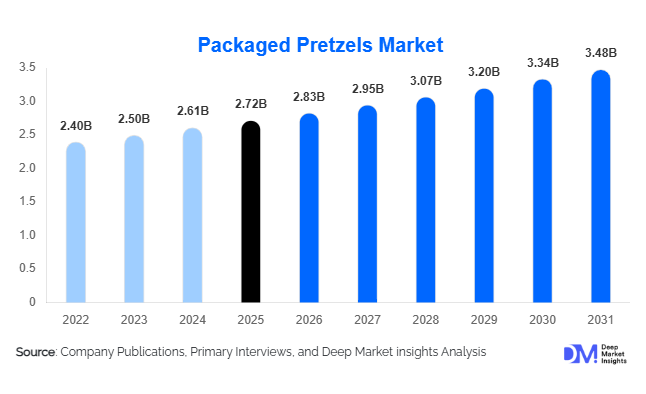
According to Deep Market Insights, the global packaged pretzels market size was valued at USD 2.72 billion in 2025 and is projected to grow from USD 2.83 billion in 2026 to reach USD 3.48 billion by 2031, expanding at a CAGR of 4.2% during the forecast period (2026–2031). The packaged pretzels market growth is primarily driven by the increasing demand for convenient, on-the-go snack options, rising preference for flavored and health-focused variants, and the expansion of retail and e-commerce distribution channels worldwide.
Key Market Insights
- Hard pretzels remain the leading product type, favored for their long shelf life, convenience, and widespread availability in supermarkets and convenience stores globally.
- Salted/classic pretzel variants dominate flavor preferences, supported by strong consumer familiarity and routine snacking behavior across multiple consumption occasions.
- North America holds the largest regional market share, driven by high snack consumption, extensive retail infrastructure, and strong e-commerce penetration.
- Asia-Pacific is emerging as the fastest-growing region, led by rising urbanization, westernized diets, and growing disposable incomes in countries like China and India.
- Online retail channels are expanding rapidly, allowing consumers to access a wider variety of flavors, packaging formats, and premium product offerings through e-commerce platforms.
- Innovation in flavors and health-focused pretzels, including low-sodium, protein-fortified, and gluten-free variants, is driving market differentiation and growth.
What are the latest trends in the packaged pretzels market?
Flavor and Functional Innovation
Manufacturers are expanding flavor portfolios, introducing savory, sweet, and coated pretzels to cater to evolving consumer tastes. Functional pretzels, such as high-protein, gluten-free, and low-sodium options, are increasingly popular among health-conscious consumers. This trend not only broadens market appeal but allows brands to target premium pricing segments, attracting both young adults and fitness-focused demographics. Regional flavors inspired by local tastes are also gaining traction, providing opportunities for differentiation in competitive markets.
Expansion of E-Commerce and Direct-to-Consumer Channels
The growth of online grocery platforms, subscription snack boxes, and direct-to-consumer websites has transformed the packaged pretzels market. Consumers increasingly rely on digital channels to access niche flavors, specialty packaging, and bulk packs. Online platforms allow brands to test new products, gather consumer feedback, and deliver personalized snack bundles, enhancing brand engagement and repeat purchases. This trend is particularly strong in North America, Europe, and APAC countries with high internet penetration.
What are the key drivers in the packaged pretzels market?
Convenience and Snacking Culture
Global consumers are increasingly adopting on-the-go lifestyles, driving demand for ready-to-eat snacks such as packaged pretzels. The portability, ease of storage, and long shelf life of hard pretzels make them ideal for busy households, office consumption, and travel. Urbanization, increasing working populations, and shorter meal patterns are significant factors supporting the convenience-driven growth of this market.
Premiumization and Taste Diversification
Flavor innovation and premium pretzel variants are attracting consumers willing to pay more for indulgence or unique taste experiences. Specialty coatings, sweet-salty combinations, and health-enriched formulations (e.g., protein, fiber, low-sodium) are enabling manufacturers to cater to premium and functional snack segments. This diversification has increased brand loyalty and market share among both traditional and younger consumers.
What are the restraints for the global market?
Health Concerns Over Sodium and Additives
High sodium content in traditional pretzels can limit appeal among health-conscious consumers. Awareness campaigns around salt intake and processed snack consumption have driven some buyers to reduce pretzel consumption, especially in markets like North America and Europe.
Raw Material Price Volatility
Fluctuating wheat and grain prices, coupled with transportation and packaging cost increases, can affect profitability. Smaller manufacturers may struggle to absorb these costs, impacting pricing flexibility and limiting market expansion in price-sensitive regions.
What are the key opportunities in the packaged pretzels industry?
Health-Focused and Functional Pretzels
Growing consumer awareness of nutrition creates opportunities for low-sodium, high-protein, gluten-free, and fortified pretzel variants. These products appeal to active and health-conscious consumers, expanding the target audience beyond traditional snack buyers. Manufacturers investing in these categories can leverage premium pricing and brand differentiation strategies.
Emerging Markets and Retail Expansion
Rapid urbanization and modern retail expansion in Asia-Pacific and Latin America offer untapped opportunities. Increasing supermarket penetration, growing middle-class income, and rising exposure to Western-style snacks are supporting demand. Early entrants in these regions can establish strong brand presence and scale distribution networks before market saturation occurs.
Report Scope
| Report Metric | Details |
|---|---|
| Market Size in 2025 | USD 2.72 Billion |
| Market Size in 2026 | USD 2.83 Billion |
| Market Size in 2031 | USD 3.48 Billion |
| CAGR | 4.2% (2026-2031) |
| Base Year for Estimation | 2025 |
| Historical Data | 2022-2024 |
| Forecast Period | 2026-2031 |
| Report Coverage | Revenue Forecast, Competitive Landscape, Supply Chain Disruption, Growth Factors, Environment & Regulatory Landscape and Trends |
| Geographies Covered | North America, Europe, APAC, Middle East and Africa, LATAM |
| Countries Covered | U.S., Canada, U.K., Germany, France, Spain, Italy, Russia, Nordic, Benelux, Rest of Europe, China, Korea, Japan, India, Australia, Singapore, Taiwan, South East Asia, Rest of Asia-Pacific, UAE, Turky, Saudi Arabia, South Africa, Egypt, Nigeria, Rest of MEA, Brazil, Mexico, Argentina, Chile, Colombia, Rest of LATAM |
Explore more data points, trends and opportunities Download Free Sample Report
Product Type Insights
The global pretzel market is primarily led by hard pretzels, which account for approximately ~72% of total market share in 2025. The dominance of hard pretzels is largely attributed to their extended shelf life, ease of transportation, cost-efficient large-scale manufacturing, and strong compatibility with modern retail distribution systems. Their durability allows manufacturers and retailers to maintain inventory efficiency while supporting global export activities, making them the preferred format across supermarkets, convenience stores, and e-commerce platforms. Increasing consumer preference for convenient, ready-to-eat snacks that combine affordability with consistent taste profiles continues to reinforce demand for hard pretzels across developed and emerging markets.Soft pretzels are witnessing steady expansion, particularly within foodservice environments such as bakeries, stadiums, cafes, and quick-service restaurants, where freshness and experiential consumption play a significant role. Growth in premium retail formats and frozen ready-to-bake offerings is further expanding accessibility beyond traditional outlets. Meanwhile, filled pretzels and mini pretzels are emerging as innovation-driven formats, appealing to consumers seeking indulgent snacking experiences, portion control, and flavor variety. These products benefit from rising experimentation with cheese-filled, chocolate-coated, and seasoned variants that align with evolving consumer expectations for novelty and sensory appeal.Specialty and artisanal pretzels, including organic, gluten-conscious, and regionally inspired flavor profiles, are gaining momentum in urban markets and online retail ecosystems. Premiumization trends, coupled with growing awareness of ingredient sourcing and clean-label formulations, are encouraging manufacturers to introduce small-batch and craft-style offerings. The increasing penetration of direct-to-consumer platforms and niche snack subscription models further supports the expansion of specialty pretzels, positioning them as high-margin products targeting affluent and health-aware consumers.
Application Insights
Retail consumption represents the largest application segment in the global pretzel market, primarily driven by rising at-home snacking habits, impulse purchasing behavior, and increasing demand for convenient packaged foods. The leading driver for this segment is the structural shift toward frequent snacking occasions replacing traditional meal patterns, particularly among working professionals and younger demographics. Multi-pack formats, resealable packaging, and value offerings encourage bulk purchasing while enhancing household consumption frequency. Retailers are also expanding private-label pretzel offerings, improving price accessibility and category penetration.The foodservice application segment is expanding rapidly as pretzels become integrated into diversified menus across cafes, quick-service restaurants, entertainment venues, and transportation hubs. Pretzels serve as versatile menu items that can be positioned as snacks, meal accompaniments, or premium experiential foods. Increasing demand for grab-and-go meal solutions and convenience-oriented eating habits is encouraging operators to incorporate both fresh and packaged pretzel options. Additionally, vending machine channels and institutional catering environments are contributing incremental volume growth.Emerging consumption avenues such as online snack subscription services, corporate gifting programs, and curated snack assortments are reshaping application dynamics. These channels benefit from rising digital commerce adoption and consumer interest in discovery-based purchasing experiences. Export-oriented demand is also expanding, particularly in markets with limited domestic pretzel manufacturing capacity but increasing exposure to Western snack brands through globalization and tourism.
Distribution Channel Insights
Supermarkets and hypermarkets remain the dominant distribution channel, accounting for approximately ~42% of global market share in 2025. The leadership of this segment is primarily driven by strong product visibility, organized shelf placement, promotional pricing strategies, and consumer preference for one-stop shopping environments. Large retail chains enable manufacturers to launch new flavors and formats at scale while benefiting from established logistics infrastructure and consistent consumer footfall.Convenience stores continue to play a critical role in impulse-driven purchases, particularly in urban areas where on-the-go consumption patterns are prevalent. Smaller pack sizes and single-serve formats perform strongly in this channel, supported by increasing commuter traffic and extended store operating hours. The accessibility of convenience retail supports frequent purchase cycles and enhances brand exposure.E-commerce represents the fastest-growing distribution channel, supported by rapid digital adoption, direct-to-consumer strategies, and targeted online marketing campaigns. Subscription snack boxes, personalized recommendations, and bundled product offerings are improving customer retention and purchase frequency. Social media engagement, influencer collaborations, and digital advertising campaigns are increasingly integrated into brand strategies, enabling companies to connect directly with younger consumers and niche audiences.Foodservice distribution is expanding across metropolitan regions, where pretzels are offered as both packaged snacks and freshly prepared items. Partnerships between manufacturers and foodservice operators are strengthening supply chain integration while enabling menu innovation and localized product customization.
Consumer Type Insights
Group households and family consumers represent the largest consumer segment, driven by shared snacking occasions and cost-efficient multi-pack purchases. The leading driver for this segment is the increasing normalization of communal snacking during entertainment, social gatherings, and home-based leisure activities. Pretzels are widely perceived as versatile snacks suitable for diverse age groups, supporting repeat household purchases and strong brand loyalty.Young adults aged 18–30 years significantly influence market innovation, driving demand for bold flavors, bite-sized formats, and better-for-you positioning. This demographic demonstrates strong engagement with digital retail channels and responds actively to social media marketing, limited-edition launches, and experiential branding strategies. Health-conscious variants, including baked and reduced-sodium pretzels, resonate particularly well within this consumer group.Consumers aged 31–50 years contribute substantially to premium and soft pretzel demand, prioritizing product quality, taste authenticity, and convenience. Their purchasing behavior increasingly reflects willingness to pay for premium ingredients and artisanal formats. High-income consumers across age groups are accelerating adoption of specialty pretzels positioned as indulgent yet sophisticated snack alternatives, reinforcing premiumization trends within the category.
Explore more data points, trends and opportunities Download Free Sample Report
Packaged Pretzels Market Segmentations
By Product Type
- Hard Pretzels
- Soft Pretzels
- Filled Pretzels
- Mini & Bite-Sized Pretzels
- Specialty/Artisanal Pretzels
By Flavor Type
- Salted/Classic
- Savory/Seasoned
- Sweet/Coated
- Health-Focused/Functional
By Distribution Channel
- Supermarkets & Hypermarkets
- Convenience Stores
- Online Retail
- Foodservice & Vending
By Consumer Type
- Households/Families
- Young Adults
- Adults
- High-Income/Premium Consumers
Regional Insights
North America
North America represents the largest regional market, accounting for approximately ~42–45% of global market share in 2025, with the United States serving as the primary growth engine. Regional growth is driven by deeply established snacking culture, high per-capita consumption of savory snacks, and extensive retail penetration across both physical and digital channels. Continuous product innovation, including flavored, protein-enriched, and better-for-you pretzel variants, supports category expansion. Advanced logistics networks, strong private-label competition, and high adoption of e-commerce grocery platforms further enhance accessibility. Additionally, packaging innovation focused on portability and freshness retention encourages repeat purchases and strengthens brand differentiation.
Europe
Europe holds approximately ~25–28% of the global pretzel market, supported by strong cultural heritage and traditional consumption patterns, particularly in Germany, alongside expanding demand in the United Kingdom and France. Regional growth is driven by premiumization trends, increasing preference for authentic bakery-style snacks, and rising demand for organic and clean-label food products. Western European consumers are increasingly seeking functional snack options with reduced additives and improved nutritional profiles. The expansion of specialty retail stores and artisanal bakeries, combined with innovation in flavored and gourmet pretzel offerings, continues to elevate market value across the region.
Asia-Pacific
Asia-Pacific is the fastest-growing regional market, accounting for approximately ~15–18% share in 2025. Growth is primarily driven by rapid urbanization, expanding middle-class populations, and increasing exposure to Western snack formats across China, India, and South Korea. The proliferation of modern retail infrastructure and strong growth in mobile-based e-commerce platforms are accelerating product accessibility. Younger consumers influenced by global food trends and social media are increasingly experimenting with premium and imported snack products. Localization strategies, including regionally adapted flavors and smaller packaging formats, are further supporting market penetration across diverse consumer groups.
Latin America
Latin America accounts for approximately ~7–9% of global market share, with Brazil, Mexico, and Argentina serving as key markets. Regional growth is supported by rising disposable incomes, expanding urban populations, and gradual modernization of retail infrastructure. Increasing penetration of supermarkets and convenience retail is improving availability of packaged snack products, while younger consumers drive demand for affordable indulgent snacks. Manufacturers are introducing competitively priced offerings and localized flavor innovations to capture price-sensitive yet aspirational consumers seeking international snack experiences.
Middle East & Africa
The Middle East & Africa region contributes approximately ~5–7% of global market share, led by demand in South Africa, the United Arab Emirates, and Saudi Arabia. Growth in this region is driven by rapid urban development, expanding expatriate populations, and rising adoption of Western-style snacking habits. Increasing disposable income levels and the expansion of modern retail and mall-based foodservice outlets are improving product accessibility. Additionally, the growth of organized retail chains and rising youth demographics are fostering higher consumption of packaged snacks, positioning pretzels as convenient and premium snack alternatives within evolving consumption patterns.
Key Players in the Packaged Pretzels Market
- PepsiCo, Inc.
- Utz Brands, Inc.
- Frito-Lay North America
- Intersnack Group GmbH & Co. KG
- Conagra Brands, Inc.
- J&J Snack Foods Corp.
- Baker’s Pretzels, Inc.
- Old Dutch Foods, Ltd.
- Campbell Soup Company
- Pretzel Crisps
- Peeterman’s Snack Company
- Alexander & Hornung GmbH & Co. KG
- Kellogg Company
- MCCORMICK & Company, Inc.
- Grupo Bimbo, S.A.B. de C.V.