Out-of-Home Coffee Market Size
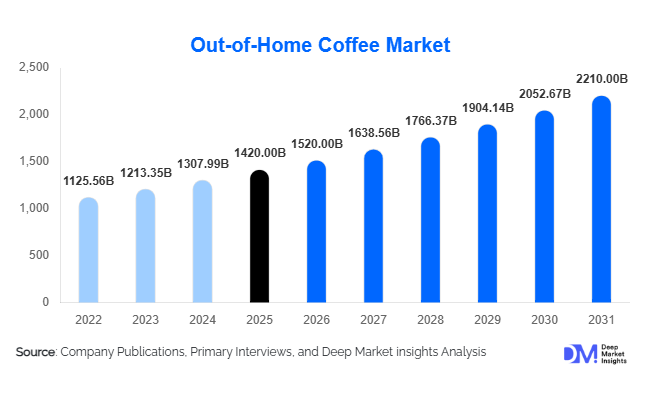
According to Deep Market Insights, the global out-of-home coffee market size was valued at USD 1,420 billion in 2025 and is projected to grow from USD 1,520 billion in 2026 to reach USD 2,210 billion by 2031, expanding at a CAGR of 7.8% during the forecast period (2026–2031). The out-of-home coffee market growth is primarily driven by increasing urbanization, rising disposable incomes, and the expanding café culture worldwide. The growing demand for premium coffee experiences, coupled with the proliferation of global coffee chains and digital ordering platforms, is further accelerating market expansion. Additionally, the shift toward on-the-go consumption and social coffee experiences continues to reshape consumer behavior, positioning out-of-home coffee as a key segment within the global foodservice industry.
Key Market Insights
- Coffee chains dominate the market, accounting for nearly 38% of total consumption due to strong brand presence and global expansion strategies.
- Espresso-based beverages lead demand, contributing over 40% of total sales driven by consumer preference for lattes and cappuccinos.
- Takeaway and on-the-go formats are rapidly expanding, representing approximately 45% of service models globally.
- North America holds the largest market share, supported by high per capita coffee consumption and established café infrastructure.
- Asia-Pacific is the fastest-growing region, fueled by urbanization and increasing Western lifestyle adoption.
- Digital transformation and mobile ordering are reshaping customer engagement and operational efficiency across coffee chains.
What are the latest trends in the out-of-home coffee market?
Premiumization and Specialty Coffee Growth
The out-of-home coffee market is witnessing a strong shift toward premium and specialty coffee offerings. Consumers are increasingly seeking high-quality beans, artisanal brewing methods, and unique flavor profiles. This trend is driving the growth of specialty cafés and premium coffee chains, particularly in urban centers. Single-origin coffees, micro-lot sourcing, and third-wave coffee culture are becoming mainstream, enhancing consumer willingness to pay higher prices for differentiated experiences. Additionally, café ambiance, personalization, and brand storytelling are playing a critical role in attracting younger demographics.
Digitalization and Omnichannel Coffee Retail
Technology integration is transforming the way consumers interact with coffee brands. Mobile ordering, contactless payments, and app-based loyalty programs are becoming standard features across leading coffee chains. Delivery platforms are expanding market reach, enabling consumers to access café-quality coffee without visiting physical outlets. AI-driven personalization, subscription models, and predictive analytics are improving customer retention and operational efficiency. This digital shift is particularly appealing to tech-savvy consumers, accelerating the adoption of omnichannel retail strategies in the coffee industry.
What are the key drivers in the out-of-home coffee market?
Urbanization and Changing Consumer Lifestyles
Rapid urbanization and busy lifestyles are significantly increasing demand for convenient coffee consumption options. Consumers are increasingly relying on takeaway and drive-thru services, making out-of-home coffee an essential part of daily routines. The rise of co-working spaces and flexible work environments is further supporting demand for café-based social and professional interactions.
Expansion of Global and Regional Coffee Chains
The aggressive expansion of international and regional coffee chains is driving accessibility and market penetration. Franchising models are enabling rapid outlet growth, particularly in emerging markets such as India, China, and Southeast Asia. This expansion is increasing consumer exposure to branded coffee experiences, boosting overall market demand.
What are the restraints for the global market?
High Operational and Input Costs
Rising costs associated with rent, labor, and raw materials such as coffee beans and dairy products are impacting profit margins for market participants. Independent cafés are particularly vulnerable to cost fluctuations, which can limit their ability to compete with large chains.
Competition from At-Home Coffee Consumption
The increasing adoption of home coffee machines and premium coffee pods is posing a challenge to the out-of-home coffee market. Consumers in developed regions are increasingly replicating café-style beverages at home, which may reduce the frequency of out-of-home consumption.
What are the key opportunities in the out-of-home coffee industry?
Expansion in Emerging Markets
Emerging economies such as India, China, and Indonesia present significant growth opportunities due to rising disposable incomes and evolving consumer preferences. The growing middle-class population and increasing exposure to global coffee culture are driving demand for café experiences in these regions. Market players can leverage localized menus and pricing strategies to capture untapped demand.
Technology Integration and Smart Coffee Ecosystems
The integration of advanced technologies such as AI, IoT-enabled coffee machines, and digital ordering platforms offers significant opportunities for market growth. These technologies enhance operational efficiency, reduce wait times, and improve customer experience. Subscription-based coffee models and personalized recommendations are also emerging as key growth drivers.
Report Scope
| Report Metric | Details |
|---|---|
| Market Size in 2025 | USD 1420 Billion |
| Market Size in 2026 | USD 1520 Billion |
| Market Size in 2031 | USD 2210 Billion |
| CAGR | 7.8% (2026-2031) |
| Base Year for Estimation | 2025 |
| Historical Data | 2022-2024 |
| Forecast Period | 2026-2031 |
| Report Coverage | Revenue Forecast, Competitive Landscape, Supply Chain Disruption, Growth Factors, Environment & Regulatory Landscape and Trends |
| Geographies Covered | North America, Europe, APAC, Middle East and Africa, LATAM |
| Countries Covered | U.S., Canada, U.K., Germany, France, Spain, Italy, Russia, Nordic, Benelux, Rest of Europe, China, Korea, Japan, India, Australia, Singapore, Taiwan, South East Asia, Rest of Asia-Pacific, UAE, Turky, Saudi Arabia, South Africa, Egypt, Nigeria, Rest of MEA, Brazil, Mexico, Argentina, Chile, Colombia, Rest of LATAM |
Explore more data points, trends and opportunities Download Free Sample Report
Outlet Type Insights
The outlet type landscape in the out-of-home coffee market reflects a dynamic interplay between global standardization and localized personalization, shaped by evolving consumer preferences, urbanization, and the growing importance of convenience and experience. Coffee chains continue to dominate this segment, accounting for approximately 38% of the global market share in 2025. The leading position of coffee chains is primarily driven by their ability to deliver consistent product quality across geographies, supported by well-established supply chains, advanced brewing technologies, and standardized operating procedures. Strong brand recognition further reinforces consumer trust, enabling these chains to attract a broad customer base spanning different demographics and income groups. Additionally, their extensive global networks and aggressive expansion strategies allow them to secure prime retail locations in high-footfall areas such as shopping malls, airports, business districts, and transit hubs.Overall, the outlet type segment of the out-of-home coffee market is characterized by a high degree of diversification, with each outlet category catering to specific consumer needs and consumption occasions. While coffee chains continue to lead in terms of scale and market share, independent cafés, QSRs, convenience stores, and workplace services are collectively contributing to the market’s growth by addressing evolving preferences for quality, convenience, and experience. The interplay between these outlet types is expected to intensify competition while simultaneously driving innovation and expanding the overall market landscape.
Coffee Type Insights
The out-of-home coffee market is characterized by a diverse portfolio of coffee types, each catering to distinct consumer preferences, consumption occasions, and regional tastes. Among these, espresso-based coffee continues to dominate the global landscape, accounting for approximately 42% of the overall market share. This dominance is primarily driven by the versatility and widespread appeal of beverages such as lattes, cappuccinos, and macchiatos, which have become staples across cafés, quick service restaurants, and premium coffee chains. The growth of espresso-based coffee is closely linked to the expansion of café culture worldwide, supported by advancements in coffee machine technology, barista training, and the standardization of brewing processes. Additionally, consumers increasingly associate espresso-based beverages with quality, customization, and indulgence, further reinforcing their leading position in the market.Cold coffee and iced variants are witnessing a surge in popularity, particularly among younger consumers and in warmer climates. Products such as iced lattes, cold brews, and nitro coffee are gaining traction due to their refreshing taste and perceived novelty. The growth of this segment is closely tied to changing consumption patterns, where coffee is increasingly viewed as a lifestyle beverage rather than just a morning necessity. Seasonal promotions, innovative flavor combinations, and visually appealing presentations are further driving demand in this category.Ready-to-drink coffee served in out-of-home settings is also expanding rapidly, supported by the growing demand for convenience and time-saving options. These products are particularly popular in transit hubs, retail stores, and vending environments, where consumers seek quick and hassle-free solutions. The integration of ready-to-drink formats with digital ordering systems and self-service kiosks is enhancing accessibility and contributing to overall market growth.
Service Model Insights
The service model landscape in the out-of-home coffee market reflects evolving consumer lifestyles, technological advancements, and the increasing emphasis on convenience. Takeaway services represent the leading segment, accounting for approximately 45% of the market share. The dominance of this segment is driven by the fast-paced nature of modern urban life, where consumers prioritize speed and accessibility. Coffee chains and independent cafés are optimizing their operations to cater to takeaway demand by streamlining ordering processes, enhancing packaging solutions, and strategically locating outlets in high-traffic areas such as business districts and transportation hubs.Drive-thru services are experiencing rapid expansion, especially in North America, where car-centric lifestyles and suburban development support this model. The efficiency and convenience of drive-thru services make them particularly attractive for daily commuters. Coffee chains are investing heavily in optimizing drive-thru operations through digital menu boards, AI-driven order management systems, and mobile app integrations to reduce wait times and enhance customer satisfaction.Delivery services, enabled by the proliferation of digital platforms and mobile applications, are emerging as a significant growth channel. Urban consumers, in particular, are increasingly relying on delivery for their coffee consumption, driven by convenience and the integration of coffee offerings into broader food delivery ecosystems. Partnerships with third-party delivery platforms, along with the development of proprietary apps, are enabling coffee brands to expand their reach and tap into new customer segments. The growth of delivery services is further supported by advancements in packaging technology that ensure product quality during transit.
End-Use Insights
The end-use landscape of the out-of-home coffee market is shaped by a wide range of commercial and institutional applications, each contributing to overall demand growth. The hospitality sector, encompassing hotels, restaurants, and cafés, represents a major end-use segment. Coffee plays a critical role in enhancing guest experiences, serving as both a complementary offering and a revenue-generating product. Hotels, in particular, are increasingly investing in premium coffee solutions, including in-room coffee machines and specialty café concepts, to differentiate their offerings and attract discerning customers.Emerging applications such as co-working spaces and retail-integrated cafés are further expanding the scope of the market. Co-working environments are incorporating coffee services as a core offering to attract freelancers, startups, and remote workers. Similarly, retail stores are integrating café concepts to enhance customer engagement and increase dwell time. These innovative applications are contributing to the diversification of the end-use landscape and creating new growth opportunities for market participants.
Explore more data points, trends and opportunities Download Free Sample Report
Out-of-Home Coffee Market Segmentations
By Outlet Type
- Coffee Chains
- Independent Cafés & Coffee Shops
- Quick Service Restaurants
- Full-Service Restaurants
- Convenience Stores & Fuel Stations
- Workplace & Institutional Coffee Services
By Coffee Type
- Espresso-Based Coffee
- Brewed Coffee
- Specialty Coffee
- Cold Coffee & Iced Variants
- Ready-to-Drink (RTD) Coffee
By Service Model
- Dine-in
- Takeaway
- Drive-thru
- Delivery
By Price Tier
- Premium
- Mid-Range
- Economy
By Consumer Demographics
- Millennials & Gen Z
- Working Professionals
- Students
- Travelers & Tourists
Regional Insights
North America
North America accounts for approximately 35% of the global out-of-home coffee market, with the United States serving as the primary growth engine. The region’s high coffee consumption levels, well-established café culture, and strong presence of leading coffee chains contribute significantly to market dominance. One of the key growth drivers in North America is the widespread adoption of convenience-oriented service models, including drive-thru and takeaway formats, which align with busy consumer lifestyles. Additionally, the region is characterized by a high degree of digital integration, with mobile ordering, loyalty programs, and contactless payments enhancing customer experiences and operational efficiency.Premiumization is another critical driver, as consumers increasingly seek high-quality and customized coffee beverages. The growing popularity of specialty coffee and artisanal brewing methods is further supporting market expansion. In Canada, similar trends are observed, with a strong emphasis on sustainability, ethical sourcing, and innovative product offerings. The presence of a mature retail infrastructure and high disposable incomes also contribute to sustained growth in the region.
Europe
Europe holds around 30% of the global market share, driven by its rich coffee heritage and deeply ingrained café culture. Countries such as Italy, Germany, and France are key contributors, each with distinct coffee traditions that influence consumption patterns. The region’s growth is supported by a strong preference for high-quality coffee, as well as the increasing adoption of specialty and artisanal offerings. Northern Europe, in particular, is witnessing rapid growth in specialty coffee consumption, driven by a sophisticated consumer base and a strong focus on sustainability and transparency.Another important driver in Europe is the emphasis on experiential consumption, with cafés serving as social hubs and cultural spaces. The integration of coffee with food offerings, such as pastries and desserts, further enhances the overall value proposition. Additionally, the region is benefiting from the expansion of independent coffee shops and micro-roasteries, which are introducing innovative concepts and driving competition. Regulatory support for sustainable practices and ethical sourcing is also playing a role in shaping market dynamics.
Asia-Pacific
Asia-Pacific is the fastest-growing region in the out-of-home coffee market, with a CAGR of approximately 9%. Rapid urbanization, rising disposable incomes, and changing consumer lifestyles are key factors driving growth in this region. Countries such as China and India are emerging as major markets, supported by a growing middle class and increasing exposure to Western consumption patterns. The expansion of international coffee chains, along with the rise of domestic brands, is significantly enhancing market accessibility and awareness.One of the primary growth drivers in Asia-Pacific is the increasing popularity of café culture among younger consumers, who view coffee consumption as a social and aspirational activity. Digital innovation is also playing a crucial role, with mobile ordering, delivery platforms, and cashless payments becoming integral to the consumer experience. Additionally, the region’s diverse climatic conditions and cultural preferences are driving demand for a wide range of coffee types, including cold and specialty beverages. Government initiatives supporting urban development and retail infrastructure are further facilitating market expansion.
Latin America
Latin America represents a unique market, characterized by its dual role as both a major coffee producer and a growing consumer base. Countries such as Brazil and Mexico are key contributors, with strong domestic consumption supported by cultural familiarity and accessibility. The region is witnessing increasing investments in café infrastructure, including the expansion of coffee chains and the development of modern retail formats.A significant growth driver in Latin America is the rising demand for premium and specialty coffee, as consumers become more aware of quality and origin. The availability of locally sourced beans provides a competitive advantage, enabling producers and retailers to offer fresh and distinctive products. Tourism is another important factor, with coffee experiences and café culture attracting international visitors. Additionally, economic development and urbanization are contributing to the growth of out-of-home consumption, particularly in metropolitan areas.
Middle East & Africa
The Middle East and Africa region is experiencing steady growth in the out-of-home coffee market, driven by a combination of economic, cultural, and demographic factors. In the Middle East, countries such as the United Arab Emirates and Saudi Arabia are witnessing rapid expansion of café culture, supported by high disposable incomes, a young population, and a strong preference for social dining experiences. The proliferation of premium coffee chains and luxury café concepts is further enhancing market growth.Overall, the Middle East and Africa region presents significant growth potential, with ongoing investments in hospitality, retail, and infrastructure creating a favorable environment for market expansion. The combination of traditional coffee heritage and modern consumption trends is expected to drive sustained growth in the coming years.
Key Players in the Out-of-Home Coffee Market
- Starbucks Corporation
- McDonald’s Corporation
- Dunkin’ Brands Group
- Costa Coffee
- Tim Hortons
- Nestlé (Nespresso OOH)
- JAB Holding Company
- Lavazza Group
- Peet’s Coffee
- Tata Consumer Products
- Luckin Coffee
- Caffè Nero
- Caribou Coffee
- Gloria Jean’s Coffees
- The Coffee Bean & Tea Leaf