Organic Whey Protein Market Size
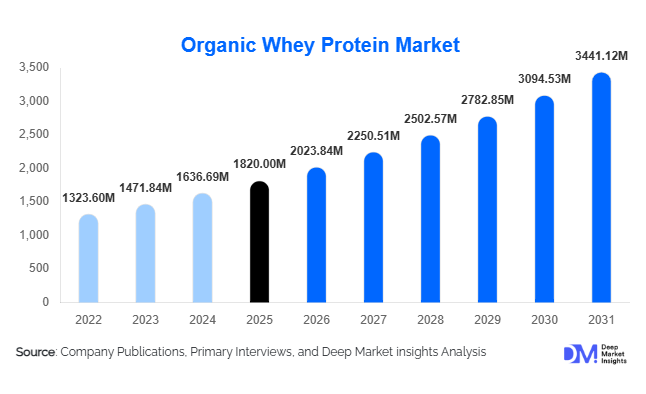
According to Deep Market Insights, the global organic whey protein market size was valued at USD 1,820 million in 2026 and is projected to grow from USD 2,023.84 million in 2026 to reach USD 3,441.12 million by 2031, expanding at a CAGR of 11.2% during the forecast period (2026–2031). The market growth is primarily driven by increasing consumer preference for clean-label nutrition, the rising fitness and wellness trend, and the expansion of organic-certified whey protein products across global sports, clinical, and functional food applications.
Key Market Insights
- Organic whey protein is gaining popularity among health-conscious and fitness-oriented consumers, due to its high bioavailability, muscle recovery benefits, and clean, hormone-free sourcing.
- Grass-fed and isolate whey protein dominate premium segments, catering to consumers who prioritize quality, traceability, and lactose-free options.
- North America dominates the global market, supported by high disposable incomes, established fitness culture, and widespread adoption of organic certifications.
- Asia-Pacific is the fastest-growing region, led by rising health awareness and expanding middle-class demand in China, India, and Japan.
- Online and D2C channels are emerging as critical sales platforms, offering subscription models, personalized nutrition, and easy access to premium organic whey products.
- Technological adoption, including personalized nutrition apps, AI-driven product recommendations, and innovative formulation technologies, is reshaping the way consumers purchase and consume whey protein products.
What are the latest trends in the organic whey protein market?
Grass-Fed and Clean-Label Products Gaining Traction
Consumers are increasingly prioritizing organically sourced whey protein derived from grass-fed cows due to its superior nutritional profile and ethical sourcing practices. Brands are focusing on clean-label formulations free from hormones, antibiotics, and GMOs, appealing to both fitness enthusiasts and clinical nutrition users. This trend also aligns with the sustainability agenda, as ethical sourcing and organic certification enhance consumer trust and justify premium pricing.
Integration of Personalized Nutrition Platforms
Digital health platforms are enabling personalized nutrition solutions that recommend whey protein types, dosage, and consumption timing based on individual health data. AI-driven apps, subscription boxes, and wellness-focused eCommerce portals are becoming increasingly important, allowing consumers to customize intake for fitness, weight management, or therapeutic purposes. These innovations help build brand loyalty and increase repeat purchases.
What are the key drivers in the organic whey protein market?
Rising Health and Fitness Awareness
Global consumers are increasingly adopting preventive health and active lifestyles, driving the demand for high-quality, organic protein supplements. Whey protein, especially in isolate and grass-fed forms, is favored for muscle recovery, weight management, and immune support. Fitness enthusiasts, professional athletes, and aging populations are primary contributors to demand.
Regulatory Support for Organic Certification
Governments in North America, Europe, and parts of Asia have strengthened organic certification regulations, improving product credibility and market trust. Harmonization of standards supports cross-border trade and institutional adoption, enabling market expansion for certified organic whey products.
Growth in Clinical and Functional Nutrition Applications
Organic whey protein is increasingly incorporated into clinical nutrition and functional food products, targeting elderly care, post-surgery recovery, and metabolic health. Hospitals, healthcare providers, and nutraceutical companies are driving demand through bulk procurement and integration into therapeutic diets.
What are the restraints for the global market?
High Pricing Compared to Conventional Whey
Organic whey protein commands a significant price premium due to certification costs, limited organic milk supply, and higher production expenses. This can limit adoption in price-sensitive regions and among cost-conscious consumers, particularly in emerging markets.
Supply Chain Complexity
Maintaining an organic-certified supply chain requires strict traceability, adherence to farming regulations, and consistent quality control. Fluctuations in organic feed availability and milk supply pose challenges, impacting production planning and scalability.
What are the key opportunities in the organic whey protein industry?
Emerging Market Expansion
Rising health awareness, growing disposable income, and increasing interest in sports nutrition in countries like China, India, Brazil, and Mexico present significant opportunities. Companies can expand regional distribution networks and target urban middle-class populations with premium organic whey products.
Institutional Partnerships & Clinical Nutrition
Partnerships with hospitals, elderly care centers, and therapeutic nutrition providers offer opportunities for bulk sales and product endorsement. Organic whey protein’s high bioavailability and health benefits make it ideal for inclusion in medical nutrition and recovery programs.
Technological Integration in Personalized Nutrition
Subscription-based wellness platforms and AI-driven personalized nutrition apps enable brands to offer tailored organic whey protein solutions. Personalized recommendations, automated delivery, and digital engagement increase consumer retention and enable premium pricing strategies.
Report Scope
| Report Metric | Details |
|---|---|
| Market Size in 2025 | USD 1820 Million |
| Market Size in 2026 | USD 2023.84 Million |
| Market Size in 2031 | USD 3441.12 Million |
| CAGR | 11.2% (2026-2031) |
| Base Year for Estimation | 2025 |
| Historical Data | 2022-2024 |
| Forecast Period | 2026-2031 |
| Report Coverage | Revenue Forecast, Competitive Landscape, Supply Chain Disruption, Growth Factors, Environment & Regulatory Landscape and Trends |
| Geographies Covered | North America, Europe, APAC, Middle East and Africa, LATAM |
| Countries Covered | U.S., Canada, U.K., Germany, France, Spain, Italy, Russia, Nordic, Benelux, Rest of Europe, China, Korea, Japan, India, Australia, Singapore, Taiwan, South East Asia, Rest of Asia-Pacific, UAE, Turky, Saudi Arabia, South Africa, Egypt, Nigeria, Rest of MEA, Brazil, Mexico, Argentina, Chile, Colombia, Rest of LATAM |
Explore more data points, trends and opportunities Download Free Sample Report
Product Type Insights
The organic whey protein market is strongly led by organic whey protein isolate (WPI), which accounts for approximately 38% of the global market share in 2025. The dominance of WPI is primarily driven by its superior nutritional profile, including high protein purity exceeding 90%, minimal fat and carbohydrate content, and significantly reduced lactose levels. These characteristics make isolate formulations highly suitable for performance athletes, fitness enthusiasts, aging populations, and individuals with lactose sensitivity. Increasing consumer preference for clean-label, fast-absorbing protein sources has accelerated adoption across sports nutrition, clinical supplementation, and premium wellness products. The rising demand for targeted nutrition solutions such as muscle recovery formulas, weight management products, and metabolic health supplements further reinforces WPI’s leadership position.Organic whey protein concentrate (WPC) continues to maintain a strong presence due to its balanced nutritional composition and relatively lower cost compared to isolates. WPC is widely used in functional foods, protein snacks, and dairy-based beverages where moderate protein levels and improved taste profiles are preferred. Meanwhile, organic whey protein hydrolysate (WPH) is gaining traction in specialized applications requiring rapid digestion and enhanced bioavailability, including infant nutrition and clinical recovery formulations. However, higher production costs limit its widespread adoption. Overall, innovation in filtration technologies, organic dairy sourcing, and premiumization trends are shifting the market toward higher-purity protein formats, positioning isolates as the long-term growth engine within the product segment.
Application Insights
Sports and fitness nutrition remains the leading application segment, representing nearly 52% of global organic whey protein demand. Growth in this segment is primarily driven by the global expansion of fitness culture, increased participation in recreational sports, and the mainstream adoption of protein supplementation beyond professional athletes. Consumers increasingly view protein as an essential daily nutrient rather than a niche performance product, supporting sustained demand across protein powders, ready-to-drink beverages, and performance recovery formulations. The rise of personalized nutrition programs and wearable fitness technologies has further strengthened demand for organic and traceable protein sources.Functional foods represent a rapidly expanding application area as manufacturers integrate organic whey protein into everyday food products such as fortified cereals, bakery items, dairy alternatives, and protein-enriched snacks. Consumers are actively seeking convenient nutritional solutions that combine health benefits with taste and convenience, encouraging food manufacturers to incorporate organic protein ingredients into mainstream product portfolios. Clinical nutrition is emerging as one of the fastest-growing applications due to increasing awareness of protein’s role in immune health, muscle preservation, post-surgical recovery, and age-related nutrition management. Healthcare providers and hospitals are increasingly recommending high-quality protein supplementation, particularly for elderly populations and patients undergoing therapeutic treatment.Additional emerging applications include cosmeceuticals and beauty-from-within formulations, where protein peptides support skin elasticity and hair health. Meal replacement products and wellness beverages are also driving incremental demand, reflecting a broader shift toward preventive healthcare and holistic nutrition trends across global markets.
Distribution Channel Insights
Online distribution channels lead the global market with approximately 44% share in 2025, supported by the rapid digitalization of retail and evolving consumer purchasing behavior. The leading driver behind online channel growth is the increasing preference for convenience, product transparency, and personalized purchasing experiences. Consumers benefit from detailed ingredient information, certification verification, subscription-based purchasing models, and algorithm-driven product recommendations, which collectively enhance brand loyalty and repeat purchases. Direct-to-consumer (DTC) strategies allow brands to build stronger consumer relationships while improving margins and gathering valuable behavioral data.Social media platforms, influencer-led marketing, and fitness community engagement have become critical tools in driving online sales, particularly among younger demographics seeking trusted product endorsements. Cross-border eCommerce has also expanded access to premium organic whey products in developing markets where physical retail availability remains limited.Offline channels continue to play a strategic role despite the rise of digital retail. Specialty nutrition stores, pharmacies, and supermarkets provide experiential purchasing opportunities, enabling consumers to evaluate product quality and receive expert guidance. Retail visibility supports brand credibility, impulse buying behavior, and market penetration in regions where online adoption remains moderate. The integration of omnichannel retail strategies, including click-and-collect models and hybrid purchasing journeys, is expected to further strengthen distribution efficiency.
End-Use Insights
Sports nutrition, functional food manufacturing, and clinical nutrition collectively represent the primary end-use industries for organic whey protein. Among these, sports nutrition remains the dominant end-use sector, driven by growing consumer awareness regarding muscle health, endurance performance, and post-workout recovery. The leading growth driver within this segment is the increasing normalization of protein supplementation among everyday consumers, including working professionals and aging populations seeking active lifestyles.Functional food manufacturers are increasingly incorporating organic whey protein into mainstream food categories to enhance nutritional value without compromising sensory appeal. The clean-label movement and regulatory emphasis on ingredient transparency are encouraging manufacturers to shift toward certified organic protein sources, thereby expanding industrial demand.Clinical nutrition is the fastest-growing end-use segment, supported by global demographic shifts toward aging populations and rising prevalence of chronic health conditions requiring nutritional intervention. Hospitals, rehabilitation centers, and long-term care facilities are integrating protein-enriched diets to support recovery outcomes and prevent muscle loss. Export-oriented production models further strengthen demand, particularly from North America and Europe supplying certified organic whey ingredients to rapidly developing markets across Asia-Pacific and Latin America.
Explore more data points, trends and opportunities Download Free Sample Report
Organic Whey Protein Market Segmentations
By Product Type
- Organic Whey Protein Concentrate
- Organic Whey Protein Isolate
- Organic Whey Protein Hydrolysate
By Form
- Powder
- Liquid
- Ready-to-Drink
- Bars & Snacks
By Source
- Grass-Fed Organic Whey
- Non-Grass-Fed Organic Whey
- Plant-Enhanced Organic Whey Blends
By Distribution Channel
- Offline
- Online
By End-Use Industry
- Sports & Fitness Nutrition
- Functional Foods & Beverages
- Clinical & Therapeutic Nutrition
- Infant & Maternal Nutrition
- Cosmeceutical & Personal Care
Regional Insights
North America
North America accounts for approximately 36% of the global organic whey protein market, led by strong demand in the United States and Canada. Regional growth is driven by a mature fitness ecosystem, high consumer purchasing power, and widespread adoption of premium nutritional supplements. Consumers demonstrate strong preference for grass-fed, non-GMO, and certified organic protein products, reflecting advanced awareness of ingredient sourcing and sustainability. The expansion of subscription-based digital nutrition platforms, personalized health programs, and performance-focused wellness trends continues to accelerate consumption. Additionally, well-established dairy infrastructure and advanced protein processing technologies support large-scale production and export capabilities, reinforcing the region’s leadership position.
Europe
Europe represents roughly 28% of global market share, with Germany, the United Kingdom, and France acting as major consumption hubs. Regional growth is strongly supported by stringent organic certification standards, sustainability-focused consumer behavior, and regulatory encouragement of clean-label food production. European consumers increasingly prioritize environmentally responsible sourcing, animal welfare practices, and carbon-conscious dairy farming, driving demand for certified organic whey products. Integration of protein ingredients into functional foods, bakery products, and dairy innovations has expanded usage beyond supplements. Rising adoption among flexitarian consumers seeking balanced nutrition also contributes to sustained regional expansion.
Asia-Pacific
Asia-Pacific is the fastest-growing regional market, led by China, India, and Japan. Growth is primarily driven by rising disposable incomes, rapid urbanization, and expanding middle-class populations adopting health-conscious lifestyles. Increasing awareness of protein deficiency and preventive healthcare is accelerating demand for nutritional supplementation across both fitness and general wellness categories. The rapid expansion of digital commerce ecosystems and mobile-first retail platforms has significantly improved access to premium imported organic whey protein products. Additionally, growing gym penetration, youth fitness culture, and government initiatives promoting health and nutrition awareness further support long-term market growth across the region.
Latin America
Latin America is experiencing steady growth, with Brazil and Mexico emerging as key markets. Regional expansion is supported by rising participation in fitness activities, increasing urban health awareness, and growing availability of mid-priced organic nutrition products. Younger consumers are driving demand for protein supplementation as part of lifestyle-oriented wellness trends. Improvements in retail distribution networks and expanding local manufacturing capabilities are enhancing product accessibility. Export partnerships with North American and European producers also contribute to market development by introducing certified organic formulations into regional markets.
Middle East & Africa
The Middle East & Africa region presents a dual market dynamic, combining production opportunities with expanding consumption demand. Parts of Africa serve as sources of high-quality dairy inputs, supporting organic whey supply chains, while the Middle East—particularly the UAE, Saudi Arabia, and Qatar—represents a rapidly growing consumption market driven by high-income populations and strong interest in premium health products. Rising lifestyle-related health concerns, increasing gym memberships, and government-led wellness initiatives are encouraging adoption of protein supplementation. Growth in modern retail infrastructure, sports nutrition retail chains, and cross-border eCommerce is further improving product availability across the region. Intra-African trade and localized wellness initiatives are also gradually strengthening regional demand for organic nutritional products.
Key Players in the Organic Whey Protein Market
- Glanbia Nutritionals
- Fonterra Co-operative Group
- Arla Foods
- Hilmar Nutritionals
- Abbott Laboratories
- Carbery Group
- Dairy Farmers of America
- Allied Blending
- WPC Group
- MGP Ingredients
- Morinaga Milk Industry
- Asahi Group Holdings
- Synlait Milk Ltd
- NZMP
- Nestlé Health Science