Organic Compost Market Size
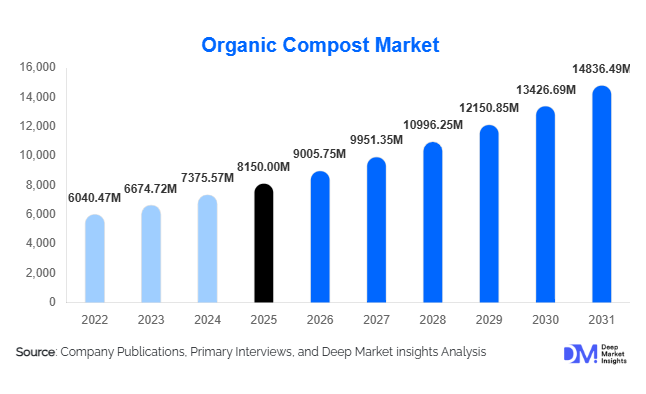
According to Deep Market Insights, the global organic compost market size was valued at USD 8,150 million in 2025 and is projected to grow from USD 9,005.75 million in 2026 to reach USD 14,836.49 million by 2031, expanding at a CAGR of 10.5% during the forecast period (2026–2031). The organic compost market growth is primarily driven by the increasing global shift toward sustainable agriculture, rising demand for organic food products, and government-backed waste management initiatives promoting composting and circular economy practices.
Key Market Insights
- Organic compost is gaining prominence as a sustainable alternative to chemical fertilizers, driven by increasing awareness of soil health and long-term agricultural productivity.
- Agriculture remains the dominant application segment, accounting for over half of global demand due to rising adoption of organic farming practices.
- Asia-Pacific leads the global market, supported by strong agricultural dependence and government initiatives promoting compost usage.
- Europe is witnessing rapid growth, driven by stringent waste management regulations and circular economy policies.
- Technological advancements in composting, including in-vessel systems and bio-enhanced compost, are improving product quality and scalability.
- Urban composting and municipal waste programs are emerging as key supply-side drivers, ensuring steady raw material availability.
What are the latest trends in the organic compost market?
Expansion of Circular Economy and Waste-to-Compost Initiatives
Governments and municipalities worldwide are increasingly promoting organic waste recycling through composting programs. Source segregation mandates, landfill diversion targets, and urban composting initiatives are significantly boosting feedstock availability for compost production. Cities are investing in centralized composting facilities and partnering with private players to scale operations. This trend is not only reducing environmental pollution but also creating a sustainable supply chain for organic compost, strengthening its role in circular economy models.
Rising Adoption of Enriched and Value-Added Compost Products
The market is witnessing a shift toward fortified compost products enriched with biofertilizers, micronutrients, and microbial inoculants. These value-added products enhance crop yield and soil fertility, making them attractive for commercial agriculture. Innovations such as pelletized compost and liquid compost formulations are expanding application areas, including precision agriculture and greenhouse farming. This trend is enabling manufacturers to differentiate their offerings and command premium pricing.
What are the key drivers in the organic compost market?
Growing Demand for Sustainable Agriculture
The global transition toward sustainable and regenerative agriculture is a major driver of organic compost demand. Farmers are increasingly adopting compost to improve soil structure, enhance water retention, and boost microbial activity. Unlike chemical fertilizers, compost provides long-term benefits, making it a preferred choice for environmentally conscious farming practices. This shift is particularly evident in regions with strong organic food demand and sustainability policies.
Government Regulations and Incentives
Regulatory frameworks promoting organic waste management and composting are accelerating market growth. Governments are offering subsidies, tax incentives, and financial support for composting infrastructure development. Policies mandating waste segregation and landfill reduction are also increasing the availability of organic feedstock, driving production capacity expansion across regions.
What are the restraints for the global market?
Inconsistent Product Quality
One of the major challenges in the organic compost market is the variability in product quality, particularly from small-scale or unregulated producers. Differences in nutrient composition and contamination risks can limit adoption among large-scale farmers who require consistent inputs for crop production.
High Transportation and Logistics Costs
Organic compost is bulky and has low value density, making transportation over long distances economically challenging. This limits market scalability and increases dependence on localized production and consumption models, posing a restraint for global trade expansion.
What are the key opportunities in the organic compost industry?
Government-Led Waste Management Programs
Large-scale government initiatives focused on waste segregation and composting present significant growth opportunities. Public-private partnerships in municipal composting projects are creating stable revenue streams and expanding market reach. These programs are particularly impactful in urban areas with high organic waste generation.
Expansion of Organic Farming
The increasing global acreage under organic farming is creating sustained demand for compost products. Farmers are seeking high-quality organic inputs to meet certification standards and improve crop yield. This trend offers opportunities for manufacturers to develop specialized compost formulations tailored to specific crops and soil conditions.
Report Scope
| Report Metric | Details |
|---|---|
| Market Size in 2025 | USD 8150.00 Million |
| Market Size in 2026 | USD 9005.75 Million |
| Market Size in 2031 | USD 14836.49 Million |
| CAGR | 10.5% (2026-2031) |
| Base Year for Estimation | 2025 |
| Historical Data | 2022-2024 |
| Forecast Period | 2026-2031 |
| Report Coverage | Revenue Forecast, Competitive Landscape, Supply Chain Disruption, Growth Factors, Environment & Regulatory Landscape and Trends |
| Geographies Covered | North America, Europe, APAC, Middle East and Africa, LATAM |
| Countries Covered | U.S., Canada, U.K., Germany, France, Spain, Italy, Russia, Nordic, Benelux, Rest of Europe, China, Korea, Japan, India, Australia, Singapore, Taiwan, South East Asia, Rest of Asia-Pacific, UAE, Turky, Saudi Arabia, South Africa, Egypt, Nigeria, Rest of MEA, Brazil, Mexico, Argentina, Chile, Colombia, Rest of LATAM |
Explore more data points, trends and opportunities Download Free Sample Report
Product Type Insights
The organic compost market is broadly segmented into solid compost, liquid compost, pelletized compost, and enriched compost formulations, each catering to distinct agricultural and horticultural requirements. Among these, solid compost continues to dominate the global landscape, contributing approximately 55% of total market demand. Its dominance is primarily attributed to its versatility, cost-effectiveness, and ease of handling across diverse farming systems. Solid compost is widely preferred in traditional agricultural practices, especially in large-scale field cultivation where soil conditioning, moisture retention, and long-term fertility enhancement are critical. Farmers value solid compost for its ability to improve soil structure over time, enhance microbial activity, and reduce dependency on synthetic fertilizers. Additionally, its compatibility with mechanized spreading equipment has further strengthened its position in commercial agriculture, particularly in regions with extensive farmland such as Asia-Pacific and North America.Pelletized compost is emerging as a highly convenient and scalable solution, especially for mechanized and commercial farming operations. The compact and uniform structure of pelletized compost enables easy storage, transportation, and application, reducing logistical inefficiencies. This form is particularly gaining traction in regions with large-scale agricultural exports, where operational efficiency and consistency in nutrient delivery are critical. Farmers benefit from its slow-release nutrient properties, which ensure sustained soil fertility over longer cultivation cycles. The growing demand for automation in agriculture and the expansion of agribusiness enterprises are expected to further strengthen this segment.Enriched compost represents a rapidly growing niche within the market, driven by increasing demand for high-performance soil amendments. These products are enhanced with additional nutrients, beneficial microorganisms, and organic additives designed to improve soil fertility and crop productivity. Enriched compost is particularly favored in intensive farming systems and nutrient-depleted soils, where baseline compost alone may not be sufficient to achieve optimal yields. The segment is witnessing strong demand from organic certification programs and regenerative agriculture initiatives, which emphasize soil health restoration and long-term sustainability. As global agricultural systems continue to transition toward eco-friendly inputs, enriched compost is expected to record significant expansion.
Application Insights
The application landscape of the organic compost market is diverse, with agriculture remaining the dominant segment, accounting for nearly 52% of global demand. This leadership is primarily driven by the increasing adoption of organic farming practices worldwide, as governments and regulatory bodies encourage sustainable agriculture to address soil degradation, chemical overuse, and food safety concerns. Compost plays a vital role in improving soil fertility, enhancing water retention capacity, and supporting long-term agricultural productivity. The rising global population and subsequent food demand have further intensified the need for sustainable soil management solutions, positioning compost as a critical input in modern agriculture systems.Landscaping and gardening applications are also witnessing steady growth, particularly in urban environments where green infrastructure development is becoming a priority. Municipal authorities, real estate developers, and commercial establishments are increasingly investing in landscape beautification projects, parks, and green belts. Compost is widely used in these applications to improve soil quality, support plant growth, and promote sustainable green spaces. Residential gardening trends, especially post-pandemic, have further accelerated demand as individuals increasingly engage in home gardening and organic cultivation practices.Soil remediation and environmental restoration represent emerging but highly significant application areas for organic compost. These applications are particularly important in land reclamation projects, mining site rehabilitation, and erosion control initiatives. Compost helps restore degraded soils by improving nutrient content, enhancing microbial diversity, and stabilizing soil structure. Governments and environmental organizations are increasingly incorporating compost-based solutions into ecological restoration programs, further expanding the market’s application scope.
Distribution Channel Insights
The distribution landscape of the organic compost market is evolving rapidly, with direct B2B sales continuing to dominate, accounting for approximately 46% of total market distribution. Large-scale farmers, agribusiness companies, and agricultural cooperatives prefer direct procurement due to cost advantages, bulk purchasing efficiency, and customized product supply. This channel is particularly strong in regions with intensive agricultural activity, where long-term supply contracts and integrated farming solutions are common. Manufacturers often engage directly with end-users to provide tailored compost formulations based on soil conditions and crop requirements, strengthening long-term business relationships.Online distribution channels are gaining rapid traction, driven by the digitalization of agricultural supply chains and the growing penetration of e-commerce platforms. These platforms offer convenience, competitive pricing, and wider product selection, making them increasingly attractive to tech-savvy farmers and urban consumers. The ability to compare products, access reviews, and receive doorstep delivery has significantly enhanced adoption rates, particularly in urban and peri-urban regions.Government procurement channels also play a vital role in the distribution ecosystem, especially in developing economies where agricultural subsidies and rural development programs are prominent. Governments often procure compost in bulk and distribute it to farmers at subsidized rates to promote sustainable farming practices. These initiatives not only support market growth but also encourage widespread adoption of organic soil management techniques.
End-Use Industry Insights
The agriculture sector remains the primary end-use industry for organic compost, driven by increasing global food demand and the shift toward sustainable and regenerative farming practices. Compost is widely used to improve soil fertility, enhance crop yields, and reduce dependence on chemical fertilizers. Governments and agricultural organizations worldwide are promoting compost usage as part of broader sustainability and climate resilience strategies, reinforcing its importance in modern agriculture.Landscaping and turf management represent another significant end-use category, particularly in urban infrastructure development, sports complexes, and commercial real estate projects. Compost is used extensively to maintain healthy turf, improve soil structure, and support sustainable landscaping practices. Municipal greening initiatives and urban beautification programs are also contributing to increased demand in this segment.Environmental restoration projects are emerging as a key growth area, where compost is used to rehabilitate degraded land, restore ecosystems, and improve biodiversity. Waste management and recycling industries are also integrating composting into their sustainability frameworks, converting organic waste into valuable soil amendments and supporting circular economy initiatives.
Explore more data points, trends and opportunities Download Free Sample Report
Organic Compost Market Segmentations
By Feedstock Type
- Agricultural Waste Compost
- Animal-Based Compost
- Municipal Solid Waste (MSW) Compost
- Food Waste Compost
- Industrial Organic Waste Compost
By Composting Technology
- Aerobic Composting
- Anaerobic Composting
- Vermicomposting
- Hybrid Composting Systems
By Product Form
- Solid Compost
- Liquid Compost
- Pelletized Compost
- Enriched/Fortified Compost
By Application
- Agriculture
- Horticulture
- Landscaping & Gardening
- Soil Remediation
- Nurseries & Greenhouses
By Distribution Channel
- Direct Sales (B2B)
- Retail Stores
- Online Platforms
- Government Procurement Programs
Regional Insights
Asia-Pacific
Asia-Pacific leads the global organic compost market, accounting for approximately 38% of total market share in 2025. The region’s dominance is driven by its large agricultural base, high population density, and increasing demand for food security. Countries such as India and China are at the forefront of market expansion, supported by strong government initiatives promoting organic farming, soil health improvement programs, and large-scale waste management policies. The rising awareness among farmers regarding soil degradation caused by excessive chemical fertilizer use has further accelerated compost adoption. Additionally, rapid urbanization and increasing organic food consumption are contributing to sustained regional growth. The availability of low-cost raw materials and labor also supports large-scale compost production in this region.
North America
North America holds approximately 27% of the global market, with the United States being the primary contributor. The region benefits from advanced agricultural technologies, high awareness of environmental sustainability, and strong consumer demand for organic food products. Government regulations promoting waste recycling and organic farming have significantly supported market expansion. The presence of large-scale commercial farms and advanced composting infrastructure further enhances regional growth. Additionally, increasing investments in sustainable agriculture and regenerative farming practices are driving long-term demand for high-quality compost products.
Europe
Europe accounts for around 25% of the global market, driven by stringent environmental regulations and strong circular economy initiatives. Countries such as Germany, France, and the United Kingdom are leading the adoption of composting practices as part of their waste management and sustainability strategies. The European Union’s emphasis on reducing landfill waste and promoting organic agriculture has significantly boosted compost usage. Consumer preference for organic food and eco-friendly agricultural inputs continues to support steady market growth across the region.
Latin America
Latin America is witnessing steady market growth, led by countries such as Brazil and Mexico. The region’s expanding agricultural sector, coupled with increasing adoption of sustainable farming practices, is driving demand for organic compost. Fertile land availability and growing export-oriented agriculture are further supporting market expansion. Government initiatives promoting soil conservation and organic farming are expected to strengthen long-term growth prospects.
Middle East & Africa
The Middle East & Africa region is emerging as the fastest-growing market, with a CAGR exceeding 12%. Growth is primarily driven by increasing focus on soil restoration, desert agriculture initiatives, and rising investments in agricultural modernization. Water scarcity and soil degradation challenges have encouraged the adoption of compost as a sustainable soil amendment. Governments in the region are increasingly investing in green agriculture projects and food security programs, further supporting market expansion. Additionally, international collaborations and technology transfers are enhancing compost production capabilities across the region.
Key Players in the Organic Compost Market
- Veolia Environment S.A.
- Waste Management Inc.
- Republic Services Inc.
- SUEZ Group
- FCC Environment
- Clean Harbors Inc.
- Stericycle Inc.
- Recology Inc.
- Renewi plc
- Compost Systems GmbH
- Reterra Group
- Agrilife Composting
- MyNOKE
- NutriSoil
- Kahariam Farms