Organic Cocoa Market Size
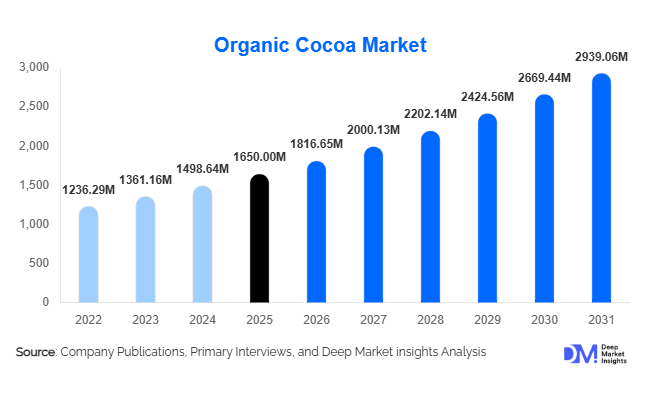
According to Deep Market Insights, the global organic cocoa market size was valued at USD 1,650 million in 2025 and is projected to grow from USD 1,816.65 million in 2026 to reach USD 2,939.06 million by 2031, expanding at a CAGR of 10.1% during the forecast period (2026–2031). The organic cocoa market growth is primarily driven by rising consumer preference for clean-label and sustainably sourced ingredients, increasing demand for premium chocolate products, and expanding applications across cosmetics and nutraceutical industries.
Key Market Insights
- Organic cocoa demand is strongly driven by premium chocolate consumption, particularly in Europe and North America where ethical sourcing is a key purchase driver.
- Fairtrade and sustainability certifications are becoming essential, with a growing share of consumers prioritizing traceability and ethical farming practices.
- Europe dominates the global market, accounting for over one-third of total demand due to high organic food adoption.
- Asia-Pacific is the fastest-growing region, fueled by rising disposable incomes and urbanization in countries such as China and India.
- Cosmetics and personal care applications are expanding rapidly, leveraging organic cocoa butter in natural skincare formulations.
- Supply constraints and premium pricing continue to shape market dynamics due to limited organic farming output.
What are the latest trends in the organic cocoa market?
Rising Demand for Ethical and Traceable Cocoa
Consumers are increasingly demanding transparency in sourcing, pushing manufacturers to adopt traceable supply chains and certifications such as Fairtrade and organic labels. Blockchain-enabled traceability systems are gaining traction, allowing consumers to track cocoa origins and verify ethical practices. This trend is reshaping procurement strategies, with companies forming direct partnerships with farmers to ensure quality and sustainability while strengthening brand credibility.
Expansion into Non-Food Applications
Organic cocoa is witnessing rising adoption beyond food and beverages, particularly in cosmetics and nutraceuticals. Organic cocoa butter is widely used in skincare products due to its antioxidant and moisturizing properties. Additionally, cocoa-based functional foods and supplements are gaining popularity for their health benefits, including improved cardiovascular health and stress reduction. This diversification is creating new revenue streams for manufacturers and expanding market potential.
What are the key drivers in the organic cocoa market?
Growing Demand for Clean-Label Products
Increasing consumer awareness regarding the harmful effects of synthetic chemicals has led to a strong shift toward organic and clean-label food products. Organic cocoa aligns with this trend, offering a natural and chemical-free alternative. This is particularly evident in developed markets, where consumers are willing to pay premium prices for certified organic products.
Premiumization of Chocolate Products
The global chocolate industry is undergoing premiumization, with consumers seeking high-quality, artisanal, and ethically sourced products. Organic cocoa serves as a key ingredient in premium chocolate offerings, enabling manufacturers to differentiate their products and command higher price points. This trend is further supported by rising disposable incomes and changing consumer lifestyles.
What are the restraints for the global market?
High Production Costs
Organic cocoa farming involves higher labor costs, lower yields, and strict certification requirements, making it significantly more expensive than conventional cocoa production. These costs are passed on to consumers, limiting market penetration in price-sensitive regions.
Supply Chain Limitations
The availability of organic cocoa is constrained by limited farming regions and vulnerability to climate conditions. Supply chain disruptions, including weather fluctuations and logistical challenges, can impact production volumes and price stability, posing challenges for market growth.
What are the key opportunities in the organic cocoa industry?
Growth in Emerging Markets
Emerging economies such as China and India present significant growth opportunities due to rising disposable incomes and increasing awareness of organic products. Expanding urban populations and changing dietary preferences are driving demand for premium cocoa-based products, creating new avenues for market expansion.
Integration of Technology in Supply Chains
The adoption of advanced technologies such as blockchain and digital traceability systems is improving transparency and efficiency in the organic cocoa supply chain. These technologies enhance consumer trust and enable manufacturers to ensure compliance with sustainability standards, providing a competitive advantage in the market.
Report Scope
| Report Metric | Details |
|---|---|
| Market Size in 2025 | USD 1650.00 Million |
| Market Size in 2026 | USD 1816.65 Million |
| Market Size in 2031 | USD 2939.06 Million |
| CAGR | 10.1% (2026-2031) |
| Base Year for Estimation | 2025 |
| Historical Data | 2022-2024 |
| Forecast Period | 2026-2031 |
| Report Coverage | Revenue Forecast, Competitive Landscape, Supply Chain Disruption, Growth Factors, Environment & Regulatory Landscape and Trends |
| Geographies Covered | North America, Europe, APAC, Middle East and Africa, LATAM |
| Countries Covered | U.S., Canada, U.K., Germany, France, Spain, Italy, Russia, Nordic, Benelux, Rest of Europe, China, Korea, Japan, India, Australia, Singapore, Taiwan, South East Asia, Rest of Asia-Pacific, UAE, Turky, Saudi Arabia, South Africa, Egypt, Nigeria, Rest of MEA, Brazil, Mexico, Argentina, Chile, Colombia, Rest of LATAM |
Explore more data points, trends and opportunities Download Free Sample Report
Product Type Insights
The organic cocoa market is characterized by a diverse range of product types, each playing a distinct role in shaping overall demand dynamics. Among these, organic cocoa powder continues to dominate the market, accounting for approximately 32% of the total share. This leadership position is largely attributed to its widespread application across multiple industries, particularly in beverages, bakery products, and confectionery. The increasing consumer inclination toward healthier and minimally processed food ingredients has further strengthened the demand for organic cocoa powder. Its versatility, longer shelf life, and compatibility with a wide range of formulations make it a preferred choice for manufacturers seeking to cater to the growing clean-label and organic product segments.Cocoa butter, another key product type, is witnessing significant growth momentum due to its expanding applications beyond the food sector. While it remains a critical ingredient in chocolate manufacturing, its increasing utilization in cosmetics and personal care products has opened new avenues for growth. The moisturizing and antioxidant properties of organic cocoa butter make it highly desirable in skincare formulations, including lotions, creams, and lip care products. As consumers increasingly prioritize natural and chemical-free personal care solutions, the demand for organic cocoa butter is expected to rise steadily.In addition, emerging product forms such as cocoa nibs and cocoa liquor are gaining traction, particularly within the premium and artisanal segments. These products are increasingly being used by specialty chocolate makers and gourmet food brands to differentiate their offerings. The rising popularity of bean-to-bar chocolate and craft confectionery has significantly contributed to the growth of these niche segments. Consumers seeking authentic and minimally processed cocoa experiences are driving demand for such innovative product formats, thereby expanding the overall scope of the organic cocoa market.
Application Insights
The application landscape of the organic cocoa market is heavily dominated by the food and beverages segment, which contributes approximately 68% of the total demand. This segment’s leadership is primarily driven by the extensive use of organic cocoa in chocolate and confectionery products, as well as in a wide range of beverages such as hot chocolate, flavored milk, and health drinks. The increasing consumer preference for organic and clean-label food products has significantly boosted the adoption of organic cocoa across mainstream and premium product categories.The cosmetics and personal care segment represents the fastest-growing application area within the organic cocoa market. This growth is fueled by the increasing consumer shift toward natural and organic skincare products. Organic cocoa butter, in particular, is widely used in formulations aimed at hydration, anti-aging, and skin repair. The rising awareness of the harmful effects of synthetic chemicals in personal care products has prompted consumers to seek safer alternatives, thereby driving demand for cocoa-based ingredients.Overall, the application landscape reflects a strong alignment with broader consumer trends, including health consciousness, sustainability, and premiumization. These factors are expected to continue shaping demand patterns across all application segments in the coming years.
Distribution Channel Insights
The distribution channel landscape of the organic cocoa market is dominated by direct B2B sales, which account for over 50% of the total market share. This dominance is primarily due to the nature of the industry, where large-scale manufacturers procure organic cocoa in bulk quantities directly from suppliers and producers. Direct sourcing not only ensures consistent quality and supply but also allows manufacturers to establish long-term relationships with certified organic farmers and cooperatives.In the retail segment, supermarkets and specialty organic stores play a crucial role in making organic cocoa products accessible to end consumers. These channels cater to the growing demand for packaged organic cocoa products, including cocoa powder, nibs, and ready-to-use mixes. Specialty stores, in particular, are gaining prominence due to their focus on premium and niche organic products, attracting health-conscious and environmentally aware consumers.Moreover, the rise of direct-to-consumer (D2C) models is further transforming the distribution landscape. Many organic cocoa brands are leveraging their online presence to establish direct relationships with consumers, offering personalized experiences and exclusive product offerings. This trend is expected to gain further momentum as digitalization continues to reshape the retail ecosystem.
End-Use Industry Insights
The end-use industry landscape of the organic cocoa market is led by chocolate manufacturers, who account for approximately 40% of the total demand. This segment’s dominance is driven by the increasing global consumption of chocolate, particularly in premium and organic categories. Chocolate manufacturers are increasingly incorporating organic cocoa to cater to evolving consumer preferences for high-quality, ethically sourced products.The cosmetics industry is another rapidly growing end-use segment, driven by the increasing use of organic cocoa butter in skincare and personal care products. The shift toward natural and organic ingredients has significantly boosted the demand for cocoa-based formulations. Manufacturers are capitalizing on this trend by developing a wide range of products that highlight the benefits of organic cocoa, including moisturization, skin nourishment, and anti-aging properties.Additionally, other industries such as pharmaceuticals and food service are gradually adopting organic cocoa, further diversifying its end-use applications. This expanding industrial base is expected to contribute to sustained market growth over the forecast period.
Explore more data points, trends and opportunities Download Free Sample Report
Organic Cocoa Market Segmentations
By Product Type
- Organic Cocoa Beans
- Organic Cocoa Butter
- Organic Cocoa Powder
- Organic Cocoa Liquor
- Organic Cocoa Nibs
By Form
- Whole Cocoa
- Powdered Cocoa
- Liquid / Cocoa Paste
By Certification Type
- USDA Organic
- EU Organic
- Fairtrade Organic
- Rainforest Alliance Certified
By Application
- Food & Beverages
- Cosmetics & Personal Care
- Nutraceuticals & Functional Foods
- Pharmaceuticals
By Distribution Channel
- Direct/B2B Sales
- Supermarkets & Hypermarkets
- Specialty Organic Stores
- Online Retail/E-commerce
- Convenience Stores
Regional Insights
North America
North America accounts for approximately 28% of the global organic cocoa market, with the United States serving as the primary driver of regional demand. The region’s growth is underpinned by a high level of consumer awareness regarding organic products and a strong preference for premium and clean-label food items. The increasing adoption of organic lifestyles, coupled with rising concerns about health and sustainability, has significantly boosted the demand for organic cocoa.Key drivers of regional growth include the widespread adoption of clean-label ingredients, the growing popularity of plant-based and functional foods, and the strong presence of premium chocolate manufacturers. Additionally, the emphasis on ethical sourcing and fair-trade practices has encouraged companies to invest in certified organic cocoa supply chains. The expansion of e-commerce platforms and the increasing availability of organic products in mainstream retail channels further support market growth in the region.
Europe
Europe dominates the global organic cocoa market, accounting for around 36% of the total share. The region’s leadership is driven by strong demand in countries such as Germany, the United Kingdom, Switzerland, and France, where consumers exhibit a high level of awareness regarding sustainability and organic products. The presence of established chocolate manufacturers and a well-developed organic food industry further strengthens Europe’s position in the market.Regional growth is primarily driven by stringent regulatory standards that promote organic certification and sustainable sourcing practices. European consumers are highly conscious of environmental and ethical issues, which has led to increased demand for fair-trade and organic cocoa products. Additionally, the region’s strong tradition of chocolate consumption, combined with the growing trend of premiumization, continues to fuel market expansion.Innovation also plays a crucial role in driving growth, as manufacturers introduce new product variants that cater to evolving consumer preferences. The increasing focus on health and wellness, along with the rising popularity of vegan and plant-based diets, further contributes to the demand for organic cocoa in Europe.
Asia-Pacific
Asia-Pacific is the fastest-growing region in the organic cocoa market, with a projected CAGR exceeding 12%. Countries such as China, India, and Japan are witnessing a surge in demand, driven by rising disposable incomes and increasing consumer awareness of organic products. The expanding middle-class population and rapid urbanization are key factors contributing to market growth in the region.The primary drivers of regional growth include changing dietary patterns, increasing consumption of chocolate and confectionery products, and the growing influence of Western lifestyles. Consumers in Asia-Pacific are becoming more health-conscious, leading to a shift toward organic and natural food products. Additionally, the rapid expansion of retail infrastructure and e-commerce platforms has improved product accessibility, further boosting demand.Government initiatives promoting organic farming and sustainable agriculture also play a significant role in supporting market growth. As local production of organic cocoa increases, the region is expected to become an important player in the global supply chain.
Latin America
Latin America holds a unique position in the organic cocoa market, serving as both a major producer and exporter. Countries such as Peru, Ecuador, and the Dominican Republic are among the leading suppliers of organic cocoa, contributing significantly to global demand. The region’s favorable climatic conditions and rich biodiversity make it an ideal location for cocoa cultivation.Key growth drivers include increasing investments in organic farming practices, government support for sustainable agriculture, and the rising adoption of fair-trade certifications. These factors have enhanced the region’s competitiveness in the global market. Additionally, the growing demand for high-quality and traceable cocoa products has encouraged producers to focus on organic cultivation methods.The expansion of export markets and the strengthening of supply chain infrastructure further support regional growth. Latin America’s role as a key supplier is expected to remain critical as global demand for organic cocoa continues to rise.
Middle East & Africa
The Middle East and Africa region is experiencing moderate growth in the organic cocoa market, with increasing demand in countries such as the United Arab Emirates and South Africa. While the Middle East primarily represents a consumption-driven market, Africa plays a crucial role as a major production hub for cocoa.Regional growth is driven by rising urbanization, increasing disposable incomes, and a growing preference for premium and organic food products. In the Middle East, the expanding retail sector and the increasing presence of international brands have improved the availability of organic cocoa products. Meanwhile, Africa’s growth is supported by its strong agricultural base and significant contributions from West African countries in cocoa farming.Efforts to promote sustainable and organic farming practices, along with investments in supply chain development, are expected to enhance the region’s market potential. As awareness of organic products continues to grow, both consumption and production are likely to witness steady expansion in the coming years.